
 https://www.omahamediagroup.com/images/uploads/monster_gallery/Omaha-Media-Group-Black.jpg
admin
https://www.omahamediagroup.com/images/uploads/monster_gallery/Omaha-Media-Group-Black.jpg
admin
Unlock technical SEO: Boost website performance and growth

TL;DR:
- Technical SEO is the unseen engine enabling search engines to crawl, understand, and index your site effectively. Neglecting core pillars like crawlability, indexability, and site performance risks making your valuable content invisible to the right audiences. Continuous technical optimization aligned with user behavior and evolving technologies is essential for sustained organic growth and competitive advantage.
You’ve invested in polished web design, quality content, and a brand that looks the part. Yet your website barely registers in search results, and organic traffic stays stubbornly flat. The frustrating reality is that most business sites suffer from hidden technical roadblocks that neither great writing nor great design can fix. Technical SEO is the unseen engine beneath every high-performing website, and without it, even your best digital assets are largely invisible to search engines and the customers actively looking for what you offer.
Table of Contents
- Defining technical SEO: The foundation for discoverability
- Key pillars of technical SEO: What matters most
- Modern challenges: Why technical SEO is more complex in 2026
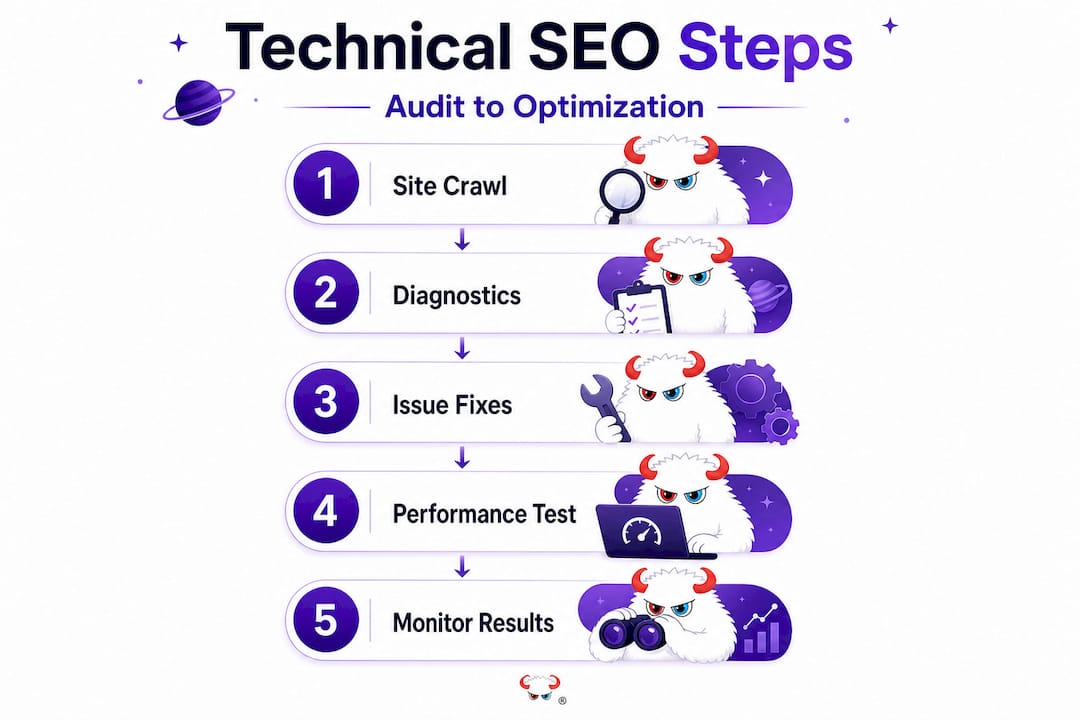
- Practical steps: Auditing and improving your technical SEO
- Technical SEO: What most guides won’t tell you
- Get expert help leveling up your technical SEO
- Frequently asked questions
Key Takeaways
| Point | Details |
|---|---|
| Site infrastructure matters | Technical SEO ensures search engines can access and understand your pages for ranking opportunities. |
| Prioritize core pillars | Focus first on crawlability, indexing, performance, and mobile optimization for maximum impact. |
| Technology adds challenges | JavaScript and AI make technical SEO more complex, so extra checks are now required in 2026. |
| Audit and fix regularly | Continual audits and prioritized fixes keep your site discoverable and future-proof. |
| Growth depends on foundation | Even great content and design need strong technical SEO to drive measurable business results. |
Defining technical SEO: The foundation for discoverability
Technical SEO refers to the process of optimizing your website’s underlying infrastructure so that search engines can access, understand, and serve your content to the right audience. According to Search Engine Land, technical SEO is “the practice of optimizing a website’s infrastructure so search engines can crawl, render, index, and serve your content correctly and efficiently.” That’s a precise definition worth unpacking, because each of those four verbs represents a stage where things can go wrong.
Crawling means a search engine bot visits your pages. Rendering means it processes the page’s code to understand what users actually see. Indexing means that page gets stored in the search engine’s database. Serving means the right page appears for the right query. Break any link in that chain and your content simply doesn’t reach its audience, no matter how good it is.
“For business owners, the practical goal of technical SEO is to make sure your valuable pages are discoverable and eligible to appear in search results by fixing issues that prevent crawling, processing, and indexing.” — Technical SEO Checklist
Many growth-focused executives mistakenly treat SEO as a content problem or a keyword problem. Technical SEO sits below both. Think of it like the electrical system in a building: you can furnish every room beautifully, but if the wiring is faulty, the lights won’t come on. Strong technical groundwork, explored further through SEO services built for measurable outcomes, is what makes everything else work. Businesses that understand how adapting to SEO changes protects their organic traffic gain a lasting competitive edge.
The core takeaway here is straightforward: content strategy and technical SEO are not substitutes for each other. They are interdependent. Without a technically sound foundation, your content investment simply doesn’t compound the way it should.
Key pillars of technical SEO: What matters most
Having defined technical SEO’s importance, let’s break down exactly which technical aspects merit your attention and action. Core technical SEO categories include crawlability, indexability, site architecture, performance and Core Web Vitals, mobile optimization, HTTPS security, structured data, and canonicalization. Each pillar serves a distinct function and carries its own set of risks when neglected.
Here’s how these pillars stack up in terms of business impact and urgency:
| Technical SEO pillar | What it affects | Business risk if ignored |
|---|---|---|
| Crawlability | Bot access to pages | Key pages never found |
| Indexability | Pages in search database | Invisible to searchers |
| Site architecture | Link equity distribution | Authority wasted on low-value pages |
| Core Web Vitals | Page speed and stability | Rankings and conversions both drop |
| Mobile optimization | Mobile search visibility | Majority of traffic underserved |
| HTTPS security | Trust signals and rankings | Browsers warn users away |
| Structured data | Rich results eligibility | Competitors earn more clicks |
| Canonicalization | Duplicate content resolution | Split authority, confused indexing |
Let’s walk through the most high-impact pillars with specific examples:
-
Crawlability. If your robots.txt file accidentally blocks your product pages, search engines cannot visit them. This happens more often than most businesses realize, especially after website migrations or CMS updates.
-
Indexability. A page can be crawlable but still excluded from the index via a “noindex” tag or a misconfigured canonical URL. Confirm your most valuable pages are genuinely indexed by checking Google Search Console regularly.
-
Core Web Vitals. Google measures three metrics: Largest Contentful Paint (page load speed), Interaction to Next Paint (responsiveness), and Cumulative Layout Shift (visual stability). All three affect both rankings and user satisfaction. Learn how boosting Core Web Vitals translates directly into lower bounce rates and higher conversions.
-
Structured data. Also called schema markup, this is code you add to pages to help search engines understand content type, such as products, events, or reviews. Sites with proper structured data are eligible for rich results, which earn significantly higher click-through rates than standard listings.
-
Canonicalization. When multiple URLs serve the same or similar content, search engines get confused about which version to rank. Canonical tags tell search engines which version is authoritative, consolidating ranking signals rather than splitting them.
Pro Tip: Start your technical SEO review with a crawl of your own site using a tool like Screaming Frog or Google Search Console. Filter for pages returning 4xx errors, flagged as “noindex,” or blocked by robots.txt. Even a 30-minute audit often surfaces critical issues that have been quietly costing you rankings for months. Staying ahead of digital marketing trends means keeping your technical foundation clean as algorithms evolve.
Modern challenges: Why technical SEO is more complex in 2026
Understanding the key pillars is essential, but it’s equally crucial to face the modern challenges added by evolving technologies and digital expectations. In 2026, technical SEO is not just about HTML and clean code. JavaScript frameworks, AI-driven search results, and increasingly complex rendering environments have added layers of diagnostic complexity that even well-designed sites must navigate carefully.
Technical SEO work is now increasingly discussed in the context of AI-driven search and citation systems, but the underlying mechanics still rely on traditional crawl, render, and index foundations. That means even as AI tools reshape how results are displayed, your site’s technical infrastructure remains the gatekeeper to visibility.
The JavaScript problem is particularly relevant for business sites built on modern frameworks. JavaScript-heavy sites can appear visually flawless to users but fail to render properly for search engine crawlers. When a site relies on client-side JavaScript to load its main content, a crawler may see only a blank shell until it returns for a second rendering pass. That delay can result in content being indexed incorrectly or not at all.

Here’s a quick comparison of common technical SEO challenges by site type:
| Site type | Primary technical risks | Recommended diagnostic |
|---|---|---|
| JavaScript-heavy (React, Next.js) | Rendering failures, delayed indexing | Google’s URL Inspection Tool, rendering tests |
| E-commerce | Duplicate content, crawl budget waste | Canonical tags, faceted navigation controls |
| Large content sites | Index bloat, orphan pages | Sitemap audits, internal link mapping |
| Local business sites | Missing schema, slow mobile speed | Structured data validators, PageSpeed Insights |
The complexity goes further with AI-driven search features like featured snippets, knowledge panels, and AI overviews. To be considered for these placements, your content must not only be well-written but technically accessible, structured logically, and marked up with appropriate schema. Sites that ignore image SEO best practices, for instance, miss out on visual search opportunities that are growing in AI-assisted results.
The pace of change adds pressure. Reviewing recent SEO updates regularly is no longer optional for business leaders who want to protect traffic investments.
Key technical challenges to monitor in 2026:
- Client-side rendering failures that hide content from crawlers
- AI crawler access issues as new bot types require updated robots.txt rules
- Core Web Vitals regressions triggered by new third-party scripts or design updates
- Crawl budget mismanagement on large sites where bots waste time on low-value pages
- Structured data errors that disqualify pages from rich results despite valid content
Pro Tip: Use Google’s Rich Results Test and the URL Inspection Tool inside Search Console at least once per quarter. These two free tools will tell you exactly how Google sees and renders your pages, which is the ground truth you need for effective technical decision-making.
Practical steps: Auditing and improving your technical SEO
Knowing the technical landscape sets the stage. Now it’s time for actionable tactics that diagnose and advance your website’s technical foundation. A structured audit approach separates businesses that see organic growth from those that keep investing in content without results.
A strong technical audit workflow follows a clear priority: confirm important pages are crawlable and indexable first, then improve site performance through Core Web Vitals optimization. Here is a practical framework to follow:
-
Verify crawl access. Review your robots.txt file and confirm no critical pages or directories are accidentally blocked. Check for crawl errors in Google Search Console under the Coverage report.
-
Audit index status. Use the “site:” search operator and Search Console’s Index Coverage report to confirm your key pages are indexed. Flag any important pages showing “Excluded” status and investigate the cause.
-
Review page speed. Run your highest-priority pages through Google’s PageSpeed Insights. Prioritize fixes for mobile, since mobile-first indexing means Google ranks based on how your site performs on phones, not desktops.
-
Check for duplicate content. Use a site crawler to identify pages with duplicate or near-duplicate content. Add or correct canonical tags to point search engines to the primary version of each page.
-
Validate structured data. Use Google’s Rich Results Test to check schema markup on your product, service, FAQ, and article pages. Errors here directly cost you eligibility for high-visibility rich results.
-
Map internal links. Ensure your most important pages receive internal links from other relevant pages on your site. Orphaned pages (those with no internal links pointing to them) rarely get crawled consistently.
-
Test rendering. For JavaScript-heavy sites, use the URL Inspection Tool to view the rendered HTML and confirm your content is fully visible to Google’s crawler, not just to users.
Stat callout: Sites that fix Core Web Vitals issues have seen measurable improvements in both rankings and user engagement metrics, with some reporting double-digit gains in organic click-through rates after performance optimization.
The connection between technical SEO and revenue is direct. Understanding how to qualify the leads that organic search generates becomes far more valuable once your technical foundation ensures the right audience actually finds your site.
Pro Tip: Prioritize fixing technical issues on your highest-revenue pages first. A product page generating $50,000 per month in revenue that has an indexing problem is worth far more immediate attention than a blog post with minimal commercial intent. Technical SEO should always be guided by business value, not just audit scores.
Technical SEO: What most guides won’t tell you
Most technical SEO content gives you a checklist. Run your audit, fix your errors, improve your scores, repeat. That framework isn’t wrong, but it misses what actually separates businesses that sustain organic growth from those that plateau after an initial improvement.
The uncomfortable truth is this: technical SEO is not a project. It’s an operating discipline. Every new feature your development team ships, every third-party script your marketing team adds, and every site redesign your agency delivers has the potential to introduce technical regressions. Sites that treat technical SEO as a one-time cleanup find themselves right back where they started within six to twelve months, sometimes faster.
What most guides also ignore is the relationship between technical SEO and real user behavior. Audit tools measure technical compliance, but they don’t tell you whether your site structure matches how your customers actually think and search. A technically perfect site with a confusing information architecture still fails users and, by extension, search engines. Sustainable growth requires aligning your infrastructure with both search engine requirements and user intent simultaneously.
There’s also a prioritization problem that rigid checklists create. Not every technical issue carries equal business weight. A minor structured data warning on a blog post is categorically different from a canonical tag error on your primary service page. Businesses that chase perfect audit scores instead of focusing on business-critical pages often spend significant resources fixing issues that generate zero revenue impact.
Understanding how adapting to technical SEO shifts requires more than reading algorithm updates. It requires building an internal process that monitors, flags, and resolves technical regressions before they compound into measurable traffic losses. The businesses winning in organic search in 2026 are not those with the cleanest audit reports. They are those with the fastest feedback loops between technical discovery and business-driven resolution.
Get expert help leveling up your technical SEO
With a clearer picture of what really drives organic performance, the next step is determining whether your internal team has the bandwidth and expertise to execute consistently. Technical SEO demands ongoing attention, specialized tools, and the experience to prioritize the right fixes at the right time.

Monstrous Media Group builds technical SEO systems that stop revenue leaks and drive measurable growth. Our approach connects full SEO services with a broader comprehensive digital marketing strategy, so your technical foundation and your growth campaigns reinforce each other rather than working in silos. We focus on real outcomes, not vanity metrics, and our clients see the difference in traffic, qualified leads, and revenue. If maximizing marketing ROI is your goal, building on a sound technical SEO infrastructure is where it starts. Let’s talk about what your site needs to perform at its full potential.
Frequently asked questions
Why is technical SEO important for my business?
Technical SEO ensures search engines can discover and serve your valuable pages, making effective marketing and growth possible. Without it, your pages may never appear in search results regardless of content quality.
What are common technical SEO issues that hurt rankings?
Typical problems include blocked pages, poor site speed, broken or duplicate content signals, unoptimized mobile experiences, and JavaScript errors that prevent crawlers from seeing your content. All of these fall within core technical SEO categories that directly affect rankings.
Does technical SEO matter if I’m focused on content and design?
Absolutely. Search engines rely on technical signals to access and surface your content, so design and writing alone are not enough for sustained visibility. Crawling, rendering, indexing, and serving must all work correctly before content quality factors in.
How has AI changed technical SEO in 2026?
AI-powered search tools add complexity to how results are generated and displayed, but the underlying crawl-render-index foundations remain essential. Sites that ignore technical SEO basics will not benefit from AI-driven visibility, regardless of content quality.
What should I prioritize first in a technical SEO audit?
Start with crawlability, indexability, and Core Web Vitals, as these drive both discoverability and user experience. A solid technical audit workflow fixes these foundational issues before moving to more advanced optimizations.
Recommended
Hire the team to help you with your website, app, or other marketing needs.
We have a team of digital marketers who can help plan and bring to life all your digital marketing strategies. They can help with social media marketing, email marketing, and digital advertising!
CONTACT US
Comments