
 https://www.omahamediagroup.com/images/uploads/monster_gallery/Omaha-Media-Group-Black.jpg
admin
https://www.omahamediagroup.com/images/uploads/monster_gallery/Omaha-Media-Group-Black.jpg
admin
How to manage digital campaigns for measurable growth

TL;DR:
- Implementing structured frameworks like RACE or SOSTAC ensures campaign consistency and effective management.
- Setting SMART goals and segmenting audiences sharpen targeting and improve campaign outcomes.
- Continuous optimization with data analysis and AI tools enhances ROI and allows for rapid adaptation.
Managing digital campaigns without a clear system is like pouring water into a bucket full of holes. You spend, you launch, you wait, and the ROI never quite materializes the way you expected. For digital marketing managers and small business owners, this frustration is real and expensive. The good news is that campaign chaos is not inevitable. With the right frameworks, precise planning, and a commitment to continuous optimization, you can transform scattered ad spend into a predictable growth engine. This guide walks you through every phase, from laying strategic groundwork to measuring what actually matters.
Table of Contents
- Laying the groundwork: Strategy frameworks and prerequisites
- Planning your campaign: Goals, audience, and channel selection
- Creative production, execution, and workflow management
- Optimization and measuring success: Analytics, AI, and iteration
- Why real campaign success relies on nimble adaptation
- Take your digital campaigns to the next level
- Frequently asked questions
Key Takeaways
| Point | Details |
|---|---|
| Structured planning is critical | Using a framework organizes your digital campaigns for success and prevents wasted resources. |
| SMART goals drive results | Defining clear, measurable objectives ensures every campaign action supports business growth. |
| Continuous optimization matters | Weekly reviews, testing, and adapting with data keep your campaigns effective and cost-efficient. |
| Blend automation with oversight | Leverage AI and automation for efficiency, but always apply human judgment for best impact. |
Laying the groundwork: Strategy frameworks and prerequisites
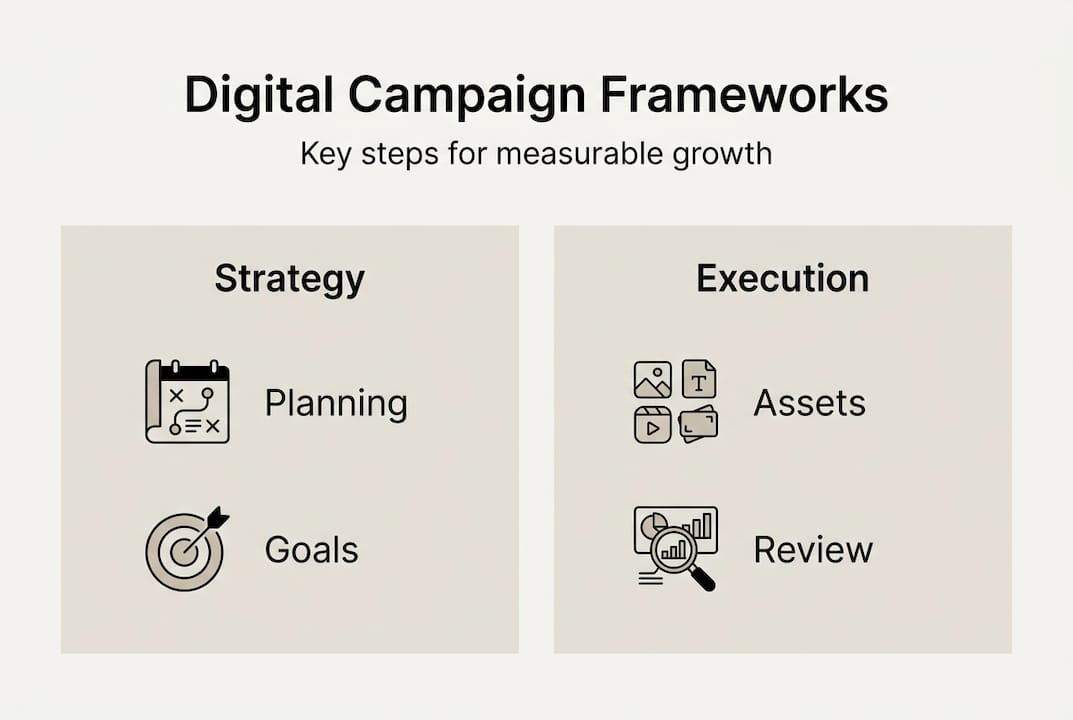
Every high-performing campaign starts with structure. Without it, even generous budgets get consumed by guesswork. Understand campaigns shows that using frameworks like HubSpot’s campaign tool, RACE, or SOSTAC brings structure and cross-channel integration that keeps your team aligned and your messaging consistent.
These frameworks are not interchangeable buzzwords. Each one serves a distinct purpose. RACE (Reach, Act, Convert, Engage) focuses on the customer lifecycle across digital touchpoints. SOSTAC (Situation, Objectives, Strategy, Tactics, Actions, Control) is a broader strategic planning model that works well for annual or quarterly campaign cycles. HubSpot’s built-in campaign tool ties execution directly to CRM data, making attribution cleaner and reporting faster.
| Framework | Core steps | Best for |
|---|---|---|
| RACE | Reach, Act, Convert, Engage | Lifecycle and funnel campaigns |
| SOSTAC | Situation, Objectives, Strategy, Tactics, Actions, Control | Quarterly strategic planning |
| HubSpot | Plan, Create, Launch, Report | CRM-integrated campaign teams |
Before you pick a framework, make sure your team has the prerequisites in place:
- A defined campaign owner with decision-making authority
- Access to marketing automation tools that connect your channels
- Clean audience data segmented by behavior, demographics, or purchase history
- Baseline performance benchmarks from previous campaigns
- A consistent approach to social media management across platforms
- Documented email marketing strategies tied to campaign goals
Pro Tip: If your team is small, start with RACE. It is visual, easy to communicate, and maps directly to how customers move through your funnel. Save SOSTAC for when you are planning at a higher strategic level with multiple stakeholders.
The framework you choose matters less than the discipline you apply to it. Consistency in how you plan, execute, and review is what separates campaigns that build momentum from those that stall after the first week.
Planning your campaign: Goals, audience, and channel selection
With a structured approach established, it is time to plan with precision. Vague goals produce vague results. Marketing Campaigns confirms that key steps include setting SMART goals, audience research, and channel selection, and skipping any one of these creates gaps that no budget can fix.
SMART goals are Specific, Measurable, Achievable, Relevant, and Time-bound. Instead of “increase brand awareness,” a SMART goal reads: “Generate 500 new email subscribers from paid social within 60 days at a cost per acquisition under $8.” That level of specificity gives your team a target and gives you a clear way to measure success.
Audience segmentation is equally critical. Think beyond demographics. Map your audience to their buying journey stage. A prospect who just discovered your brand needs different messaging than someone who visited your pricing page three times last week. Behavioral data, purchase history, and engagement signals all sharpen your targeting.
| Ad channel | Best fit objective | Audience strength |
|---|---|---|
| Google Search | High-intent conversions | In-market buyers |
| Meta Ads | Awareness and retargeting | Interest-based segments |
| Nurture and retention | Existing subscribers | |
| B2B lead generation | Professional titles and industries |
Here is a sequential workflow for effective campaign planning:
- Define your SMART goal and tie it to a revenue outcome
- Audit your current audience data for gaps and accuracy
- Map audience segments to their buying journey stage
- Select channels based on where your audience is most active
- Set budget allocations per channel based on historical performance
- Align your setting business goals process with campaign timelines
- Choose your digital marketing platforms and confirm tracking is in place before launch
Pro Tip: The most common goal-setting mistake is setting too many objectives for one campaign. Pick one primary goal. Supporting metrics can inform decisions, but chasing five goals at once dilutes your creative, your budget, and your ability to learn what actually worked.
Creative production, execution, and workflow management
Once the campaign plan is solid, focus turns to developing and launching creative assets with efficient workflow management. This is where many campaigns lose momentum. The strategy is strong, but execution becomes fragmented because no one owns the process.

Every campaign needs a core set of assets: a creative brief that aligns the team on tone and message, graphics sized for each platform, ad copy variants for testing, and landing pages built to convert. Each asset should trace back to your campaign goal. If it does not serve the objective, cut it.
Marketing Campaigns reinforces that content creation, execution with calendars and tasks, and continuous measurement are core steps in any campaign that delivers results.
Here is a practical execution workflow:
- Brief your creative team using a one-page campaign brief
- Build a content calendar with deadlines for each asset type
- Assign ownership for copy, design, landing pages, and tracking setup
- Schedule a review cycle with clear feedback deadlines
- Use automation tools to schedule and deploy across channels
- Apply email design tips to ensure your email assets are optimized before send
Team roles that must be clearly defined:
- Campaign manager: owns the timeline and budget
- Copywriter: delivers all written assets on schedule
- Designer: produces platform-specific visuals
- Analytics lead: confirms tracking is live before launch
- Approver: one person with final sign-off authority
Pro Tip: Streamline your review process by limiting feedback rounds to two. The first round catches major issues. The second round is for final polish. More than two rounds usually signals unclear briefs, not bad creative.
Campaigns that execute consistently outperform campaigns that execute perfectly once. Cadence builds audience familiarity, and familiarity builds trust.
Optimization and measuring success: Analytics, AI, and iteration
After execution, ongoing optimization and data-driven oversight ensure continual improvement and higher ROI. Launching a campaign is not the finish line. It is the starting line for learning.
The AI marketing campaign guide from Think with Google highlights that tracking hygiene, hybrid manual and automation structures, weekly reviews, A/B testing, and focusing on KPIs like ROAS, CPA, and CTR are the pillars of modern campaign optimization.
Start by tracking the right KPIs:
- ROAS (Return on Ad Spend): Revenue generated per dollar spent on ads
- CPA (Cost Per Acquisition): What you pay to acquire one customer or lead
- CTR (Click-Through Rate): How compelling your creative and targeting are
- Engagement rate: How your audience interacts with content beyond the click
- Conversion rate: The percentage of clicks that complete your desired action
Here is a numbered process for ongoing optimization:
- Confirm all tracking pixels and UTM parameters are firing correctly before week one ends
- Run a weekly performance review against your SMART goal benchmarks
- Identify your top and bottom performing ad sets and reallocate budget accordingly
- Launch A/B tests on one variable at a time: headline, image, or call to action
- Use AI-powered marketing tools to surface patterns your team might miss manually
- Review insights from AI in campaign management to understand where automation adds real value
- Apply learnings from AI and email performance to refine your email sequences
Pro Tip: Data overload kills good decisions. Pick three primary KPIs that directly connect to your campaign goal and review those first. Secondary metrics provide context, not direction. If your ROAS is strong but your CTR is low, you have a targeting win but a creative opportunity. Fix one thing at a time.
Why real campaign success relies on nimble adaptation
Here is the uncomfortable truth most campaign guides skip: following a framework perfectly does not guarantee results. We have seen businesses execute SOSTAC to the letter and still miss their targets because the market shifted mid-campaign and no one adjusted.
The mistake most teams make is treating their chosen methodology as a contract rather than a compass. They chase the latest automation tool or copy a competitor’s channel mix without asking whether it fits their specific audience and context. Process becomes a substitute for thinking.
Real campaign mastery emerges from blending structure with rapid experimentation. The framework gives you a starting point. Your data and your team’s observations tell you when to deviate. The best campaigns we have seen succeed because the team was willing to pause, read the signals, and make a call that the original plan did not anticipate.
The teams that win are not the ones with the best plan. They are the ones who adapt fastest when the plan meets reality.
Work with digital marketing experts who understand both the process and the judgment calls that no playbook can fully prepare you for. Outcomes matter more than adherence to method.
Take your digital campaigns to the next level
Putting these strategies into practice takes more than a checklist. It takes the right systems, the right team, and the experience to know when to push and when to pivot.
At Monstrous Media Group, we build campaign systems that stop revenue leaks and drive measurable growth. From digital marketing services that align your channels to proven SEO services that extend your campaign’s organic reach, we deliver outcomes, not activity reports. If you are ready to move from campaign chaos to a predictable growth engine, let’s talk. Our team is ready to audit your current approach and build a system that works.
Frequently asked questions
What are the most important KPIs for digital campaigns?
ROAS, CPA, and CTR are the essential KPIs that tell you whether your campaigns are generating real business value, not just impressions.
How often should I review and optimize my campaigns?
Weekly reviews and A/B testing are the recommended cadence, giving you enough data to make informed adjustments without reacting to daily noise.
Which frameworks are best for structured campaign management?
HubSpot’s tool, RACE, and SOSTAC are the leading frameworks for integrated campaign planning, each suited to different team sizes and planning horizons.
How can AI improve my digital campaigns?
AI accelerates pattern recognition and automates repetitive tasks, but hybrid manual and automated structures with human oversight consistently outperform fully automated approaches.
Recommended
- Digital Marketing Company in Omaha | Monstrous Media Group
- Drive Revenue Growth with High-Performing PPC Campaigns by Monstrous Media Group
- From stale to stellar: Transforming your marketing strategy for success
- Leveraging PPC Advertising for Long-Term Business Growth | Monstrous Media Group LLC
- Master digital marketing measurement: 26% higher ROI in 2026 - The data driven marketer
Hire the team to help you with your website, app, or other marketing needs.
We have a team of digital marketers who can help plan and bring to life all your digital marketing strategies. They can help with social media marketing, email marketing, and digital advertising!
CONTACT US
Comments