
- how does seo work
- omaha seo agency
- omaha seo company
- seo omaha
- what is seo
What is SEO?
-
08/05/2022
-
in 45 seconds
 https://www.omahamediagroup.com/images/uploads/monster_gallery/Omaha-Media-Group-Black.jpg
admin
https://www.omahamediagroup.com/images/uploads/monster_gallery/Omaha-Media-Group-Black.jpg
admin

TL;DR:
- Effective SEO increases visibility, qualified traffic, and revenue for online businesses.
- Core SEO elements include content quality, backlinks, page experience, technical setup, and credibility signals.
- Long-term commitment with strategic, authoritative content outperforms quick fixes in today’s AI-influenced search landscape.
Most business leaders assume SEO is a technical puzzle solved by stuffing keywords into web pages. That assumption costs real money. SEO, done right, is one of the most powerful revenue levers available to any business competing online. It determines whether your ideal customer finds you or your competitor first. This guide cuts through the noise, explains what SEO actually means in business terms, breaks down its core building blocks, and gives you a clear picture of what to prioritize. Whether you are new to digital marketing or looking to sharpen your strategy, this is where clarity starts.
| Point | Details |
|---|---|
| SEO is strategic | SEO aligns your online presence with how customers search, directly supporting business revenue goals. |
| Trust and expertise matter | Authoritative, trustworthy, and well-cited content is prioritized by search engines now more than ever. |
| Modern SEO is ongoing | Effective SEO requires regular updates, content improvements, and a focus on user experience over short-term tricks. |
| Clear metrics drive action | Business leaders should track KPIs like organic traffic and conversion rates to measure SEO success. |
SEO stands for Search Engine Optimization. At its core, it means improving your website so that search engines like Google rank it higher when people search for products or services you offer. But that definition only scratches the surface.
Think of search engines as the world’s most demanding librarians. They want to point users to the most relevant, trustworthy, and useful content available. Your job is to make your website the obvious choice. That means creating content that matches how your customers actually search, earning credibility signals from other reputable sites, and ensuring your technical setup does not get in the way.
Here is why this matters for your bottom line: SEO drives visibility and revenue by directly influencing how easily people find your business online. More visibility means more qualified visitors. More qualified visitors means more leads and more sales. It is that direct.
Understanding business SEO basics is no longer optional for growth-minded leaders. It is a core business competency, like understanding your financials or your sales pipeline.
Here is what SEO is actually doing for your business:
“SEO is not about gaming the system. It is about creating the best possible experience for your audience and making it easy for search engines to recognize that value.”
The businesses that win at digital marketing success treat SEO as a long-term investment, not a one-time project. Consistency and strategic thinking separate the leaders from the laggards.
Understanding the “why” behind SEO, let’s break down its building blocks. SEO is not one thing. It is a system of interconnected elements, each reinforcing the others.
According to a ranking factor breakdown, the key drivers are page experience and Core Web Vitals at 28%, content quality and depth at 25%, and backlinks at 22%, with E-E-A-T signals and technical factors rounding out the picture.
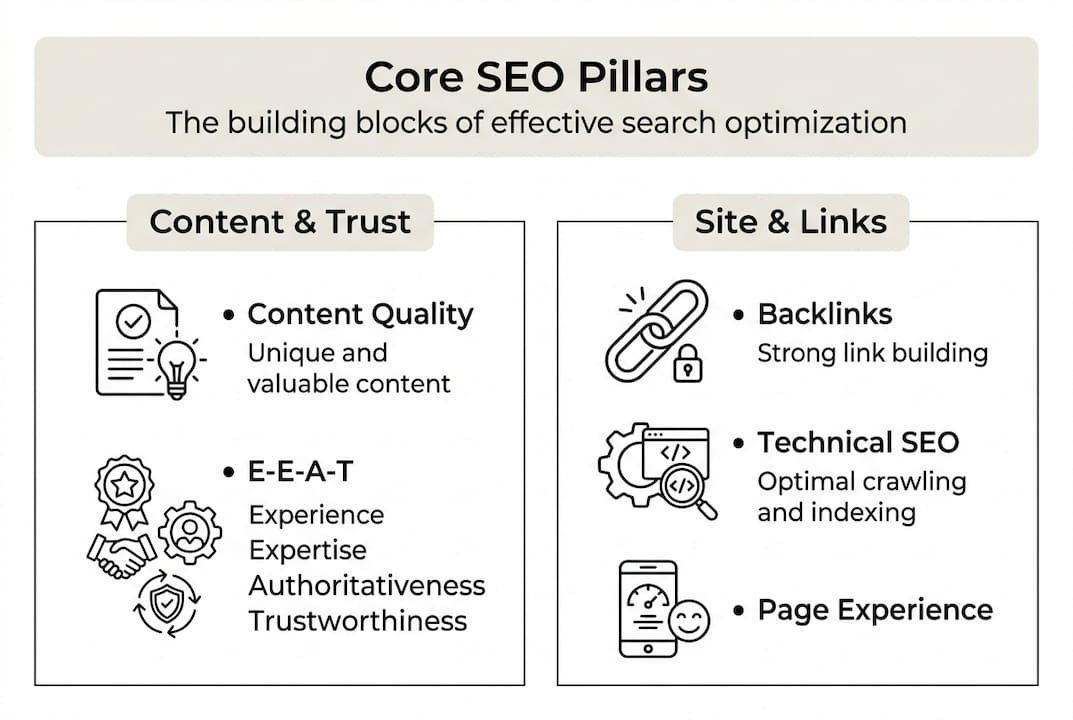
| SEO pillar | What it means | Business impact |
|---|---|---|
| Content quality | In-depth, useful, audience-focused information | Attracts and converts qualified visitors |
| Backlinks | Links from credible external websites | Builds domain authority and trust |
| Page experience | Load speed, mobile usability, Core Web Vitals | Reduces bounce rates, improves rankings |
| Technical SEO | HTTPS, structured data, mobile optimization | Ensures search engines can crawl your site |
| E-E-A-T | Expertise, Experience, Authority, Trustworthiness | Signals credibility to both users and Google |
Let’s unpack each one briefly.
Content quality is your foundation. Content that serves your audience earns attention, shares, and return visits. Thin, generic content does the opposite.

Backlinks are like professional endorsements. When a respected website links to yours, it signals to Google that your content is worth referencing. Earning these links requires producing genuinely valuable resources.
Page experience is increasingly non-negotiable. Core Web Vitals and page experience directly influence rankings. A slow, clunky site loses both rankings and customers.
Technical SEO is the infrastructure layer. Technical SEO best practices like HTTPS security, proper site structure, and structured data markup ensure search engines can actually read and index your site correctly.
E-E-A-T (Expertise, Experience, Authority, Trustworthiness) is Google’s framework for evaluating whether your content deserves to rank. Demonstrating real-world expertise through author credentials, case studies, and cited data builds this signal over time.
Pro Tip: Do not try to overhaul all five pillars simultaneously. Audit your weakest area first, fix it methodically, then move to the next. Focused improvement beats scattered effort every time.
With the foundations set, let’s discuss what actually works for SEO in 2026. The landscape has shifted significantly, and strategies that worked three years ago may now be liabilities.
The biggest shift is the rise of AI-powered and generative search. 2026 SEO trends show that AI and Generative Engine Optimization (GEO) now reward comprehensive, well-cited content, with authoritative sources seeing 30 to 40% higher visibility. But here is the critical nuance: core technical and on-page fundamentals still matter just as much.
Here are the top five strategic priorities for SEO success in 2026:
Staying current with adapting to SEO changes is not optional in this environment. The rules keep evolving, and businesses that ignore updates fall behind fast.
Do not overlook the details either. Even something as specific as optimizing your images for SEO contributes to page speed, accessibility, and search visibility in ways that compound over time.
Pro Tip: Do not abandon fundamentals chasing every new trend. The businesses winning in 2026 are those who mastered the basics first, then layered in modern tactics like GEO optimization and content clusters on top of a solid foundation.
Knowing what works, here is how you can measure whether your SEO strategy is on the right track. Data without context is noise. These are the metrics that actually tell you something meaningful.
| KPI | What it measures | Why it matters |
|---|---|---|
| Organic traffic | Visitors arriving from unpaid search results | Shows overall SEO reach and trend direction |
| Keyword rankings | Your position for target search terms | Indicates competitive visibility |
| Conversion rate from search | Percentage of organic visitors who take action | Connects SEO directly to revenue outcomes |
| Bounce rate | Visitors who leave without engaging | Signals content relevance and page experience quality |
| Revenue attribution | Revenue traced back to organic search | Proves ROI to stakeholders |
For non-technical leaders, the most important thing is to look at trends, not snapshots. A single month of data tells you very little. Three to six months of consistent movement in organic traffic and conversions tells you whether your strategy is working.
In AI-driven search environments, measurable authority signals like citations, statistics, and E-E-A-T indicators are becoming primary visibility drivers. Tracking how often your content is cited or referenced by other sources is a forward-looking metric worth monitoring.
Here are practical steps for connecting SEO outcomes to business goals:
The goal is not to drown in dashboards. It is to identify the two or three metrics that most directly reflect business health and watch those closely.
After exploring metrics, here is a perspective you will not hear from most SEO agencies.
Most business leaders treat SEO like a switch. Flip it on, wait for traffic, measure results, repeat. That mindset is why so many SEO investments underperform. The businesses that consistently win in organic search do not treat it as a tactic. They treat it like talent development: a long-term commitment to building something that compounds in value.
Real SEO authority is earned by genuinely answering your customers’ questions better than anyone else online. Not by gaming algorithms. Not by publishing volume for volume’s sake. By being the most useful, credible, and trustworthy source in your space.
We have seen businesses with modest budgets outrank well-funded competitors simply because they committed to big-picture SEO strategy with patience and consistency. The shortcut seekers plateau. The trust builders grow. That distinction is the most important thing we can share with any business leader serious about SEO.
Now that you know how SEO drives real business results, here is how to put that knowledge into action. Understanding SEO is one thing. Executing it consistently, at a level that moves rankings and revenue, is another challenge entirely.
At Monstrous Media Group, we build SEO systems grounded in evidence, not guesswork. Our team combines technical expertise, content strategy, and data-driven optimization to produce outcomes that show up where it counts: in your pipeline and your revenue. We do not sell activity reports. We build the kind of sustainable search presence that keeps generating qualified leads long after the initial investment. Explore our SEO services in Omaha or learn how our digital marketing solutions can accelerate your growth.
Page experience at 28% and content quality at 25% are currently the top-weighted SEO ranking factors, making user-focused optimization the highest priority.
Yes. SEO improves online visibility, which drives more qualified visitors to your site and directly increases leads and sales over time.
SEO is a long-term strategy. Most businesses see noticeable improvements in rankings and traffic within 3 to 6 months of consistent, well-executed effort.
In 2026, AI-driven search rewards comprehensive, well-cited, and topically authoritative content, making depth and credibility more important than ever before.
We have a team of digital marketers who can help plan and bring to life all your digital marketing strategies. They can help with social media marketing, email marketing, and digital advertising!
CONTACT US
Comments