
 https://www.omahamediagroup.com/images/uploads/monster_gallery/Omaha-Media-Group-Black.jpg
admin
https://www.omahamediagroup.com/images/uploads/monster_gallery/Omaha-Media-Group-Black.jpg
admin
What is search engine ranking? Guide for visibility & growth

The difference between page one and page two of Google is not just a few positions. It is the difference between being found and being invisible. Top 3 results capture 68.7% of all clicks, and 75% of users never scroll past the first page. For business owners and marketing executives, that math is not abstract. It is revenue sitting on the table or walking out the door. This guide breaks down exactly how search engine ranking works, what drives it, and what you can do right now to move your business up the results page.
Table of Contents
- Defining search engine ranking: What it is and why it matters
- How search engines determine rankings: Factors and algorithms explained
- Ranking signals that impact your website the most
- Key nuances: Local searches, trending topics, and AI impacts
- Myths, expert nuances, and what Google doesn’t say
- How to boost your search engine ranking: Actionable steps
- Partnering for better rankings and greater business results
- Frequently asked questions
Key Takeaways
| Point | Details |
|---|---|
| Ranking drives business growth | Higher search engine rankings bring more website visitors and potential customers. |
| Focus on quality and experience | Content quality, user experience, and trustworthiness are critical ranking factors. |
| Adapt to evolving algorithms | Stay current with updates and adjust your strategy as ranking factors and SERPs change. |
| Local and AI trends affect results | Local intent, review signals, and AI-driven SERP features can significantly impact visibility. |
| Act on proven steps | Regular audits, great content, authoritative backlinks, and technical fixes boost your ranking. |
Defining search engine ranking: What it is and why it matters
Search engine ranking is not a mystery, but it is often misunderstood. At its core, search engine ranking is the process by which search engines like Google determine the order of web pages in search results for a given query, using algorithms that evaluate hundreds of signals. Think of it as a real-time competition where your website is judged against every other page on the internet for relevance, quality, and trustworthiness.
Why does this matter for your business? Because ranking higher means more people see your brand before they see your competitors. Higher visibility translates directly into more website traffic, more leads, and more sales. SEO statistics consistently show that the first organic result earns roughly 39.8% of all clicks for a given search.
Here is what ranking affects for your business:
- Brand exposure: Appearing on page one signals credibility to potential customers.
- Lead volume: More clicks mean more opportunities to convert visitors into buyers.
- Sales growth: Organic traffic from high rankings costs less per acquisition than paid ads over time.
- Competitive positioning: Outranking a competitor means capturing their potential customers.
“Ranking is not just an SEO metric. It is a business asset that compounds over time, delivering traffic and leads without a recurring ad spend.”
Strong marketing strategies always account for organic search as a primary growth channel, not an afterthought.
How search engines determine rankings: Factors and algorithms explained
Now that we know what ranking is, let’s look at how search engines actually decide what pages come first. Google’s systems are sophisticated, but their core logic is consistent. Google’s ranking systems analyze query meaning, content relevance, quality through E-E-A-T (expertise, experience, authoritativeness, and trustworthiness), usability through page experience, and context like location and search history.
Here is a breakdown of the main ranking factor categories:
| Factor category | What it measures | Business impact |
|---|---|---|
| Relevance | Keyword and topic match | Determines if your page appears at all |
| Content quality | E-E-A-T signals | Affects how high you rank |
| Page experience | Core Web Vitals, mobile usability | Influences ranking and bounce rate |
| Backlinks | Authority from other sites | Boosts domain credibility |
| Context | User location, device, history | Personalizes results per user |
Algorithm weights shift depending on the query type. A search for a local restaurant prioritizes proximity and reviews. A search for a software tutorial prioritizes depth and accuracy. Understanding how search works at this level helps you create content that fits the intent behind the query, not just the words in it.
The SEO essentials your site needs go beyond keywords. Technical health, SEO and content quality, and the page experience update all play measurable roles in where you land.

Pro Tip: Run a Core Web Vitals check using Google Search Console before investing in new content. A slow or unstable page will underperform no matter how good the writing is.
Ranking signals that impact your website the most
With different factors in play, which ones should you prioritize for maximum business impact? The data gives us a clear answer. According to a 2025 study, page experience accounts for 28% of ranking weight, content quality for 25%, and backlinks for 22%. Together, these three signals represent nearly three-quarters of what moves the needle.
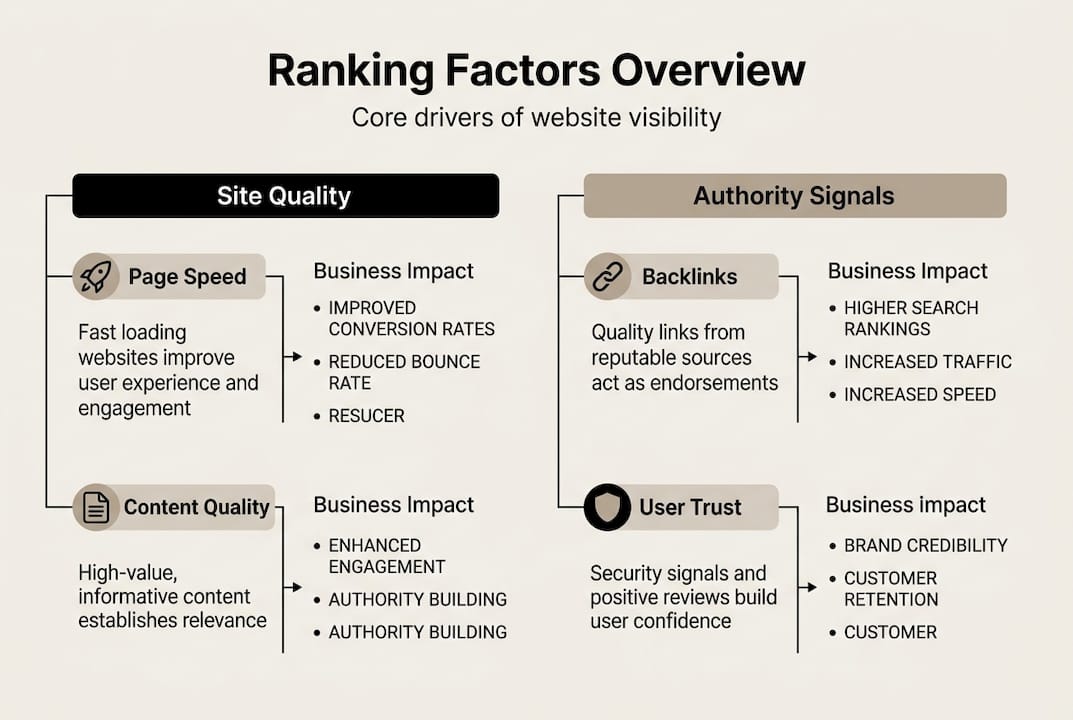
Click-through rate data reinforces why top positions are worth fighting for. AIOSEO research confirms that the gap between position one and position five is dramatic, with each step down the page cutting your traffic share significantly.
Here is where to focus your effort:
- Page experience: Fast load times, mobile responsiveness, and visual stability are non-negotiable in 2026.
- Content quality: Pages that answer user intent thoroughly and accurately outperform thin or keyword-stuffed content.
- Backlinks: Links from authoritative, relevant sites signal trust to Google’s algorithm.
- Internal linking: Connecting related pages on your site helps Google understand your topical authority.
- Image optimization: Properly formatted images improve load speed and can drive traffic from image search.
The importance of quality content cannot be overstated. Pair that with smart SEO image optimization and you cover two of the top three ranking drivers efficiently. Staying current with SEO industry changes ensures your strategy does not fall behind algorithm shifts.
Key nuances: Local searches, trending topics, and AI impacts
Ranking is not one-size-fits-all. Let’s look at situations where the rules change significantly.
For local businesses, the ranking game has its own playbook. Local searches prioritize Google Business Profile completeness, NAP (name, address, phone number) consistency across directories, and the volume and quality of customer reviews. Showing up in the local map pack is often more valuable than ranking on page one organically.
AI is reshaping the search results page in ways that affect every business. AI Overviews appear in 47% to 86% of queries depending on the topic, and zero-click results reduce traditional click-through rates by roughly 30%. This means ranking number one no longer guarantees the same traffic it once did.
Here are the nuances every business owner should know:
- Freshness matters: For trending topics, news, or time-sensitive queries, recently updated content ranks above older pages even if those older pages have more backlinks.
- Technical blocks are absolute: Crawl errors, noindex tags, or blocked resources can prevent a page from ranking entirely, regardless of content quality.
- Zero-click features: Featured snippets, knowledge panels, and AI answers can pull traffic away from your site even when you rank well.
- Review signals: For local businesses, a steady stream of genuine reviews directly influences map pack placement.
“A technically broken page is invisible to Google, no matter how valuable its content is. Fix the foundation before building the house.”
Pro Tip: Claim and fully optimize your Google Business Profile today. It is one of the highest-ROI actions a local business can take, and it costs nothing but time.
Explore local SEO strategies and stay updated with latest SEO industry notes to keep pace with Google algorithm changes.
Myths, expert nuances, and what Google doesn’t say
After covering edge cases, it is vital to sort fact from fiction about how ranking really works.
The most persistent myth is that you can pay Google for better organic rankings. You cannot. No payments influence rankings; Google’s search results are determined by algorithm, not by ad spend. Paid ads appear separately and do not boost organic position.
Another common misconception is that repeating a keyword more often will push you higher. Keyword density as a ranking tactic is outdated. Topical authority and entity coverage matter far more. Google rewards pages that cover a subject thoroughly and accurately, not pages that stuff a phrase into every paragraph.
Here is what the evidence actually supports:
- Backlinks are debated: Google downplays their importance, but industry studies show a strong correlation between high-quality backlinks and top rankings.
- Brand signals matter: Direct traffic, branded searches, and mentions across the web correlate with stronger rankings, even if Google does not officially confirm this.
- Manipulative tactics backfire: Buying links, cloaking content, or using AI-generated spam can trigger manual penalties that are difficult and time-consuming to recover from.
- Authority beats volume: One authoritative, well-structured page on a topic outperforms ten thin pages targeting the same keyword.
Pro Tip: Build your content strategy around topics, not just keywords. Cover a subject from multiple angles with interlinked pages, and you build the kind of topical authority that Google rewards consistently.
Stay sharp on what is changing by following the latest in SEO from sources that track algorithm behavior closely.
How to boost your search engine ranking: Actionable steps
With these myths cleared up, let’s drill down to concrete steps for improving your own search rankings.
- Audit for crawl errors. Use Google Search Console or a tool like Semrush to identify pages that are blocked, broken, or returning errors. Fix these before anything else.
- Optimize mobile performance and Core Web Vitals. Google uses mobile-first indexing, meaning your mobile site is what gets ranked. Slow load times and layout shifts hurt both rankings and conversions.
- Build topical content clusters. Create a pillar page on a broad topic and support it with detailed subtopic pages. This structure signals depth and authority to search engines.
- Earn authoritative backlinks. Focus on getting links from relevant, reputable sites through guest posts, partnerships, and original research. Quality beats quantity every time.
- Track SERP feature changes. Monitor whether AI Overviews or featured snippets are appearing for your target queries. If they are, adapting to SEO changes in your content format can help you capture those positions.
- Prepare for page experience standards. Review preparing for page experience requirements and ensure your site meets current Core Web Vitals thresholds.
Businesses that audit for crawl errors and optimize mobile speed consistently outperform competitors who focus only on content creation without addressing technical foundations.
Pro Tip: Set a monthly SEO audit calendar. Rankings shift constantly, and a quarterly review is too slow to catch drops before they cost you significant traffic.
Partnering for better rankings and greater business results
Understanding ranking mechanics is the first step. Executing a strategy that moves the needle consistently is where most businesses need a partner, not just a plan.

At Monstrous Media Group, we build systems that generate, capture, and close more revenue through search. Our SEO services cover everything from technical audits and content strategy to backlink development and SERP feature optimization. We do not sell activity reports. We deliver measurable ranking improvements tied to real business outcomes. Our digital marketing experts work alongside your team to align search strategy with your broader growth goals. If you are ready to stop guessing and start ranking, reach out for a consultation and let us show you exactly where your biggest opportunities are.
Frequently asked questions
How does Google actually decide rankings?
Google analyzes hundreds of signals including keywords, page quality, E-E-A-T, page experience, backlinks, and user context to determine where a page appears for a given search. Google’s ranking systems evaluate all of these simultaneously, not in isolation.
Can I pay Google to rank higher?
No. No payments influence organic rankings. Paid ads appear in a separate section and have no effect on where your site ranks in organic results.
What are the most important factors to improve ranking quickly?
Content quality, page experience, and authoritative backlinks deliver the fastest and most durable ranking improvements. Page experience accounts for 28% of ranking weight, making it the single largest factor in recent studies.
Why has my site ranking dropped suddenly?
Sudden drops are typically caused by technical issues, a Google algorithm update, increased competition, or AI Overviews pulling clicks away from organic results. AI Overviews reduce traditional click-through rates by roughly 30% in affected query categories.
Do backlinks still matter in 2026?
Yes. While Google emphasizes content quality and experience, industry studies show a strong and consistent correlation between high-quality backlinks and top organic rankings across competitive industries.
Recommended
Hire the team to help you with your website, app, or other marketing needs.
We have a team of digital marketers who can help plan and bring to life all your digital marketing strategies. They can help with social media marketing, email marketing, and digital advertising!
CONTACT US
Comments