
 https://www.omahamediagroup.com/images/uploads/monster_gallery/Omaha-Media-Group-Black.jpg
admin
https://www.omahamediagroup.com/images/uploads/monster_gallery/Omaha-Media-Group-Black.jpg
admin
What is paid search? A guide to profitable digital ads

TL;DR:
- Paid search is a real-time auction system where ad placement depends on bid and quality score. Successful campaigns require ongoing management, optimization, and coordination with SEO efforts. Overlooking factors like ad fraud, broad match misuse, and proper tracking can lead to significant budget waste and lost revenue.
Most business owners assume paid search is a simple game of outbidding the competition. Pay more, win the top spot, get more customers. That assumption is costing companies thousands of dollars every month. Paid search is actually a digital advertising model where businesses bid in real-time auctions to display ads on search engine results pages (SERPs), paying only when someone clicks. Knowing the difference between that myth and reality is the first step toward running campaigns that generate actual revenue. This guide breaks down how paid search works, what determines your ad placement, and the critical mistakes that quietly drain budgets.
Table of Contents
- Defining paid search: What it is and why it matters
- How paid search works: The real-time auction explained
- Common pitfalls and advanced nuances of paid search
- Maximizing business results with paid search strategies
- What most paid search guides get wrong
- How to get expert help with paid search
- Frequently asked questions
Key Takeaways
| Point | Details |
|---|---|
| Paid search defined | Paid search means pay-per-click ads shown on search engine results pages, decided by real-time auctions. |
| Auction mechanics | Your ad’s placement depends on bid, ad quality, and context, not just your budget. |
| Common pitfalls | Automation errors and poor tracking are common causes of wasted ad spend in paid search. |
| Strategy for results | Use value-based bidding, good creative, and ongoing audits to drive real revenue from paid search. |
| Expert support | Professional management helps avoid mistakes and maximize your paid search investment. |
Defining paid search: What it is and why it matters
Paid search sits at the intersection of intent and timing. When a prospect types a query into Google or Microsoft Bing, they are already looking for something specific. Paid search lets you put your solution directly in front of that person at the exact moment they want it. That kind of precision is something traditional advertising has never been able to offer.
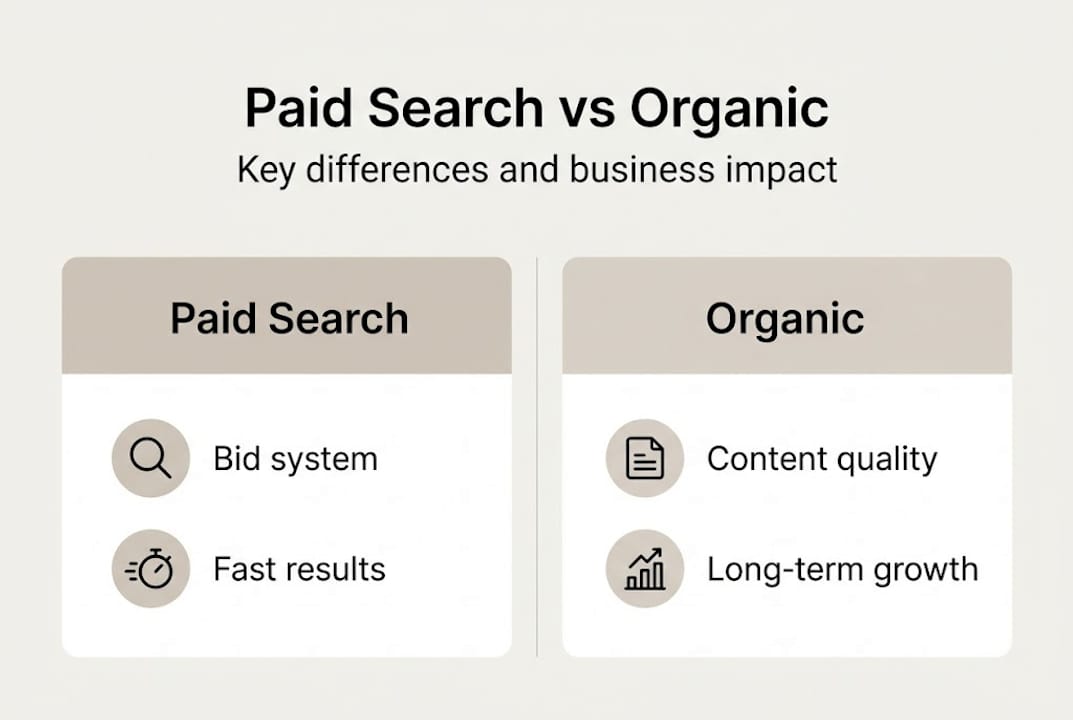
Organic search listings are earned through content quality, technical optimization, and authoritative backlinks. Paid search ads, by contrast, appear at the top or bottom of the SERP and are labeled as ads. The core mechanic is a pay-per-click model, meaning you pay only when a user clicks your ad. If no one clicks, you owe nothing. That model gives you measurable accountability that most other advertising channels simply cannot match.
Google dominates this space. The platform commands roughly 90% of global search market share, making Google Ads the default starting point for most advertisers. Microsoft Ads, which reaches users on Bing and partner sites, rounds out the major platforms and often delivers lower cost-per-click in certain industries due to reduced competition.
Here is why businesses consistently invest in paid search as part of their digital marketing strategies:
- Immediate visibility: Unlike SEO, which can take months to gain traction, paid ads can drive traffic the same day a campaign launches.
- Granular targeting: You can target by keyword, geography, device, time of day, and audience demographics.
- Spend control: Set daily or monthly budget caps, and adjust them at any time.
- Measurable ROI: Every click, conversion, and dollar spent can be tracked back to specific ads and keywords.
- Scalability: Increase spend when campaigns perform well, and pull back when they do not.
Pro Tip: Start with a narrow keyword list and a modest daily budget. Prove your cost-per-acquisition before scaling spend. Chasing volume before validating profitability is one of the most common early mistakes in paid search.
How paid search works: The real-time auction explained
Every single search query triggers a real-time auction that takes milliseconds to complete. You never see it happening, but the outcome determines whether your ad appears, where it ranks, and what you pay per click. Understanding this process is what separates advertisers who waste budget from those who generate returns.
Here is how the auction unfolds, step by step:
- A user types a search query into Google.
- Google identifies all advertisers whose keywords match the query.
- Each eligible advertiser receives an Ad Rank score.
- Ads are displayed in order of Ad Rank, not simply by the highest bid.
- The advertiser pays the minimum amount needed to maintain their position, not their maximum bid.
Ad Rank is determined by a formula: bid multiplied by Quality Score, plus the impact of ad assets, search context, and auction-time thresholds. Quality Score is a diagnostic rating from 1 to 10 based on three components: expected click-through rate (CTR), ad relevance to the keyword, and landing page experience. A low Quality Score means you pay more for the same position or get outranked by competitors bidding less.
This is a critical insight. A competitor with a $2 bid and a Quality Score of 9 can outrank you at a $5 bid with a Quality Score of 3. Optimizing for ad quality is not optional; it directly affects your costs and results.
When it comes to bidding strategy, advertisers have two primary paths:
| Bidding approach | Best for | Key benefit | Key risk |
|---|---|---|---|
| Manual CPC | Experienced advertisers with historical data | Full control over individual keyword bids | Labor-intensive; requires ongoing attention |
| Smart Bidding (automated) | Campaigns with conversion data | Optimizes in real time using machine learning | Requires sufficient data; can overspend early |
Pro Tip: Before enabling Smart Bidding strategies through your advertising services partner, ensure your conversion tracking is fully configured. Automated bidding learns from your data. Feed it bad data and it will optimize for the wrong outcomes.
It is also worth understanding Google Ads compliance policies, as violations can result in account suspensions that pause campaigns without warning.
Common pitfalls and advanced nuances of paid search
Even advertisers who understand the basics often run into costly surprises. Paid search is not inherently difficult, but it rewards attention and punishes neglect. Several advanced dynamics catch even experienced marketers off guard.

One of the most misunderstood risks is ad fraud and invalid clicks, which account for roughly 14% of all ad clicks. Competitors, bots, and click farms generate fake traffic that drains budget without producing leads. Using click fraud protection tools and monitoring your traffic quality reports is non-negotiable for any account spending meaningful budget.
Another common trap is broad match keyword misuse. Broad match keywords cast a wide net, triggering ads on loosely related or irrelevant queries. Without Smart Bidding running alongside them, broad match campaigns can bleed budget on searches that have no connection to your actual offer. Negative keywords, which exclude irrelevant search terms, are your primary defense.
Here is a breakdown of frequent paid search hazards and how to mitigate each one:
| Risk | What happens | Mitigation |
|---|---|---|
| Poor conversion tracking | Campaigns optimize for the wrong signals | Audit tracking setup before launch |
| AI over-automation | Smart Bidding optimizes before sufficient data exists | Wait for at least 30 conversions before enabling |
| Organic cannibalization | Paid ads compete with your own organic listings | Run SEO/SEM coordination through SEO strategy reviews |
| Ad fraud | Budget wasted on invalid clicks | Use fraud detection tools; review placement reports |
| Negative keyword conflicts | Ads excluded from relevant searches | Audit negative lists quarterly |
“Set and forget is not a strategy in paid search. It is a slow leak in your revenue pipeline. Accounts without regular management deteriorate while spend continues.”
Organic cannibalization deserves special attention. When your paid ad and your organic listing both appear for the same query, you may be paying for a click you would have gotten for free. The solution is not to avoid paid search on branded terms entirely, but to analyze the incremental value each channel adds and coordinate both together.
Maximizing business results with paid search strategies
Knowing what to avoid is half the equation. The other half is building a systematic approach that ties every campaign decision back to revenue outcomes, not vanity metrics like impressions or raw click volume.
Here is a strategy checklist that high-performing advertisers follow consistently:
- Value-based bidding: Assign conversion values that reflect actual revenue contribution, not just conversion counts. This allows Smart Bidding to prioritize high-value actions.
- Full-funnel tracking: Set up tracking for every meaningful touchpoint, from first click to closed sale. Relying on last-click attribution alone misrepresents which campaigns are actually driving results.
- Creative asset testing: Rotate multiple ad headlines and descriptions. Optimized headlines can boost CTR by 30%, which directly lowers your cost per click.
- Landing page optimization: Your ad gets the click, but your landing page earns the conversion. Align page messaging with ad copy, and eliminate friction in the form or checkout flow.
- Channel diversification: Do not depend solely on Google. Microsoft Ads, YouTube, and performance-based display campaigns can extend reach while lowering average CPCs.
- Weekly performance audits: Review search term reports, Quality Scores, conversion rates, and budget pacing every week. Problems that go unchecked for a month can erase a quarter of results.
Pro Tip: If you are managing PPC advertising for long-term growth, treat your account as a living system, not a one-time project. The advertisers generating the strongest returns are running structured review cycles and testing new creative on a rolling basis.
For business owners serious about revenue growth with PPC, the emphasis should always be on downstream outcomes, meaning pipeline, closed deals, and customer lifetime value, not surface-level metrics that feel good but do not move the business forward. Staying current on future advertising trends also helps you anticipate shifts before they affect your campaigns.
What most paid search guides get wrong
Most paid search content promises fast, scalable results if you just follow a simple framework. That framing is misleading, and it sets advertisers up for disappointment. Real paid search performance is not built in a campaign launch. It is built through iterations, accumulated data, and honest analysis of what the numbers are actually saying.
AI automation is the clearest example of this problem. Smart Bidding is genuinely powerful, but it gets treated as a hands-off solution when it is anything but. Automated bidding needs clean conversion data, appropriate learning windows, and human oversight to stay on track. Campaigns running without regular audits drift silently, optimizing for signals that no longer reflect your actual business goals.
Few guides address organic cannibalization seriously either. Your SEO and paid search teams need to be working from the same playbook. Without that coordination, you can end up paying for clicks on branded queries where your organic listing already ranks first. Long-term PPC planning requires integrating both channels into a unified traffic strategy, not running them as independent silos.
How to get expert help with paid search
Applying these strategies consistently while managing a business is a real challenge. Paid search demands ongoing attention, data analysis, and creative testing to stay profitable.

Monstrous Media Group specializes in building expert PPC management systems that eliminate guesswork and stop budget waste before it starts. As a multi-award-winning SEM and SEO firm, we design paid search campaigns around your revenue goals, not activity metrics. From account setup and keyword strategy to weekly audits and creative testing, we manage every layer. Our digital marketing services extend across SEO, web development, and integrated campaign management. If you want a paid search strategy built to produce measurable outcomes, reach out to schedule a consultation and see exactly where your current campaigns are leaving money on the table.
Frequently asked questions
What is the difference between paid search and organic search?
Paid search refers to ads displayed on SERPs using a bidding model, while organic search listings are earned based on content relevance and SEO performance. Paid ads appear immediately; organic rankings take time to build.
How much does paid search advertising cost?
Costs vary by industry and keyword competitiveness, but the PPC model means you only pay when someone clicks your ad, making it adaptable for businesses with a range of budgets.
How do I make my paid search campaigns more effective?
Prioritize value-based bidding, configure full-funnel conversion tracking, test creative assets regularly, and run weekly audits to catch performance issues before they compound into significant budget loss.
Can paid search hurt my organic SEO rankings?
Paid ads do not directly affect organic rankings, but cannibalization with organic traffic can occur when both compete for the same queries, which requires coordinated SEM and SEO management to address.
What are the main risks of paid search advertising?
The primary risks include 14% invalid click rates from ad fraud, budget waste from poor targeting, AI automation errors without sufficient data, and tracking failures that corrupt campaign optimization signals.
Recommended
Hire the team to help you with your website, app, or other marketing needs.
We have a team of digital marketers who can help plan and bring to life all your digital marketing strategies. They can help with social media marketing, email marketing, and digital advertising!
CONTACT US
Comments