
 https://www.omahamediagroup.com/images/uploads/monster_gallery/Omaha-Media-Group-Black.jpg
admin
https://www.omahamediagroup.com/images/uploads/monster_gallery/Omaha-Media-Group-Black.jpg
admin
How strategic content fuels SEO success and business growth

TL;DR:
- Content is the core signal for relevance, quality, and user satisfaction in SEO.
- Google’s E-E-A-T framework emphasizes experience, expertise, authority, and trustworthiness.
- Regular content updates and a people-first approach are essential for sustained growth and rankings.
Most business leaders assume SEO is a keyword game. Pack the right terms into a page, add a few backlinks, and rankings follow. That belief costs companies real revenue. Content is the foundation of SEO, serving as the primary signal for relevance, quality, and user satisfaction in Google’s ranking algorithms. Keywords matter, but they are inputs, not the engine. The engine is content: how it’s written, structured, updated, and aligned with what your audience actually needs. This guide breaks down exactly how strategic content drives SEO performance, protects you from algorithm shifts, and compounds into measurable business growth.
Table of Contents
- Why content is the foundation of effective SEO
- Understanding Google’s E-E-A-T: How quality fuels rankings
- Core content dynamics: Matching intent, structure, and optimization
- The compounding business value of optimized content
- The future: AI, human, and the people-first approach to content
- What most leaders miss about content’s real SEO impact
- Drive growth and rankings with a proven SEO content partner
- Frequently asked questions
Key Takeaways
| Point | Details |
|---|---|
| Content is core to SEO | Strategic, high-quality content is the most important factor in achieving high search rankings and organic business growth. |
| E-E-A-T drives rankings | Google rewards content that demonstrates experience, expertise, authority, and trust—especially in sensitive industries. |
| Optimization multiplies value | Well-structured, intent-matched, and continually refreshed content fuels ranking and revenue momentum over time. |
| Human input beats pure AI | AI-generated content must be enhanced and edited by people to meet quality and trust standards and maximize SEO results. |
Why content is the foundation of effective SEO
With the misconception debunked, we can examine exactly why content holds this central role in SEO. Google’s algorithm has evolved well beyond simple keyword matching. Today, it evaluates hundreds of signals to determine whether a page genuinely serves the person searching. Content is where most of those signals live.
“Content is the foundation of SEO, serving as the primary signal for relevance, quality, and user satisfaction in Google’s ranking algorithms.”
When Google crawls your site, it reads your content to understand what your business does, who it serves, and whether your pages answer real questions better than competitors. SEO and quality content work together because search engines reward pages that demonstrate subject matter depth, not just surface-level coverage. A page that thoroughly addresses a topic earns authority. Authority earns rankings. Rankings earn traffic. Traffic earns revenue.
The financial case is compelling. SEO yields an average ROI of 748%, reaching as high as 1,389% in sectors like real estate, with a meta-analysis of 10 studies confirming a strong effect size for traffic and rankings driven by content quality, keywords, and backlinks. That kind of return does not come from technical tweaks alone.
Here is what high-quality content consistently delivers:
- Relevance signals that help Google match your pages to the right search queries
- Trust indicators that build credibility with both algorithms and real readers
- Compounding authority as more pages earn links and social engagement over time
- Lower bounce rates because visitors find genuine answers and stay longer
- Conversion pathways that turn organic visitors into qualified leads
Creative content marketing also builds brand identity, which reinforces the trust signals Google increasingly values. Content is not just an SEO tactic. It is a business asset that appreciates with every update and every new piece you publish.
Understanding Google’s E-E-A-T: How quality fuels rankings
With content established as the starting point, let’s see how Google measures and rewards true content quality. The framework is called E-E-A-T: Experience, Expertise, Authoritativeness, and Trustworthiness. Trust sits at the center. Without it, the other three signals carry far less weight.
Google evaluates content quality through E-E-A-T, and pages that score high on these dimensions rank higher, especially for YMYL (Your Money or Your Life) topics like finance, health, and legal services. For those niches, weak content is not just a rankings problem. It is a brand safety risk.
A recent Semrush study found that strong E-E-A-T signals correlate with a 30.64% increase in AI-generated citation appearances, meaning your content gets referenced more often in AI-driven search results. That is a significant visibility multiplier in 2026.
| E-E-A-T signal | What Google looks for | Business impact |
|---|---|---|
| Experience | First-hand knowledge, case studies, real examples | Higher trust, lower bounce rate |
| Expertise | Author credentials, depth of coverage | Stronger topical authority |
| Authoritativeness | Backlinks, brand mentions, citations | Improved domain ranking power |
| Trustworthiness | Accuracy, transparency, security (HTTPS) | Algorithm resilience, conversion lift |
For more detail on how adapting to SEO changes protects your rankings, the pattern is consistent: businesses that invest in E-E-A-T signals weather algorithm updates far better than those chasing shortcuts.
Pro Tip: Add author bios with real credentials to every key content page. A named expert with verifiable experience signals E-E-A-T to both Google and your readers, and it costs nothing to implement. Learn more about E-E-A-T to build a complete checklist for your content team.
Core content dynamics: Matching intent, structure, and optimization
Once you understand what quality means, the next step is nailing the technical and structural side of content for SEO. Even brilliant writing fails to rank if it ignores the mechanics that search engines rely on to evaluate and index pages.
Key mechanics include matching search intent, keyword optimization, skimmable structure using headings and lists, internal linking, and content freshness. On-page elements like title tags, meta descriptions, and header hierarchy enhance crawlability and directly influence rankings. Ignoring any of these is like building a great product and putting it in an unmarked box.

Search intent is the most underestimated factor. A page targeting “content marketing” but written for beginners will not rank for an executive searching for ROI benchmarks. Aligning with search intent means understanding the goal behind the query, not just the words in it.
Here is a practical on-page checklist you should never skip:
- Title tag: Include the primary keyword within the first 60 characters
- Meta description: Write a clear, benefit-driven summary under 160 characters
- H1 and H2 headings: Use keyword-rich, descriptive headers that reflect content hierarchy
- Internal links: Connect related pages to distribute authority and guide users
- Content freshness: Update pages regularly to signal ongoing relevance
- Image alt text: Describe visuals with relevant keywords for accessibility and indexing
- Page speed: Slow pages lose rankings; page experience updates confirm this
Pro Tip: Use content optimization strategies to audit your top 10 pages quarterly. Small structural fixes, like adding a missing H2 or refreshing a meta description, often produce ranking gains within weeks without creating new content from scratch. Your SEO best practices should include this as a standing quarterly task.
The compounding business value of optimized content
Getting structure right drives immediate gains, but let’s see how those content efforts translate into lasting business growth. The most underutilized strategy in content SEO is the content refresh, and the data behind it is striking.
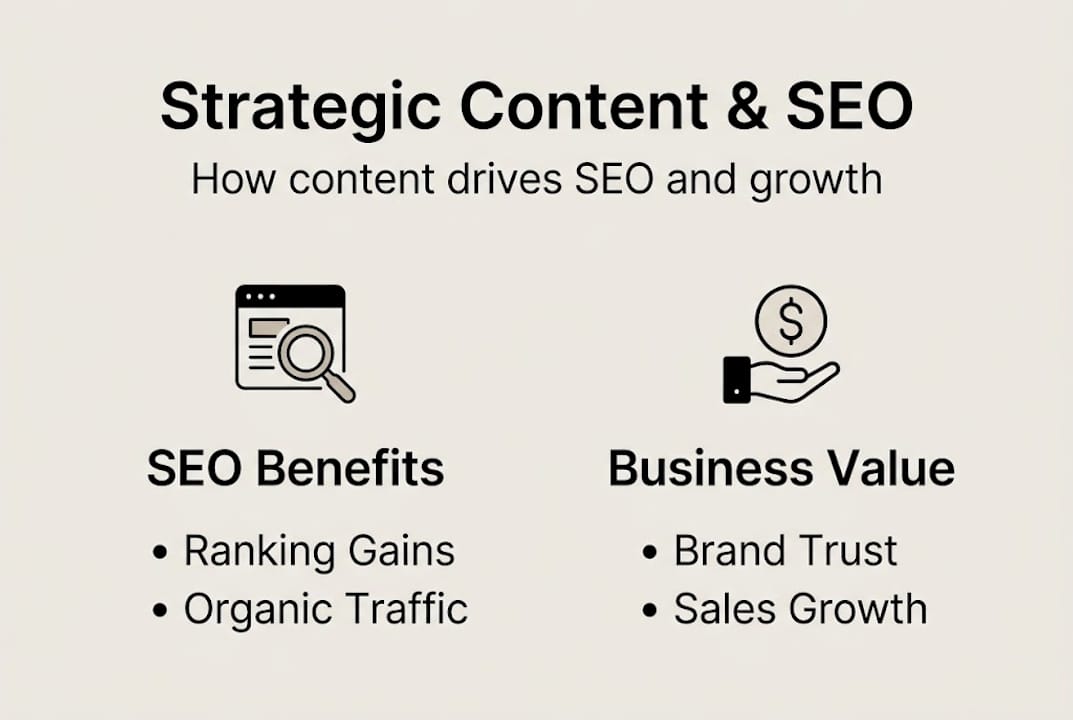
Key stat: Refreshing content by 31 to 100% yields an average position gain of 8 spots (p=0.026) and reduces ranking decay by 87%. Pages that received major rewrites gained an average of 5.45 positions, while non-updated pages lost 2.51 positions on average. That gap compounds over time.
Here is how to run a content refresh program that drives results:
- Audit existing content for traffic decay, outdated statistics, and thin coverage
- Prioritize pages ranked in positions 5 through 20 as they have the highest uplift potential
- Expand content depth by adding new sections, examples, or updated data
- Strengthen internal linking to connect refreshed pages with newer, high-authority content
- Update publish dates only after making substantive changes, not cosmetic edits
The content refresh strategies that produce the biggest wins treat existing content as an appreciating asset, not a one-time expense.
| Approach | Avg. ranking change | Traffic impact |
|---|---|---|
| Major content rewrite | +5.45 positions | Significant uplift |
| Moderate expansion (31%+) | +8.0 positions | Strong sustained growth |
| No update | -2.51 positions | Gradual decay |
Real-world results reinforce this. Case studies show 700% organic traffic growth in the Forex niche over 8 months and 390% traffic growth for an AI platform, both driven by content clusters and E-E-A-T optimization. Combined with SEO ROI benchmarks averaging 748%, the business case for investing in content quality is not debatable. Tracking content updates and SEO performance monthly lets you connect specific content actions to ranking outcomes.
The future: AI, human, and the people-first approach to content
Maximized content value depends on evolving with the times. Let’s clarify where to balance AI and human expertise today. AI tools have transformed content production speed, but speed without substance is a liability in 2026.
A 16-month study found that pure AI content ranks 23% lower than human-written content, acquires 61% fewer backlinks, and carries a 3.2x higher deindexation risk. However, AI-assisted content with human editing closes that gap to just 4%. The lesson is clear: AI is a production tool, not a replacement for expertise.
“People-first content means writing for humans first, search engines second. Google’s systems are designed to reward exactly that.”
The hybrid approach works because it combines AI’s efficiency with human judgment, original insight, and real-world experience. Those are the elements that produce E-E-A-T signals. Here is what a people-first content framework looks like in practice:
- Use AI to draft structure, generate outlines, and surface related subtopics
- Have subject matter experts review and enrich every piece with original perspective
- Add first-hand examples, client stories, or proprietary data wherever possible
- Avoid over-optimization: keyword density above 3% signals manipulation, not relevance
- Write for the reader’s decision, not just the search query
Learn how AI in content strategy can be structured responsibly to maintain rankings while scaling output. The businesses winning in search today are not the ones publishing the most content. They are the ones publishing the most credible content. See real AI content impact data to understand the full risk picture before committing to an AI-only workflow.
What most leaders miss about content’s real SEO impact
Here is the uncomfortable truth: most business leaders underinvest in content because they cannot see it working in real time. Paid ads show results in hours. Content shows results in months. That timeline mismatch leads to chronic underinvestment in the strategy with the highest long-term ROI.
SEO is not dead. It has matured. Search engines now judge content on substance, trust, and differentiation, not volume or keyword density. The leaders who treat content as a commodity, something to produce cheaply and quickly, consistently lose ground to competitors who treat it as a strategic asset.
The real SEO-content connection is this: every piece of content you publish is either building your authority or diluting it. There is no neutral. Smart executives stop asking “how much content do we need?” and start asking “what content will make us the most trusted source in our category?” That shift in thinking is where the biggest missed ROI lives.
Drive growth and rankings with a proven SEO content partner
If this article has made one thing clear, it is that content-driven SEO is not a set-it-and-forget-it tactic. It requires strategy, expertise, and consistent execution.

Monstrous Media Group combines human expertise with AI-enabled tools to audit, optimize, and scale content that earns real rankings and drives measurable revenue. Our team builds content systems grounded in E-E-A-T principles, search intent alignment, and continuous performance tracking. Whether you need a full content audit, a refresh program, or an integrated digital marketing solutions strategy, we deliver outcomes, not reports. Explore our SEO services and request a consultation to see where your content is leaking rankings and revenue.
Frequently asked questions
How does content directly impact SEO rankings?
Content signals relevance and quality to search engines, which evaluate it as the primary factor in determining how well a page serves a user’s query. Strong content earns higher positions by satisfying both algorithmic criteria and real reader needs.
What type of content earns the highest SEO value in 2026?
Content that demonstrates real experience, deep expertise, and verified trustworthiness performs best. Google prioritizes E-E-A-T content across all niches, with even stricter standards for finance, health, and legal topics.
How often should business content be updated for SEO?
Refreshing content by 31% or more produces an average gain of 8 ranking positions and reduces ranking decay by 87%, making quarterly content audits a high-ROI practice for most businesses.
Why is AI-only content risky for SEO?
Pure AI content ranks 23% lower than human-written content and carries a 3.2x higher deindexation risk, while human-edited AI content narrows that performance gap to just 4%.
How does quality content affect business ROI?
SEO delivers an average ROI of 748% when supported by quality content, making it one of the highest-returning digital marketing investments available to business leaders today.
Recommended
Hire the team to help you with your website, app, or other marketing needs.
We have a team of digital marketers who can help plan and bring to life all your digital marketing strategies. They can help with social media marketing, email marketing, and digital advertising!
CONTACT US
Comments