
 https://www.omahamediagroup.com/images/uploads/monster_gallery/Omaha-Media-Group-Black.jpg
admin
https://www.omahamediagroup.com/images/uploads/monster_gallery/Omaha-Media-Group-Black.jpg
admin
Proven SEO strategies for business growth and revenue impact

SEO has never been more critical, or more complex, for business owners and marketing executives trying to drive real revenue. The rules have shifted dramatically, with AI-powered search, zero-click results, and algorithm updates reshaping how customers find and trust brands online. Chasing every new trend is a fast path to wasted budget and zero results. What actually works is a disciplined, structured approach that balances short-term wins with long-term bets, allocating roughly 60 to 70% of your effort to quick wins, 20% to site health, and 10% to innovation. This guide gives you that framework, step by step.
Table of Contents
- The new SEO reality for business in 2026
- Core components of a winning SEO strategy
- Balancing short-term wins, site health, and innovation
- AI, LLMs, and search: How to future-proof your strategy
- Measuring success: Metrics that fuel business growth
- Elevate your SEO: Next steps with expert support
- Frequently asked questions
Key Takeaways
| Point | Details |
|---|---|
| Balance your efforts | Strategically split your SEO focus between quick wins, ongoing maintenance, and innovation for consistent results. |
| Optimize for AI search | Clear, structured content and long-tail keywords help you capture high-value AI-driven traffic. |
| Ditch vanity metrics | Track revenue, lead quality, and real business outcomes—not just organic visits or keyword ranks. |
| Emphasize E-E-A-T signals | Showcase expertise, authoritativeness, and trustworthiness for both human and AI-driven search success. |
| Update for AI and LLMs | Adapt SEO now to future-proof your business against rapid changes in how people search online. |
The new SEO reality for business in 2026
The SEO landscape your team navigated three years ago barely resembles what exists today. AI-driven search engines, large language models (LLMs), and zero-click features have fundamentally changed how search results are generated and consumed. Understanding these SEO changes for businesses is no longer optional. It is the price of staying competitive.
One of the most striking shifts involves the value of AI-generated search traffic. Visitors arriving through AI search are 4.4x more valuable than traditional organic visitors, making LLM optimization a genuine revenue priority, not just a technical exercise. At the same time, zero-click searches mean your content must earn visibility even when users never click through to your site.
Here is what modern SEO success looks like in practice:
- Revenue contribution replaces traffic volume as the primary KPI
- AI visibility and brand mentions matter as much as keyword rankings
- E-E-A-T (Experience, Expertise, Authoritativeness, Trustworthiness) signals are weighted heavily by both traditional and AI search engines
- Topical authority outperforms isolated keyword targeting
- Human insight and original perspective differentiate content in an AI-saturated landscape
Learn more about AI and SEO fundamentals to understand how answer engine optimization is reshaping discovery.
“The businesses winning in search right now are not the ones publishing the most content. They are the ones publishing the most trusted content, built on real expertise and structured for both humans and machines.”
The shift away from vanity metrics toward revenue and AI visibility is not just a measurement preference. It is a strategic realignment that separates growing businesses from stagnant ones.
Core components of a winning SEO strategy
Now that you understand why SEO is different in 2026, let’s break down the essential building blocks of a competitive strategy. A strong SEO service foundation covers five interconnected areas, each reinforcing the others.
Here are the core steps, in order:
- Keyword research — Identify high-intent, revenue-relevant queries your audience actually uses, including long-tail and conversational phrases.
- Competitor analysis — Map where competitors rank, what content they produce, and where gaps exist that your brand can fill.
- Technical and on-page optimization — Fix crawl errors, improve page speed, and align title tags, H1s, and URLs with target keywords.
- Off-page authority building — Earn backlinks from credible, relevant sources to signal trustworthiness to search engines.
- LLM and AI search optimization — Structure content so AI systems can extract and cite it accurately in generated responses.
The core SEO strategy steps above are not new in concept, but their execution has evolved significantly. On-page priorities now include Core Web Vitals, schema markup, and E-E-A-T signals that were secondary concerns just a few years ago. The Google page experience update made site performance a direct ranking factor, and that standard has only risen since.

| Factor | Conventional SEO focus | AI-first SEO focus |
|---|---|---|
| Content goal | Keyword density | Entity clarity and topical depth |
| Link strategy | Volume of backlinks | Authority and relevance of sources |
| Metrics | Rankings and traffic | Revenue, leads, AI citations |
| Content format | Long-form articles | Structured, extractable answers |
| User signals | Bounce rate | Engagement and conversion rate |
Pro Tip: Technical site health is the foundation everything else rests on. A beautifully written piece of content will underperform if your site loads slowly, has broken internal links, or lacks proper schema markup. Audit your technical baseline before investing heavily in content production.
Balancing short-term wins, site health, and innovation
With the framework in mind, here is how to practically allocate your team’s time and budget for measurable results. The most effective SEO programs are not all-in on one approach. They operate on three tracks simultaneously.
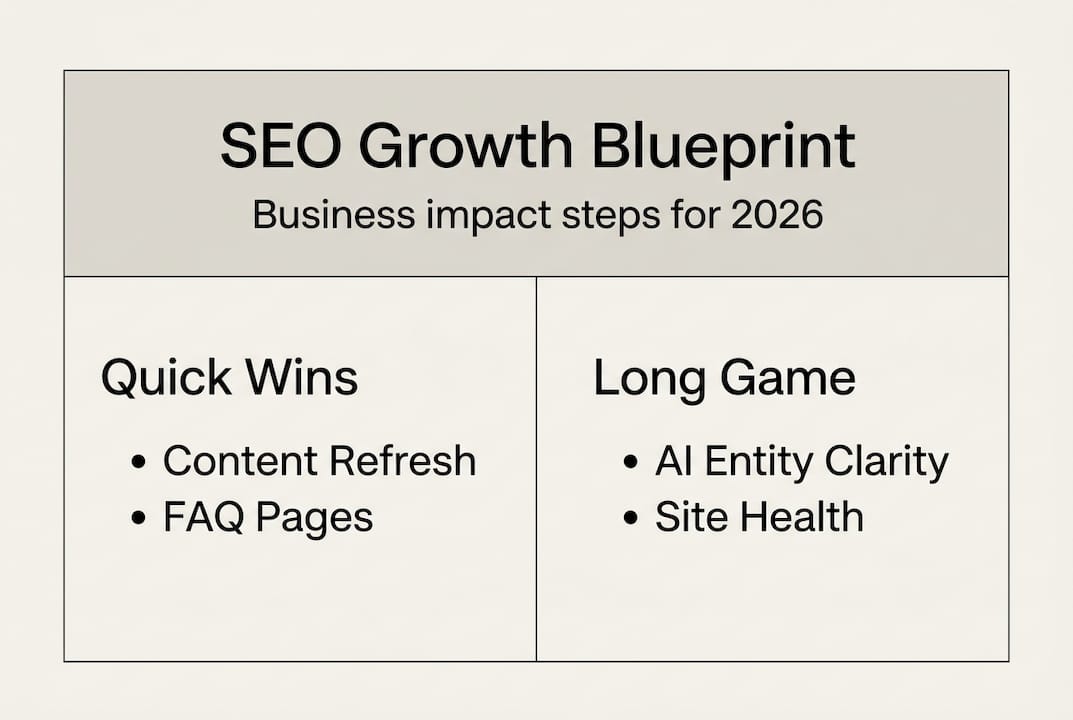
The recommended SEO effort split looks like this:
| Track | Allocation | Examples |
|---|---|---|
| Short-term wins | 60 to 70% | Content refreshes, FAQ pages, structured data, meta updates |
| BAU (site health) | 20% | Technical audits, crawl fixes, Core Web Vitals monitoring |
| Long-term bets | 10% | New content channels, AI search experiments, brand authority plays |
Short-term wins are the engine of consistent growth. Refreshing underperforming content, adding FAQ schema, and updating meta descriptions can produce ranking improvements within weeks. BAU work keeps your site healthy so those wins stick. Long-term bets, like experimenting with AI-optimized content formats or building topical authority in a new vertical, pay off over quarters, not days.
The results of this balanced approach are not theoretical. Strategic SEO reallocation produced a 165% increase in organic leads, 250% more traffic, and 189% revenue growth for a B2B software company within six months. That kind of outcome comes from discipline, not luck.
- Refresh your top 20 pages by traffic every quarter
- Fix technical issues before adding new content
- Test one new channel or format per quarter as your long-term bet
- Review your effort split monthly to prevent resource drift
Pro Tip: Review your effort allocation quarterly. Teams that skip this review tend to drift toward 90% BAU work, which maintains the status quo but never accelerates growth. Pair your SEO investment with smart balancing of SEO and PPC to maximize total search visibility without doubling your budget.
For teams looking to grow without adding operational complexity, scaling without complexity is a practical resource worth reviewing.
AI, LLMs, and search: How to future-proof your strategy
The future is already here. Large language models now power a significant portion of how people discover, evaluate, and trust businesses online. Ignoring this shift means leaving revenue on the table.
AI Overviews trigger on 21% of queries, favoring question-based content, top-10 rankings, and strong topical authority. That means your content needs to be structured so AI systems can extract precise, trustworthy answers from it, not just rank for a keyword.
Here are four steps to optimize for LLMs and AI search:
- Write with clarity — Use plain, direct language. AI systems favor content that answers questions without ambiguity.
- Structure for extraction — Use headers, bullet points, and schema markup so AI can parse and cite your content accurately.
- Build audience-first content — Focus on genuine user intent, not keyword stuffing. AI search visitors are 4.4x more valuable, so quality matters more than volume.
- Target long-tail and conversational queries — Long-tail SEO and conversational queries are now essential for capturing AI-driven traffic, especially for niche and high-intent searches.
User-generated content and FAQs add authenticity that AI systems recognize and reward. Reviews, community questions, and real customer language signal that your brand is trusted by actual people, not just optimized by algorithms.
Additionally, optimizing your graphics for AI search ensures your visual assets contribute to discoverability, not just aesthetics. Pair this with AI-driven marketing improvements across your channels for compounding impact. Our AI-powered digital marketing services are built specifically for this new reality. Teams looking for AI tools to support execution can also explore AI tools for agencies as a starting point.
Measuring success: Metrics that fuel business growth
Having transformed your execution, let’s make sure you measure results that your board and sales teams actually care about. Traffic numbers feel good. Revenue numbers close deals.
Retiring vanity metrics like total organic traffic and average position is not about lowering your standards. It is about raising them. When you stop optimizing for clicks and start optimizing for conversions, your entire content strategy sharpens.
Here is a five-step process to build a measurement framework executives trust:
- Map SEO goals to revenue outcomes — Every tracked metric should connect to a dollar value or pipeline stage.
- Set conversion-weighted visibility scores — Weight keyword rankings by the conversion rate of the pages they drive traffic to.
- Track AI visibility and brand mentions — Monitor how often your brand appears in AI-generated answers and third-party citations.
- Measure organic lead quality — Volume means nothing if leads do not convert. Track lead-to-close rates from organic channels.
- Report in business language — Present results as revenue impact, not ranking improvements, to earn executive buy-in.
| Old metric | Why it misleads | Better alternative |
|---|---|---|
| Total organic traffic | Includes low-intent, zero-value visits | Organic revenue contribution |
| Average keyword position | Ignores conversion potential | Conversion-weighted visibility |
| Number of backlinks | Volume without quality context | Authority score of linking domains |
| Bounce rate | Misread as negative engagement | Engagement rate and time on page |
“When you stop reporting on what search engines see and start reporting on what your CFO cares about, SEO earns a permanent seat at the revenue table.”
Pairing your SEO measurement with strong engagement metrics for email gives you a fuller picture of how organic and owned channels work together to drive growth.
Elevate your SEO: Next steps with expert support
If you have read this far, you already understand that SEO in 2026 is not a set-it-and-forget-it activity. It is a system, and systems need expert design to produce consistent outcomes.

At Monstrous Media Group, we build professional SEO services that are engineered around your revenue goals, not activity reports. Our team handles the technical complexity, content strategy, AI optimization, and ongoing measurement so your internal team can focus on closing business. We integrate SEO with your broader digital marketing solutions to create a unified growth engine that compounds over time. If you are ready to stop guessing and start growing, request a strategy session or site audit with our team today. Real outcomes, not busywork.
Frequently asked questions
What is the most important SEO strategy for businesses in 2026?
The most effective approach is a balanced one: allocate 60 to 70% to short-term wins, 20% to site health, and 10% to long-term innovation, while optimizing for both AI search and user experience simultaneously.
How do AI and LLMs change SEO for business?
AI and LLMs prioritize clear, structured, and authentic content, making long-tail queries and topical authority more critical than ever. AI search visitors are 4.4x more valuable than traditional traffic, so optimizing for these systems directly impacts revenue.
Which SEO metrics should business owners focus on now?
Focus on metrics tied to revenue, conversion-weighted visibility, and brand mentions. Retiring vanity metrics like total organic traffic and average position frees your team to optimize for outcomes that actually matter to growth.
What is the best way to optimize my content for AI search?
Use clear, entity-rich language, answer questions directly, and build content around user intent and long-tail keywords. Long-tail and conversational queries are now essential for capturing AI-driven traffic effectively.
Can smaller businesses compete with larger brands in SEO?
Absolutely. Focusing on niche authority, authentic user-generated content, and long-tail SEO for AI levels the playing field significantly, giving smaller brands a genuine path to visibility without requiring enterprise-level budgets.
Recommended
Hire the team to help you with your website, app, or other marketing needs.
We have a team of digital marketers who can help plan and bring to life all your digital marketing strategies. They can help with social media marketing, email marketing, and digital advertising!
CONTACT US
Comments