
 https://www.omahamediagroup.com/images/uploads/monster_gallery/Omaha-Media-Group-Black.jpg
admin
https://www.omahamediagroup.com/images/uploads/monster_gallery/Omaha-Media-Group-Black.jpg
admin
How user experience drives SEO growth and rankings

TL;DR:
- User experience signals like Core Web Vitals and behavioral metrics significantly influence Google rankings.
- Improving site structure, content engagement, and visual stability boosts both SEO and business outcomes.
- Many SEO teams overlook real user needs, focusing too much on technical checks rather than genuine satisfaction.
Major ranking shifts rarely happen because someone added more keywords to a page. They happen because Google’s systems detected that real users were more satisfied on one site than another. Search engine optimization has evolved far beyond meta tags and backlink counts. Today, user experience (UX) sits at the center of how Google decides which pages deserve top positions. This guide breaks down exactly how UX influences your rankings, which signals Google actually measures, and what steps you can take to build a site that satisfies both algorithms and real visitors.
Table of Contents
- Why user experience matters for SEO rankings
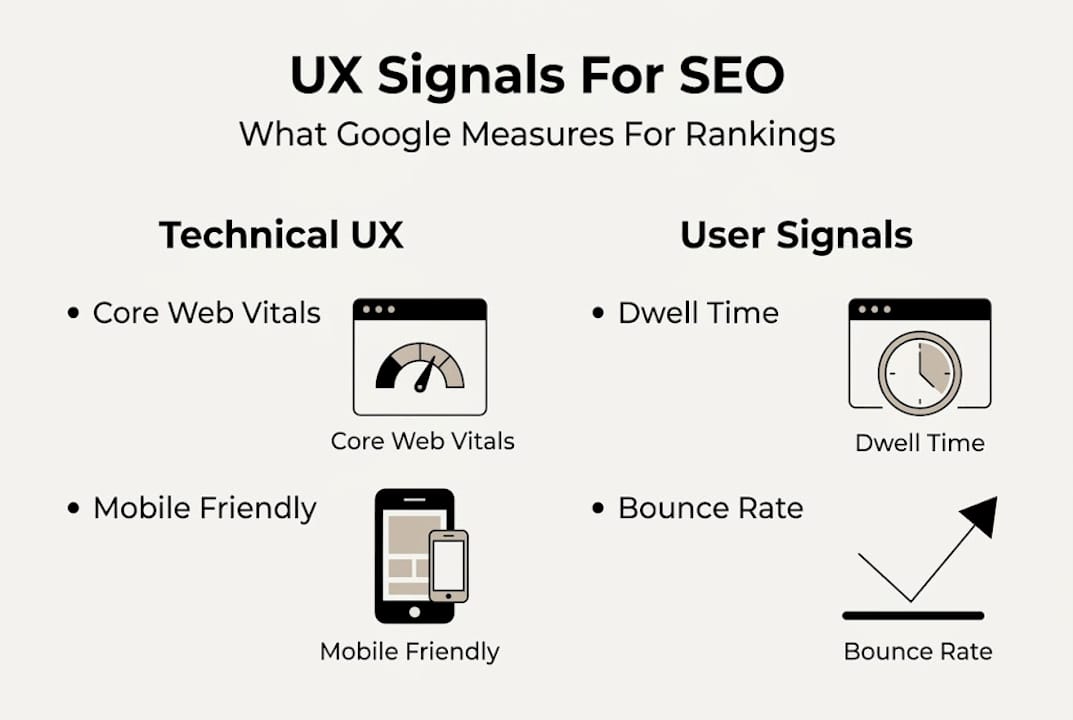
- Key UX factors Google actually measures
- How UX strategy improves both rankings and business outcomes
- Balancing technical metrics with authentic user engagement
- Why most SEO teams underestimate real user experience
- Next steps: Bring your UX and SEO together
- Frequently asked questions
Key Takeaways
| Point | Details |
|---|---|
| User signals matter | Google rewards sites that engage and satisfy real users through behavior signals and UX metrics. |
| Beyond technical SEO | Core Web Vitals and technical metrics matter most as tie-breakers—content quality and UX are the long game. |
| Strategic UX drives growth | Investing in user-centered design improves rankings, engagement, and business outcomes over time. |
| Balance data and experience | The best SEO strategies blend technical fixes with authentic content that resonates emotionally and solves user needs. |
Why user experience matters for SEO rankings
Google’s primary goal has always been to surface the most satisfying result for any given query. Early algorithms relied heavily on keyword density and backlink volume because those were the easiest signals to measure at scale. As machine learning improved, Google gained the ability to read behavioral signals from billions of users, turning real visitor actions into ranking data.
When someone searches for a term, clicks your result, reads your page for four minutes, and never returns to the search results page, Google interprets that as a strong quality signal. The opposite, a user who clicks your result and immediately bounces back to search for a better answer, sends a negative signal known as pogo-sticking. These behavioral signals like Navboost, click data, dwell time, CTR from SERPs, and pogo-sticking influence rankings by indicating content quality and satisfaction.
“Google’s ranking systems are designed to surface reliable information and reward pages that demonstrate expertise, authoritativeness, and trustworthiness, but behavioral satisfaction signals increasingly act as real-world validation of those qualities.”
Here is why this matters for your strategy:
- Click-through rate (CTR): A compelling title and meta description earn more clicks, signaling relevance.
- Dwell time: Longer time on page tells Google your content answered the user’s question.
- Pogo-sticking: Rapid returns to the SERP signal a mismatch between expectation and content.
- Scroll depth: How far users read indicates genuine interest in your content.
The SEO changes over the past few years confirm this trajectory. UX is no longer a soft consideration. It is Google’s tie-breaker when two pages have similar content quality and backlink profiles. The page that keeps users engaged wins.
Pro Tip: Stop optimizing purely for rankings and start optimizing for user satisfaction. Loyal, engaged visitors share your content, return to your site, and convert at higher rates. Rankings follow naturally.
Key UX factors Google actually measures
Having established why UX shapes SEO, it is crucial to pinpoint exactly which UX signals Google’s systems evaluate. Not all UX improvements carry equal weight in search. Google has formalized several of these signals into measurable metrics, with Core Web Vitals (CWV) being the most prominent.
Core Web Vitals consist of three technical performance measurements: Largest Contentful Paint (LCP), which measures how fast the main content loads; First Input Delay (FID), which measures interactivity responsiveness; and Cumulative Layout Shift (CLS), which measures visual stability. These are not abstract concepts. A page that loads slowly, freezes on interaction, or jumps around as it renders creates real frustration for users.
The business case for improving these numbers is clear. A B2B SaaS case study showed that optimizing Core Web Vitals led to a threefold ranking improvement by boosting LCP scores and reducing bounce rate by more than 40%. That is not a marginal gain. That is a competitive leap.
Here is a summary of the key UX signals Google measures and their ranking impact:
| UX signal | What it measures | Ranking impact |
|---|---|---|
| LCP | Page load speed for main content | High |
| FID / INP | Interactivity and responsiveness | High |
| CLS | Visual stability during load | Medium-High |
| Bounce rate | Percentage of single-page sessions | Medium |
| Dwell time | Time spent on page before returning to SERP | High |
| CTR | Clicks earned relative to impressions | Medium-High |
To prioritize these factors in your own audits, follow this sequence:
- Run a Core Web Vitals audit using Google Search Console and PageSpeed Insights.
- Identify pages with the highest traffic and worst CWV scores first.
- Measure bounce rate and average session duration in Google Analytics.
- Compare high-bounce pages against low-bounce pages to identify content or design gaps.
- Fix technical issues first, then improve content structure and readability.
The Google Page Experience update made these signals official ranking factors, and keeping pace with latest SEO trends means treating CWV audits as routine maintenance, not one-time projects.
How UX strategy improves both rankings and business outcomes
Once you know what signals matter, the next step is crafting a UX strategy that boosts both SEO and business results. The good news is that improvements in one area almost always reinforce the other.

Consider site structure. A logical, intuitive navigation helps users find what they need quickly, which reduces bounce rates and increases pages per session. Those same structural qualities make it easier for Google’s crawlers to index your content and understand topical relationships across your site. One investment, two payoffs.
UX improvements like logical site structure, scannable content, and post-transaction funnels earn natural links and shares, which indirectly boost SEO. This is the feedback loop that most executives miss. You do not need to beg for backlinks when your content genuinely solves problems. People share and link to resources that made their lives easier.
“Content that resonates emotionally and practically earns trust, and trust is the currency that converts visitors into customers and casual readers into brand advocates.”
Here is how keyword-focused versus user-focused content strategies compare in practice:
| Approach | Short-term ranking | Long-term ranking | Conversion rate | Backlink earning |
|---|---|---|---|---|
| Keyword-focused | Moderate | Declining | Low | Minimal |
| User-focused | Moderate | Growing | High | Strong |
Practical steps to build a user-focused UX strategy:
- Audit your content flow: Does each page guide the user toward a clear next step?
- Improve scannability: Use headers, short paragraphs, and bullet points so users can find answers fast.
- Optimize images and media: Slow-loading visuals kill dwell time. Review your approach to optimizing website graphics as part of every page audit.
- Align content with intent: Match your page’s content depth and format to what users actually expect when they search that query.
The connection between SEO and quality content is not theoretical. Sites that invest in genuine user value consistently outperform those chasing algorithmic shortcuts.
Balancing technical metrics with authentic user engagement
Strategic UX is not just a checklist. It is a continual balance between measurable metrics and real user reactions. This distinction matters more than most teams realize.
Core Web Vitals are important, but context matters. CWV is important, yet they are not “giant factors” in isolation. Over-focusing on metrics can cause teams to miss the content and UX nuance that actually drives engagement. A page can pass every CWV threshold and still fail to hold attention if the content does not resonate.
Here is a practical sequence for balancing technical and qualitative UX work:
- Fix the foundation first. Address any failing Core Web Vitals scores before focusing on content refinement.
- Audit content for real user intent. Ask whether each page answers the actual question behind the search, not just the keyword.
- Gather qualitative feedback. Use heatmaps, session recordings, and on-site surveys to understand where users lose interest.
- Test and iterate. Run A/B tests on headlines, layouts, and calls to action to see what actually improves engagement.
- Monitor behavioral signals monthly. Track dwell time, bounce rate, and scroll depth as ongoing health indicators, not just post-launch metrics.
The pitfall most teams fall into is treating UX as a one-time project. They fix their CWV scores, check the box, and move on. Meanwhile, user expectations evolve, competitors improve, and behavioral signals quietly shift against them.
User-centric content earns trust, loyalty, and backlinks because it treats visitors as people with real problems, not as traffic statistics. This is the foundation of balancing SEO and content quality in a way that compounds over time.
Pro Tip: Build a simple monthly UX review into your SEO workflow. Pull your top 10 pages by traffic, check their behavioral metrics, and read the actual user feedback from surveys or support tickets. Patterns will emerge that no audit tool can surface.
Why most SEO teams underestimate real user experience
Here is an uncomfortable truth: most SEO teams are optimizing for the wrong audience. They are building pages for crawlers and audits, not for the humans who actually land on those pages.
The conventional approach prioritizes technical checklists, keyword density reports, and backlink gap analyses. These are useful tools, but they measure inputs, not outcomes. Real outcomes come from understanding why a user stayed on your page, what made them click your call to action, and what made them share your content with a colleague.
Keyword-stuffed sites feel sterile, fail to attract links or shares, and miss the emotional resonance that user-centric content builds for better engagement and backlinks. This is not a soft argument. It is a measurable business reality.
The smarter approach is to treat your content and design as ongoing user experiments. Every page is a hypothesis about what your audience needs. Behavioral data either confirms or challenges that hypothesis. Teams that operate this way adapt faster, earn more organic links, and build the kind of brand authority that no algorithm update can erase.
Keeping up with digital marketing trends means recognizing that the gap between technical SEO and human-centered design is closing fast. The teams that close it intentionally will outperform those who wait for rankings to tell them something went wrong.
Next steps: Bring your UX and SEO together
If you have made it this far, you understand that rankings are a byproduct of genuine user satisfaction, not the other way around. The question is whether your current site infrastructure and content strategy are actually built to deliver that satisfaction at scale.

At Monstrous Media Group, we build systems that connect UX improvements directly to search performance and revenue outcomes. Our digital marketing services are designed to eliminate the gap between what your site looks like and how it actually performs for real users. If you are ready to move from theory to measurable results, explore our SEO solutions and see how a structured approach to UX-driven SEO can change your growth trajectory.
Frequently asked questions
Which UX metrics most impact SEO rankings in 2026?
Google gives the most weight to Core Web Vitals including LCP, FID, and CLS, alongside behavioral signals like dwell time and CTR. A threefold ranking improvement was documented in one case study after CWV optimization alone.
Can improving user experience alone boost my search visibility?
Yes. Significant UX upgrades can lift rankings and lower bounce rates even without major keyword changes. One case study recorded a bounce rate drop over 40% and a threefold ranking gain purely from UX improvements.
Is content quality or technical performance more important for SEO?
Both matter, but technical metrics often act as tie-breakers when content quality is comparable. Per Google’s own guidance, CWV are not giant factors on their own, making user-centered content the longer-term differentiator.
What’s the biggest UX mistake that hurts SEO?
Focusing exclusively on keywords while ignoring real user needs. Keyword-stuffed sites fail to earn links or shares because they lack the emotional resonance that keeps users engaged and coming back.
Recommended
- Search Engine Optimization (SEO) | SEO Services in Omaha. NE
- Navigating the Evolving Landscape of SEO: Adapting to Recent Changes for Business Success
- Why are Both SEO and Quality Content Important For the Purpose of Building Traffic?
- Preparing for the Google Page Experience update
- Google Maps ranking: what it is and how to improve it
Hire the team to help you with your website, app, or other marketing needs.
We have a team of digital marketers who can help plan and bring to life all your digital marketing strategies. They can help with social media marketing, email marketing, and digital advertising!
CONTACT US
Comments