
 https://www.omahamediagroup.com/images/uploads/monster_gallery/Omaha-Media-Group-Black.jpg
admin
https://www.omahamediagroup.com/images/uploads/monster_gallery/Omaha-Media-Group-Black.jpg
admin
How to Run SEO Experiments That Drive Business Growth


TL;DR:
- SEO experiments replace guesswork with structured, evidence-based testing to improve organic performance.
- Proper setup and single-variable tests over 4 to 8 weeks help measure changes like rankings and CTR accurately.
- Real-world conditions require flexibility; small, frequent experiments build knowledge and drive better SEO outcomes.
Most businesses invest in SEO on gut instinct. They publish content, tweak meta titles, build links, and then wait, hoping rankings improve. When results are mixed, they adjust again, still without certainty about what actually moved the needle. This cycle of guessing is expensive and slow. SEO experiments replace that guesswork with structured, evidence-based testing, giving you a reliable method to know exactly which changes drive traffic, clicks, and revenue. This guide walks you through everything you need: preparation, experiment design, execution, measurement, and scaling your wins.
Table of Contents
- Understanding SEO experiments and why they matter
- What you need to run an SEO experiment
- Designing and running your SEO experiment: Step by step
- Measuring, analyzing and scaling your SEO results
- Troubleshooting and common mistakes in SEO experimentation
- Our take: What most guides get wrong about SEO experiments
- How Monstrous Media Group can boost your SEO experimentation
- Frequently asked questions
Key Takeaways
| Point | Details |
|---|---|
| SEO experiments offer clarity | They let you measure what truly works, reducing guesswork and wasted effort. |
| Preparation is essential | Proper tools, clear baselines, and organization support reliable results. |
| Test one change at a time | Isolating variables ensures you know what impacts performance. |
| Analyze before scaling | Validate wins before rolling changes out sitewide for best ROI. |
| Troubleshoot proactively | Expect curveballs—document issues and stay flexible for long-term success. |
Understanding SEO experiments and why they matter
SEO experiments are controlled tests where you isolate a specific on-page or technical variable, such as a meta title, schema markup, or internal link structure, apply it to a defined set of pages, and then measure the outcome against a control group. Unlike traditional A/B testing, which typically compares two versions of a page for conversion rate optimization, SEO experiments focus on how changes influence organic search performance, including rankings, impressions, and organic click-through rates.
The distinction matters. A standard A/B test can return results within days because it measures user behavior in real time. SEO experiments are slower because search engines need time to re-crawl, re-index, and re-rank pages after a change. This requires patience and careful planning, but the payoff is significant. When adapting to SEO changes becomes part of your standard workflow, you stop reacting to algorithm shifts and start proactively engineering your search performance.
The core benefits of running structured SEO experiments include:
- Measurable ROI: You can directly connect specific changes to specific outcomes, making it easier to justify SEO investment to stakeholders.
- Reduced risk: Testing on a subset of pages before rolling out sitewide protects you from unintended ranking drops.
- Faster learning: Systematic experiments shorten the feedback loop, so your team learns what works in weeks rather than months.
- Competitive advantage: Most businesses still rely on intuition. Data-backed SEO gives you a structural edge.
Common types of SEO experiments include meta title and description rewrites, schema markup implementation, internal link restructuring, content length and format changes, and Google Page Experience update related technical improvements such as Core Web Vitals optimization.
“SEO experiments create a feedback loop between your actions and your outcomes. Without them, you’re flying blind in one of your most important acquisition channels.”
What you need to run an SEO experiment
To get reliable results, you’ll need a strong foundation. Here’s what to prepare before launching your first SEO experiment.
Running an SEO experiment without the right setup produces noise, not insight. The infrastructure you build now determines how confidently you can act on results later. Structuring SEO experiments for content marketing requires the same discipline as any other business initiative: define the inputs, control the process, and measure the outputs.

Essential tools and data requirements:
| Category | What You Need | Why It Matters |
|---|---|---|
| Analytics platform | Google Analytics 4, Adobe Analytics | Tracks organic traffic, sessions, conversions |
| Search console | Google Search Console | Monitors CTR, impressions, rankings |
| SEO software | Ahrefs, Semrush, Screaming Frog | Baseline keyword and page performance data |
| Change log system | Spreadsheet or project management tool | Documents every site change and timestamp |
| Testing framework | SplitSignal, SearchPilot, or custom setup | Manages control vs. variant groups |
Organizational prerequisites are just as important as technical ones. You need stakeholder buy-in before touching production pages. Without it, a developer might push an unrelated update mid-experiment, contaminating your data and wasting weeks of work.
Here is how to prepare your experiment environment step by step:
- Audit your current analytics setup to confirm tracking is accurate across all key pages.
- Establish baseline metrics for at least 30 days before making any changes.
- Identify your test and control page groups, ensuring they are similar in traffic volume, domain authority, and content type.
- Document all other planned site changes so you can pause or reschedule them during active experiments.
- Align with your team on what a successful outcome looks like and what threshold of change is meaningful.
For SEO and quality content experiments specifically, you’ll also want to control for seasonality. Running a content experiment during a product launch or a major holiday period introduces variables you cannot control, which skews your results.
Pro Tip: Always set your baseline period to at least four weeks and compare year-over-year data where possible. Seasonality is the silent killer of clean SEO experiment results.
Designing and running your SEO experiment: Step by step
Once you have all prerequisites, you’re ready to design and implement SEO experiments. Here’s how to do it, step by step.
A well-designed experiment starts with clarity and ends with action. The biggest mistake teams make is running vague tests like “improve the page” and then wondering why results are inconclusive. Every experiment needs a single, testable hypothesis.
Step-by-step experiment design:
- Define a clear hypothesis. Example: “Adding FAQ schema markup to our top 20 product pages will increase organic CTR by 15% within eight weeks.” Specific. Measurable. Time-bound.
- Select your test pages. Choose pages with enough traffic to generate statistically meaningful data. Pages with fewer than 500 monthly organic sessions will take much longer to show clear signals.
- Implement your single change. Only one variable at a time. If you change the meta title AND add schema markup simultaneously, you cannot know which drove the result. SEO service methodologies built on A/B testing principles reinforce this single-variable discipline.
- Set your test duration. Most experiments need a minimum of four to eight weeks. Shorter tests risk catching noise rather than signal.
- Monitor actively. Check Google Search Console weekly for ranking and CTR shifts. Flag any unexpected algorithm updates or technical issues that might affect results.
- Analyze outcomes and decide. Did the variant outperform the control? By how much? Is the difference large enough to be meaningful? If yes, scale the change. If inconclusive, extend the test or refine the hypothesis.
Comparison of common SEO test types:
| Test Type | How It Works | Best For | Limitations |
|---|---|---|---|
| A/B split | Two versions of the same page served alternately | High-traffic single pages | Complex to implement for SEO |
| Time-based | Change applied, before/after comparison | Smaller sites with fewer pages | Vulnerable to seasonality |
| Split-URL | Separate URLs for control and variant | Large-scale content experiments | Requires careful canonicalization |
| Grouped page test | Similar pages split into test and control sets | Category or template-level changes | Requires careful page matching |
Pro Tip: Never run overlapping experiments on the same URLs. Concurrent tests create confounding variables that make it nearly impossible to attribute results to a specific change.
Measuring, analyzing and scaling your SEO results
With your experiment completed, the next step is extracting clear insights and making data-driven decisions. Here’s how to measure and amplify your SEO successes.
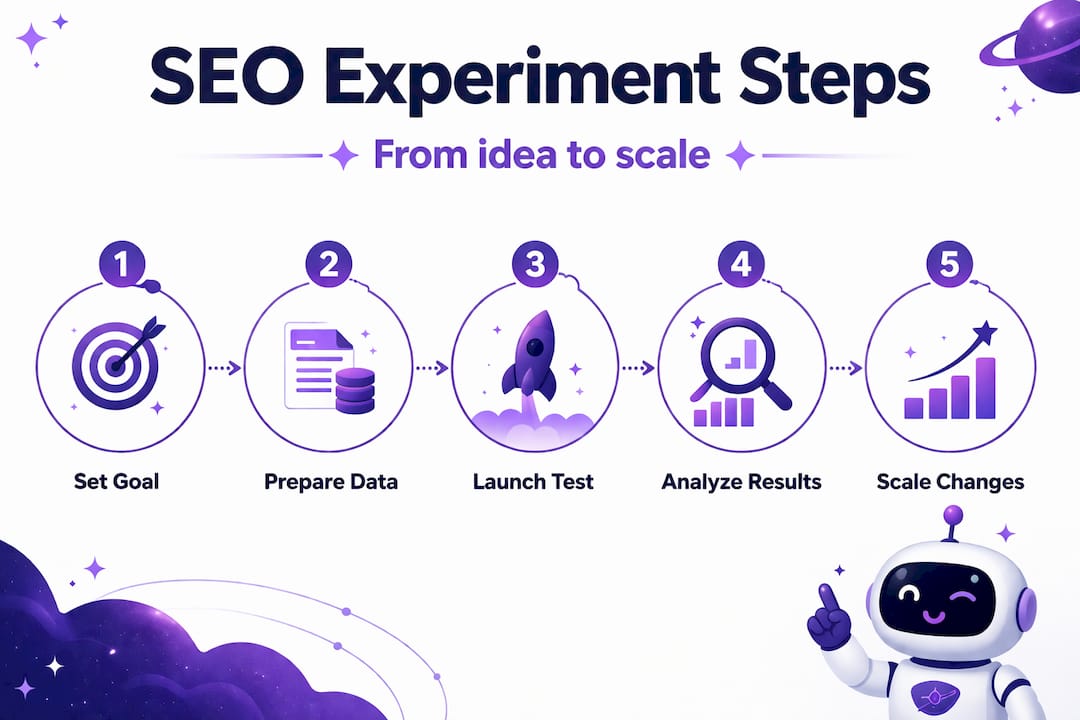
The measurement phase is where most teams make critical errors. They either look at data too early, before search engines have fully processed the change, or they track vanity metrics that don’t connect to business outcomes. Focus on what matters.
Primary metrics to track:
- Organic traffic (sessions and users from non-paid search)
- Click-through rate (CTR) for target keywords in Google Search Console
- Average position for test page rankings
- Conversions attributed to organic traffic (leads, purchases, signups)
- Impressions as a leading indicator of indexing and visibility shifts
Checking latest SEO notes and industry updates during your measurement window is important. If Google rolls out a core algorithm update mid-experiment, your results may reflect the algorithm change rather than your test variable. Document the dates of any known updates and adjust your analysis accordingly.
Control groups are your best tool for isolating causation. If your test pages see a 20% traffic increase but your control pages see a 15% increase during the same period, the true lift from your experiment is closer to 5%, not 20%. This distinction is critical for presenting honest results to leadership.
Common measurement pitfalls to avoid:
- Ending the test too early because early results look promising
- Ignoring control group performance when calculating lift
- Mixing multiple changes and attributing all results to one variable
- Using too small a sample size to draw statistically meaningful conclusions
- Failing to account for algorithm updates or major news events in your niche
Once you have a confirmed winner, scaling is straightforward. Apply the winning change to all similar pages across the site, monitor the rollout using August SEO updates as a benchmark for industry conditions, and re-establish baselines for your next experiment. SEO improvement compounds over time. Each successful experiment builds on the last.
Troubleshooting and common mistakes in SEO experimentation
Even with careful planning, things can go wrong. Let’s troubleshoot the most common problems so you can navigate them like a pro.
Inconclusive results are frustrating but common. They don’t mean the experiment failed. They mean the signal was too weak to detect clearly. Before scrapping a test, ask whether you ran it long enough, whether the test pages had sufficient traffic, and whether any external factors, such as a competitor’s content push or a seasonal demand shift, may have influenced results.
Algorithm updates mid-experiment are one of the hardest challenges to manage. When Google rolls out a broad digital marketing trends related update during your test window, the safest approach is to pause the experiment, document the update date, and resume once rankings stabilize. Attempting to analyze results through an algorithm disruption produces unreliable data.
Common mistakes and how to fix them:
- Testing too many variables at once: Revert to single-variable testing. Accept that fewer experiments done cleanly beat more experiments done messily.
- Ignoring data from the control group: Always compare test page performance against the control group, not just against historical data.
- Short test windows: Commit to at minimum four weeks, preferably six to eight, before drawing conclusions.
- No change log: If you can’t identify exactly when a change was made, you can’t attribute results to it. Log every change with a timestamp.
- Seasonality bias: Run tests during stable demand periods. Avoid launching during major holidays, product launches, or industry events.
- Reacting to week-one data: Search engines take time to process changes. The first week of data almost always overstates or understates the actual impact.
Pro Tip: Always run single-variable tests and document every change with a date and description. This documentation becomes your most valuable asset when diagnosing unexpected ranking shifts, not just during active tests but months later.
One often-overlooked issue is data pollution from internal sources, such as a sudden spike in paid traffic that inflates overall session counts and muddies organic metrics. Keep your organic and paid data segments completely separate throughout the experiment window.
Our take: What most guides get wrong about SEO experiments
Most articles on SEO experimentation present the process as cleaner than it actually is. They describe controlled conditions, clean control groups, and neat before-and-after comparisons. Real websites don’t work that way. Real websites have messy traffic patterns, overlapping marketing campaigns, development queues that don’t pause for SEO tests, and algorithm updates that arrive without warning.
The uncomfortable truth is that perfect SEO experiments rarely exist outside of large enterprise teams with dedicated testing infrastructure. For most businesses, you are working with imperfect conditions, and that is completely fine. An imperfect but well-measured experiment still produces better decisions than no experiment at all. The goal is not scientific perfection. The goal is directional clarity.
What we consistently see in practice, after running hundreds of SEO campaigns, is that teams who embrace adapting SEO for business conditions with flexibility make faster progress than teams who wait for ideal conditions. The businesses that grow their organic channels most consistently are the ones running small, frequent experiments rather than big, infrequent ones. They iterate, document, and build institutional knowledge over time.
The other major gap in standard SEO experiment guides is the human element. Getting organizational buy-in for testing is often harder than running the test itself. Developers need to hold their release schedule. Content teams need to avoid editing test pages. Marketing needs to flag upcoming campaigns that could affect traffic. The technical process is the easy part. Building a culture where experimentation is the norm, where people understand that a failed test is still a win because it generates data, is the real challenge. Start small, document your wins loudly, and build from there.
How Monstrous Media Group can boost your SEO experimentation
Running structured SEO experiments requires expertise, the right tools, and a disciplined process that most in-house teams are still building. At Monstrous Media Group, we design, execute, and scale SEO experiments as part of a broader growth system built to produce real outcomes, not activity reports.

Our SEO services are built around measurable performance, meaning every test we run is tied to traffic, conversions, and revenue, not just rankings. We integrate SEO experimentation with your full digital marketing solutions stack, ensuring that your paid, organic, and content channels reinforce each other rather than compete. If you’re ready to stop guessing and start building a data-driven SEO engine, let’s talk. We’ll help you set up the infrastructure, run the tests, and scale what actually works.
Frequently asked questions
How long should an SEO experiment run for reliable results?
Most SEO experiments require at least four to eight weeks to filter out noise and observe measurable changes in rankings, CTR, and organic traffic.
Can you run multiple SEO experiments at the same time?
You can run concurrent experiments, but never on the same URLs. Overlapping tests on shared pages create data pollution that makes it impossible to attribute results accurately.
What are the best metrics to track for SEO tests?
Track organic traffic, click-through rate, and conversions as your primary success indicators, with average position and impressions serving as supporting signals.
Is it necessary to use paid tools to run SEO experiments?
Paid tools make experiment tracking significantly easier and more reliable, but you can begin with Google Search Console, Google Analytics 4, and a structured spreadsheet for manual tracking until you’re ready to invest in dedicated platforms.
Recommended
- Navigating the Evolving Landscape of SEO: Adapting to Recent Changes for Business Success
- PPC Advertising for Long-Term Business Growth
- Leveraging PPC Advertising for Long-Term Business Growth | Monstrous Media Group LLC
- Search Engine Optimization (SEO) | SEO Services in Omaha. NE
- Waarom clicks niet leiden tot aankopen: tips voor KMO’s
Hire the team to help you with your website, app, or other marketing needs.
We have a team of digital marketers who can help plan and bring to life all your digital marketing strategies. They can help with social media marketing, email marketing, and digital advertising!
CONTACT US
Comments