
Recruitment marketing strategy is the discipline of applying marketing systems, content, and channel logic to attract, nurture, and convert talent before and during the hiring process. Done right, it builds a predictable, higher-quality candidate pipeline that cuts time-to-hire and lowers cost-per-qualified-hire. Done as a series of disconnected job posts and career fair sponsorships, it produces exactly what most companies have today: a leaky funnel nobody can explain.
The single first move, before you touch a budget or a channel plan, is this: pick one role and define its candidate profile and role-specific Employee Value Proposition (EVP). Not a generic “great culture, great benefits” pitch. A specific answer to why a senior backend engineer or an enterprise account executive should choose you over three other open offers this week.
That first step forces clarity on everything downstream:
- Which channels that persona actually uses to research employers
- What content answers their real objections (comp transparency, remote flexibility, growth path)
- What a “qualified” applicant looks like for that role, so you can measure quality instead of volume
Everything else in this guide builds outward from that one decision.
Key Takeaways
A recruitment marketing strategy succeeds when role-specific EVPs, mapped content, and ATS-integrated measurement work together as one system rather than as separate initiatives run in isolation.
| Point | Details |
|---|---|
| Start with one persona and EVP | Define a single role-specific candidate profile and EVP before building any campaign. |
| Measure quality, not volume | Track cost-per-qualified-application and offer-acceptance rate instead of raw applicant counts. |
| Integrate ATS before scaling | Confirm campaign source data flows into your ATS so hires can be traced back to specific channels. |
| Pilot before you roll out company-wide | Run a four-to-six-week inbound and outbound pilot with a documented baseline before expanding. |
| Monstrousmediagroup builds the connected system | Monstrousmediagroup pairs a funnel audit with a pilot campaign and a live attribution dashboard tying spend to hires. |
Table of Contents
- What Is Recruitment Marketing Strategy and Why It Moves Hiring Numbers
- What Are the Six Foundations of a Recruitment Marketing Strategy?
- How Do You Build a Recruitment Marketing Strategy Step by Step?
- What Content and Channels Work Best for Recruitment Campaigns?
- Where Do Candidates Drop Off in the Hiring Funnel?
- How Do You Measure Recruitment Marketing ROI?
- What Technology Stack Supports Recruitment Marketing?
- How Long Does It Take to Build a Recruitment Marketing Program?
- What Does Monstrous Media Group’s Recruitment Marketing Work Look Like?
- How Should You Position Your Employer Brand Against Competitors?
- Who Needs to Be Involved in Recruitment Marketing Decisions?
- What Are the Compliance Risks in Recruitment Marketing?
- What Do Successful Recruitment Marketing Programs Look Like in Practice?
- How Do You Keep Improving a Recruitment Marketing Strategy?
- Recruitment Marketing Is Infrastructure, Not a Campaign Calendar
- How Monstrous Media Group Turns This Strategy Into a Working System
- Sources
What Is Recruitment Marketing Strategy and Why It Moves Hiring Numbers
Recruitment marketing is the practice of using marketing strategies and tools to promote the value of working for an employer, aimed specifically at attracting, engaging, and retaining talent through content and messaging that reaches passive candidates who aren’t actively browsing job boards. Traditional recruiting waits for applicants to show up. Recruitment marketing goes and finds them, months before a requisition even opens.
The practical difference shows up in what gets measured. Traditional recruiting tracks job posts and application counts. Recruitment marketing tracks content performance, message resonance, and channel attribution, the same way a demand-generation team tracks a buyer’s journey from first touch to closed deal. That shift matters because volume metrics lie. A job post that gets 400 applicants and zero qualified candidates is a worse outcome than one that gets 40 applicants and five hires.
Why this moves the numbers leadership actually cares about:
- Structured recruitment marketing programs report measurable gains in candidate quality and pipeline resilience, meaning fewer emergency reqs and less scrambling when a key hire falls through late in the process.
- Employer brand signals affect response rates directly. Candidates research employers before responding to outreach, and a well-managed employer brand converts more of that passive outreach into real conversations.
- Cost-per-qualified-application, not cost-per-application, becomes the metric that ties recruiting spend to business outcomes leadership will actually fund.
The companies still stuck on cost-per-click and applicant volume are optimizing for the wrong variable. The ones pulling ahead are optimizing for quality-of-hire and time-to-fill for hard roles, and they can prove it with data.
What Are the Six Foundations of a Recruitment Marketing Strategy?
Every durable program rests on six foundations. Skip one and the whole structure gets wobbly, usually in a way that doesn’t show up until three months in when nobody can explain why a campaign generated applicants but no hires.
- Target talent profiles. Segment by role family, seniority, and decision drivers, not just job title. A junior nurse and a nurse manager respond to entirely different messages, even though both technically work in “healthcare.” Build three to five profiles maximum to start; more than that and your content team can’t keep pace.
- Role-specific EVP. A generic company-wide EVP undersells specialized roles and oversells entry-level ones. A role-specific EVP increases response rates for outbound sourcing and improves conversion in nurture sequences, because it answers the actual question the candidate is asking: “what’s different about this job, here, right now.”
- Content strategy. Map content types to funnel stage, not just to whatever your marketing team already produces for customers. Culture stories build awareness; role-specific deep dives drive application intent.
- Channel strategy. Owned channels (career site, employee content, email) compound over time. Paid channels (programmatic job ads, sponsored LinkedIn posts) buy speed but stop producing the moment spend stops. Most teams need both, weighted by how urgent the req is.
- Candidate journey mapping. This is the organizing artifact for the entire strategy. It forces you to define what happens at every stage, from first exposure to accepted offer, and what content or action moves someone to the next stage.
- Measurement and ATS integration. Without this, none of the above is provable. This full six-foundation framework only works if awareness, engagement, pipeline, and quality metrics feed back from your applicant tracking system, not a separate spreadsheet nobody updates.
A useful internal exercise: for each open req in the next quarter, write down which of these six foundations is genuinely missing. Most teams find it’s not the content or the channels. It’s the measurement loop.
How Do You Build a Recruitment Marketing Strategy Step by Step?
Building this correctly follows a sequence. Skipping ahead to campaigns before the audit and goal-setting phases is the most common reason recruitment marketing programs stall after an initial burst of activity.
- Audit what exists. Pull your career site analytics, current Glassdoor and LinkedIn ratings, a full inventory of existing content (job descriptions, employee videos, blog posts), and your ATS’s current source-of-hire data. Most audits turn up more usable content than teams expect, just scattered and unmeasured.
- Set measurable goals with baselines. Define target KPIs before you launch anything: current cost-per-qualified-application, current time-to-fill by role family, current offer-acceptance rate. Without a baseline, you can’t prove lift later.
- Run the persona and EVP workshop. Pull hiring managers, recent hires, and current high performers into a working session for your priority roles. The output should be a one-page profile and EVP statement per role family, not a 40-slide deck nobody references again.
- Design a pilot campaign, both directions. A practical pilot pairs a four to six week outbound push (targeted sourcing, sponsored content) with linked inbound assets (a landing page, a nurture email sequence) and full ATS tracking, so you can measure lift in response rate and apply rate against your baseline.
- Integrate before you scale. Confirm campaign UTMs flow into your analytics platform, and that analytics data ties to ATS source fields. This is the step most teams skip, and it’s the reason six months later nobody can say which channel actually produced hires.
- Iterate on real data. Kill underperforming channels fast. Double down on what’s converting. Rebuild the persona if the pilot reveals your assumptions about the candidate were wrong, which happens more often than teams expect.
Deliverables checklist for this phase:
- Audit report with current-state metrics
- One-page persona and EVP document per priority role family
- Pilot campaign brief with defined success criteria
- ATS/analytics integration confirmed and tested before launch
This sequence takes real coordination, and it’s where fixing a recruitment funnel with the right digital infrastructure, rather than another point solution, tends to pay off fastest.
What Content and Channels Work Best for Recruitment Campaigns?
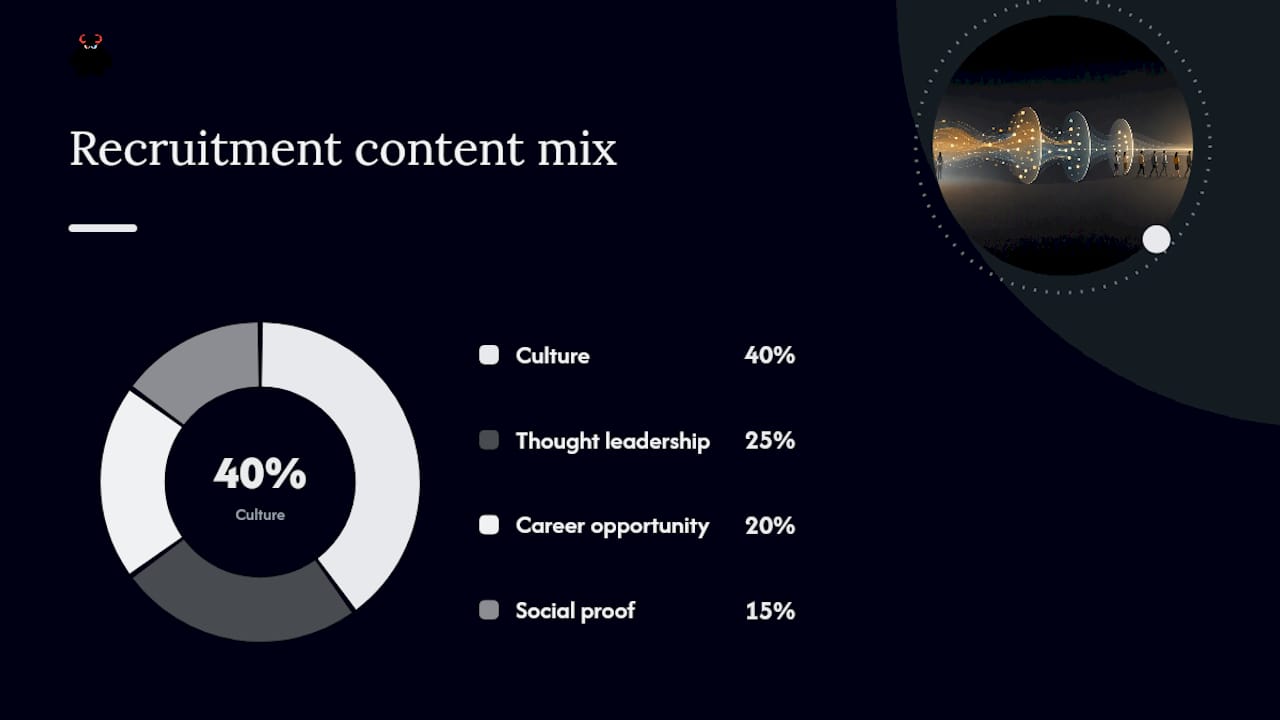
Content mix is not a matter of taste. A widely used and effective baseline splits content roughly 40% culture, 25% thought leadership, 20% career opportunity, and 15% social proof. Culture content earns attention from passive candidates who aren’t job hunting yet. Thought leadership builds credibility with senior candidates who research before they’ll even take a call. Career-opportunity content, the actual job postings and role deep dives, is the conversion layer. Social proof, employee testimonials and Glassdoor signals, closes the trust gap right before someone applies.
Channel mapping should follow the persona, not the budget cycle:
- Engineering roles: technical blogs, GitHub presence, developer-focused LinkedIn content, niche job boards over broad ones
- Sales roles: LinkedIn thought leadership from current sales leaders, referral incentive programs, targeted outbound sourcing
- Operations roles: local job boards, community partnerships, career site SEO optimized for location-based search terms
Career site basics get overlooked constantly. Job pages should be indexed for search (structured data helps here), and the apply process should take under five minutes on mobile. Every extra form field between a candidate and “submit” costs you applicants who never come back.
Pro Tip: Programmatic paid channels work well for high-volume, lower-specialization roles where speed matters more than message precision. Targeted paid channels, LinkedIn sponsored content, niche communities, work better for senior and specialized roles where the wrong applicant volume actually hurts your recruiter’s time more than it helps.
A content strategy built around genuine brand identity rather than generic stock messaging tends to outperform on engagement, particularly with passive candidates who’ve seen a hundred nearly identical “join our team” posts already.
Where Do Candidates Drop Off in the Hiring Funnel?
The candidate journey runs from awareness through application, interview, offer, hire, and onboarding, and every one of those stage transitions is a place candidates can quietly disappear. Awareness content (culture posts, thought leadership) should push toward the career site. The career site should push toward a fast, mobile-first application. The application should trigger a response within a defined service-level window, not a two-week black hole.
The most common drop-off points, in order of how often they show up in funnel audits:
- Application abandonment. Long forms, required account creation, and duplicate data entry (resume upload followed by manually retyping the same resume) kill completion rates.
- Silence after applying. Candidates who hear nothing for two or three weeks assume rejection and stop being available when you finally call.
- Interview scheduling friction. Manual back-and-forth email scheduling loses candidates who have three other interviews already scheduled elsewhere.
- Offer-stage hesitation. Weak employer brand signals discovered late (bad Glassdoor reviews found the night before signing) can unravel an accepted verbal offer.
Fixes are mostly operational, not creative. Reduce apply time to under five minutes. Add a chatbot or auto-responder confirming receipt within minutes, not days. Set and enforce a recruiter response SLA, 48 hours is a common standard. Track stage-by-stage conversion rate as a core metric, not just top-of-funnel volume, so you know exactly where candidates are actually leaving.
How Do You Measure Recruitment Marketing ROI?
Recruitment marketing has to be measured across five KPI tiers: awareness (career site traffic, content reach), engagement (time on page, content shares, email open rates), pipeline (applications, qualified applications, interview-to-offer ratio), quality (offer-acceptance rate, 90-day retention, hiring manager satisfaction scores), and efficiency (cost-per-qualified-application, time-to-fill).
Cost-per-qualified-application, not raw cost-per-application, is the number that should anchor budget conversations with finance. Calculate it by dividing total campaign spend by the count of applications that actually meet your defined “qualified” bar, not total applications received. A campaign producing 200 applicants at $12 each looks cheap until you learn only eight were qualified, at which point the real cost is $300 per qualified applicant.
The reporting framework that holds up under leadership scrutiny:
- Track impression-to-application rate by channel to see where content is converting versus just generating views.
- Build multi-touch attribution at a basic level first, first-touch and last-touch source fields in your ATS, before attempting anything more sophisticated.
- Report on a monthly cadence for pipeline health, quarterly for quality and ROI, since quality metrics like retention need time to mature.
Many teams still fail to close this loop; measurement rarely connects campaign spend directly to the value of resulting hires, which is exactly the gap that makes recruiting budgets vulnerable in the next planning cycle. The team that can show a dashboard tying a specific campaign to five hires with strong 90-day retention wins the next budget conversation without having to argue for it.
What Technology Stack Supports Recruitment Marketing?
A functioning stack has five layers: a career site or CMS that supports fast content publishing, a recruitment marketing platform for campaign and content management, marketing automation for nurture sequences, an ATS as the system of record for hires, and analytics tying it all together. Missing any one layer creates a manual workaround that eventually breaks under volume.
The data flow that matters: a campaign generates a click, analytics captures the source, the candidate applies through the career site, the ATS records that application with the source tag intact, and the hire event closes the loop back to the original campaign. Break that chain anywhere and attribution collapses into guesswork.
Where automation earns its place:
- Nurture sequences for passive candidates who engaged but haven’t applied, triggered by content downloads or email signups
- Lead scoring that flags high-fit candidates for recruiter outreach before they even apply
- Programmatic spend optimization that shifts budget toward channels producing qualified applicants, not just clicks
AI and automation are increasingly used to predict candidate behavior and personalize content at scale, but that only works safely with governance in place: clear consent language for data collection, regular bias testing on any scoring model, and an audit trail for every automated decision that touches a real candidate. A marketing automation setup built with those guardrails from day one avoids the compliance scramble that hits teams who bolt on automation after the fact.
How Long Does It Take to Build a Recruitment Marketing Program?
A realistic build follows a 90/180/360-day arc, not a big-bang launch.
- Days 1 to 90: Complete the audit, define one or two priority personas and EVPs, launch a single pilot campaign, and confirm basic ATS/analytics integration. Acceptance criteria: baseline metrics documented, one measurable pilot completed with a clear win/loss read.
- Days 90 to 180: Build out the content library across the priority personas, automate at least one nurture sequence, and confirm full ATS sync across all active campaigns. Acceptance criteria: multi-touch source data flowing cleanly, content production cadence established.
- Days 180 to 360: Stand up full-funnel dashboards reporting on all five KPI tiers, and shift from campaign-by-campaign thinking to a sustained employer brand program with ongoing content production.
Budget allocation scales with role complexity more than headcount. Companies hiring mostly high-volume, lower-specialization roles can lean on programmatic spend and lighter content investment. Companies competing for scarce specialized talent need heavier investment in owned content and employer brand, since paid spend alone won’t close credibility gaps with senior candidates who research extensively before responding.
What Does Monstrous Media Group’s Recruitment Marketing Work Look Like?
Monstrousmediagroup approaches recruitment marketing the way it approaches every revenue system: as infrastructure that either protects pipeline or leaks it. That’s the same lens applied to lead-generation funnels for clients across industries, and hiring funnels behave more like sales funnels than most HR teams assume, with drop-off points, attribution gaps, and measurable leaks.
The most common fix isn’t a new channel or a bigger budget. It’s closing the gap between where a campaign spends money and where the ATS actually records a hire. Most teams have never seen that connection made visible, because nobody built the integration to show it to them.
That operational lens, treating a hiring funnel as a system with measurable inputs and outputs rather than a series of unrelated tactics, is what separates a recruitment marketing program that scales from one that produces a brief spike in applicants and then quietly reverts to baseline three months later.
How Should You Position Your Employer Brand Against Competitors?
Competitive positioning starts with an honest audit of what candidates see when they research your company against the two or three employers actually competing for the same talent pool. Pull Glassdoor ratings, LinkedIn follower engagement, and current job posting language for direct competitors, not aspirational ones. Most teams benchmark against companies far larger than their actual talent competition and miss the real fight happening one tier down.
Employer brand positioning works best when it’s built on a genuine differentiator, not a copy of whatever the market leader says. If a competitor owns “innovation” in candidate messaging, competing on the same word is a losing bet. Compensation transparency, actual flexibility (not “flexible” as a euphemism for unlimited availability), or a faster, less bureaucratic interview process are differentiators candidates notice and remember, because most companies still get these basics wrong.
Response rates to proactive outreach hinge heavily on this positioning work. A well-managed employer brand converts more passive outreach into real conversations, and candidates typically form that first impression within minutes of researching a company, long before a recruiter’s message ever lands in their inbox. That means your Glassdoor presence, your careers page, and your LinkedIn activity are doing positioning work whether you’ve planned for it or not.
Run this competitive audit quarterly, not once. Talent markets shift fast, particularly for specialized roles, and an EVP that differentiated you eighteen months ago may now just be table stakes across the entire competitive set.
Who Needs to Be Involved in Recruitment Marketing Decisions?
Recruitment marketing fails more often from misalignment than from bad strategy. Talent acquisition, marketing, HR leadership, and hiring managers all touch this program, and each one optimizes for something slightly different if nobody sets shared goals upfront.

Marketing teams tend to think in campaign cycles and brand consistency. Talent acquisition thinks in requisitions and time-to-fill. Hiring managers care almost exclusively about whether the candidates showing up can actually do the job. None of those priorities are wrong, but left unreconciled they produce content that looks great and converts nobody, or campaigns that generate volume hiring managers immediately reject.
The fix is a shared KPI set, agreed before campaigns launch, not negotiated after a disappointing quarterly review. Put marketing, TA, and at least one hiring manager per priority role family in the same planning conversation, and hold everyone accountable to the same pipeline and quality metrics rather than separate scorecards.
Practical alignment mechanisms that work:
- A monthly cross-functional review of pipeline metrics, not just a TA-only meeting
- Hiring managers reviewing and approving role-specific EVP language before it goes into campaigns
- A single shared dashboard, not three separate reports that each tell a slightly different story
Finance also belongs in this loop earlier than most teams include them. A recruitment marketing budget defended with cost-per-qualified-application data, rather than headcount requests alone, survives budget season far more often.
What Are the Compliance Risks in Recruitment Marketing?
Recruitment marketing touches employment law and data privacy in ways generic brand marketing doesn’t. Job advertising language is subject to anti-discrimination regulation, meaning content and targeting choices, not just the job description text itself, can create legal exposure if candidate segmentation drifts toward protected-class proxies.
Targeted advertising is where this risk concentrates most. Programmatic and social platform targeting that narrows an audience by age, gender, or location in ways that correlate with protected characteristics can violate equal employment opportunity principles, even when no one intended discriminatory targeting. Review targeting parameters on every paid campaign with the same scrutiny applied to job description language.
Candidate data handling carries its own obligations. Nurture sequences, lead scoring, and any AI-assisted candidate screening require clear consent language, defined data retention limits, and a documented process for candidates who want their data removed. Regular bias audits on any automated scoring model matter here too, since a model trained on historical hiring data can quietly reproduce past bias at scale if nobody checks.
Baseline compliance checklist worth reviewing quarterly:
- Ad targeting parameters reviewed for indirect protected-class correlation
- Consent language current for all data collection points (forms, chatbots, nurture signups)
- Any automated scoring or AI screening tool audited for disparate impact
- Data retention and deletion policy documented and followed, not just written
None of this should read as a reason to avoid automation or targeted advertising. It’s a reason to govern them deliberately, with the same rigor applied to financial reporting, rather than treating recruitment marketing as a lower-stakes category of marketing where those standards don’t apply.
What Do Successful Recruitment Marketing Programs Look Like in Practice?
The pattern across successful programs isn’t a bigger budget. It’s tighter integration between content, channel targeting, and ATS attribution, run as a repeatable cycle rather than a one-off campaign.
A common structure that works: a company facing high turnover on a specific role family builds a role-specific EVP after interviewing current top performers in that role, then pairs a short outbound sourcing pilot with inbound content (a landing page, employee testimonial video, targeted email sequence) and tracks the pilot’s response and apply rate against a documented baseline. Programs following this inbound-outbound pairing with linked ATS tracking consistently show measurable lift over baseline sourcing methods, because the comparison is apples to apples rather than a vague “it felt more effective” impression.
The best practice pattern that shows up repeatedly:
- Start with one role family, not a company-wide rollout, to keep the pilot measurable and fast to iterate
- Pair inbound content with an active outbound push rather than running either in isolation
- Build the ATS tracking before launch, not as a retrofit after the campaign is already live
- Treat the first pilot as a learning exercise, expect to revise the persona or EVP based on what the data actually shows
The programs that stall tend to share the opposite pattern: broad rollout across every role at once, content produced without a channel plan, and attribution added as an afterthought once someone in finance asks for proof of ROI.
How Do You Keep Improving a Recruitment Marketing Strategy?
Recruitment marketing strategy isn’t a project with an end date. It’s a system that needs continuous testing, the same discipline applied to any paid acquisition channel in consumer marketing.
A/B testing belongs on nearly every element: subject lines in nurture sequences, landing page headline variants, apply-button placement and copy, and even EVP framing across different candidate segments. Test one variable at a time and let each test run long enough to reach a real sample size before drawing conclusions, particularly for lower-volume specialized roles where it takes longer to accumulate meaningful data.
Optimization priorities should follow the funnel stage with the worst conversion rate, not whichever stage is easiest to test. If awareness content is thriving but application completion is weak, testing new culture content is wasted effort; the fix belongs on the apply form itself.
A sustainable optimization cadence:
- Review stage-by-stage conversion data monthly, and flag the single worst-performing stage for testing that cycle
- Run one meaningful test per funnel stage per quarter rather than scattering small tweaks everywhere at once
- Retire underperforming content and channels on a set schedule instead of letting them run indefinitely out of habit
- Revisit personas and EVPs at least annually, since talent market conditions and competitor positioning shift faster than most teams expect
Programs that treat this as ongoing infrastructure, with a standing review cadence and a backlog of tests, consistently outperform the ones that build a strategy once and revisit it only when hiring volume drops off a cliff.
Recruitment Marketing Is Infrastructure, Not a Campaign Calendar
Recruitment marketing works when you treat it the same way you’d treat any revenue system: something that needs monitoring, integration, and deliberate maintenance, not a seasonal campaign you launch and forget. The teams getting real lift aren’t the ones with the biggest content budgets. They’re the ones who built the plumbing, ATS integration, attribution, a shared dashboard, before they scaled spend.
Prioritize small, testable pilots over sweeping rollouts. A four-to-six-week pilot with clear baseline metrics tells you more than a company-wide campaign launched on faith. And measurement has to come before scale, not after; a program that can’t attribute a single hire to a specific channel isn’t ready for a bigger budget, no matter how good the content looks.
The practitioner’s shortcut worth remembering: if you can’t currently trace one real hire back to the campaign that sourced them, fix that connection before you fix anything else.
- Vector
How Monstrous Media Group Turns This Strategy Into a Working System
Everything in this guide, personas, EVPs, content, channel mapping, ATS integration, measurement, needs an execution partner who treats it as connected infrastructure rather than a stack of separate vendor contracts. That’s the gap Monstrousmediagroup closes: recruitment marketing built as a revenue-protection system, not a rotating set of disconnected tactics that leak candidates at every stage transition.

An initial engagement typically starts with a funnel audit, the same audit outlined earlier in this guide, mapped against your current career site, ATS setup, and content inventory. From there, Monstrousmediagroup designs a pilot campaign paired with a working dashboard that ties spend directly to pipeline and quality metrics, so leadership sees proof, not projections, before committing to scale.
That work draws on recruitment marketing services built specifically for this kind of funnel repair, backed by marketing automation for candidate nurture sequences and SEO and AEO visibility systems that make sure your career content actually surfaces where passive candidates are searching. If your hiring funnel is producing applicants but not the right hires, reach out to Monstrousmediagroup to scope a funnel audit and pilot campaign built around your specific priority roles.
Sources
- What is Recruitment Marketing? - Rally
- Noon
- Employer branding strategy: The complete 2026 guide - Talentprise