
Programmatic job ads use automated bidding and machine learning to distribute job postings across boards, aggregators, and social channels, then continuously shift budget toward the sources that actually produce applicants and hires rather than clicks. The verdict: this is the right tool for high-volume, multi-location, or hard-to-fill roles where manual posting can’t keep pace with demand. It’s the wrong tool if your career site is broken or your job feed is a mess, because programmatic will just spend money finding that out faster.
Recruiting teams considering the switch from flat-fee postings should expect a specific set of outcomes, not vague “efficiency” gains:
- Lower cost-per-apply and cost-per-hire as the bidding engine learns which sources convert
- Faster scale across dozens or hundreds of open requisitions without adding recruiter headcount
- Less manual job-board management, since the platform reallocates spend automatically instead of you logging into five different portals
Enterprise adoption of this model still sits in the low-to-mid 30% range, which means most talent acquisition teams are still posting manually and paying flat fees for underperforming placements.
Key Takeaways
Programmatic job ads work when feed hygiene, career-site conversion, and cost-per-hire measurement are fixed before spend begins, not after.
| Point | Details |
|---|---|
| Definition and mechanics | Programmatic automates distribution and shifts budget toward channels producing applicants and hires, not clicks. |
| Expected cost improvements | Switching from flat-fee postings commonly cuts cost-per-apply in the mid-20s to 30% range over 30–60 days. |
| Fix the foundation first | Audit job feed fields and career-site conversion before evaluating any platform. |
| Budget with discipline | Apply a 70/20/10 split across proven, test, and experimental channels with job-level CPA caps. |
| Build it as a system | Monstrousmediagroup pairs programmatic display with feed hygiene and private analytics to protect hiring budgets end to end. |
Table of Contents
- How Does Programmatic Job Advertising Actually Work?
- What Results Should You Expect From Programmatic Recruitment Advertising?
- What Do You Need Before Buying a Programmatic Platform?
- How Should You Budget a Programmatic Job Ad Campaign?
- Which KPIs Actually Prove Programmatic Is Working?
- What Are the Most Common Programmatic Job Ad Mistakes?
- What Does a 60-Day Programmatic Launch Look Like?
- Monstrous Media Group: Embedding Programmatic Into Recruitment Systems
- What Privacy Rules Apply to Programmatic Job Ads?
- How Do You Target and Segment Programmatic Job Ad Audiences?
- How Do You Optimize Job Ad Creative Dynamically?
- How Does Programmatic Fit Into a Broader Recruitment Marketing Strategy?
- Where Is Programmatic Recruitment Advertising Headed?
- What Should Recruiting Teams Prioritize First?
- Turn Programmatic Spend Into a Protected Revenue System
- Sources
How Does Programmatic Job Advertising Actually Work?
Programmatic recruitment advertising runs on a loop, not a single action. Understanding that loop matters more than knowing any vendor’s dashboard, because every platform on the market runs some version of it.
- Feed ingestion. Your applicant tracking system (ATS) exports an XML or JSON feed of open jobs. Standard fields (title, location, salary, employment type, category) get read by the platform’s matching engine.
- Rules and bidding. You (or the platform) set rules: maximum cost-per-apply, minimum applicant volume, priority roles. A bidding engine then decides, in real time, how much to pay for placement on each channel.
- Distribution. The system pushes listings to job aggregators, niche boards, programmatic display inventory, and social remarketing pools, often simultaneously.
- Measurement to apply. This is the part most recruiters miss. The platform doesn’t just count clicks. It tracks whether a click on Indeed or a niche nursing board actually completed an application on your career site.
- Reallocation. Budget shifts away from channels producing cheap clicks and toward channels producing completed applications, and ideally, hires.
That mechanism borrows directly from broader ad-tech: demand-side platforms and real-time bidding auctions decide placement in milliseconds, the same infrastructure that powers programmatic display advertising outside of recruiting.
Statistic to know: the fundamental shift here is moving from paying for space to paying for outcomes. Traditional job boards charge a flat fee whether you get 3 applicants or 300. Programmatic buys are priced on cost-per-click or cost-per-apply, which forces the platform to keep optimizing instead of collecting a fee and walking away.
What Results Should You Expect From Programmatic Recruitment Advertising?
The business case for programmatic job advertising rests on a specific, measurable claim: recruiters switching from flat-fee postings commonly see cost-per-apply drops in the mid-20s to 30% range, with the bulk of that improvement showing up over the first 30 to 60 days as the algorithm learns which sources actually convert.
That number matters more in certain hiring contexts than others. Programmatic delivers the strongest return in:
- High-volume retail and seasonal hiring, where you need hundreds of applicants fast and manual board management can’t scale.
- Multi-site operations, where the same role needs to run across dozens of locations with different labor markets and different competitive pressure.
- Niche and specialist roles, where standard job boards underperform and the platform’s ability to test display and social channels finds pools a recruiter wouldn’t think to check.
Programmatic will not fix a bad job description, and it will not fix a career site that loses candidates at the apply button. It amplifies whatever you already have. It doesn’t rewrite the funnel for you.
One underrated benefit: programmatic lets you test new channels without signing a long-term contract. Instead of committing to a year on a niche board that might not perform, you can allocate a small test budget, measure applies and hires, and cut it loose in weeks if the numbers don’t hold up.
What Do You Need Before Buying a Programmatic Platform?
Programmatic is a scaling tool, not a repair tool. Buying a platform before your foundation is solid is the single most common way recruiting teams waste budget in year one.
Start with the job feed itself. Titles, locations, salary ranges, and job type fields all need to be clean and standardized, because the bidding engine matches on those fields, and inconsistent data leads directly to misclassified listings and wasted spend.
Run through this checklist before signing anything:
- Audit every job feed field for consistency: title formatting, location granularity, salary ranges present and not blank, employment type tagged correctly
- Test how your feed actually parses when pulled into a sample platform, not just how it looks in your ATS
- Check your career site’s apply funnel on mobile specifically, since a large share of programmatic-driven traffic arrives on phones
- Map source-of-hire tracking in your ATS and build a UTM naming convention before launch, not after
- Decide who owns recruitment analytics internally: recruiting, marketing, or a shared function, before data starts flowing in
A broken career-site conversion funnel is the most expensive mistake in this list, because it’s invisible in the ad platform’s own reporting. The platform sees clicks. It doesn’t see the candidate who abandoned your application form on page three.
Pro Tip: Run a test batch of 10 applications through your own career site on a mobile device before you launch any programmatic campaign. If you can’t finish an application in under three minutes, your candidates can’t either.
How Should You Budget a Programmatic Job Ad Campaign?
A workable heuristic, borrowed from broader performance-marketing budget frameworks and adapted for recruitment advertising, is the 70/20/10 split:
- 70% to proven channels that already show reliable cost-per-apply performance for your roles and locations.
- 20% to programmatic tests on new channels, audiences, or job categories you haven’t validated yet.
- 10% to experimental spend, things like new display placements or social remarketing pools you’re not confident in but want data on.
Set cost-per-apply or cost-per-hire caps at the job level, not the campaign level. A software engineering role and a warehouse associate role should never share a CPA ceiling, because their labor markets behave completely differently.
Ramp expectations matter too. Expect clicks and early cost-per-click signals within the first week. Meaningful cost-per-apply and cost-per-hire improvement takes longer, typically 30 to 60 days as the bidding engine accumulates enough data to optimize confidently.
| Hiring Volume | Monthly Budget Range | Typical Focus |
|---|---|---|
| Small (5–20 open roles) | Entry-level programmatic spend | Single high-priority role types, tight CPA caps |
| Mid (20–100 open roles) | Moderate spend across multiple job families | Multi-location testing, source-of-hire tracking |
| Enterprise (100 open roles or more) | Substantial spend across the full 70/20/10 split | Full channel diversification, dedicated pacing rules per job category |
Exact dollar figures vary too widely by industry and market to state as a fixed table, but the allocation logic holds regardless of scale: protect what works, test deliberately, and never let experimental spend exceed 10% of the total.
Which KPIs Actually Prove Programmatic Is Working?
Clicks and impressions tell you almost nothing about whether programmatic job advertising is doing its job. The metrics that matter are the ones tied to the hiring funnel itself:
- Cost-per-apply (CPA): what you pay for each completed application, tracked per channel and per job
- Cost-per-hire (CPH): the ultimate efficiency metric, since a channel producing cheap applies that never convert to hires isn’t actually cheap
- Time-to-fill: how quickly a requisition closes once programmatic distribution begins
- Interview rate and offer rate: these expose whether the applicants you’re attracting are actually qualified, not just plentiful
Measuring to hire, not to click, is the entire premise behind programmatic job advertising’s pay-for-performance model. A common attribution pitfall: a candidate clicks a programmatic ad on their phone, then applies later from a desktop through a direct search. Without server-side tracking and clean UTM parameters, that hire gets misattributed to organic search instead of the channel that actually sourced it.
Build a weekly dashboard tracking CPA and applicant volume by channel, and a monthly rollup tracking CPH, time-to-fill, and offer rate by job family. Reconcile ATS data against ad platform data monthly, since discrepancies between the two are usually the first sign of a tracking or feed problem, not a performance problem.
What Are the Most Common Programmatic Job Ad Mistakes?
Dirty job feeds are the single most expensive, most preventable problem in programmatic recruitment advertising. Inconsistent titles, missing locations, and incomplete salary data cause the bidding engine to misclassify roles and waste spend on the wrong audiences before you ever notice.
Watch for these operational failures:
- Missing or malformed location data that causes a role to get shown to candidates hundreds of miles away
- Vague or duplicate job titles across similar roles, which confuses the matching algorithm and dilutes performance data
- Vendor incentive misalignment, where the platform’s own sales team is compensated on ad spend volume rather than your cost-per-hire, a conflict worth asking about directly before signing a contract
- Optimizing for clicks instead of hires, which happens by default unless you explicitly configure cost-per-apply or cost-per-hire as the optimization goal
Before any campaign launch, run a feed audit against a checklist: are all required fields populated, does the feed parse cleanly in a sandbox environment, and does your contract include a clause letting you cancel or reallocate spend if CPA targets aren’t met within 60 days.
Pro Tip: Ask any programmatic vendor directly how their account managers are compensated. If it’s tied to ad spend rather than your hiring outcomes, you already know whose interests the platform is optimizing for.
What Does a 60-Day Programmatic Launch Look Like?
A structured rollout beats an improvised one, because programmatic rewards teams that fix the foundation before turning on spend.
Pre-launch (before day 0):
- Complete a full job feed audit and fix title, location, and salary field gaps
- Build a standardized UTM naming convention across all channels
- Fix the two or three biggest career-site conversion leaks, especially on mobile
Days 0 to 7:
- Verify the ATS-to-platform integration is pulling live, accurate data
- Confirm baseline metrics: current CPA, CPH, and time-to-fill before optimization begins
Days 7 to 30:
- Review channel-level performance weekly and reallocate the 20% test budget away from underperformers
- Apply automatic stop-start rules that pause channels once a role hits its applicant quota, preventing overspend on diminishing returns
- Flag any job categories where CPA is running above target and adjust bidding rules
Days 30 to 60:
- Compare CPA and CPH against your pre-launch baseline
- Decide which test-budget channels earn a permanent spot in the 70% tier
- Scale budget on validated channels only after two full optimization cycles confirm the trend
Monstrous Media Group: Embedding Programmatic Into Recruitment Systems
Programmatic job ads only work as part of a system, not a standalone purchase. Monstrousmediagroup builds that system by combining programmatic display advertising with career-site conversion fixes and private analytics infrastructure, so ad spend is protected by clean data at every stage rather than leaking out through a broken funnel or a misread feed.
The recruiting teams that get the most out of programmatic aren’t the ones with the biggest budgets. They’re the ones whose feed, career site, and measurement stack were fixed before the first dollar of ad spend went out the door.
This is why the work starts upstream of the ad platform itself:
- Auditing and fixing job feed hygiene before any campaign launches
- Rebuilding career-site apply funnels to convert the traffic programmatic sends
- Standing up private analytics to track cost-per-hire, not just cost-per-click, across every channel
Recruiting teams and staffing operations exploring this approach can review Monstrousmediagroup’s work in recruitment marketing and staffing and recruitment industry solutions.
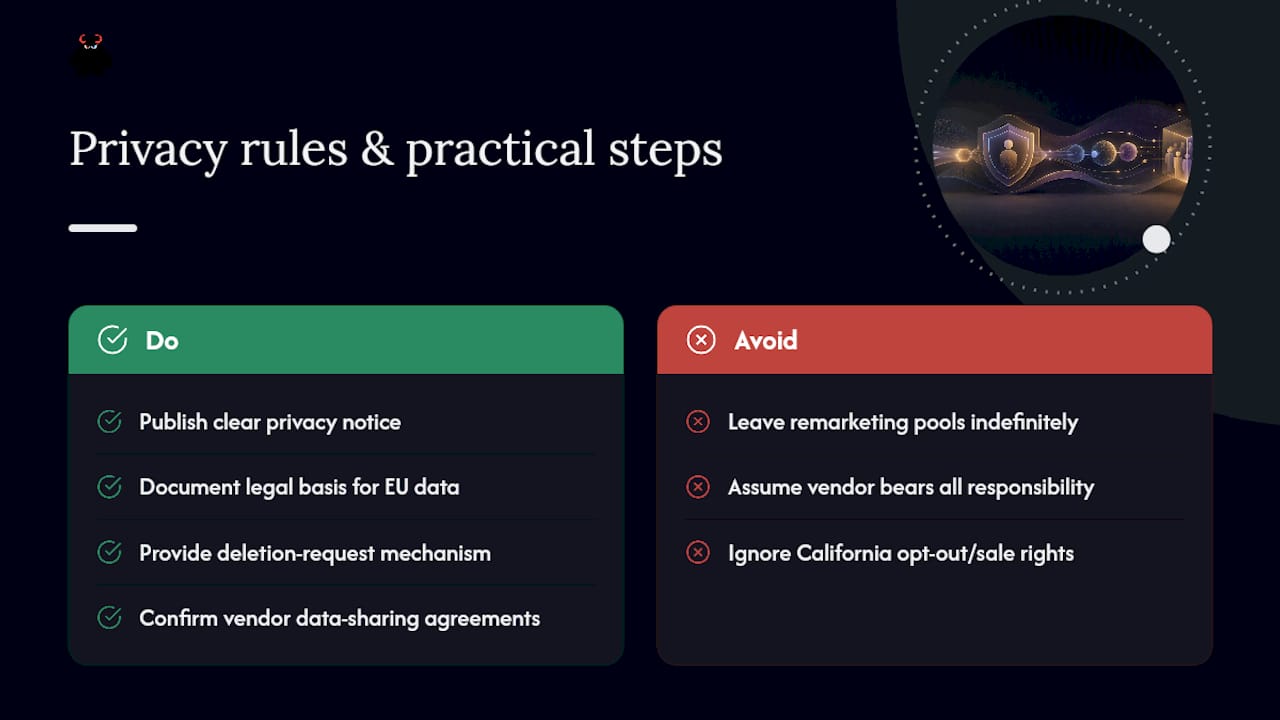
What Privacy Rules Apply to Programmatic Job Ads?
Programmatic job advertising collects candidate-level data, applicant IP addresses, device identifiers, browsing behavior, sometimes location data pulled from mobile devices. That data flow puts recruiting squarely inside the same privacy frameworks that govern digital advertising generally.
Under the EU’s General Data Protection Regulation, any candidate data collected from applicants in the European Union requires a documented legal basis for processing, clear disclosure of what’s collected, and a mechanism for candidates to request deletion. Job ads targeting European candidates, even indirectly through broad programmatic distribution, can trigger these obligations.
In the United States, the California Consumer Privacy Act and its expanded successor give California residents the right to know what personal data a company collects and to opt out of its sale, a category that can include the kind of data-sharing arrangements common in programmatic ad exchanges. Other states have adopted similar frameworks, and the patchwork is expanding, not shrinking.
Practical steps matter more than legal theory here. Make sure your ATS and career site have a clear privacy notice covering how applicant data is used in advertising retargeting. Confirm your programmatic vendor’s data-sharing agreements with third-party ad exchanges, since you’re ultimately responsible for candidate data even when a vendor is the one moving it. Retention policies matter too. Don’t let candidate remarketing pools sit indefinitely once a role is filled.
How Do You Target and Segment Programmatic Job Ad Audiences?
Audience segmentation is where programmatic starts to outperform flat job postings, because it lets you treat different candidate pools differently instead of running one generic ad to everyone.

Basic segmentation splits candidates by job function, seniority, and geography, letting the platform bid differently for a warehouse role in Ohio versus a nursing role in Texas. More advanced platforms build lookalike audiences, modeling the traits of your best recent hires (industries they came from, sites they browsed, search terms they used) and finding candidates who match that profile even if they’ve never visited a job board.
Retargeting is the third layer, and it’s often the most cost-effective. A candidate who visited your career page and started an application but didn’t finish gets shown a follow-up ad, usually at a lower cost than a cold impression, because that candidate already showed intent.
The risk with all three techniques is over-narrowing. Segment too aggressively on a hard-to-fill role and you shrink the pool below what the bidding engine needs to optimize effectively. A reasonable rule: start broad on any new role, let the algorithm gather data for the first two to three weeks, then narrow segmentation once you see which candidate profiles are actually converting to applications and interviews.
How Do You Optimize Job Ad Creative Dynamically?
Static job ad creative, the same headline and image running for weeks, wastes the one advantage programmatic gives you: the ability to test and swap creative automatically based on performance data.
Dynamic creative optimization works by testing multiple headline, image, and call-to-action combinations simultaneously, then shifting impression share toward whichever combination produces the highest apply rate for a given audience segment. A warehouse job ad might perform better with a photo of the actual facility and a headline emphasizing shift flexibility for one audience segment, while a headline emphasizing starting pay performs better for another.
Personalization extends this further. Some platforms can swap creative elements based on the candidate’s location, device, or even time of day, showing a commute-time-focused headline to a mobile user browsing during an evening commute.
The practical takeaway for recruiting teams: don’t hand a platform one static ad and walk away. Build at least three headline variants and two image options per major job category, and review creative performance data every two weeks, not just channel-level spend data. Creative fatigue is real in recruitment advertising the same way it is in consumer advertising, and an ad that performed well in week one can decay by week four if the same audience keeps seeing it.
How Does Programmatic Fit Into a Broader Recruitment Marketing Strategy?
Programmatic job advertising is a distribution and optimization layer, not a replacement for employer branding, and treating it as a standalone tactic is how teams end up disappointed with the results.
Employer brand content, the careers page copy, employee testimonials, culture messaging, determines whether a candidate who clicks a programmatic ad actually completes an application. Programmatic can get someone to your career site efficiently, but it can’t make them want to work there. That work happens upstream, in the recruitment marketing strategy that shapes your career site and job descriptions before the first ad ever runs.
The strongest recruiting operations treat channels as complementary layers: organic search and employee referrals build a baseline pipeline, programmatic scales volume and fills gaps quickly, and retargeting recaptures candidates who showed intent but didn’t convert. Cutting any one layer to over-invest in another usually backfires, since programmatic performs worse when it’s the only channel carrying the weight of an entire hiring plan.
Cross-channel measurement is the piece most teams skip. If your programmatic dashboard and your organic recruitment marketing metrics live in separate systems with no shared source-of-hire tagging, you can’t tell which channel actually deserves credit for a given hire, and budget decisions end up based on guesswork instead of data.
Where Is Programmatic Recruitment Advertising Headed?
Machine learning in recruitment is moving from simple rule-based bidding toward predictive models that forecast which candidates are likely to accept an offer, not just click an ad or complete an application. That shift changes what “optimization” means: instead of optimizing purely for cheap applies, platforms increasingly weight quality signals, interview show-rate, offer-acceptance likelihood, into the bidding decision itself.
Automation is also expanding into creative generation. Expect more platforms to auto-generate headline and description variants directly from ATS job data, reducing the manual work of building ad copy for hundreds of open roles at once.
The bigger structural trend is convergence. Programmatic job advertising increasingly overlaps with broader digital job ad optimization and general programmatic display advertising infrastructure, meaning the skills and tools recruiting teams need look more like performance marketing every year, not less. Teams that treat recruitment advertising as a specialized silo, disconnected from the marketing team’s own data practices and measurement discipline, will fall further behind teams that build one shared, disciplined operating system for both.
What Should Recruiting Teams Prioritize First?
Most advice on programmatic job advertising treats it as a tool you turn on. That framing is backwards, and it’s the reason so many recruiting teams try programmatic once, get mediocre results, and conclude it doesn’t work for their industry.
The conventional advice focuses on picking the right platform. The evidence points somewhere else entirely: feed hygiene and career-site conversion determine outcomes more than platform choice does. A recruiting team with a clean feed and a functional apply flow running a mid-tier platform will consistently outperform a team with a premium platform and a broken funnel.
If you’re prioritizing one thing before anything else, prioritize the audit. Fix your job feed fields, fix your mobile apply flow, and build source-of-hire tracking into your ATS before you evaluate a single vendor. Programmatic doesn’t create quality where none exists. It just finds and amplifies whatever quality, or dysfunction, is already built into your recruiting operation.
That’s not a comfortable message for a market full of platforms promising instant results. It’s the accurate one.
Turn Programmatic Spend Into a Protected Revenue System
Monstrousmediagroup builds the operational system programmatic job advertising depends on, not just the ad accounts. Instead of handing you a dashboard and a login, the work starts with fixing feed hygiene, career-site conversion, and measurement infrastructure so every dollar of ad spend has somewhere clean to land.

That distinction matters because most programmatic disappointment traces back to the same root cause: a platform running on top of a broken funnel. Monstrousmediagroup’s approach to paid search advertising and PPC management applies the same outcome-based discipline used in recruitment advertising, cost-per-result over cost-per-click, so budget gets reallocated toward what actually produces hires, not just applicants.
If your recruiting team is evaluating programmatic platforms right now, the smarter first step is a conversation about whether your feed and career site are ready for it. Reach out to Monstrousmediagroup to get a straightforward assessment of what’s currently leaking budget before you sign a vendor contract.
Sources
Core claims in this article draw from the DirectEmployers programmatic job advertising guide, the Easy.jobs recruiter’s guide to programmatic spend, Radancy’s overview of programmatic recruitment advertising, and the Wikipedia entry on demand-side platforms.
Frequently Asked Questions
What is the difference between programmatic job ads and regular job postings?
Regular job postings charge a flat fee regardless of how many qualified applicants they produce. Programmatic job ads use automated bidding and machine learning to distribute listings across multiple channels and continuously shift budget toward the sources actually producing applications and hires.
How much does programmatic job advertising cost?
Pricing typically runs on cost-per-click or cost-per-apply rather than a flat fee. Teams switching from flat-fee postings commonly see cost-per-apply drop in the mid-20s to 30% range within 30 to 60 days as the bidding engine optimizes.
Do I need an ATS to use programmatic job advertising?
Yes, in practice. Programmatic platforms pull job data through an XML or JSON feed from your applicant tracking system, and clean, standardized fields for title, location, salary, and job type are required for the matching engine to work correctly.
How long does it take to see results from programmatic job ads?
Early signals like clicks and cost-per-click typically appear within the first week. Meaningful improvements in cost-per-apply and cost-per-hire generally take 30 to 60 days as the algorithm accumulates enough data to optimize confidently.
What channels does programmatic job advertising cover?
Programmatic distribution typically spans job aggregators, niche industry boards, programmatic display inventory, and social remarketing pools, all managed through a single feed and bidding engine.
What is a job feed audit and why does it matter?
A job feed audit checks that titles, locations, salary data, and job type fields are consistent and complete across your ATS export. Dirty feeds cause the bidding engine to misclassify roles, which wastes budget before a campaign even launches.
Is programmatic job advertising GDPR and CCPA compliant?
Compliance depends on how your organization and vendor handle candidate data, not on the technology itself. You need a documented legal basis for data collection under GDPR for European candidates, and under the CCPA, California residents have rights to know about and opt out of data sales tied to ad targeting.
Can programmatic job ads fix a low-converting career site?
No. Programmatic amplifies whatever conversion rate your career site already has. If your apply funnel loses candidates before completion, programmatic sends more traffic into that same leak rather than fixing it.
What is the 70/20/10 budget framework for programmatic recruiting?
It's a practical allocation heuristic: 70% of budget goes to channels with proven performance, 20% tests new programmatic channels or audiences, and 10% goes to experimental placements you haven't validated yet.
Which KPIs matter most in programmatic job advertising?
Cost-per-apply and cost-per-hire matter most, alongside time-to-fill, interview rate, and offer rate. Measuring clicks alone tells you almost nothing about whether a channel is actually producing qualified hires.
- [What Is Programmatic Job Advertising? A Guide for Recruiters Getting Started • DirectEmployers Association](https://directemployers.org/2026/07/13/what-is-programmatic-job-advertising/) - [Easy](https://easy.jobs/blog/programmatic-job-advertising-a-recruiters-guide/) - [Demand-side platform - Wikipedia](https://en.wikipedia.org/wiki/Demand-side_platform)