
 https://www.omahamediagroup.com/images/uploads/monster_gallery/Omaha-Media-Group-Black.jpg
admin
https://www.omahamediagroup.com/images/uploads/monster_gallery/Omaha-Media-Group-Black.jpg
admin
Why invest in web design: driving growth in 2026

83% of small businesses now have a website, yet most still struggle to turn that digital presence into real revenue. The gap between having a website and having one that actually works for your business is wider than most owners realize. Web design is not a cosmetic expense. It is a revenue infrastructure decision. This guide breaks down what separates high-performing business websites from digital dead weight, and why the smartest investment you can make right now is in a site built to grow with you.
Table of Contents
- Why web design matters for business growth
- Essential principles: Modern web design best practices
- Web design vs. DIY and automation: What really delivers ROI?
- Maximizing your web investment: Tangible results and ongoing value
- What most business owners miss about web design investment
- Take your web presence further with expert support
- Frequently asked questions
Key Takeaways
| Point | Details |
|---|---|
| Web design boosts growth | A well-designed website attracts more leads, enhances credibility, and supports business revenue goals. |
| Follow proven principles | Modern web design requires a mobile-first approach, fast load times, and user-friendly layouts. |
| Prioritize ongoing updates | Continuous improvement yields more value from your site than a one-time redesign. |
| Professional > DIY long-term | Investing in expert design delivers greater scalability, security, and return on investment for your business. |
Why web design matters for business growth
Your website is often the first handshake a prospect has with your brand. That first impression forms in under three seconds, and it is shaped almost entirely by design. Poor layout, slow load times, or outdated visuals signal to visitors that your business may not be trustworthy. That is a lead you just lost before you even knew they arrived.
Businesses with websites report stronger lead generation via SEO compared to those relying on referrals alone. That shift matters because referral pipelines are unpredictable. A well-designed site paired with improved SEO outcomes creates a consistent, scalable channel for new business.
Here is how traditional marketing stacks up against a website-driven approach:
| Factor | Traditional marketing | Website-driven approach |
|---|---|---|
| Reach | Limited by geography | Global, 24/7 availability |
| Cost per lead | Higher over time | Decreases as SEO compounds |
| Credibility signals | Print, word of mouth | Design, reviews, content |
| Measurability | Difficult to track | Fully trackable with analytics |
| Scalability | Requires more spend | Scales with content and SEO |
Beyond lead generation, graphic design’s impact on brand perception is significant. Consistent visual identity across your site builds the kind of trust that converts browsers into buyers. And when you layer in channels like email marketing benefits, your website becomes the hub that ties every campaign together.
Key reasons web design directly drives business outcomes:
- First impressions are formed in under three seconds based on visual design alone
- Brand credibility rises when your site meets modern user expectations
- Lead quality improves when site structure guides visitors toward conversion
- SEO performance is tied directly to technical design decisions
“A website is not a brochure. It is your hardest-working sales asset, running around the clock without a salary.”
Essential principles: Modern web design best practices
Understanding why web design matters is step one. Knowing how to execute it well is where most businesses fall short. The standards have shifted considerably, and what worked in 2020 can actively hurt your rankings and conversions today.
Mobile-first design, Core Web Vitals optimization, and prototypical layouts are now the baseline for effective business websites. Mobile-first means designing for the smallest screen first, then scaling up. This approach forces clarity and prioritization, which benefits every device. Core Web Vitals are Google’s performance metrics measuring load speed, interactivity, and visual stability. Poor scores push your site down in search results and drive visitors away.
Here are five core design principles every SMB website needs in 2026:
- Mobile-first architecture — Design for phones before desktops, since most traffic arrives on mobile
- Core Web Vitals compliance — Optimize load speed, layout stability, and responsiveness for both users and search engines
- Familiar navigation patterns — Use layouts users already know so they can find what they need without friction
- Clear calls to action — Every page should guide the visitor toward one specific next step
- Accessible design — Color contrast, font size, and keyboard navigation serve both users and legal compliance
Staying current with digital marketing design trends helps you anticipate what your audience expects before they even articulate it. Pair that with a solid foundation in digital marketing strategies and your site becomes a system, not just a page.
| Design element | Impact on performance |
|---|---|
| Page load under 2 seconds | Reduces bounce rate significantly |
| Mobile-responsive layout | Improves rankings and session time |
| Familiar navigation | Increases pages per visit |
| Strong CTA placement | Lifts conversion rate |
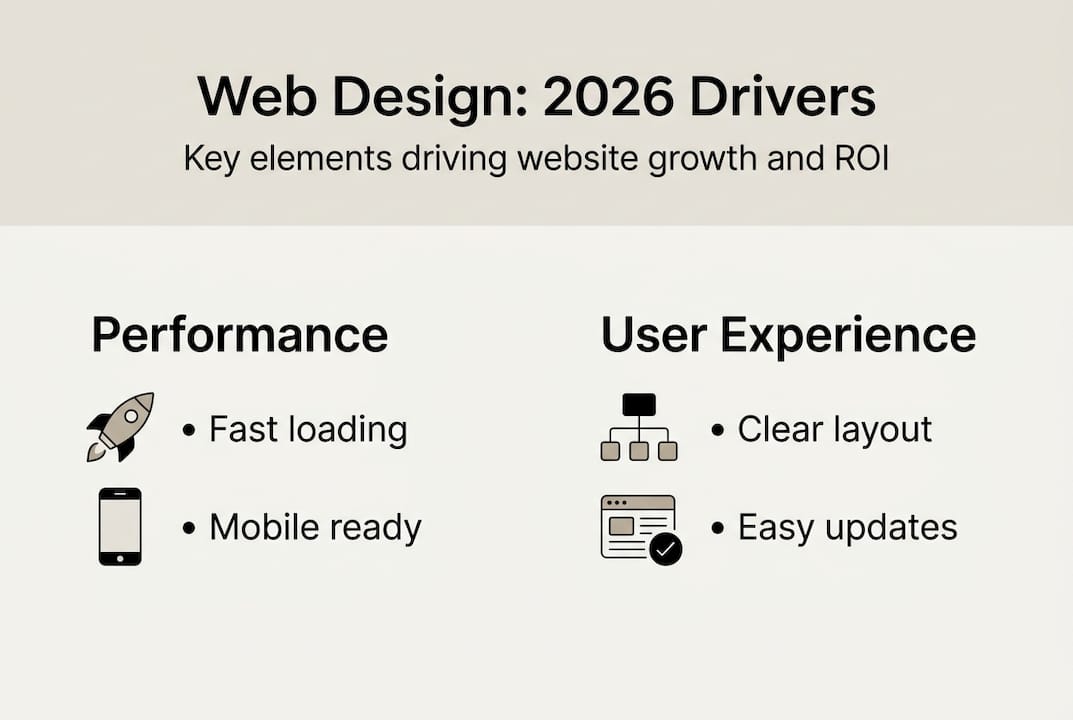
Pro Tip: Resist the urge to be too clever with your layout. Prototypical designs, meaning ones that follow familiar patterns, consistently outperform highly unique designs in user satisfaction and conversion metrics.
Web design vs. DIY and automation: What really delivers ROI?
DIY website builders and AI-powered tools have made it easier than ever to put something online. That accessibility is genuinely useful for testing an idea or launching a simple landing page. But for businesses serious about growth, the limitations surface fast.
No-code and AI tools lower barriers but fall short in scalability, security, and long-term ROI. Most SMBs that start with DIY tools eventually hit a ceiling where the platform cannot support their needs. Migrating away from those platforms is often more expensive than building professionally from the start.

Here is a direct comparison:
| Factor | DIY/AI website tools | Professional web design |
|---|---|---|
| Upfront cost | Low | Moderate to higher |
| Ongoing cost | Monthly subscriptions | Maintenance and updates |
| Scalability | Limited by platform | Built to your growth plan |
| Security | Platform-dependent | Custom hardened solutions |
| SEO performance | Basic, often limited | Fully optimized architecture |
| Support | Community forums | Dedicated expert team |
The benefits of marketing automation are real, but automation tools work best when the underlying site is built to support them. A DIY site often cannot integrate cleanly with CRM systems, advanced analytics, or custom conversion funnels.
Common pitfalls of the “set it and forget it” approach:
- Security vulnerabilities accumulate as platforms go unpatched
- Design drift occurs as your brand evolves but the site stays frozen
- Performance degradation happens as plugins and third-party scripts pile up
- SEO stagnation sets in when content and technical structure are never refreshed
Pro Tip: When budgeting for your website, factor in the cost of ongoing updates, security monitoring, and content refreshes. A site without maintenance is a liability, not an asset. Expert web design built with adaptability in mind pays dividends far beyond the launch date.
Maximizing your web investment: Tangible results and ongoing value
Building a great website is not a one-time event. It is the beginning of a continuous improvement cycle. Businesses that treat their site as a living asset consistently outperform those that launch and walk away.
Ongoing website updates are a priority for 90% of SMBs, and that commitment is not accidental. It reflects a hard-learned truth: the market shifts, algorithms update, and user expectations evolve. Your site must keep pace or lose ground.
90% of small and mid-sized businesses treat website updates as an ongoing operational priority, not a one-time project.
To prove and sustain your web ROI, track these metrics consistently:
- Organic traffic growth — Measures how well your SEO investment is compounding over time
- Bounce rate — Signals whether visitors find what they expected when they land on your pages
- Conversion rate — Tracks the percentage of visitors completing a desired action
- Lead source attribution — Identifies which channels and pages drive the most qualified leads
- Page load speed — Directly tied to both user experience and search ranking
- Return visitor rate — Indicates brand loyalty and content relevance
Pairing your site with SEO service upgrades accelerates the compounding effect of your content. Combine that with strategies from ROI with email marketing and you create multiple revenue touchpoints working in sync. Even design choices, like those covered in minimalist UI benefits, directly influence how long visitors stay and how likely they are to convert.
The businesses winning online are not necessarily spending the most. They are investing strategically, measuring consistently, and iterating with purpose.
What most business owners miss about web design investment
Here is the uncomfortable truth most agencies will not tell you: the biggest mistake is not underinvesting in web design. It is treating your website as a finished product.
We see it constantly. A business spends real money on a beautiful site, launches it with excitement, and then leaves it untouched for three years. Meanwhile, competitors iterate, Google updates its algorithm, and user expectations shift. That once-impressive site quietly becomes a liability.
90% of SMBs plan ongoing updates because the ones who have been in the game long enough know that a static site is a shrinking asset. And prototypical designs consistently outperform flashy, trend-chasing layouts because familiarity builds trust faster than novelty.
The smartest investment is not the most visually stunning site. It is a well-architected, adaptable foundation built to absorb updates, integrate new tools, and scale with your business goals. Think of it less like remodeling a room and more like building a system. Insights on minimalist design insights reinforce this point: restraint and clarity outperform complexity every time. Build for longevity, not for launch day applause.
Take your web presence further with expert support
If this guide has clarified one thing, it is that effective web design is a business system, not a line item. The sites that generate consistent leads, rank well in search, and convert visitors into customers are built with strategy, maintained with discipline, and optimized with data.
At Monstrous Media Group, we build custom web design solutions that are engineered for outcomes, not aesthetics alone. Our advanced SEO services ensure your site gets found, and our integrated digital marketing programs keep your pipeline full. If you are ready to stop guessing and start growing, we are ready to build the system that makes it happen. Reach out today to schedule a consultation and see what a results-driven web presence looks like in practice.
Frequently asked questions
What is the ROI of professional web design for small businesses?
Professional web design strengthens brand credibility and creates a scalable lead channel, with businesses reporting stronger SEO-driven lead generation compared to referral-only approaches.
How often should a business update its website?
Plan for major redesigns every two to three years and minor updates on an ongoing basis, since 90% of SMBs prioritize continuous website improvements as a core business activity.
Are DIY web builders good enough?
DIY tools work for simple or early-stage sites, but no-code solutions fall short when your business needs scalability, security, and a site architecture that supports real marketing performance.
What web design trends matter most in 2026?
Mobile-first design, Core Web Vitals, and prototypical layouts deliver the strongest business results this year, prioritizing user familiarity and technical performance over visual novelty.
Recommended
Hire the team to help you with your website, app, or other marketing needs.
We have a team of digital marketers who can help plan and bring to life all your digital marketing strategies. They can help with social media marketing, email marketing, and digital advertising!
CONTACT US
Comments