
 https://www.omahamediagroup.com/images/uploads/monster_gallery/Omaha-Media-Group-Black.jpg
admin
https://www.omahamediagroup.com/images/uploads/monster_gallery/Omaha-Media-Group-Black.jpg
admin
Why digital advertising matters: boost results and revenue

TL;DR:
- Digital advertising accounts for over 81.6% of global ad spend, driven by consumer online behavior.
- Effective digital strategies focus on precision targeting, real-time optimization, and attribution measurement.
- Fraud, ad tech leakage, and taxes pose significant threats, emphasizing the need for transparency and disciplined management.
Digital advertising now commands 81.6% of all advertising revenue globally, yet most executives still treat it as a line item rather than a revenue engine. That gap between spend and strategy is where growth gets lost. This guide cuts through the noise to show you exactly why digital advertising has become non-negotiable, where the real opportunities lie, and which pitfalls quietly drain your budget before a single customer ever sees your ad. Whether you’re scaling a mid-market brand or running a multi-channel enterprise campaign, what follows will sharpen how you think about, allocate, and measure every dollar you put into digital.
Table of Contents
- The explosive growth of digital advertising
- Why digital advertising drives business growth
- The pitfalls: fraud, taxes, and ad tech leakage
- Applying digital advertising strategies for real results
- What most guides miss about digital advertising
- Accelerate success with expert digital advertising help
- Frequently asked questions
Key Takeaways
| Point | Details |
|---|---|
| Massive growth | Digital advertising now dominates global spend and can’t be ignored by growth-minded leaders. |
| ROI and risks | High-performing channels drive results but come with fraud, taxes, and ad tech waste businesses must address. |
| Actionable strategies | Smart auditing, platform choices, and transparency boost returns and limit digital advertising pitfalls. |
| Continuous optimization | Success relies on relentless testing and adapting—not just spending more. |
The explosive growth of digital advertising
The numbers are hard to ignore. The global digital ad market is projected toward $750 billion, representing more than four out of every five dollars spent on advertising worldwide. That kind of dominance doesn’t happen by accident. It reflects a fundamental shift in where consumers spend their attention and where businesses find the highest return on their marketing investment.
To put that in perspective, here’s how digital stacks up against traditional advertising channels:
| Channel | Estimated global spend share | Growth trajectory |
|---|---|---|
| Digital (search, social, display) | 81.6% | Accelerating |
| Television | 10.2% | Declining |
| Print (newspapers, magazines) | 3.1% | Declining |
| Out-of-home | 3.8% | Stable |
| Radio | 1.3% | Declining |
Three forces are driving this shift. First, consumer behavior has moved online permanently. People research purchases, compare prices, and make buying decisions through digital channels before ever speaking to a salesperson. Second, digital advertising delivers measurable results that traditional media simply cannot match. You can track impressions, clicks, conversions, and revenue attribution in real time. Third, the targeting precision of digital platforms lets you reach exactly the right audience at exactly the right moment, something a billboard or TV spot can never do.
Key reasons digital advertising has become essential for business growth:
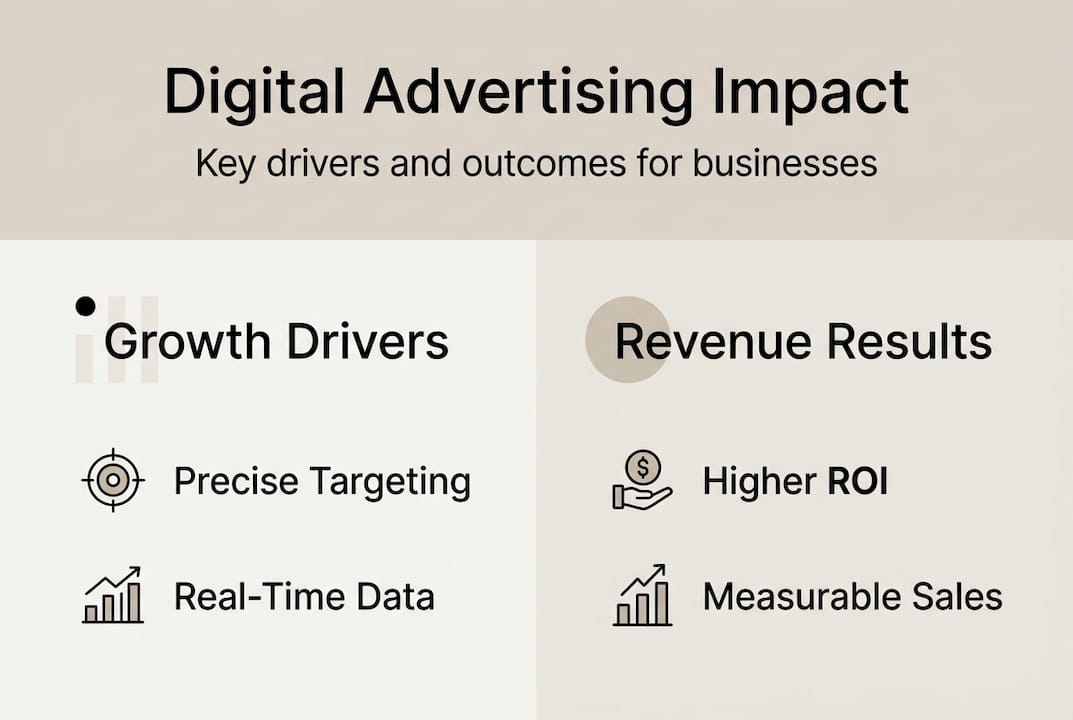
- Precision targeting: Reach audiences by demographics, behavior, purchase intent, and location
- Real-time optimization: Adjust campaigns mid-flight based on live performance data
- Scalable budgets: Start small and scale what works without committing to large fixed contracts
- Attribution clarity: Connect ad spend directly to revenue outcomes with trackable conversion paths
- Global reach: Access markets across geographies without proportional cost increases
Staying current on advertising trends shaping the future is no longer optional for executives who want to compete. Ignoring digital advertising in 2026 is the equivalent of refusing to answer your phone in 1995. The market has moved, and the businesses that adapt are the ones capturing share. Monitoring digital marketing trends consistently separates the brands that lead from the ones that follow.
Why digital advertising drives business growth
Spend alone doesn’t create growth. Strategy does. The real power of digital advertising lies in its ability to connect specific actions to specific revenue outcomes, a capability that traditional media has never been able to offer at scale.
Not all digital channels perform equally. Here’s how the top performers compare against traditional options:
| Advertising type | Targeting capability | Cost efficiency | Attribution | Avg. ROI potential |
|---|---|---|---|---|
| PPC (paid search) | High | High | Direct | Very high |
| Email marketing | Very high | Very high | Direct | Very high |
| Social media ads | High | Moderate | Moderate | High |
| Display advertising | Moderate | Moderate | Indirect | Moderate |
| Television | Low | Low | Minimal | Low |
| Very low | Very low | None | Very low |
PPC and email consistently rank as the highest ROI channels available to businesses today. That’s not a coincidence. Both formats allow granular targeting, direct response tracking, and continuous optimization based on real data.
Here’s how digital advertising translates directly into revenue growth:
- Capture demand at the moment of intent. Search ads place your brand in front of buyers who are actively looking for what you sell. This is the highest-converting moment in any purchase journey.
- Nurture leads through the funnel. Retargeting and email sequences keep your brand visible to prospects who showed interest but didn’t convert immediately.
- Expand reach without proportional cost. Social and display campaigns build awareness at scale, feeding your pipeline with new prospects continuously.
- Optimize in real time. Unlike a print ad that’s locked in once it runs, digital campaigns let you redirect budget to what’s working within hours.
- Measure everything. Revenue attribution connects ad spend to closed deals, giving you the data to justify and scale your investment.
Learning more about driving revenue with PPC reveals just how much precision is available to businesses willing to invest in the right execution. Similarly, maximizing ROI with email remains one of the most underutilized strategies among mid-market companies.

Pro Tip: Run A/B tests on your highest-spend campaigns every 30 days. Testing one variable at a time, whether that’s headline, audience segment, or landing page, compounds gains over time and prevents budget from flowing to underperformers. Real digital success stories are built on this kind of disciplined iteration.
The pitfalls: fraud, taxes, and ad tech leakage
Here’s the part most agencies don’t talk about. For every dollar you invest in digital advertising, a significant portion may never reach a real human being. Understanding where that money goes is the first step to protecting it.
The biggest threats to your digital ad budget include:
- Ad fraud: Bots and click farms generate fake impressions and clicks, consuming budget without producing any real engagement
- Made-for-advertising (MFA) sites: Low-quality websites that exist purely to collect ad revenue, offering zero value to advertisers
- Ad tech intermediaries: The chain of platforms, exchanges, and middlemen between you and your publisher
- Brand safety violations: Your ads appearing next to harmful or irrelevant content, damaging brand perception
- Rising digital ad taxes: State-level taxes that increase campaign costs without increasing reach or results
“Only 41 cents of every programmatic dollar actually reaches a publisher. The rest is absorbed by ad tech leakage across intermediaries, with a $63 billion blind spot in ad fraud costing advertisers at a scale most executives never see on a campaign report.”
That 41-cent figure is staggering when you do the math on a meaningful ad budget. Spend $500,000 programmatically and roughly $295,000 of it may never reach an actual content publisher, let alone a qualified buyer.
The regulatory environment adds another layer of complexity. Digital ad taxes at the state level, like Washington State’s framework, can increase your effective campaign cost by 10% or more. For small and mid-sized businesses operating on tighter margins, that’s a material hit to competitiveness that doesn’t show up in your platform dashboard.
Pro Tip: Demand transparency from every platform and agency you work with. Request inclusion lists that specify exactly which sites carry your ads. Commission third-party audits of your programmatic spend at least once per year. The businesses that protect their ad spend with these tools consistently outperform those that don’t.
Applying digital advertising strategies for real results
Knowing the risks is only half the equation. Executing a disciplined digital advertising strategy is what separates businesses that grow from those that simply spend. Here’s a practical framework you can apply right now.
- Audit your current spend. Before adding budget, understand where your existing dollars are going. Pull placement reports, check for MFA sites, and identify which channels are actually driving conversions versus just impressions.
- Choose platforms based on your audience, not trends. Where does your ideal customer spend time online? B2B companies often see stronger returns from LinkedIn and search. B2C brands may find more leverage in social and display.
- Build your attribution model first. Decide how you’ll measure success before you launch. Last-click attribution misses most of the story. Consider multi-touch models that credit every interaction in the buyer’s journey.
- Set up inclusion and exclusion lists. Specify which sites and placements are acceptable for your brand. This single step can dramatically reduce fraud exposure and improve traffic quality.
- Track performance weekly, optimize monthly. Weekly reviews catch problems early. Monthly optimization cycles give campaigns enough data to make meaningful adjustments without overreacting to noise.
- Demand detailed reporting from your agency or platforms. Vague metrics like “impressions” and “reach” are not business outcomes. Insist on cost per acquisition, conversion rate, and revenue attribution in every report.
The best platforms and strategies deliver strong ROI, but only when execution is disciplined and fraud protections are in place. Exploring proven advertising and marketing strategies built around your specific industry gives you a significant head start.
Pro Tip: Create a performance scorecard that tracks your top five KPIs every week. When a metric moves more than 15% in either direction, investigate before assuming it’s a trend. Reactive decisions based on single-week data waste more budget than almost any other mistake in digital advertising.
What most guides miss about digital advertising
Most conversations about digital advertising focus on budget. Bigger budgets, better results. That logic sounds reasonable until you look at where the money actually goes. The executives who consistently outperform their competitors aren’t spending more. They’re wasting less.
The real competitive edge in digital advertising is relentless optimization, not higher spend. Best practices in this industry shift every 12 to 18 months. The platforms change their algorithms, fraud patterns evolve, and new channels emerge. The only sustainable advantage is building a process that audits, adapts, and improves continuously.
We’ve seen businesses cut their cost per acquisition by 40% without increasing their budget, simply by eliminating MFA placements, tightening their inclusion lists, and improving post-campaign analysis. The money was always there. It was just going to the wrong places.
Transparent, data-driven agency relationships outlast any channel hack or platform trend. If your current partner can’t show you exactly where your ads ran, who saw them, and what revenue they produced, that relationship is costing you more than their fee. Exploring overlooked digital channels often reveals significant untapped revenue potential that more obvious strategies miss entirely.
Accelerate success with expert digital advertising help
Understanding the landscape is the first step. Building a system that executes consistently and protects your budget while scaling results is where most businesses need a proven partner.

At Monstrous Media Group, we don’t sell advertising activities. We build revenue systems. Our digital marketing expertise spans campaign strategy, audience targeting, fraud protection, and performance optimization across every major channel. From SEO services that drive long-term organic growth to email marketing campaigns that convert at industry-leading rates, we engineer every engagement around measurable outcomes. If your current digital advertising strategy isn’t producing clear, attributable revenue growth, let’s change that. Connect with our team for a custom consultation and see exactly where your opportunity lies.
Frequently asked questions
How can I measure the ROI of my digital advertising campaigns?
Track performance using clear KPIs like cost per acquisition, conversion rate, and customer lifetime value relative to your total ad spend. Multi-touch attribution models give you the most accurate picture of which channels and touchpoints are actually driving revenue.
What is ad fraud and how does it affect my business?
Ad fraud uses bots and fake traffic to generate illegitimate impressions and clicks, draining your budget without producing real engagement or conversions. The scale of fraud reaches $63 billion annually, making it one of the most significant threats to advertising ROI.
How do digital ad taxes impact small businesses?
Digital ad taxes can raise effective campaign costs by 10% or more, compressing margins and reducing the competitive reach of smaller advertisers who can’t absorb those increases as easily as large enterprises.
What are inclusion lists and why do they matter?
Inclusion lists specify the exact websites and placements where your ads are allowed to appear, keeping your budget away from fraudulent or low-quality inventory. They are one of the most effective tools for protecting ad spend and improving traffic quality.
Which digital channels deliver the highest ROI?
PPC and email marketing consistently deliver the highest ROI for most businesses because both offer direct attribution, precise targeting, and continuous optimization potential that broad-reach channels simply can’t match.
Recommended
Hire the team to help you with your website, app, or other marketing needs.
We have a team of digital marketers who can help plan and bring to life all your digital marketing strategies. They can help with social media marketing, email marketing, and digital advertising!
CONTACT US
Comments