
 https://www.omahamediagroup.com/images/uploads/monster_gallery/Omaha-Media-Group-Black.jpg
admin
https://www.omahamediagroup.com/images/uploads/monster_gallery/Omaha-Media-Group-Black.jpg
admin
What Is On-Page SEO? A 2026 Guide for Marketers
TL;DR:
- On-page SEO involves optimizing website content, HTML, and structure to improve search rankings and attract targeted organic traffic. It emphasizes relevance, intent matching, and thorough content, with elements like title tags, headers, internal links, and schema playing crucial roles. Ongoing audits and updates are essential, as Google continuously recrawls pages, making on-page SEO a vital, controllable foundation for ranking success.
On-page SEO is the practice of optimizing individual web pages — their content, HTML source code, metadata, and structure — to rank higher in search engine results and attract relevant organic traffic. As defined by Search Engine Land, the goal is to make pages “relevant, useful, and easy to understand” for both users and search bots. Unlike off-page SEO, which depends on external signals like backlinks, on-page optimization is entirely within your control. That makes it the most immediate lever available to website owners, digital marketers, and content creators who want to move the needle on search visibility without waiting on third parties.
What is on-page SEO and what does it include?
On-page SEO is the practice of optimizing the content and HTML elements you directly control on each webpage to improve rankings and attract qualified traffic. It sits alongside off-page SEO and technical SEO as one of three core SEO disciplines, but it is the only one where every change is yours to make and deploy today.
The core components that define a well-optimized page include:
- Title tags: The clickable headline in search results. Google uses the title tag to understand the page topic and match it to search queries. Misaligned or duplicate title tags reduce both relevance signals and click-through rate.
- Meta descriptions: Not a direct ranking factor, but a strong meta description increases the likelihood a searcher clicks your result over a competitor’s. Think of it as ad copy for your organic listing.
- Header tags (H1, H2, H3): Headers organize content for readers and signal content hierarchy to crawlers. Every page needs one H1 that clearly states the topic. Subheadings (H2, H3) break content into scannable sections that match the sub-questions users ask.
- Body content: Google prioritizes main page content over peripheral elements like navigation and footers when indexing and ranking. Your body copy must cover the topic thoroughly and match the searcher’s intent, not just repeat a keyword.
- URL structure: Short, descriptive URLs that include the target keyword outperform long, parameter-heavy strings in both rankings and user trust.
- Internal links: Linking to related pages distributes authority across your site and helps crawlers discover and index content efficiently.
- Image optimization: Every image needs a descriptive file name and alt text. This serves accessibility requirements and gives search engines additional context about page content. Monstrousmediagroup covers image SEO techniques in detail for teams that want to go deeper.
- Structured data (schema markup): Schema does not directly boost rankings, but it can change how your result appears in search, triggering rich results like star ratings, prices, and FAQs that increase click-through rate significantly.
- Core Web Vitals: Google’s LCP, INP, and CLS metrics measure real-world page performance and influence rankings as part of broader quality signals. Slow, unstable pages lose ground to faster competitors even when content quality is equal.
Pro Tip: Run a Core Web Vitals audit in Google Search Console before touching content. A page that loads in 4 seconds will underperform a slightly weaker page that loads in 1.2 seconds. Fix performance first, then optimize copy.
Why on-page SEO is important compared to off-page and technical SEO

On-page SEO answers the fundamental question Google asks about every page: does this content deserve to rank for this query? Off-page and technical SEO create the conditions for ranking, but on-page optimization is what makes a page relevant.
The table below clarifies how the three SEO disciplines differ in scope, control, and function:
| SEO type | What it covers | Your control level | Primary ranking question answered |
|---|---|---|---|
| On-page SEO | Content, HTML, metadata, UX signals | Full | Does this page match the searcher’s intent? |
| Off-page SEO | Backlinks, brand mentions, authority signals | Partial | Do other sites vouch for this page? |
| Technical SEO | Crawlability, rendering, site architecture | Full (server level) | Can Google access and process this page? |
A technically sound site with strong backlinks still fails to rank if the page content does not clearly address what the user is searching for. Ahrefs frames on-page SEO as the sum of content and structure you directly control, with intent matching being the critical variable beyond simple keyword placement. That framing matters because it shifts the focus from gaming algorithms to genuinely serving users, which is exactly what Google’s ranking systems reward.
One persistent misconception is that keyword density drives rankings. It does not. Stuffing a keyword 20 times into 500 words signals low quality to modern ranking systems. The correct approach is to cover the topic with enough depth and clarity that Google can confidently match your page to the full range of related queries.
How to optimize on-page SEO: a practical checklist
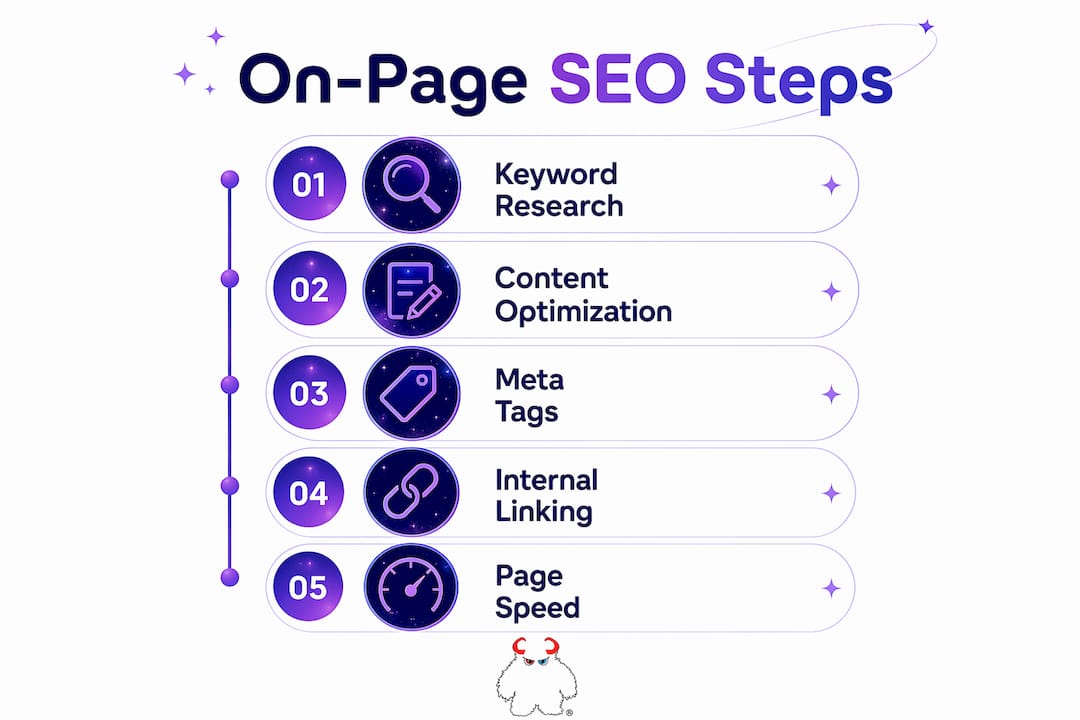
Effective on-page optimization follows a repeatable workflow. Here is the sequence Monstrousmediagroup recommends for any page you want to rank:
- Identify the primary keyword and search intent. Determine whether the searcher wants information, a comparison, or a product. A page targeting “best CRM for small business” needs a comparison format, not a definition article.
- Write a title tag that includes the keyword and a clear benefit. Keep it under 60 characters. Avoid keyword repetition and generic phrases like “Home” or “Page 1.”
- Write a meta description under 160 characters. Include the keyword and a specific reason to click. Treat it as a one-sentence pitch.
- Set one H1 that matches the title tag’s core topic. Inconsistencies between the title tag, H1, and body content cause Google to rewrite your title in search results, which reduces CTR and confuses users.
- Structure body content with H2 and H3 subheadings that address the sub-questions your target audience is asking. Use tools like Ahrefs or Semrush to identify related queries.
- Cover the topic thoroughly. Google’s indexing weights main body content heavily. Thin pages that skim the surface consistently underperform pages that answer the full question.
- Add internal links to 2 to 4 related pages. Use descriptive anchor text that tells the reader and the crawler what the linked page covers.
- Optimize every image with a keyword-relevant file name and a descriptive alt attribute.
- Add schema markup where it applies. Product pages, articles, FAQs, and local businesses all have schema types that can trigger rich results in Google Search.
- Audit Core Web Vitals using Google Search Console or PageSpeed Insights. Address LCP and CLS issues before publishing or republishing the page.
- Monitor after recrawl. Changes influence rankings once Googlebot recrawls the updated page, which typically takes days to a few weeks. Track position changes in Google Search Console after each update.
Pro Tip: Do not optimize every page at once. Prioritize pages that already rank in positions 8 to 20. A targeted on-page update to a near-ranking page produces faster, more measurable results than starting from scratch.
Common pitfalls and advanced nuances in on-page optimization
Most on-page SEO failures come from one of three sources: conflicting signals, ignored technical controls, or treating optimization as a one-time event.
- Conflicting on-page signals. When the title tag, H1, and body copy send different messages about the page topic, Google often rewrites the title displayed in search results. This creates a mismatch between what the user expects and what they find, which increases bounce rate and reduces ranking stability.
- Ignoring robots meta tags. Robots meta tags and X-Robots-Tag HTTP headers give you granular control over what gets indexed and followed at the page level. A page accidentally tagged “noindex” will not appear in search regardless of how well it is optimized. Audit these controls regularly, especially after site migrations or CMS updates.
- Overestimating schema’s ranking impact. Structured data improves how your result looks in search, not necessarily where it ranks. The value is in higher click-through rates from rich results, not a direct position boost.
- Treating on-page SEO as a one-time fix. Google updates its ranking systems continuously. A page that performed well in 2024 may need content updates, intent realignment, or performance improvements to hold its position in 2026.
“On-page quality and clarity still matter in Google’s AI-assisted search features. No special rewriting is necessary. The same principles that made pages rank before generative AI apply now.” — Semrush, summarizing Google’s generative AI search guidance
The rise of AI-driven search features like Google’s AI Overviews has not changed the fundamentals. Pages that clearly answer a specific question, with well-structured content and consistent on-page signals, remain the primary source material for AI-generated responses. Clarity and depth are not just SEO tactics. They are the price of entry for appearing in any search format.
Key takeaways
On-page SEO is the most direct, fully controllable lever for improving search rankings, and every element from title tags to Core Web Vitals must work together to signal clear intent to both users and Google.
| Point | Details |
|---|---|
| On-page SEO defined | Optimizing content, HTML, and UX signals on individual pages to match search intent and rank higher. |
| Intent matching is primary | Keyword density is irrelevant. Pages must cover the topic with enough depth to satisfy the full query. |
| Consistency across elements | Title tag, H1, and body copy must align. Conflicting signals cause Google to rewrite titles and reduce CTR. |
| Schema improves CTR, not rank | Structured data changes how results appear in search, increasing click-through without directly boosting position. |
| Optimization is ongoing | Google recrawls pages continuously. Regular audits and updates are required to maintain and improve rankings. |
Why on-page SEO is the foundation, not the finish line
After working through hundreds of site audits, the pattern is consistent: businesses that treat on-page SEO as a one-time checklist always plateau. The ones that treat it as an operational system, reviewing pages quarterly, updating content to match shifting intent, and monitoring Core Web Vitals as a standing metric, compound their gains over time.
The most common mistake is prioritizing link building before the page itself is worth linking to. A page with a weak title, thin content, and a 4-second load time will not convert the authority from backlinks into rankings. On-page quality is what makes every other SEO investment pay off.
There is also a tendency to over-engineer schema and structured data while neglecting the basics. Schema is a multiplier, not a foundation. Get the title tag, H1, and body content right first. Then layer in schema to improve how that already-strong page appears in search results.
For teams navigating recent changes in SEO, the practical advice is straightforward: write for the person searching, structure for the crawler, and measure both. That combination has not changed, and it will not change regardless of how Google’s AI features evolve.
— Vector
Ready to build an on-page SEO system that produces results?
Monstrousmediagroup works with businesses that are serious about search visibility as a revenue system, not a marketing activity. The team delivers expert SEO services that cover on-page audits, technical optimization, and content strategy built around measurable ranking outcomes. Every engagement starts with a clear picture of where your pages stand and a prioritized plan for closing the gap.

If your site is generating traffic but not converting it, or ranking on page two when you should be on page one, the problem is almost always fixable at the on-page level. Monstrousmediagroup’s digital marketing services combine on-page SEO with technical and off-page strategies to build the kind of search presence that drives consistent, qualified leads. Schedule a consultation to see exactly where your pages are leaving revenue on the table.
FAQ
What is on-page SEO in simple terms?
On-page SEO is the process of optimizing the content and HTML elements on a webpage so search engines can understand what the page is about and rank it for relevant queries. It includes title tags, headers, body content, internal links, and page performance signals.
How does on-page SEO differ from off-page SEO?
On-page SEO covers elements you control directly on your site, such as content and metadata. Off-page SEO refers to external signals like backlinks and brand mentions from other websites that indicate authority and trustworthiness.
Does schema markup improve search rankings?
Schema markup does not directly improve rankings, but it can change how your result appears in search by triggering rich results like star ratings and FAQs, which increases click-through rate.
How long does it take to see results from on-page SEO changes?
Results depend on how quickly Googlebot recrawls the updated page. Most changes take days to a few weeks to reflect in rankings, with more competitive queries taking longer to respond.
Is on-page SEO still relevant with AI-powered search?
Yes. Google’s AI-assisted search features are built on the same core quality signals. On-page quality and clarity remain the primary factors that determine whether a page appears in AI-generated responses or traditional search results.
Recommended
Hire the team to help you with your website, app, or other marketing needs.
We have a team of digital marketers who can help plan and bring to life all your digital marketing strategies. They can help with social media marketing, email marketing, and digital advertising!
CONTACT US
Comments