
 https://www.omahamediagroup.com/images/uploads/monster_gallery/Omaha-Media-Group-Black.jpg
admin
https://www.omahamediagroup.com/images/uploads/monster_gallery/Omaha-Media-Group-Black.jpg
admin
What Is Omnichannel Marketing? A 2026 Strategy Guide

TL;DR:
- Omnichannel marketing unifies all customer touchpoints into a single, coherent experience through integrated data systems. It relies on shared customer data, cross-channel orchestration, and aligned KPIs to drive customer retention and revenue growth. Organizational alignment and robust data architecture are critical for successful omnichannel implementation and outcomes.
Omnichannel marketing is defined as a customer-centric strategy that unifies every touchpoint — from email and paid search to in-store and mobile — into a single, coherent brand experience. Unlike approaches that treat channels as separate programs, omnichannel marketing connects them through a centralized customer data platform (CDP), CRM, and marketing automation infrastructure so that every interaction builds on the last. Businesses that execute this well retain 89% of their customers compared to 33% for single-channel operators. That gap is not a minor performance difference. It is the difference between a business that compounds customer value over time and one that constantly bleeds acquisition spend to replace churned buyers.
What is omnichannel marketing and how does it work?
Omnichannel marketing is the practice of orchestrating all customer-facing channels around a unified view of the individual customer, not around the channel itself. The customer’s history, preferences, and current context travel with them across every touchpoint. A buyer who researches a product on your website, clicks a retargeting ad on LinkedIn, and then calls your sales team should never have to repeat themselves. That continuity is the operational definition of omnichannel in practice.

The infrastructure behind this experience includes three core systems: a CDP or CRM that consolidates behavioral and transactional data, a marketing automation platform that triggers context-aware communications, and an analytics layer that measures performance across the full customer journey rather than by individual channel. Tools like Salesforce Marketing Cloud, HubSpot, and Adobe Experience Platform each approach this architecture differently, but the underlying requirement is the same. Data must flow freely between systems, and every team touching the customer must read from the same record.
Omnichannel has evolved from a competitive advantage into a strategic necessity. Customers now expect persistent context as a baseline, not a premium feature. When that expectation goes unmet, trust erodes fast.
Omnichannel vs multichannel: what is the real difference?
The distinction between omnichannel and multichannel marketing is not about the number of channels a business uses. It is about whether those channels share a customer view or operate in isolation.
Multichannel marketing means a business is present on email, social, paid search, and in-store, but each channel runs its own campaigns, tracks its own metrics, and has no awareness of what the others are doing. A customer who abandons a cart online might receive a discount email the next morning, while simultaneously being served a full-price retargeting ad on the same product. That is multichannel: active, but uncoordinated.
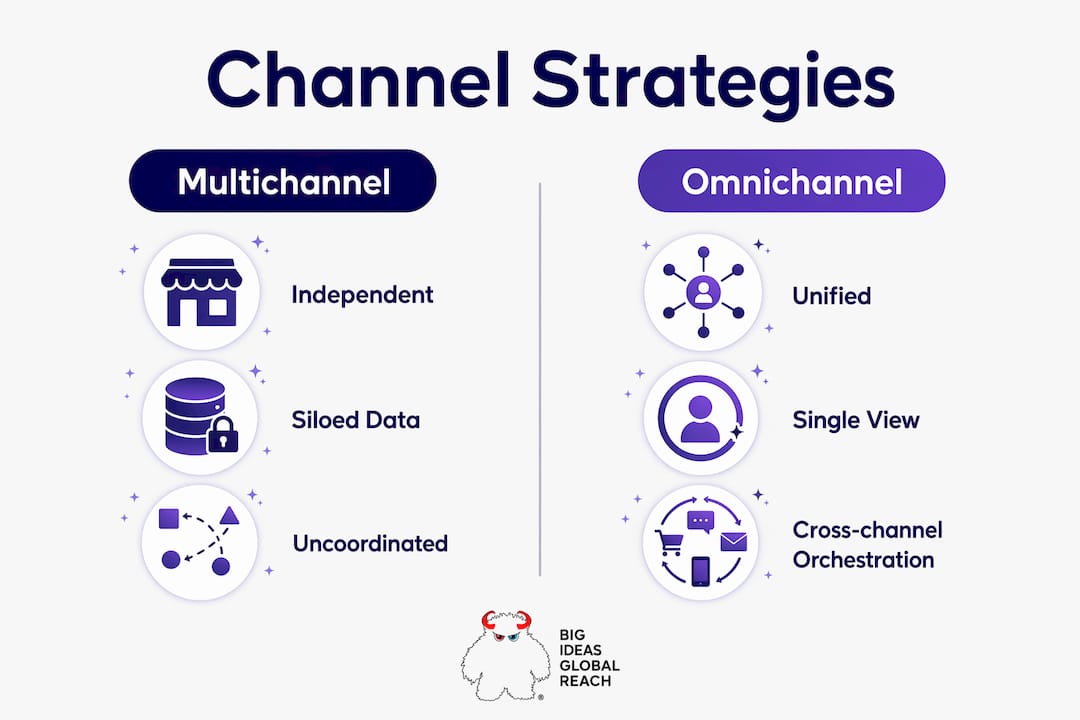
Omnichannel integration connects those channels around a single customer view so the discount email suppresses the retargeting ad, or the retargeting ad adjusts its message based on the email’s open status. The customer journey becomes coherent rather than fragmented.
| Feature | Multichannel | Omnichannel |
|---|---|---|
| Channel coordination | Independent, siloed | Unified around customer data |
| Customer experience | Fragmented, repetitive | Consistent, context-aware |
| Data architecture | Channel-specific records | Single customer view (SCV) |
| KPI structure | Per-channel metrics | Customer lifetime value (CLTV) |
| Organizational model | Departmental ownership | Cross-functional alignment |
The table above shows why omnichannel is an organizational challenge as much as a technology one. Multichannel can be managed by separate teams with separate goals. Omnichannel requires those teams to share data, share accountability, and optimize for the same outcome.
What are the core components of an omnichannel marketing strategy?
A working omnichannel marketing strategy rests on four pillars. Miss any one of them and the system breaks down at the seams.
1. Single customer view (SCV) Data unification into a single customer view is the prerequisite for everything else. Before you add channel integrations, you need one authoritative record per customer that captures behavioral data, purchase history, support interactions, and channel preferences. Without this, personalization is guesswork and journey orchestration is impossible.
2. Cross-channel orchestration Orchestration means using automation to trigger the right message on the right channel at the right moment based on real-time customer signals. Platforms like Salesforce Marketing Cloud, Klaviyo, and Braze handle this through journey builders that respond to behavioral triggers rather than scheduled batch sends. The result is communication that feels relevant rather than broadcast.
3. Real-time personalization Personalization at scale requires AI and machine learning to process behavioral signals faster than any human team can. Product recommendations, dynamic email content, and adaptive landing pages all depend on models trained on unified customer data. This is where AI-powered marketing infrastructure creates a measurable performance gap between businesses that have built the data foundation and those that have not.
4. Aligned teams and unified KPIs Misaligned departmental KPIs are one of the most common reasons omnichannel programs underperform. When the email team optimizes for open rates and the web team optimizes for session duration, neither is optimizing for what actually matters: total customer lifetime value. Unified KPIs focused on CLTV force cross-functional cooperation because no single team can move that number alone.
- Map your current customer data sources and identify gaps before selecting a CDP
- Audit existing channel KPIs and replace siloed metrics with shared CLTV targets
- Define two or three high-priority customer journeys to integrate first
- Select automation platforms that connect natively to your CRM and analytics stack
- Build a governance model that assigns data ownership and access across teams
Pro Tip: Start your omnichannel build with the post-purchase journey. It is the highest-intent moment in the customer lifecycle, the data is clean, and the ROI from retention improvements is immediate and measurable.
What business results does omnichannel marketing actually produce?
The performance data on omnichannel marketing is not ambiguous. Omnichannel customers spend 30% more per transaction, shop 70% more frequently, and spend 50% more overall than single-channel shoppers. Those numbers reflect a customer who is more engaged, more loyal, and more responsive to cross-sell and upsell communications because every interaction has been relevant and contextually aware.
At the revenue level, effective omnichannel strategies produce annual revenue increases of 10% to 15% alongside customer satisfaction score improvements of 20% to 30%. A 10% revenue lift on a $5 million business is $500,000 in incremental annual revenue. That is not a marketing metric. That is a business outcome that justifies infrastructure investment.
Customer lifetime value is the metric that ties all of this together. When retention improves, purchase frequency increases, and average transaction value rises, CLTV compounds. The business spends less on acquisition to maintain growth and more on deepening relationships with buyers who already trust the brand. That is the financial logic behind omnichannel as infrastructure rather than as a campaign tactic.
| Metric | Single-channel baseline | Omnichannel performance |
|---|---|---|
| Customer retention rate | 33% | 89% |
| Spend per transaction | Baseline | +30% |
| Purchase frequency | Baseline | +70% |
| Annual revenue uplift | Baseline | +10% to +15% |
| Customer satisfaction score | Baseline | +20% to +30% |
What are the biggest omnichannel implementation challenges?
Most omnichannel programs stall not because of technology limitations but because of organizational and data architecture problems that surface after the first integration attempt.
Data silos are the most common technical barrier. When customer records live separately in your e-commerce platform, your CRM, your email tool, and your support system, there is no single source of truth to orchestrate from. Resolving this requires a deliberate data unification project before any channel integration work begins.
Context continuity is the most visible failure mode for customers. 45% of consumers lose trust in AI support when human agents cannot access previous interaction data. That statistic points to a specific architectural gap: the handoff between automated and human touchpoints. Customers who have already explained their situation to a chatbot and then must repeat it to a live agent experience the brand as disorganized and indifferent.
Organizational alignment is the hardest problem to solve because it is not a technology purchase. It requires executive sponsorship, restructured incentives, and a governance model that gives cross-functional teams shared accountability for customer outcomes. Many businesses underestimate this work and over-invest in platforms before the organizational foundation is ready.
The most practical implementation path is to start with two or three high-impact journeys rather than attempting a full-channel integration at once. A focused onboarding journey or a cart abandonment sequence that spans email, SMS, and retargeting is manageable, measurable, and proves ROI before you commit to a broader rollout.
- Unify customer data into a single record before adding channel integrations
- Establish persistent context handoffs between AI and human support touchpoints
- Replace channel-specific KPIs with shared CLTV targets across marketing, sales, and service
- Pilot two or three customer journeys before scaling to the full channel mix
- Assign a cross-functional owner responsible for omnichannel performance, not just technology
Pro Tip: Before selecting a CDP or marketing automation platform, document your current data flows on a whiteboard. If you cannot trace a single customer record from first touch to purchase to support interaction, the technology will not fix that gap. Fix the data architecture first.
Key takeaways
Omnichannel marketing succeeds when unified customer data, cross-channel orchestration, and aligned organizational KPIs operate as a single revenue system rather than separate departmental programs.
| Point | Details |
|---|---|
| Data unification comes first | Build a single customer view before integrating channels or selecting automation tools. |
| Retention drives compounding revenue | Omnichannel businesses retain 89% of customers versus 33% for single-channel operators. |
| Context continuity is non-negotiable | Customers who must repeat themselves across channels lose trust and disengage from the brand. |
| Start small, prove ROI, then scale | Two or three focused customer journeys reduce risk and demonstrate measurable returns before full rollout. |
| Organizational alignment outweighs technology | Shared CLTV-focused KPIs across marketing, sales, and IT determine omnichannel success more than platform selection. |
Why omnichannel is an infrastructure decision, not a campaign decision
Most businesses approach omnichannel as a marketing project. They assign it to the digital team, buy a platform, and expect results within a quarter. That framing is why so many programs underdeliver.
Omnichannel is an infrastructure decision. It requires the same level of executive commitment and cross-functional coordination as a CRM implementation or an ERP migration. The technology is the easy part. The hard part is getting your email team, your paid media team, your sales team, and your customer service team to share data, share accountability, and optimize for the same number.
What I have seen consistently is that businesses with strong omnichannel results did not start with the best technology. They started with the clearest customer journey map and the most disciplined data governance. They knew exactly what a customer looked like at each stage of the lifecycle, and they built their channel integrations around that map rather than around their existing tool stack.
The other pattern worth noting: the businesses that fail at omnichannel almost always skip the organizational alignment work. They buy Salesforce Marketing Cloud or Adobe Experience Platform, run a few connected campaigns, and declare success. Six months later, the email team is back to batch-and-blast because their open rate targets do not reward journey-based sends. The technology is still there. The system is not.
Frame omnichannel as revenue infrastructure. Build the data foundation first. Align the teams before the tools. Start with the journeys that have the highest customer impact and the clearest measurement path. Then scale what works.
— Vector
How Monstrousmediagroup builds omnichannel systems that produce outcomes

Monstrousmediagroup designs and deploys integrated digital marketing systems that connect your channels, unify your customer data, and produce measurable revenue outcomes. From CDP architecture and marketing automation configuration to SEO infrastructure and AI-powered campaign management, Monstrousmediagroup builds the operational foundation that makes omnichannel work at scale. The work is not about adding more channels or running more campaigns. It is about building a system where every customer interaction compounds toward retention, lifetime value, and growth. If your current marketing stack is producing channel metrics but not revenue outcomes, that is the gap Monstrousmediagroup is built to close. Contact the team to map your current customer data architecture and identify where the highest-impact integration opportunities exist.
FAQ
What is omnichannel marketing in simple terms?
Omnichannel marketing is a strategy that connects all of your customer-facing channels, including email, paid ads, website, and in-store, around a single unified view of each customer so every interaction is consistent and context-aware.
How does omnichannel differ from multichannel marketing?
Multichannel marketing uses multiple channels independently with no shared customer data, while omnichannel marketing integrates those channels around a single customer record to deliver a coherent, personalized experience across every touchpoint.
What are the main benefits of omnichannel marketing?
Businesses with strong omnichannel engagement retain 89% of their customers compared to 33% for single-channel operators, and omnichannel customers spend 50% more overall than single-channel shoppers.
Where should a business start with omnichannel implementation?
Start by unifying customer data into a single customer view, then build two or three high-impact customer journeys before scaling to a full channel integration. This approach minimizes risk and proves ROI early.
Why do omnichannel programs fail?
The most common causes are data silos that prevent a unified customer view, misaligned departmental KPIs that reward channel metrics over customer lifetime value, and insufficient organizational alignment across marketing, sales, and IT teams.
Recommended
Hire the team to help you with your website, app, or other marketing needs.
We have a team of digital marketers who can help plan and bring to life all your digital marketing strategies. They can help with social media marketing, email marketing, and digital advertising!
CONTACT US
Comments