
 https://www.omahamediagroup.com/images/uploads/monster_gallery/Omaha-Media-Group-Black.jpg
admin
https://www.omahamediagroup.com/images/uploads/monster_gallery/Omaha-Media-Group-Black.jpg
admin
What Is Marketing Compliance? A 2026 Business Guide

TL;DR:
- Marketing compliance is an ongoing operational system that ensures all marketing activities adhere to applicable laws, regulations, and industry standards to protect revenue and brand credibility. It involves embedding legal, regulatory, and ethical requirements into workflows through automated, jurisdiction-aware processes, not just reactive reviews. Building compliance into systems enables faster, more scalable marketing while reducing legal and reputational risks in cross-border campaigns.
Marketing compliance isn’t a legal formality you hand off to your attorney once a year. It’s an operational system that determines whether your campaigns run, your brand survives scrutiny, and your revenue stays protected. What is marketing compliance, exactly? It’s the ongoing practice of aligning every marketing activity with applicable laws, regulations, and industry standards. For businesses running cross-border campaigns, a single misstep can trigger fines reaching CAD $10 million under CASL. That number alone reframes the conversation.
Table of Contents
- Key Takeaways
- What is marketing compliance and why it matters
- Key marketing regulations every business must know
- Common compliance challenges and how to solve them
- Building compliance as operational infrastructure
- Maintaining compliance as regulations evolve
- My honest take on compliance as a growth asset
- Build compliant marketing systems with Monstrous Media Group
- FAQ
Key Takeaways
| Point | Details |
|---|---|
| Compliance is infrastructure | Marketing compliance protects revenue and brand credibility, not just legal standing. |
| Regulations follow the recipient | Your campaign must comply with the laws where your audience lives, not where you operate. |
| Conflicts between laws are real | GDPR deletion rights and DORA’s 5-year immutable log requirement can directly contradict each other. |
| Strictest standard wins | Applying GDPR and CASL standards globally reduces risk and simplifies compliance management. |
| Automation reduces exposure | Centralized version control and automated legal clause insertion cut compliance errors at scale. |
What is marketing compliance and why it matters
The marketing compliance definition goes beyond avoiding fines. At its core, it means operating every marketing activity within the boundaries set by law, regulatory guidance, and ethical industry standards. That includes email campaigns, paid advertising, content marketing, data collection, and any communication that touches a potential or existing customer.
Think of it this way: compliance is the load-bearing wall of your marketing operation. Most businesses only notice it when it fails.
Here is what falls under its scope:
- Legal requirements: Federal and international laws like GDPR, CAN-SPAM, and CASL that carry enforceable penalties
- Regulatory guidance: Non-binding but practically significant documents from agencies that regulators treat as proof of legal compliance during enforcement actions
- Industry standards: Self-regulatory codes like the UK’s CAP Code, which governs advertising claims based on consumer perception rather than advertiser intent
- Internal policies: Documented procedures for content approval, data handling, and disclosure that protect the organization from internal compliance failures
The distinction between reactive and active compliance is where most organizations fail. Reactive compliance means your legal team reviews campaigns after they’re built. Active compliance means the guardrails are built into the workflow from the beginning. Compliance acts as a guardrail that improves marketing efficiency rather than slowing it down. When your team knows the rules in advance, they stop building campaigns that need to be rebuilt.
Pro Tip: Document your internal compliance policies as living operational procedures, not static PDFs. They should update when regulations change, not just when you get audited.
Key marketing regulations every business must know
The importance of marketing compliance becomes undeniable once you map the regulatory terrain your campaigns actually cross. There is no single global framework. Instead, the absence of a unified global standard forces businesses to manage layered, sometimes conflicting requirements simultaneously.
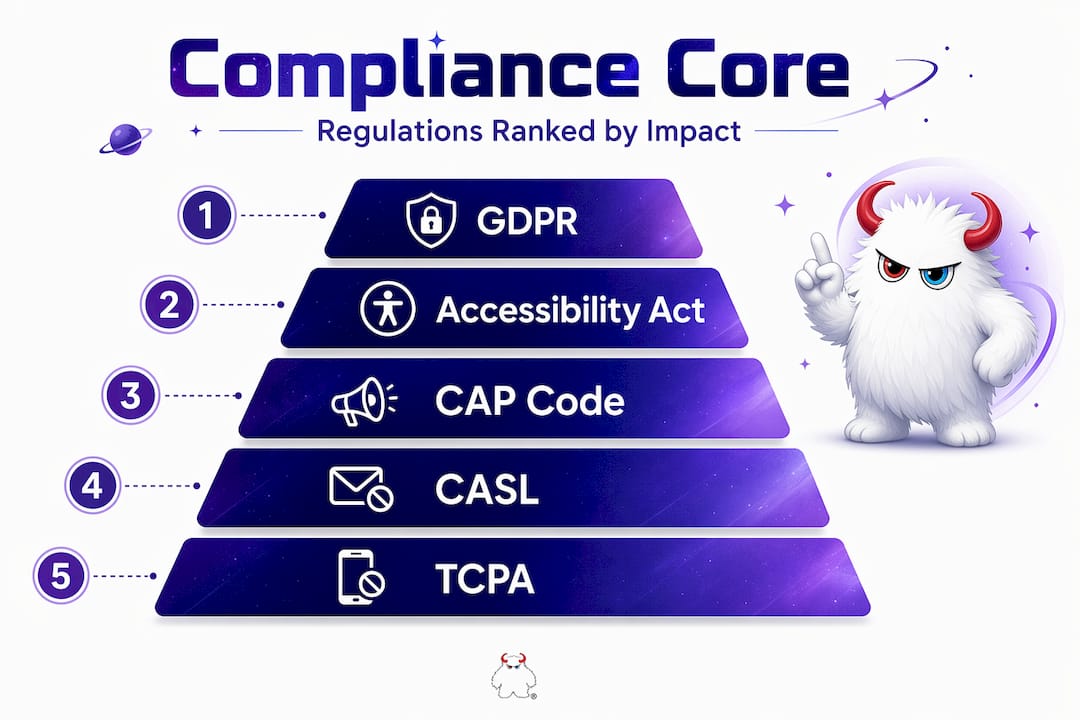
Here is a practical breakdown of the major frameworks:
| Regulation | Jurisdiction | Key Requirement | Penalty Exposure |
|---|---|---|---|
| GDPR | EU / EEA | Explicit opt-in consent, deletion rights, data minimization | Up to 4% of global annual revenue |
| CAN-SPAM | United States | Opt-out mechanism, honest subject lines, physical address | Up to $51,744 per email |
| CASL | Canada | Express or implied consent before sending, unsubscribe in 10 days | Up to CAD $10 million per violation |
| CCPA | California, USA | Consumer data access, deletion rights, opt-out of sale | Up to $7,500 per intentional violation |
| FTC Guidelines | United States | Truthful advertising, AI and influencer disclosures | Injunctions and civil penalties |
The principle that cuts across all of these is critical: regulations follow the recipient’s location, not the sender’s. If you are based in Texas and send an email to someone in Germany, GDPR applies to that message. If you send to Canada, CASL controls. This geographic anchoring means any campaign with an international audience triggers a multi-jurisdictional compliance requirement by default.
Two emerging areas demand attention in 2026. The European Accessibility Act now requires digital communications to meet accessibility standards for users with disabilities. The FTC has also introduced disclosure requirements for AI-generated content in advertising, meaning campaigns built with generative AI tools need clear labeling in certain contexts. Marketing regulations explained through yesterday’s frameworks will leave you exposed to tomorrow’s enforcement actions.
Compliance in advertising also extends to how your creative assets communicate. Under standards like the UK CAP Code, marketing compliance is judged on consumer perception, not advertiser intent. An image of a product alongside a health claim, even without explicit wording, can be treated as a regulated health claim if a reasonable consumer would interpret it that way.

Common compliance challenges and how to solve them
Understanding why compliance in marketing breaks down requires an honest look at operational friction. The problems are predictable. The solutions require deliberate systems.
-
Consent collection and documentation: Most businesses collect consent but store it poorly. When regulators ask for proof that a subscriber opted in, you need a timestamped, auditable record. Consent captured in a spreadsheet does not hold up.
-
Unsubscribe mechanism failures: CAN-SPAM requires opt-out requests to be honored within 10 business days. CASL requires action within 10 calendar days. If your email platform processes unsubscribes on a weekly batch, you are already out of compliance. Audit your suppression workflow now, not after a complaint.
-
Data retention conflicts: Financial services firms face a particularly sharp version of this problem. GDPR and CCPA grant consumers the right to request data deletion. DORA, the EU’s Digital Operational Resilience Act, mandates immutable ICT logs for at least 5 years. When a customer requests deletion of their data under GDPR and that data overlaps with operationally required logs under DORA, you face a genuine legal conflict requiring documented policy decisions, not guesswork.
-
Misleading advertising through imagery and tone: Your campaign does not need to explicitly state a false claim to trigger regulatory action. Consumer perception standards mean that an image, a color choice, or a testimonial format can create implied claims subject to enforcement.
-
Multi-channel coordination: A single campaign running across email, paid search, and display ads often involves different teams, vendors, and approval chains. Each channel may carry different disclosure requirements, and gaps between them create exposure.
Pro Tip: For international campaigns, apply the strictest global standards uniformly rather than tailoring compliance per country. Using GDPR and CASL as your baseline across all markets reduces risk and simplifies your compliance architecture significantly.
Building compliance as operational infrastructure
How to ensure marketing compliance at scale requires moving beyond checklists. The businesses that manage compliance well treat it as a system, not a review step.
Effective compliance infrastructure includes the following components:
- Centralized content and version control: One source of truth for approved message templates prevents teams from using outdated or unapproved language. Centralized version control in marketing platforms allows dynamic updates to legal clauses across all active campaigns simultaneously.
- Automated conditional logic: Jurisdiction-aware platforms can insert the correct legal disclosures, consent language, and opt-out mechanisms based on recipient location without requiring manual intervention for each campaign.
- Immutable archiving and audit trails: Every sent communication, consent record, and unsubscribe request should be logged in a format that cannot be altered. This is your defense in any regulatory inquiry.
- Regular list hygiene: Inactive addresses and invalid contacts create deliverability problems and inflate your compliance exposure. Quarterly list audits are a minimum standard.
- Documented training programs: Your marketing team and compliance officers need documented, version-controlled training records. “We trained everyone” is not a compliance defense. Proof of training on specific policies and dates is.
Customer Communication Management platforms, often called CCM platforms, are built specifically for this operational model. They coordinate message templates, embed legal clauses dynamically, and maintain the audit infrastructure that regulators expect.
Maintaining compliance as regulations evolve
Marketing compliance is not a one-time project. The regulatory environment shifts continuously, and your systems must accommodate that movement without breaking.
The practical approach includes:
- Assign a designated owner for regulatory monitoring. This person tracks updates from the FTC, EU regulators, and relevant industry bodies and translates them into operational changes before deadlines.
- Build your compliance architecture with modular legal clauses rather than hardcoded language. When a regulation changes, you update the clause library, and the change propagates across all active templates automatically.
- Schedule quarterly reviews between marketing, legal, and compliance teams. These should be structured working sessions, not status updates. Bring specific campaign examples and identify gaps together.
- Treat regulatory guidance documents as operationally binding even when they are technically non-binding. Agencies treat alignment with their guidance as practical proof of legal compliance, and that matters in enforcement contexts.
- Scale your governance model with your business. A startup running three campaigns can manage compliance manually. A company running 40 campaigns across six markets cannot. Build the governance structure before you need it, not after a violation forces it.
My honest take on compliance as a growth asset
I’ve spent years watching businesses treat marketing compliance as the department that slows campaigns down. It’s one of the most expensive misconceptions in the industry.
The organizations I’ve seen handle compliance well share one trait: they built the rules into the system before the campaign existed. Their teams never get surprised by legal review because legal requirements are already embedded in the workflow. That’s not bureaucracy. That’s speed.
The misconception that compliance is red tape comes from organizations that bolt it on at the end. When a lawyer is reviewing a finished campaign the night before launch, compliance absolutely feels like an obstacle. But when consent logic is automated, disclosure language is pre-approved, and every template is jurisdiction-aware from day one, the marketing team moves faster, not slower.
I’ve also seen what happens when compliance fails at scale. A single enforcement action from a regulator doesn’t just carry financial penalties. It triggers operational audits, reputational coverage, and customer trust erosion that outlasts the fine by years. The FTC, CASL enforcement bodies, and EU data protection authorities have all demonstrated they will pursue enforcement publicly. That publicity is often more damaging than the penalty itself.
Compliance isn’t a constraint on your marketing program. It’s the infrastructure that makes your marketing program defensible, sustainable, and scalable.
— Vector
Build compliant marketing systems with Monstrous Media Group
Marketing compliance doesn’t fix itself through awareness alone. It requires systems that embed the rules directly into your marketing operations before campaigns go live.

Monstrousmediagroup builds digital marketing infrastructure designed to generate revenue while operating within the legal and regulatory frameworks your business faces. From consent management to jurisdiction-aware campaign architecture, MMG’s marketing automation solutions eliminate the last-minute compliance scrambles that delay launches and expose businesses to regulatory risk. The goal isn’t compliance for its own sake. It’s compliant systems that produce consistent, protected revenue growth. If your current marketing operation handles compliance as an afterthought, Monstrousmediagroup can help you rebuild it as infrastructure.
FAQ
What is the marketing compliance definition?
Marketing compliance is the practice of aligning all marketing activities with applicable laws, regulations, and industry standards. It covers everything from email consent requirements to advertising disclosure rules and data protection obligations.
Why does compliance in marketing matter for business owners?
Non-compliance exposes businesses to substantial financial penalties, reputational damage, and operational disruption. Violations of regulations like CASL can result in fines up to CAD $10 million, making compliance a direct revenue protection issue.
Which regulation applies when marketing across borders?
Regulations follow the recipient’s location, not the sender’s. A U.S.-based business emailing a Canadian recipient must comply with CASL, and emailing an EU resident triggers GDPR requirements regardless of where the sender operates.
How do you ensure marketing compliance in a large organization?
Effective compliance requires centralized content version control, automated jurisdiction-aware legal clause insertion, immutable audit trails, regular list hygiene, and documented training programs for both marketing and compliance teams.
What is the biggest compliance risk in digital advertising?
Beyond data privacy violations, one of the most underestimated risks is misleading advertising through implied claims. Regulators assess compliance based on consumer perception, meaning imagery and tone can create enforceable claims even without explicit false statements.
Recommended
Hire the team to help you with your website, app, or other marketing needs.
We have a team of digital marketers who can help plan and bring to life all your digital marketing strategies. They can help with social media marketing, email marketing, and digital advertising!
CONTACT US
Comments