
 https://www.omahamediagroup.com/images/uploads/monster_gallery/Omaha-Media-Group-Black.jpg
admin
https://www.omahamediagroup.com/images/uploads/monster_gallery/Omaha-Media-Group-Black.jpg
admin
What is local SEO: a complete guide for small businesses

Most small business owners understand the importance of SEO, but many confuse it with local SEO or assume they’re the same thing. Local SEO is a specialized approach focused on optimizing your online presence to attract customers in your specific geographic area. While traditional SEO aims to rank your website globally, local SEO ensures you appear when nearby customers search for services like yours. This guide explains what local SEO is, why it matters for your business, and how to implement effective strategies that drive real foot traffic and local conversions.
Table of Contents
- Key takeaways
- What is local SEO and how does it differ from traditional SEO?
- Key components of local SEO you need to optimize
- Common local SEO challenges and how to overcome them
- Measuring local SEO success: key metrics and tools
- Enhance your local SEO with expert digital marketing services
- Frequently asked questions
Key Takeaways
| Point | Details |
|---|---|
| Local vs Traditional | Local SEO targets geographic queries and nearby customers while traditional SEO aims for broad rankings without location focus. |
| Google Business Profile | Claiming and optimizing your Google Business Profile improves local visibility with accurate hours, photos, categories, and updates. |
| NAP consistency | Maintain consistent name, address, and phone across all directories to avoid trust issues and improve rankings. |
| Local citations and reviews | Build local citations and manage reviews because they influence rankings and trust. |
| Location content and mobile | Create location specific content and optimize for mobile to boost local search visibility and foot traffic. |
What is local SEO and how does it differ from traditional SEO?
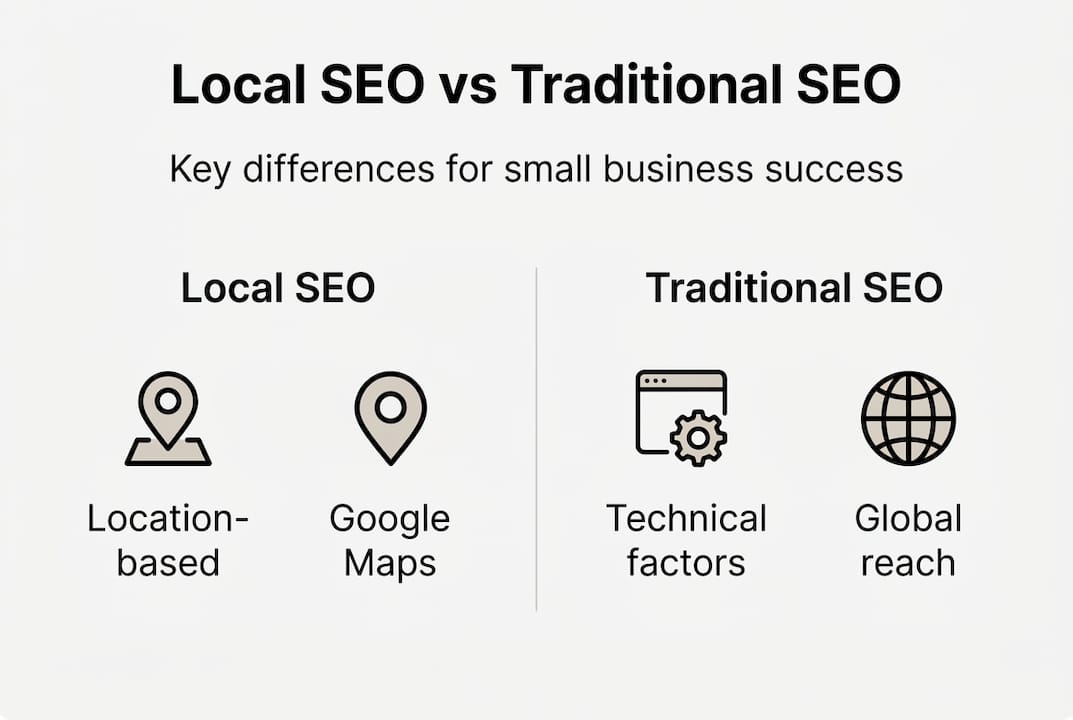
Local SEO focuses on optimizing online presence to attract local customers and rank in localized search results. Unlike traditional SEO, which targets broad keyword rankings regardless of location, local SEO zeroes in on customers within a specific geographic radius. When someone searches for “plumber near me” or “coffee shop in downtown Omaha,” local SEO determines which businesses appear in those results.
Traditional SEO focuses on ranking for competitive keywords on a national or global scale. You might optimize for “best running shoes” and compete with major retailers worldwide. Local SEO, however, targets searches with geographic intent like “running shoe store in Lincoln” or “shoe repair near me.” The competition is smaller, but the intent is higher because these searchers are ready to visit or call.
The tactics differ significantly too. Local SEO requires:
- Claiming and optimizing your Google Business Profile with accurate hours, photos, and categories
- Building local citations across directories like Yelp, Yellow Pages, and industry-specific platforms
- Managing customer reviews and responding to feedback publicly
- Creating location-specific content that mentions neighborhoods, landmarks, and local events
- Ensuring NAP (name, address, phone) consistency across every online mention
Traditional SEO prioritizes technical elements like site speed, backlink quality, and content depth without geographic considerations. Local SEO incorporates these elements but adds location signals that tell Google exactly where you serve customers. Your website might rank well nationally, but without local SEO strategies, you’ll miss the customers searching in your backyard.
Pro Tip: Even if you serve customers nationwide, implementing local SEO for your physical location builds credibility and captures high-intent local traffic that converts at higher rates than cold national traffic.
The integration matters too. Local SEO doesn’t replace your broader digital marketing strategy. It complements it by ensuring you dominate your immediate market while building toward larger goals. A restaurant chain needs both: local optimization for each location and brand-level SEO for corporate visibility. Small businesses often see faster ROI from local efforts because the competition is manageable and the customer intent is crystal clear.
Key components of local SEO you need to optimize
Google Business Profile is a critical tool for maximizing local search visibility and improved customer engagement. Your profile appears in the local map pack, the three business listings that show up above organic results for local searches. Claiming your profile is free and essential. Add high-quality photos of your storefront, products, and team. Select accurate business categories. Post updates about special offers or events. Complete every section, including attributes like “wheelchair accessible” or “free Wi-Fi.” The more complete your profile, the more likely Google will show it to searchers.
Local citations are mentions of your business name, address, and phone number across the web. Consistency is everything. If your website says “123 Main Street” but Yelp says “123 Main St.,” search engines see conflicting information and may not trust either. Build citations on:
- Major directories like Google, Bing Places, Apple Maps, and Facebook
- Industry-specific platforms relevant to your business type
- Local chambers of commerce and business associations
- News sites and local blogs that mention your business
Reviews directly impact your rankings and conversion rates. Google considers review quantity, quality, recency, and diversity when ranking local businesses. A business with 50 recent reviews will typically outrank a competitor with 10 old reviews, assuming other factors are equal. Encourage satisfied customers to leave reviews by making it easy. Send follow-up emails with direct review links. Train staff to ask for reviews at the point of sale. Respond to every review, positive or negative, to show you value feedback.

Pro Tip: Never buy fake reviews or incentivize positive reviews with discounts. Google detects these patterns and can penalize your entire profile, tanking your local rankings overnight.
Your website must work flawlessly on mobile devices. Over 60% of local searches happen on smartphones, often while people are on the go. If your site loads slowly or displays poorly on mobile, you lose those customers immediately. Implement responsive design that adapts to any screen size. Optimize images and minimize code to improve load times. Make your phone number clickable so mobile users can call with one tap.
| Component | Primary benefit | Implementation priority |
|---|---|---|
| Google Business Profile optimization | Appears in map pack results | High - start immediately |
| Local citations | Builds authority and trust | High - ongoing maintenance |
| Review management | Improves rankings and conversions | High - continuous effort |
| Mobile optimization | Captures on-the-go searchers | Medium - technical requirement |
| Local content creation | Signals relevance to area | Medium - supports other efforts |
Local backlinks from other area businesses, news sites, and community organizations signal to Google that you’re an established part of the local ecosystem. Sponsor a little league team and get a link from their website. Partner with complementary businesses for cross-promotion. Pitch story ideas to local news outlets. These links carry more weight for local rankings than generic directory links because they demonstrate real community connections.
Common local SEO challenges and how to overcome them
Many local businesses struggle with inconsistent citation data and poor review management, which hinders their search rankings. Inconsistent NAP information is the most common killer of local SEO success. You moved offices two years ago but forgot to update your Yelp listing. Your phone number changed but old directories still show the disconnected line. Every inconsistency tells Google your business information isn’t reliable.
Fix this systematically. Create a spreadsheet of every platform where your business appears. Update each one with identical information. Use the exact same format everywhere: if you abbreviate “Street” as “St.” on your website, do it everywhere. Set calendar reminders to audit your citations quarterly. When you change anything, update everywhere simultaneously.
Duplicate listings split your authority and confuse customers. Maybe you claimed your Google Business Profile, but a previous owner or employee also claimed it years ago. Now you have two profiles competing against each other, each with different information and reviews. Google may show the wrong one or neither. Search for your business name in Google Maps. If you see duplicates, claim both and request Google merge them through the support process.
Negative reviews damage your reputation and rankings, but having few or no reviews is almost worse. It signals to both Google and potential customers that you’re either new, unpopular, or not trustworthy. The solution isn’t to avoid reviews but to actively generate positive ones that outnumber the negative. Build a systematic review generation process:
- Identify your happiest customers and ask them personally
- Send automated follow-up emails after successful transactions
- Train your team to request reviews during positive interactions
- Make the process simple with direct links to your review profiles
Pro Tip: When you receive a negative review, respond professionally within 24 hours. Acknowledge the issue, apologize if appropriate, and offer to make it right. Future customers reading reviews care more about how you handle problems than whether you ever had one.
Mobile optimization failures cost you the majority of local traffic. Your desktop site looks beautiful, but mobile users see tiny text, buttons they can’t tap, and pages that take 10 seconds to load. They bounce immediately and choose a competitor. Test your site on actual mobile devices, not just browser simulators. Use Google’s Mobile-Friendly Test tool. Implement accelerated mobile pages (AMP) for key landing pages. Ensure forms work smoothly on touchscreens.
Lack of SEO knowledge stalls progress because local SEO challenges require ongoing attention and expertise. Algorithm updates change ranking factors. Competitors optimize their profiles. New platforms emerge. If you’re trying to learn everything while running your business, you’ll always be behind. Consider whether your time is better spent on core business activities while experts handle your local SEO. The ROI calculation often favors outsourcing because professionals implement strategies faster and avoid costly mistakes.
Measuring local SEO success: key metrics and tools
Tracking metrics such as local search rankings, website traffic, and Google Business Profile insights is essential to assess local SEO effectiveness. Without measurement, you’re optimizing blind. Start with local search rankings for your target keywords. Track where you rank for searches like “your service + your city” from different devices and locations. Rankings fluctuate, so monitor trends over weeks and months rather than obsessing over daily changes.
Organic traffic from local searches tells you whether your optimization efforts drive actual visitors. Use Google Analytics to segment traffic by geographic location. Filter for visitors from your service area. Track which pages they visit and whether they complete desired actions like calling, filling out forms, or visiting your location. Set up goals for these conversions so you can measure ROI directly.
Google Business Profile insights provide data you can’t get anywhere else:
- How customers found your listing (direct search vs. discovery vs. branded)
- Actions they took (website visits, direction requests, phone calls)
- Photo views and comparisons to similar businesses
- Search queries that triggered your profile
Check these insights weekly. If direction requests spike on weekends, ensure you’re staffed appropriately. If phone calls drop after a competitor opens nearby, you know you need to improve your competitive positioning.
| Metric | What it measures | Target benchmark |
|---|---|---|
| Local pack rankings | Visibility in map results | Top 3 for primary keywords |
| Organic local traffic | Website visitors from area | 20%+ month-over-month growth |
| Google Business Profile views | Profile impressions | Increasing trend |
| Review rating | Customer satisfaction | 4.5+ stars average |
| Conversion rate | Visitors who take action | 3-5% for service businesses |
Google Search Console shows which search queries bring traffic to your site and where you rank for each. Filter by location to see local performance. Identify queries where you rank on page two (positions 11-20) because these represent quick win opportunities. Small optimizations can push you to page one where click-through rates jump dramatically.
Third-party tools like BrightLocal, Moz Local, or Whitespark help monitor citations across hundreds of directories simultaneously. They alert you to inconsistencies, new mentions, and competitor activity. These tools cost money but save hours of manual checking. They also track review generation across multiple platforms from one dashboard.
Analyze data monthly to identify patterns and opportunities. Did a specific blog post about a local event drive unusual traffic? Create more local content. Did your rankings drop after a Google algorithm update? Research what changed and adjust your strategy. Local SEO success metrics should tie directly to business outcomes like increased calls, foot traffic, and revenue. If your rankings improve but revenue doesn’t, something in your conversion funnel needs attention.
Enhance your local SEO with expert digital marketing services
Local SEO requires consistent effort, technical expertise, and strategic thinking that pulls you away from running your business. Professional SEO services in Omaha implement proven strategies that increase your local visibility while you focus on serving customers. We build systems that generate, capture, and close more revenue without adding chaos to your operations.

Our digital marketing services integrate local SEO with broader marketing efforts to maximize your ROI. We optimize your Google Business Profile, build authoritative citations, manage your review generation, and create local content that resonates with your community. Our web design and development services ensure your website provides the mobile-optimized, fast-loading experience that local searchers demand. We don’t chase vanity metrics. We deliver measurable outcomes that impact your bottom line.
Frequently asked questions
What is local SEO?
Local SEO is the practice of optimizing your online presence to attract customers from specific geographic areas through location-based search results. It focuses on appearing in Google’s local map pack, local organic results, and location-specific searches. Unlike traditional SEO that targets broad keywords, local SEO emphasizes proximity, relevance, and prominence for nearby searchers.
How long does local SEO take to show results?
Most businesses see initial improvements in 3-6 months with consistent optimization efforts. Quick wins like claiming your Google Business Profile and fixing NAP inconsistencies can show results within weeks. Competitive markets and established competitors require longer timeframes, often 6-12 months for significant ranking improvements. Local SEO is ongoing because competitors constantly optimize and algorithms regularly update.
Do I need a physical location for local SEO?
Yes, legitimate local SEO requires a physical location where customers can visit or where you conduct business. Service area businesses (plumbers, electricians) can hide their address but must serve customers at their locations. Google prohibits virtual offices and PO boxes for Business Profiles. If you operate entirely online without serving specific geographic areas, traditional SEO strategies are more appropriate than local SEO.
How important are online reviews for local SEO?
Online reviews are critical ranking factors and trust signals for local SEO success. Google considers review quantity, rating, recency, and response rate when determining local rankings. Businesses with more positive recent reviews typically outrank competitors with fewer or older reviews. Reviews also influence customer decisions, with most consumers reading reviews before visiting a local business. Actively generating and managing reviews should be a top priority.
Can I do local SEO myself or should I hire an expert?
Basic local SEO tasks like claiming your Google Business Profile and building initial citations are manageable for motivated business owners. However, comprehensive local SEO requires ongoing technical expertise, competitive analysis, content creation, and strategy adjustments that consume significant time. Most small businesses find better ROI by focusing on their core operations while experts handle optimization. The cost of hiring professionals is typically offset by faster results and avoided mistakes that can damage your rankings.
Recommended
Hire the team to help you with your website, app, or other marketing needs.
We have a team of digital marketers who can help plan and bring to life all your digital marketing strategies. They can help with social media marketing, email marketing, and digital advertising!
CONTACT US
Comments