
 https://www.omahamediagroup.com/images/uploads/monster_gallery/Omaha-Media-Group-Black.jpg
admin
https://www.omahamediagroup.com/images/uploads/monster_gallery/Omaha-Media-Group-Black.jpg
admin
Website Redesign Process: A Revenue-First Guide

TL;DR:
- Most businesses treat website redesigns as cosmetic changes, risking SEO loss and revenue decline without a strategic plan. A system-level approach includes thorough audits, precise redirect mapping, and staged launches to protect organic traffic and rankings. Post-launch monitoring and stakeholder accountability are critical to achieving a successful, revenue-preserving website transformation.
Most businesses treat a website redesign as a cosmetic exercise. They pick new colors, swap out photography, and ship a fresh layout without a structured plan. The result is predictable: organic traffic drops, conversion rates stall, and the revenue that was supposed to improve gets worse. A poorly executed website redesign process can erase years of SEO equity overnight. This guide gives business owners and marketing managers a system-level playbook for every phase of redesign, from pre-launch audits to post-launch monitoring, so you protect what you have and build on it.
Table of Contents
- Key takeaways
- The website redesign process starts with planning
- Executing the redesign from design through development
- SEO-safe migration and launch strategy
- Post-launch verification and ongoing optimization
- My take on what most redesigns get wrong
- How Monstrous Media Group approaches redesigns
- FAQ
Key takeaways
| Point | Details |
|---|---|
| Audit before you design | A thorough content and SEO audit before any design work prevents ranking losses and revenue disruption. |
| Redirect mapping is non-negotiable | A redesign without a URL redirect plan risks losing 20 to 40% of organic traffic. |
| Content drives design, not the opposite | Wireframes built around content hierarchy produce better UX and stronger search performance. |
| Staged launches reduce risk | Incremental rollout strategies catch issues before they reach your full audience and damage rankings. |
| Post-launch monitoring is part of the process | Analytics, crawl reports, and Core Web Vitals data require active monitoring for at least two weeks after launch. |
The website redesign process starts with planning
Skipping the planning phase is the single most expensive mistake in a website redesign. Before any wireframe gets drawn, you need a documented baseline of exactly what you have and what you intend to protect.
Start with a full content and SEO audit. Catalog every page, its URL, its organic ranking position, its inbound link count, and its conversion contribution. This is not optional. A comprehensive URL inventory and redirect mapping exercise must happen before development begins. Without it, you are guessing which pages matter, and guesses cost traffic.
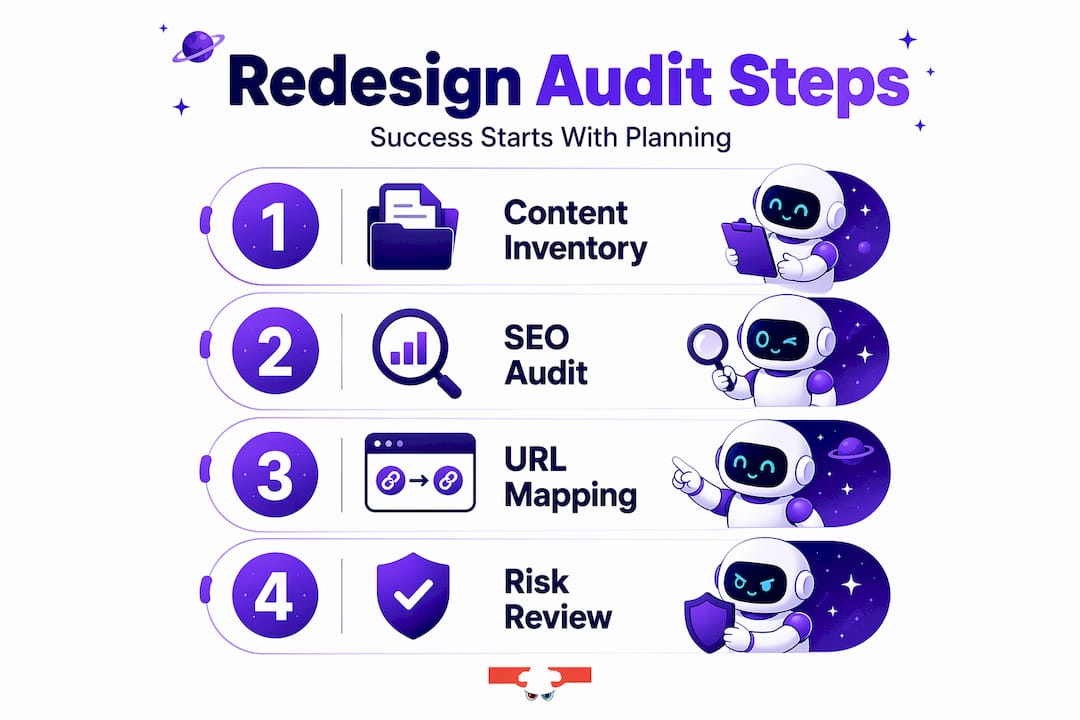
Pair that audit with clearly defined business goals and KPIs. A redesign should answer specific revenue questions. Which pages drive the most qualified leads? Where are users dropping out of the conversion funnel? What load time or usability problems are actively costing you conversions? Tie every design decision back to a measurable outcome.
Here is a practical website redesign checklist for the planning phase:
- Export a complete URL inventory with traffic, ranking, and link data
- Identify high-value pages that must preserve their URLs or receive clean 301 redirects
- Document business goals, KPIs, and the specific user problems the redesign must solve
- Gather stakeholder requirements and align on technical constraints before any vendor is selected
- Define the content structure for the new site before any visual design begins
Pro Tip: Create a spreadsheet that maps every current URL to its intended new destination before your development team writes a single line of code. This one artifact eliminates the most common and costly redesign mistakes.
| Planning Task | Risk If Skipped |
|---|---|
| URL inventory | Redirect gaps cause 404 errors and traffic loss |
| SEO audit | High-value pages get deleted without replacement |
| Goal and KPI definition | Redesign solves aesthetic problems, not revenue problems |
| Stakeholder requirements | Scope creep and project delays |
| Content structure mapping | Design gets built before content is ready, requiring costly revisions |
Executing the redesign from design through development
Once planning is complete, the execution phase runs far more predictably. The order of operations matters as much as the quality of the work.
Start with a content-first design approach. Design should follow content structure and hierarchy, not precede it. Build wireframes around the actual content, page purpose, and user flow. Skipping this step produces pages where the content gets squeezed into a template that was never built for it, which hurts both readability and search performance.
The numbered execution sequence that consistently produces the best outcomes:
- Finalize content architecture and site map based on audit findings and business goals
- Build wireframes that reflect actual content blocks, not placeholder text
- Develop high-fidelity prototypes for key conversion pages and gather internal stakeholder feedback
- Select the technology platform with infrastructure longevity in mind, not just current cost
- Build on a staging environment that mirrors the production server configuration exactly
- Apply Core Web Vitals optimization techniques during development, not as an afterthought
- Validate all redirects in the staging environment before a single URL goes live
- Run a full pre-launch SEO audit comparing staging to production for title tags, meta descriptions, canonical tags, and structured data
On technology platform selection: the infrastructure decision is where many marketing managers underinvest. A platform that is easy to launch on but difficult to maintain creates compounding technical debt. Evaluate your CMS for speed, update frequency, plugin dependency risks, and developer availability.
On Core Web Vitals specifically, Google’s thresholds for optimal performance are LCP at or below 2.5 seconds, INP at or below 200ms, and CLS at or below 0.1. Quick wins during development include preloading hero images with "fetchpriority=‘high’`, inlining critical CSS, deferring non-essential scripts, and setting explicit image dimensions to eliminate layout shifts. Reviewing image optimization practices before launch prevents a significant share of CLS and LCP problems.
Staged development and launch phases reduce risk substantially compared to a single full-site release. Incremental testing allows your team to catch broken redirects, missing metadata, and tracking failures before they affect your entire audience.
Pro Tip: Do not run your Core Web Vitals assessment only in a lab tool like Lighthouse. Lab tools give you immediate diagnostics, but field data in Google Search Console updates on a rolling 28-day basis. Plan your launch timeline accordingly.
SEO-safe migration and launch strategy
This is where the most revenue is at risk, and where the most discipline is required. A structured migration strategy is the difference between a redesign that strengthens your organic presence and one that takes six months to recover from.
The foundation is a validated 301 redirect map. Every old URL that will change must point directly to its new destination. Redirect chains are a major SEO and performance risk. Flatten them before launch. A chain where URL A redirects to URL B which redirects to URL C bleeds link equity at every step and slows crawl efficiency. Each redirect should resolve in a single hop.
| Redirect Type | Impact on SEO | Best Practice |
|---|---|---|
| 301 (permanent) | Passes most link equity | Use for all permanent URL changes |
| 302 (temporary) | Does not transfer equity | Only for genuinely temporary changes |
| Redirect chains (3+ hops) | Significant equity loss | Flatten to single-hop before launch |
| No redirect (404) | Complete equity loss | Never acceptable for high-value pages |
Pre-launch audits should compare your staging environment directly against the current live site. Check that all canonical tags, hreflang attributes, title tags, meta descriptions, structured data, and XML sitemaps are accurate on staging before go-live. Also verify that analytics tracking and conversion events fire correctly in the staging environment under production-like conditions.
For rollout strategy, a staged launch works better than flipping the entire site at once. Launch lower-traffic sections first, monitor for crawl errors and 404 spikes, then proceed to higher-traffic pages. During the launch window, maintain a code freeze on non-essential changes so that any anomalies in search behavior can be attributed to the migration and not to unrelated site changes.
- Submit the updated XML sitemap to Google Search Console immediately after launch
- Monitor crawl error reports daily for the first two weeks
- Watch for spikes in 404 responses, which signal redirect mapping gaps
- Confirm that ranking positions for your highest-value pages hold or recover within the expected timeframe
Pro Tip: Build a “redirect validation” spreadsheet before launch that includes every mapped URL, its expected destination, and the HTTP status code returned. Run it against the live site the morning of launch using a crawler tool. Surprises here are far cheaper to fix at 6 a.m. than after Google has indexed the broken state.
Post-launch verification and ongoing optimization
Launching the redesigned site is not the finish line. It is the start of the verification phase, and skipping it is how redesigns go from “successful launch” to “why did our rankings drop” three weeks later.

Post-launch monitoring of analytics tags, conversion tracking, and crawl reports for at least one to two weeks is critical. Early identification of 404 spikes or redirect chain growth prevents the ranking drops and conversion losses that otherwise go undiagnosed for months.
Key monitoring activities for the post-launch period:
- Track Core Web Vitals in Google Search Console weekly, remembering that field data reflects a 28-day rolling window
- Review user behavior data, specifically scroll depth, exit rates on conversion pages, and form completion rates, to identify UX friction the design introduced
- Audit internal links to confirm they point directly to new URLs rather than through redirect hops. Unupdated internal links dilute link equity and slow page speed
- Set up automated alerting for 404 spikes and significant drops in organic sessions so problems surface before they compound
- Review heatmaps and session recordings on redesigned conversion pages within the first 30 days
For ongoing improvement, treat the post-launch period as a continuous optimization sprint rather than a project closeout. User behavior data from the first 60 days will reveal design assumptions that did not hold in practice. Conversion rates should improve measurably within 90 days if the redesign addressed the right friction points.
Pro Tip: Segment your post-launch analytics by traffic source. Organic traffic, paid traffic, and direct traffic respond differently to a redesign. Isolating the organic segment lets you detect SEO-specific issues without noise from other channels masking the signal.
My take on what most redesigns get wrong
I have reviewed enough website redesigns to recognize the pattern that kills them. The teams are capable. The design looks better. The stakeholders are happy on launch day. And then the organic traffic chart bends downward and stays there for six months.
The root cause is almost always the same: the redesign was treated as a visual project, not a systems project. SEO preservation was not built into the workflow from day one. The redirect map was assembled in the final week before launch. Internal links were never updated after the URL structure changed. Nobody owned post-launch monitoring.
What I have learned is that the businesses that come out of a redesign stronger than before treat it as a revenue protection exercise first. Every decision, from the platform choice to the redirect strategy to the content architecture, gets evaluated against the question: does this protect or grow our organic and conversion performance?
Stakeholder management is the other underestimated variable. Design opinions multiply fast inside organizations. Without a documented goal framework tied to measurable outcomes, every stakeholder’s preference carries equal weight, and the project drifts from revenue objectives toward aesthetic consensus. That consensus rarely converts.
The best redesigns I have seen operate with a single accountable owner who understands both the business goals and the technical implications. Design by committee produces websites that look fine and perform poorly.
— Vector
How Monstrous Media Group approaches redesigns

Monstrousmediagroup builds website redesign projects as infrastructure systems, not creative exercises. Every engagement begins with the same question: what revenue is currently leaking from this site, and what does the new architecture need to do to stop it? That means SEO preservation is built into the project plan from week one, redirect mapping is validated before development begins, and Core Web Vitals targets are defined alongside design specifications.
If your redesign needs to protect organic rankings, improve conversion rates, and run on managed web infrastructure that does not require constant internal oversight, Monstrousmediagroup has the systems to deliver that. Explore SEO services and digital marketing solutions that work alongside your redesign, not after it.
FAQ
What is the first step in a website redesign process?
The first step is conducting a full content and SEO audit of the existing site. This establishes a baseline of what pages have ranking value, which URLs must be preserved or redirected, and what business goals the redesign must address.
How do I avoid losing SEO rankings during a website redesign?
Build a complete 301 redirect map before development begins, run a pre-launch audit comparing staging to your live site, and monitor crawl errors and ranking data for at least two weeks after launch. A redesign without a redirect plan risks losing 20 to 40% of organic traffic.
What are Core Web Vitals and why do they matter for redesigns?
Core Web Vitals are Google’s performance benchmarks: LCP at or below 2.5 seconds, INP at or below 200ms, and CLS at or below 0.1. Meeting these thresholds directly affects search rankings and user experience, making them a required checkpoint in any effective website revamp.
How long should post-launch monitoring last after a redesign?
Active monitoring of analytics, crawl reports, and ranking data should run for a minimum of one to two weeks. Core Web Vitals field data takes 28 days to fully reflect changes, so a complete post-launch picture requires at least a month of observation.
What is the biggest risk in a website redesign?
The biggest risk is losing organic traffic and link equity through broken or missing redirects. Redirect chains and unresolved 404 errors after a site migration can cause ranking drops that take months to recover from, directly impacting lead volume and revenue.
Recommended
Hire the team to help you with your website, app, or other marketing needs.
We have a team of digital marketers who can help plan and bring to life all your digital marketing strategies. They can help with social media marketing, email marketing, and digital advertising!
CONTACT US
Comments