
 https://www.omahamediagroup.com/images/uploads/monster_gallery/Omaha-Media-Group-Black.jpg
admin
https://www.omahamediagroup.com/images/uploads/monster_gallery/Omaha-Media-Group-Black.jpg
admin
The Role of Reporting in Marketing: A 2026 Guide

TL;DR:
- Effective marketing reporting transforms raw data into strategic insights that inform budget decisions and business outcomes. It emphasizes structured narratives, proper cadence, and closed-loop attribution to connect marketing activities directly to revenue. Building reliable reporting infrastructure requires integration, clear KPIs, and a focus on actionable decisions rather than mere data collection.
Most marketing teams have more data than they know what to do with. They have dashboards, channel metrics, click rates, and impression counts stacking up weekly. Yet when a CFO asks which campaigns actually drove revenue last quarter, the room goes quiet. The role of reporting in marketing is not to produce more numbers. It is to convert raw activity data into the kind of structured intelligence that drives budget decisions, strategy pivots, and measurable business outcomes. This guide breaks down what marketing reporting actually is, why it matters at the executive level, and how to build it as a repeatable operational system.
Table of Contents
- Key Takeaways
- What marketing reporting actually means
- Connecting marketing to revenue through closed-loop reporting
- Reporting challenges and best practices
- Using reporting to optimize campaigns and maximize ROI
- My take on reporting as a competitive system
- How Monstrousmediagroup builds reporting systems that drive revenue
- FAQ
Key Takeaways
| Point | Details |
|---|---|
| Reporting vs. dashboards | Dashboards show real-time status; reports synthesize trends and recommend next steps. |
| Closed-loop reporting | Connecting marketing data to CRM outcomes proves ROI and justifies budget allocation. |
| Audience-aligned cadence | Weekly tactical reports and monthly executive reports serve different decisions and audiences. |
| Narrative over data dumps | Context and interpretation separate trusted reports from ignored spreadsheets. |
| Reporting as infrastructure | Treat marketing reporting as an ongoing operational system, not a one-time deliverable. |
What marketing reporting actually means
There is a common mistake teams make: they confuse tracking with reporting. A dashboard shows you where things stand right now. A marketing report tells you what happened, why performance shifted, and what you should do about it. Marketing analytics reports are structured documents that synthesize trends, providing insight on what happened, why it matters, and recommended actions. That distinction matters enormously when you are trying to run a business on data.
Effective marketing reporting compiles multichannel data into a structured narrative tied to business outcomes. It does not just aggregate numbers from your paid search, email, SEO, and social channels. It connects those numbers to pipeline created, customer acquisition cost, conversion rates, and revenue influenced. Without that connection, you are reading activity logs, not business intelligence.
Core components of a high-quality marketing report include:
- Business-tied KPIs: Metrics like customer acquisition cost (CAC), marketing-attributed revenue, pipeline contribution, and return on marketing investment (ROMI) replace vanity metrics like raw impressions or follower counts.
- Data synthesis across channels: Pulling paid, organic, email, and referral data into one view to identify patterns and cross-channel dependencies.
- Interpretive narrative: A section that contextualizes performance shifts, flags anomalies, and connects data to business decisions.
- Recommended next steps: The report should end with clear guidance, not just charts.
Reporting cadence matters as much as content. Weekly reports serve operational teams making tactical adjustments. Monthly reports serve marketing leadership reviewing campaign performance. Quarterly reports go to the C-suite and focus on revenue impact, pipeline, and spend efficiency. Matching the cadence to the decision frequency of the audience is one of the most overlooked factors in building effective reports.
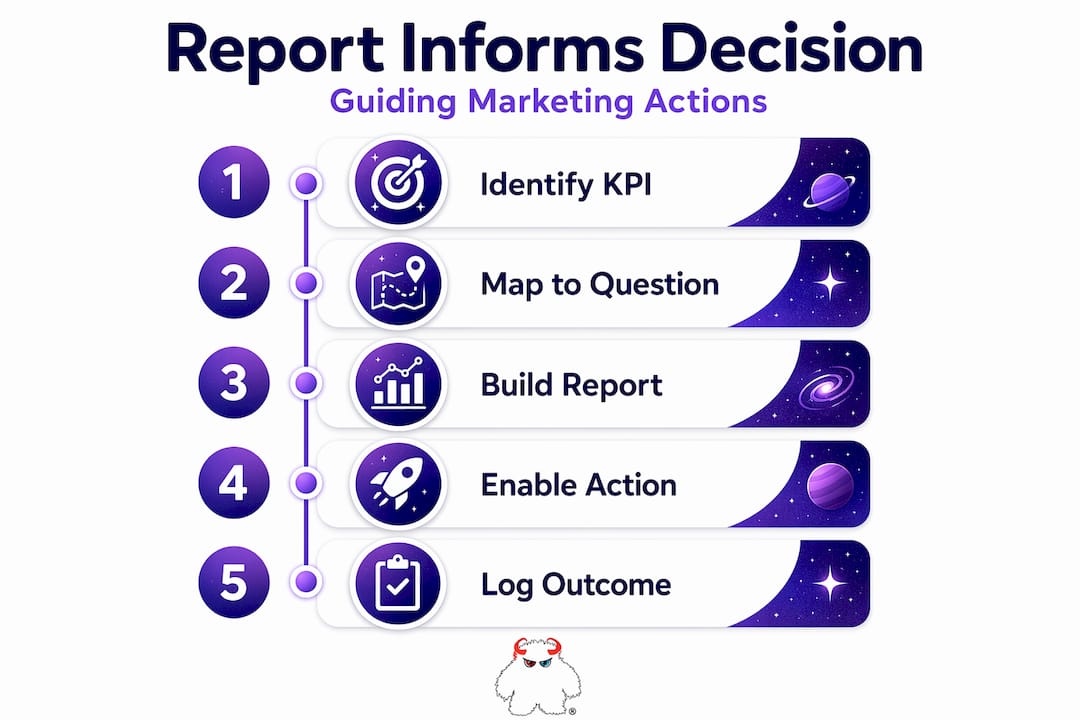
Pro Tip: Before building any report, write down the one decision this report should inform. If you cannot name it, you do not have a report. You have a data export.
Connecting marketing to revenue through closed-loop reporting
The most powerful application of marketing reporting is proving that specific marketing activity produced specific business outcomes. That requires closed-loop reporting, which connects marketing touchpoints to CRM data so you can trace a lead from first contact through to closed revenue.
Here is what that looks like in practice. A prospect clicks a paid search ad, downloads a white paper, gets nurtured through email, and eventually books a discovery call. Without closed-loop reporting, you know the ad got clicks. With it, you know that specific campaign influenced a deal worth a specific dollar amount. That is the difference between activity tracking and revenue attribution.
The table below shows the practical difference between operational reporting and executive reporting, since both serve critical but distinct purposes:
| Reporting Type | Audience | Primary KPIs | Cadence | Goal |
|---|---|---|---|---|
| Operational | Marketing team | CTR, CPL, conversion rate, channel spend | Weekly | Tactical optimization |
| Executive | C-suite, board | CAC, pipeline contribution, ROMI, revenue | Monthly/quarterly | Strategic decisions |
Executive marketing reports prioritize business outcomes and recommendation narratives over raw channel-level data. Leadership does not need to know your cost-per-click. They need to know whether the $80,000 spent on digital last quarter generated pipeline and at what efficiency ratio.
Automated reporting plays a significant role here. Manual reporting introduces delays, human error, and inconsistency. When CRM data integrates with BI tools, near-real-time visibility replaces lagging weekly exports. That accuracy builds trust across the organization and removes the credibility problem that often plagues marketing teams when they bring numbers to the executive table.
Pro Tip: Map every marketing KPI in your executive report back to a specific business question. If a metric does not help leadership decide where to invest or cut, remove it from the executive deck.
Reporting challenges and best practices
Most organizations have the tools to produce good reports. They still produce bad ones. The problem is rarely technology. It is process, discipline, and an honest assessment of what the data actually shows.
The five most common reporting failures, and how to fix them:
- Siloed data sources: Paid media, organic, email, and CRM data living in separate platforms with no unified view. Fix this with a dedicated data integration layer before building any report.
- Inconsistent UTM parameters: Mismatched or missing UTM tags create attribution black holes. Attribution errors from this problem degrade report trustworthiness over time and make channel comparisons meaningless.
- Data dumps without narrative: Sending a 40-tab spreadsheet is not reporting. It is abdication. Reports need interpretation, context, and a clear “so what.”
- Misaligned KPIs: Reporting on metrics your audience does not use to make decisions. A VP of Sales does not care about organic impressions. Align the metrics to the decisions the reader actually makes.
- No stated assumptions: Every report makes assumptions about attribution windows, channel definitions, and conversion events. Surface those assumptions explicitly or stakeholders will draw their own conclusions, often incorrect ones.
“Reporting meaningful marketing results requires surfacing what data means in context to avoid misinterpretation by stakeholders.” — Salesforce
The importance of marketing analytics increases directly with business complexity. As you add channels, geographies, and product lines, the attribution picture gets harder to read without structured reporting infrastructure. Build that infrastructure before you need it, not after a budget crisis forces the conversation.
Using reporting to optimize campaigns and maximize ROI

Reporting is not just a communication tool. It is a feedback system that tells you where to put resources next. The impact of reporting on marketing performance is most visible when teams use data to make real-time spend decisions rather than waiting for quarterly reviews.
Here is how data-driven marketing strategies apply reporting insights operationally:
- Identify high-value channels: Compare CAC and ROMI across channels to find where your budget produces the most qualified pipeline. Shift spend toward channels with lower CAC and higher close rates.
- Refine audience targeting: Behavioral and conversion data in your CRM reveals which audience segments convert at the highest rate. Use that to tighten targeting parameters in your paid campaigns and inform your email marketing ROI strategy.
- Shorten the sales cycle: Reports that track lead-to-close velocity by source reveal which campaigns attract buyers who move faster. Marketing performance tracking at this level lets you prioritize those sources in future planning cycles.
- Iterate continuously: The best marketing teams review reports at every cadence level and make documented adjustments. That creates an institutional learning loop that compounds over time.
The shift from static reporting to decision intelligence means your reports should guide actions rather than just present charts. If your weekly report does not change what your team does Monday morning, it is not serving its function.
Pro Tip: Build a simple “decisions log” alongside your reports. Each time a report informs a budget shift or targeting change, document the decision and the outcome. After six months, you have proof of reporting ROI.
My take on reporting as a competitive system
I have worked with marketing teams that had every tool imaginable and still produced reports that no one trusted. The problem was not data. It was architecture. They built dashboards when they needed intelligence systems.
What I have found is that the organizations winning on reporting share one trait: they treat it as infrastructure, not a task. They do not “do reporting” at the end of the quarter. They have built a system where data flows in, gets synthesized against business KPIs, and surfaces decisions on a predictable schedule. That consistency is what creates organizational trust in marketing data.
The uncomfortable truth about most marketing reporting is that it protects the status quo rather than challenging it. Teams report on what looks good and bury what does not. Genuinely useful reporting surfaces underperformance early, attributes it honestly, and recommends a course correction. That takes a transformed marketing strategy and some organizational courage.
My practical advice: start with one decision your leadership makes monthly that currently has no data behind it. Build a report specifically for that decision. Get it right, build trust, then expand. Trying to build the perfect enterprise reporting system from scratch always stalls. One trusted report is worth more than ten ignored dashboards.
— Vector
How Monstrousmediagroup builds reporting systems that drive revenue
If your marketing reports are not informing budget decisions or proving revenue contribution, the problem is structural. Monstrousmediagroup builds systems where data integration, attribution, and performance tracking work together as a single revenue intelligence engine, not a collection of disconnected tools.

The team at Monstrousmediagroup integrates SEO, paid media, and email performance data into reporting frameworks that give leadership the clarity to allocate spend confidently. From digital marketing infrastructure to SEO performance systems built for measurable organic growth, every service is designed to produce outcomes you can report on with confidence. Stop managing activities. Start running systems. Explore what Monstrousmediagroup builds for businesses ready to stop guessing and start growing.
FAQ
What is the role of reporting in marketing?
Marketing reporting connects campaign activity to business outcomes by synthesizing multichannel data into structured narratives that inform strategy, budget allocation, and executive decisions. It transforms raw metrics into intelligence that drives action.
How does reporting differ from a marketing dashboard?
A dashboard displays real-time status metrics, while a report synthesizes trends over time, provides interpretive context, and includes recommended actions. Marketing analytics reports are structured documents designed to guide decisions, not just display numbers.
What is closed-loop marketing reporting?
Closed-loop reporting integrates marketing analytics with CRM data to trace leads from first touchpoint through to closed revenue, proving which campaigns and channels actually contributed to sales outcomes.
How often should marketing reports be produced?
Report cadence should match the decision frequency of the audience. Weekly reports serve operational teams making tactical adjustments. Monthly reports serve marketing leadership. Quarterly reports go to the C-suite and focus on pipeline contribution, CAC, and ROMI.
What KPIs belong in an executive marketing report?
Executive reports should include revenue-tied metrics such as customer acquisition cost, marketing-attributed pipeline, return on marketing investment, and lead-to-close velocity by channel. Strip out channel-level metrics like impressions and clicks that do not connect to business outcomes.
Recommended
Hire the team to help you with your website, app, or other marketing needs.
We have a team of digital marketers who can help plan and bring to life all your digital marketing strategies. They can help with social media marketing, email marketing, and digital advertising!
CONTACT US
Comments