
 https://www.omahamediagroup.com/images/uploads/monster_gallery/Omaha-Media-Group-Black.jpg
admin
https://www.omahamediagroup.com/images/uploads/monster_gallery/Omaha-Media-Group-Black.jpg
admin
Step by Step SEO Guide for Small Business Owners

TL;DR:
- Implementing a structured, system-oriented SEO approach is crucial for small businesses to achieve measurable success and sustainable growth. Proper infrastructure, technical health, targeted content, and local authority building must work together within a continuous maintenance cycle to prevent ranking decline and enhance visibility. Ignoring these foundational elements often leads to technical blockages and wasted efforts, while disciplined system management drives long-term search traffic and revenue.
A step-by-step SEO guide is defined as a structured, sequential workflow that moves a website from invisible to indexed, from indexed to ranked, and from ranked to revenue-generating. Most small business owners treat SEO as a collection of disconnected tasks. That approach produces inconsistent results. The correct model treats SEO as operational infrastructure: a system with defined inputs, measurable outputs, and a clear maintenance schedule. Tools like Google Search Console, Ahrefs, and Google PageSpeed Insights are not optional add-ons. They are the instruments you use to measure and manage that system from day one.
What are the essential prerequisites for SEO success?
Before executing a single optimization, you need the right infrastructure in place. Think of this as laying the foundation before building the structure. Skipping this phase is the single most common reason small business SEO efforts stall within 90 days.
The three non-negotiable prerequisites are verified property access, a submitted sitemap, and a baseline performance benchmark. Google Search Console gives you all three starting points. Once your property is verified, you submit your XML sitemap directly through the Search Console interface by selecting your property, navigating to the Sitemaps report, and entering your sitemap URL. This tells Google which pages exist and signals that your site is ready to be crawled.
Pro Tip: After submitting your sitemap, check the Coverage report in Google Search Console weekly for the first month. Errors surface faster than most owners expect, and catching them early prevents weeks of lost indexing time.
For keyword research, tools like Ahrefs and SEMrush provide search volume, keyword difficulty scores, and competitor gap analysis. Both platforms offer free tiers sufficient for initial research. Google’s own Keyword Planner remains a reliable free alternative for volume estimates. For technical performance benchmarking, Google PageSpeed Insights generates both lab data and real-world field data for your mobile and desktop experience.
| Prerequisite | Tool | Purpose |
|---|---|---|
| Property verification | Google Search Console | Confirms site ownership and enables data access |
| Sitemap submission | Google Search Console | Signals crawlable pages to Google |
| Keyword research | Ahrefs or SEMrush | Identifies target terms and competitive gaps |
| Performance baseline | Google PageSpeed Insights | Measures load speed and mobile usability |
| On-page audit | Screaming Frog SEO Spider | Crawls site for broken links, missing tags, and duplicate content |
How to execute a step-by-step SEO workflow
SEO executed as a system starts with goals and moves sequentially through research, content creation, optimization, and measurement. Skipping stages or running them in parallel produces compounding errors that are difficult to diagnose later.
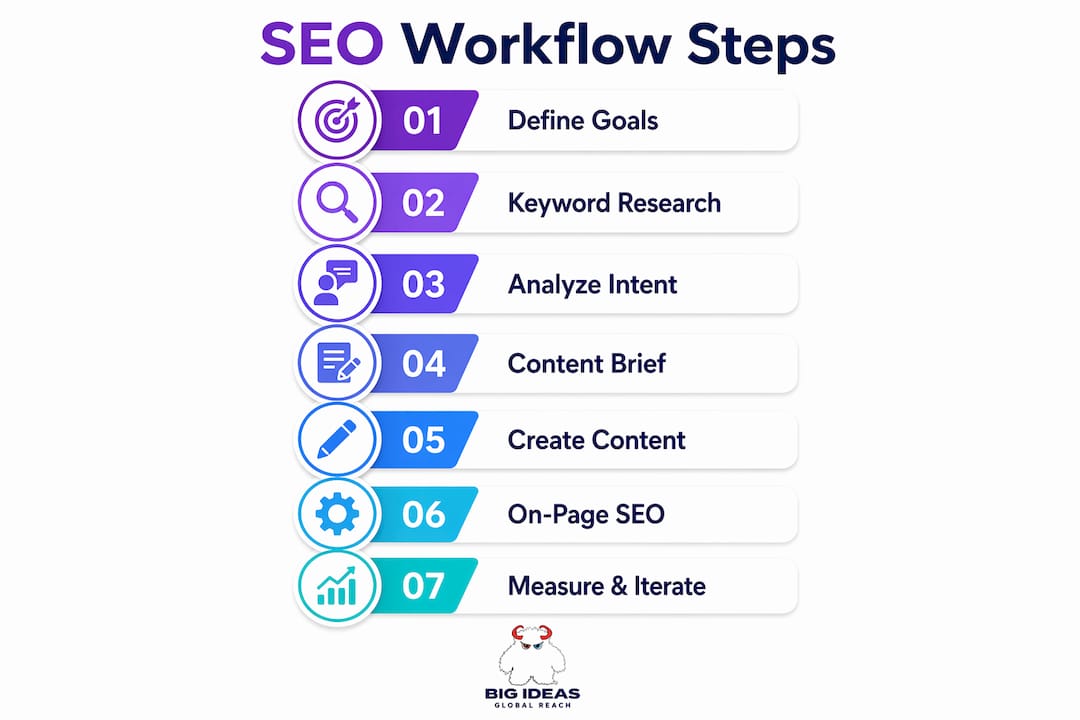
Step 1: Define measurable goals. Attach every SEO goal to a business outcome. “Rank for keyword X” is not a goal. “Generate 50 qualified leads per month from organic search by Q3” is a goal. This distinction determines which keywords you target and how you measure success.

Step 2: Conduct keyword and topic research. SEO basics executed correctly begin with identifying the specific terms your customers use, not the terms you assume they use. Use Ahrefs or SEMrush to pull search volume, keyword difficulty, and related queries. Group keywords by topic cluster rather than targeting individual terms in isolation.
Step 3: Analyze search intent. Every keyword carries an intent: informational, navigational, commercial, or transactional. A page optimized for “how to fix a leaky faucet” must deliver instructional content, not a product page. Mismatched intent is the most common reason technically sound pages fail to rank.
Step 4: Build an SEO content brief. Before writing, document the target keyword, primary intent, required headings, word count range, internal linking targets, and competitor content gaps. This brief is the operational spec for your content team or writer.
Step 5: Create people-first content. Google’s guidance on people-first content is explicit: write for the user’s specific need, not for ranking signals. Content that demonstrates genuine expertise, direct experience, and authoritative sourcing performs better in both traditional and AI-powered search results. This is the E-E-A-T framework: Experience, Expertise, Authoritativeness, and Trustworthiness.
Step 6: Execute on-page optimization. Every page requires a unique title tag (50 to 60 characters), a meta description (150 to 160 characters), one H1 heading containing the primary keyword, and a clean URL structure. Internal linking connects related pages and distributes authority across your site. Optimizing your image file sizes and alt text reduces page weight and improves accessibility simultaneously.
Step 7: Measure and iterate. Set a 30-day review cadence. Track organic impressions, click-through rate, average position, and conversions in Google Search Console and Google Analytics 4. Adjust based on data, not assumptions.
Pro Tip: When writing content for AI-powered search engines like Google’s AI Overviews or Perplexity, structure your answers in the first paragraph of each section. AI systems extract direct answers from the top of content blocks, not from conclusions.
What technical SEO optimizations are critical for search rankings?
Technical SEO is the infrastructure layer that determines whether your content can be found, crawled, and indexed at all. Strong content on a technically broken site produces no rankings. This is where most small business websites lose ground to competitors without realizing it.
Sitemap management is the first technical priority. Sitemap submission errors commonly include incorrect URLs, resources blocked by robots.txt, server accessibility failures, and invalid XML formatting. Each error type requires a specific fix. An incorrect URL requires correcting the path in your CMS sitemap settings. A robots.txt block requires editing the disallow rules to permit Googlebot access.
A critical distinction that trips up many operators: a sitemap showing “Success” status in Search Console does not mean all URLs are indexed. Sitemap success versus URL indexing are two separate states. Waiting 7 to 14 days after submission before diagnosing indexing gaps is standard practice.
Mobile performance is the second technical priority. PageSpeed Insights lab and field data often diverge, and that gap matters. Lab data reflects controlled test conditions. Field data reflects real user experience on actual devices and networks. When field data underperforms lab data, the issue typically lies in third-party scripts, render-blocking resources, or server response times under real load.
| Technical Issue | Diagnostic Tool | Fix |
|---|---|---|
| Pages not indexed | Google Search Console Coverage | Check robots.txt, canonical tags, and noindex directives |
| Slow mobile load | Google PageSpeed Insights | Compress images, defer JavaScript, enable browser caching |
| Sitemap fetch error | Search Console Sitemaps report | Verify URL path and robots.txt permissions |
| Missing structured data | Google Rich Results Test | Add schema markup for business type, reviews, and FAQs |
| Broken internal links | Screaming Frog SEO Spider | Redirect or update broken link destinations |
Pro Tip: Run a two-layer sitemap check monthly. First, confirm your sitemap returns a “Success” status. Second, cross-reference the submitted URL count against the indexed URL count in the Coverage report. Any gap larger than 10% warrants investigation.
How to build authority through link building and local SEO
Off-page SEO determines how much trust search engines assign to your site relative to competitors. Authority is not self-declared. It is earned through citations, backlinks, and consistent business signals across the web.
For link building, the most reliable approaches for small businesses are:
- Digital PR and original research. Publishing original data or case studies earns editorial links from industry publications without outreach costs.
- Local citations. Listing your business in directories like Yelp, the Better Business Bureau, and industry-specific platforms builds foundational authority and NAP consistency.
- Guest contributions. Writing for relevant industry blogs or local business publications generates contextual backlinks and referral traffic simultaneously.
- Supplier and partner links. Many vendor relationships include co-marketing opportunities. A link from a supplier’s “find a dealer” page carries genuine authority.
For local SEO, the local SEO workflow centers on three pillars: an optimized Google Business Profile, location-specific landing pages, and consistent NAP data across every citation source. NAP stands for Name, Address, and Phone number. Inconsistencies in any of these three fields across directories create conflicting signals that suppress local rankings. Your Google Business Profile should include accurate business hours, a keyword-informed business description, and a regular cadence of photo uploads and review responses.
Local landing pages must include the city or region name in the title tag, H1, and body content. Adding LocalBusiness schema markup to these pages tells search engines exactly what your business does and where it operates. Monstrous Media Group’s guide to dominating local search covers the full citation and map visibility workflow in detail.
How to maintain your SEO strategy and fix common mistakes
SEO is not a one-time project. Rankings decay when content ages, competitors publish stronger pages, and algorithm updates shift ranking criteria. A maintenance schedule prevents gradual erosion from becoming a traffic crisis.
Content updates should follow a quarterly review cycle. Pages that have dropped more than five positions in average ranking over 90 days are candidates for refresh. Common refresh actions include adding new data, expanding thin sections, improving internal linking, and updating the publication date only after making substantive changes.
Common SEO mistakes that undermine otherwise solid work include:
- Duplicate canonical tags pointing to the wrong URL, which splits authority between page versions.
- Submitting staging URLs in sitemaps, which exposes development content to Google’s index.
- Ignoring mobile usability errors flagged in Search Console, particularly missing viewport tags and oversized tap targets.
- Over-consolidating content by merging pages that serve distinct search intents into a single page.
Pro Tip: Set up a custom Search Console report filtered by pages with impressions above 100 but click-through rate below 2%. These pages rank but fail to attract clicks, usually because the title tag or meta description does not match user intent. Fixing these generates traffic gains without creating new content.
Adapting to recent search engine changes is part of the maintenance cycle, not an emergency response. Build algorithm monitoring into your quarterly review so updates are anticipated rather than absorbed as surprises.
Key takeaways
Effective SEO for small businesses requires treating search optimization as a measurable operational system, not a collection of isolated tactics, with technical health, content quality, and authority building working together from a defined goal.
| Point | Details |
|---|---|
| Start with infrastructure | Verify Google Search Console, submit your sitemap, and benchmark performance before creating content. |
| Match content to intent | Every page must align with the specific search intent behind its target keyword or it will not rank. |
| Technical health is non-negotiable | Indexing errors, slow mobile load, and sitemap failures block rankings regardless of content quality. |
| Local SEO requires consistency | NAP data, Google Business Profile, and location pages must tell a unified story across every platform. |
| Maintenance prevents decay | Quarterly content reviews and Search Console monitoring protect rankings from gradual erosion. |
Why most small business SEO fails before it starts
After working inside dozens of small business SEO engagements, the pattern is consistent. Owners invest in content or links before confirming that Google can actually crawl and index their site. They publish 20 blog posts and wonder why traffic does not move. The answer is almost always a technical blockage: a misconfigured robots.txt, a sitemap pointing to the wrong domain, or a mobile usability score so low that Google deprioritizes the site entirely.
The second failure pattern is treating SEO as a campaign rather than a system. Campaigns have end dates. Systems have feedback loops. The businesses that generate compounding organic traffic are the ones that review Search Console data monthly, update content quarterly, and build links continuously. They are not doing more work. They are doing the same work on a reliable schedule.
The third pattern I see constantly is ignoring local SEO entirely while competing in a geography-dependent market. A plumber in Omaha does not need to rank nationally. They need to dominate the local pack and the “near me” queries in their service area. That requires a completely different set of signals than national SEO, and conflating the two wastes budget and time.
The uncomfortable truth is that SEO rewards operators who treat it like accounting: systematic, scheduled, and tied to measurable outcomes. The businesses that win in search are not the ones with the biggest budgets. They are the ones with the most disciplined systems.
— Vector
Ready to build an SEO system that produces real outcomes?
Monstrous Media Group builds SEO infrastructure for small businesses and marketing teams that need results, not reports. The approach is systematic: technical audits, keyword strategy, content frameworks, and authority building executed as a connected system rather than a list of deliverables.

If your website is not generating consistent organic leads, the problem is almost always structural. Monstrous Media Group’s SEO services are built to diagnose that structure, fix what is broken, and scale what is working. For businesses that need the full stack, the digital marketing services include keyword research, traffic analysis, and campaign infrastructure aligned to your revenue goals. Schedule a consultation to see exactly where your current SEO system is leaking opportunity.
FAQ
What is a step-by-step SEO guide?
A step-by-step SEO guide is a structured workflow covering goal setting, keyword research, content creation, on-page optimization, technical SEO, link building, and ongoing measurement. Following the sequence in order prevents compounding errors that are difficult to diagnose later.
How long does it take to see SEO results?
Most websites see measurable ranking movement within 90 to 180 days of consistent SEO work, though competitive keywords in established markets can take longer. Technical fixes and local SEO optimizations often produce faster results than content-driven ranking improvements.
What tools do I need to start SEO for my small business?
Google Search Console and Google PageSpeed Insights are free and cover the core technical and performance needs. Ahrefs or SEMrush provide keyword research and competitor analysis, with free tiers available for initial use.
How does local SEO differ from standard SEO?
Local SEO targets geography-specific search queries and relies on Google Business Profile optimization, NAP consistency across directories, and location-based landing pages with LocalBusiness schema markup. Standard SEO focuses on topical authority and backlink volume without geographic constraints.
Why are my sitemap pages not showing up in Google Search Console?
A sitemap showing “Success” status confirms Google can read the file, but does not guarantee all URLs are indexed. Indexing gaps typically resolve within 7 to 14 days, but persistent gaps signal crawl blocks from robots.txt rules, noindex tags, or canonical conflicts that require direct fixes.
Recommended
Hire the team to help you with your website, app, or other marketing needs.
We have a team of digital marketers who can help plan and bring to life all your digital marketing strategies. They can help with social media marketing, email marketing, and digital advertising!
CONTACT US
Comments