
 https://www.omahamediagroup.com/images/uploads/monster_gallery/Omaha-Media-Group-Black.jpg
admin
https://www.omahamediagroup.com/images/uploads/monster_gallery/Omaha-Media-Group-Black.jpg
admin
Step-by-step B2B SEO guide for better leads and visibility

TL;DR:
- Most B2B SEO failures stem from strategic misalignment and technical barriers, not the channel itself.
- Consistent, incremental improvements and clear buyer journey mapping are essential for sustainable search success.
You’ve invested in SEO. You’ve published blog posts, updated meta tags, maybe even hired an agency. Yet pipeline numbers aren’t moving, and leadership is asking hard questions about ROI. This situation is more common than most marketing managers want to admit. B2B SEO is not broken as a channel; the process most teams follow is broken. A clear, sequenced approach covering technical foundations, buyer-aligned content, and ongoing measurement changes everything. This guide delivers exactly that, walking you through each phase so you can move from scattered tactics to a system that actually generates qualified leads.
Table of Contents
- Get your technical SEO foundation right
- Map SEO to your B2B buyer’s journey
- Step-by-step B2B SEO process checklist
- How to monitor, troubleshoot, and refine your B2B SEO
- Why most B2B SEO fails: What we’ve learned the hard way
- Take your B2B SEO further with expert support
- Frequently asked questions
Key Takeaways
| Point | Details |
|---|---|
| Technical SEO comes first | Without solid technical basics, your site won’t be visible in search no matter how good your content is. |
| Buyer intent alignment | Matching content to decision stages drives qualified leads rather than empty traffic. |
| Follow a structured process | A step-by-step approach ensures that nothing critical is missed from audit to content and tracking. |
| Monitor and adapt | Ongoing, systematic review prevents errors and improves results over time. |
| Team collaboration wins | Cooperation between content and technical teams delivers the biggest B2B SEO impacts. |
Get your technical SEO foundation right
A solid foundation prevents wasted effort, so let’s start with the essential technical pieces every B2B SEO strategy must address.
Before a single piece of content drives traffic, search engines need to find and read your site reliably. This is where most B2B companies quietly lose ground without realizing it. Your sitemap is a structured file that tells search engines which pages exist on your site and how frequently they change. Without one, crawlers have to guess. With one, you hand them a map. Technical discoverability fundamentals require you to ensure a sitemap exists, submit it through Google Search Console, and confirm your robots.txt file allows crawling of important pages.
Your robots.txt file is equally critical and far more dangerous when misconfigured. A single misplaced rule can block your entire site from being indexed. Google’s robots.txt guidance notes that some URLs may still appear in index results even if the crawler was blocked from accessing them, which can create confusing half-visibility in search results. Understanding common allow and disallow patterns is not optional; it’s foundational.
Don’t overlook image SEO optimization either. Images with missing alt text, oversized file sizes, or non-descriptive filenames are invisible to search engines and drag down overall page performance.
Core technical SEO checklist for B2B sites:
| Technical element | Why it matters | Priority |
|---|---|---|
| XML sitemap | Ensures all key pages are discoverable | Critical |
| robots.txt configuration | Controls crawler access to pages | Critical |
| Mobile responsiveness | Google indexes mobile-first | High |
| Page load speed | Affects rankings and bounce rate | High |
| HTTPS security | Trust signal for both users and Google | Critical |
| Canonical tags | Prevents duplicate content issues | Medium |
| Structured data markup | Enables rich results in search | Medium |
Critical first-step actions to complete before anything else:
- Generate and validate your XML sitemap using a reputable crawl tool
- Submit the sitemap through Google Search Console
- Open your robots.txt and check for accidental disallow rules blocking important pages
- Run a mobile usability test in Search Console
- Confirm HTTPS is active site-wide with no mixed-content warnings
- Check for crawl errors in the Coverage report inside Search Console
Pro Tip: Always review your robots.txt file directly inside Google Search Console’s robots.txt Tester before deploying any updates. It shows you exactly what Googlebot sees, catching issues before they go live.
Map SEO to your B2B buyer’s journey
With your technical groundwork laid, it’s time to ensure SEO doesn’t just bring traffic but the right traffic: your buyers.

B2B search behavior looks very different from consumer search behavior. A B2C buyer might search “best running shoes” and purchase within hours. A B2B buyer might search “enterprise data integration platform comparison,” read six articles, download two whitepapers, attend a webinar, and then enter a sales process that lasts three to six months. Your content strategy must account for that longer, more deliberate path.
The core principle here is that buyer intent alignment matters more than keyword volume. Content should answer questions that map to stakeholder needs and decision stages rather than chasing search volume numbers on spreadsheets.
“B2B buyers do not search for your product. They search for solutions to their problems. The teams that win SEO are the ones that answer those problems at every stage of the buying cycle, not just at the point of purchase.” This is the mindset shift that separates high-performing B2B content programs from the ones that generate impressions but no pipeline.
Content mapping by decision stage:
| Buyer stage | Search intent | Best content format |
|---|---|---|
| Awareness | What is this problem? | Blog posts, explainer articles |
| Consideration | How do I solve this problem? | Comparison guides, case studies |
| Decision | Which vendor should I choose? | Product pages, testimonials, ROI calculators |
| Retention | How do I get more value? | Knowledge base, tutorials, newsletters |
Steps to map content to buyer stages effectively:
- Interview three to five recent customers about what they searched during their buying process. Their language is more valuable than any keyword tool.
- Identify your three to four primary buyer personas and their specific job function concerns.
- List five questions each persona asks at every stage of the purchase journey.
- Match each question to an existing content piece or flag it as a content gap.
- Group related content into topic clusters, where one pillar page covers a broad theme and supporting articles link back to it.
- Audit internal links between pillar pages and cluster articles to ensure they reinforce topical authority.
Understanding SEO and quality content as interconnected disciplines, not separate tasks, is what allows B2B teams to build sustainable traffic. Similarly, investing in page experience optimization ensures that once buyers arrive on your pages, the experience matches their expectations.
Building content clusters does more than just organize your site. It signals to Google that your domain has genuine authority on specific topics. An enterprise software company that publishes a central pillar guide on “cloud ERP implementation” and then supports it with 10 to 15 detailed articles on related subtopics will rank more consistently than a company that publishes isolated posts with no structural connection.
Step-by-step B2B SEO process checklist
Knowing what to do matters, but here’s how you actually put each piece in place with a reliable, stepwise method.
A practical, sequenced B2B SEO rollout:
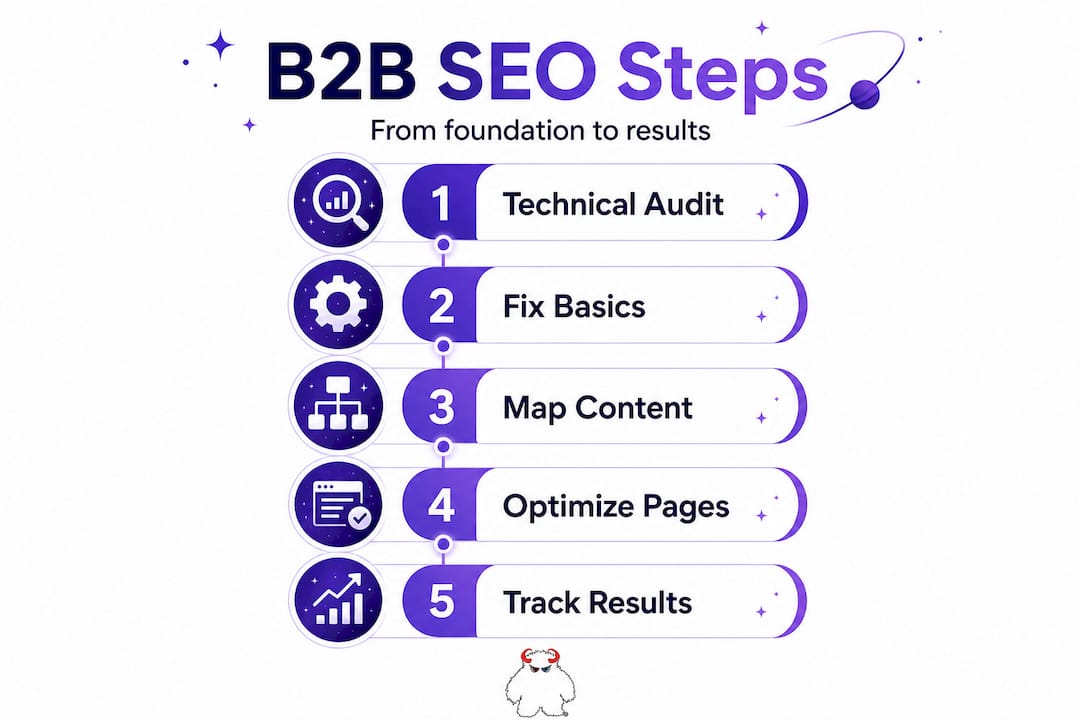
- Complete a full site audit. Use a crawl tool to identify broken links, redirect chains, duplicate content, and missing metadata across the entire site.
- Fix technical blockers. Resolve any robots.txt issues, sitemap errors, and crawl blocks identified in the audit before publishing new content.
- Conduct keyword and intent research. Prioritize terms by buyer stage and commercial relevance, not just monthly search volume.
- Build or update your pillar content. Create comprehensive guides for your top three to five topic clusters that address buyer questions at the consideration stage.
- Develop supporting cluster content. Publish detailed articles around each pillar that answer specific questions at the awareness and decision stages.
- Implement structured internal linking. Ensure all cluster articles link to their pillar page and cross-link to relevant supporting content.
- Optimize on-page elements. Update title tags, meta descriptions, header structure, and image alt text for all key pages.
- Submit updated sitemap. After content updates, resubmit your sitemap to Search Console and review the robots.txt report to confirm syntax is correct and the file is uploaded to the site root as a plain text file named robots.txt.
- Build a measurement dashboard. Track rankings, organic sessions, conversion events, and qualified leads generated from organic traffic.
- Set a review cadence. Schedule monthly audits and quarterly content refreshes to maintain and improve performance over time.
Critical statistic: Misconfigured robots.txt files are among the most frequently cited causes of sudden ranking drops. A single incorrect “Disallow: /” rule applied at the root level can effectively remove your entire site from Google’s index, sometimes without triggering an immediate alert. This is not a theoretical risk; it has happened to enterprise-level B2B sites during routine deployments.
Pro Tip: After every single edit to your robots.txt file, validate it in Search Console before pushing to production. Make this a non-negotiable step in your deployment workflow. The validation takes less than two minutes and can prevent weeks of lost visibility.
Understanding evolving SEO best practices matters here too, because Google’s approach to crawling and ranking continues to shift. What worked in 2022 may not be optimal in 2026, especially around content quality signals and helpful content standards. Your B2B SEO solutions need to account for these shifts at every phase.
How to monitor, troubleshoot, and refine your B2B SEO
Your initial campaign is launched, but the most successful B2B teams ensure continual improvement. Here’s how to systematize that.
Launching is the beginning, not the finish line. B2B SEO requires ongoing attention because search algorithms update, competitors publish new content, and buyer language evolves. Teams that treat SEO as a one-time project consistently underperform those that build a monitoring rhythm into their operations.
Tools and signals every B2B SEO team should monitor:
- Google Search Console: Track impressions, clicks, average position, and crawl coverage weekly
- Crawl log analysis: Review how often Googlebot visits key pages and whether it encounters errors
- robots.txt report in Search Console: Check for warnings or blocked pages that should be accessible
- Analytics platform: Monitor organic session quality, bounce rate by landing page, and goal completions tied to organic traffic
- Rank tracking tool: Monitor position changes for target keywords, especially around product and category pages
- Backlink monitoring: Track new and lost links pointing to your domain, as link authority affects ranking stability
Keeping up with latest SEO notes from reputable sources helps you stay ahead of algorithm changes that could affect your B2B campaign unexpectedly.
Warning: A single misplaced character in your robots.txt file, such as an extra space, a missing slash, or an uppercase letter where lowercase is expected, can cause rules to fail silently. The file will appear to load without errors, but Googlebot will not honor the intended instructions. Always test. Always verify.
When troubleshooting ranking drops, work methodically. First, check if a Google algorithm update coincides with the drop date. Second, verify that your robots.txt and sitemap have not changed unexpectedly. Third, audit the affected pages for thin content or duplicate content issues. Fourth, examine your backlink profile for any sudden drops in referring domains.
For B2B companies with regional or metro-area presence, combining national SEO strategies with local SEO approaches can capture high-intent searches from buyers in specific markets. This is particularly effective for professional services firms, regional manufacturers, and B2B service providers with geographic service areas.
Iterative optimization means treating every month’s data as a directive, not just a report. If a page ranked on page two for a key decision-stage term, that’s not a failure; it’s a signal that on-page depth, internal linking, or backlink support needs strengthening. Act on the data rather than waiting for a quarterly review to address what is visible in real time.
Why most B2B SEO fails: What we’ve learned the hard way
You’ve got the process. Now here’s the unvarnished reality from those who’ve navigated B2B SEO for years.
The most common reason B2B SEO fails is not technical. It’s strategic misalignment. Teams optimize for keywords that attract the wrong audience because no one paused to ask, “Does this keyword reflect a search our actual buyer makes?” Ranking first for a high-volume term means nothing if the visitors who arrive have no purchase authority, no budget, and no relevant problem your solution solves. Traffic is vanity. Qualified pipeline is reality.
The second failure mode is the “big bang” launch mentality. Organizations spend months planning a website overhaul or content push, launch it, wait 90 days, see modest results, and declare SEO ineffective. B2B SEO compounds over time. The teams that win are the ones making consistent, incremental improvements month after month, not the ones betting everything on a single launch.
Alignment between marketing and technical teams is also non-negotiable, and far harder than it sounds. A content team can produce excellent buyer-stage articles, but if the development team accidentally deploys a noindex tag or updates robots.txt without review, the content becomes invisible. We’ve seen this exact scenario cause months of lost rankings for otherwise well-run programs. The fix is process, not personnel. Build checklists, require validation steps, and create shared accountability between the people who create content and the people who manage site infrastructure.
Viewing digital services for B2B as an integrated system rather than a collection of isolated activities is what separates the organizations that see consistent SEO gains from those that remain stuck. SEO is not a marketing task. It’s a business system. Rankings are a byproduct of delivering the right information to the right buyer at the right moment, at scale. Focus there, and the rankings follow.
The teams we’ve seen succeed long-term share one trait: they treat monthly SEO reviews as strategic business reviews, not channel performance check-ins. They ask what changed, why it changed, and what one specific action they’ll take before next month. That discipline, more than any single tactic, is the difference-maker.
Take your B2B SEO further with expert support
If you’re ready to accelerate your SEO impact, here’s how you can get hands-on guidance and execution.
Knowing the process is one thing. Executing it consistently while managing a full B2B marketing calendar is another challenge entirely. Most in-house teams have the intent but not the bandwidth to run technical audits, produce buyer-stage content, monitor crawl reports, and maintain internal linking structures simultaneously.

That’s where specialized support changes the outcome. Monstrous Media Group builds SEO systems designed specifically for B2B marketing teams that need real results, not activity reports. From full-site technical audits to buyer-journey content programs, our SEO services for B2B are built around pipeline metrics that leadership actually cares about. We pair SEO execution with digital marketing support and marketing automation solutions to ensure that the leads organic search generates are captured and nurtured effectively. If your SEO investment isn’t producing measurable revenue outcomes, let’s fix that together.
Frequently asked questions
What B2B SEO tasks should I do first?
Start with a sitemap, ensure your robots.txt is properly configured, and confirm your site can be easily crawled and indexed before building out content or link strategies.
How is B2B SEO different from B2C SEO?
B2B SEO focuses on mapping content to buying-stage questions and longer sales cycles rather than broad keyword traffic, requiring content that answers stakeholder intent at each phase of a complex decision process.
What’s a common technical SEO mistake in B2B?
Incorrect robots.txt rules are a top mistake because some URLs may still appear in search results even when crawling is blocked, creating confusing partial visibility and potential indexing gaps.
How do I know if my B2B SEO is working?
Track both rankings and qualified leads using Google Search Console alongside your analytics platform, and prioritize conversion-related metrics like form submissions, demo requests, and content downloads from organic sessions.
How often should B2B SEO be reviewed?
Monthly reviews are the standard for high-performing B2B teams, allowing you to catch crawling errors, ranking shifts, or content gaps before they compound into larger visibility and pipeline problems.
Recommended
Hire the team to help you with your website, app, or other marketing needs.
We have a team of digital marketers who can help plan and bring to life all your digital marketing strategies. They can help with social media marketing, email marketing, and digital advertising!
CONTACT US
Comments