
 https://www.omahamediagroup.com/images/uploads/monster_gallery/Omaha-Media-Group-Black.jpg
admin
https://www.omahamediagroup.com/images/uploads/monster_gallery/Omaha-Media-Group-Black.jpg
admin
Search engines and business revenue: what you need to know

Most business leaders treat search engines as a traffic source. That framing costs them money. Search engines are not passive directories waiting to send visitors your way. They are active gatekeepers that shape buying decisions, distribute market share, and reward businesses that understand how they work. With 69% of online activities starting at a search engine, the gap between businesses that optimize for search and those that ignore it is widening fast. This article breaks down how search engines work, why they matter for revenue, and what your business needs to do right now to stay visible and competitive.
Table of Contents
- What is a search engine and how does it work?
- The financial impact: How search engines drive business growth
- Why Google dominates and what it means for your strategy
- The rise of AI and generative search: A 2026 playbook
- Winning strategies for search engine visibility in 2026
- Boost your business with expert search and digital marketing strategies
- Frequently asked questions
Key Takeaways
| Point | Details |
|---|---|
| Search engines drive growth | Most online purchases and revenue streams start from search engines. |
| Google is dominant | Focusing on Google provides the largest ROI due to its 90% market share. |
| AI is reshaping search | Generative search and AI require new strategies for visibility and revenue. |
| Quality and authority win | Top business results go to brands with technical excellence and trusted content. |
What is a search engine and how does it work?
A search engine is a system that discovers, organizes, and retrieves web content in response to a user’s query. Think of it as a massive, constantly updated library where automated librarians read every book, tag every page, and then decide which books to hand you first based on what you asked. For business owners, understanding this system is not optional. It determines whether your customers find you or your competitors.
Search engines operate through three sequential stages:
- Crawling: Automated bots follow links across the web, discovering new and updated pages. If your site has broken links or blocks bots, pages go undiscovered.
- Indexing: Discovered pages are analyzed for content, structure, and relevance, then stored in a massive database. Pages that are unclear, duplicate, or slow may be excluded.
- Ranking: When a user searches, the engine evaluates indexed pages against hundreds of signals, including relevance, authority, and user experience, to order results.
As explained in search engine operation research, search engines use three core mechanics: crawling, indexing, and ranking, each building on the last to deliver results users trust.
“Your website’s visibility is not determined at the moment someone searches. It is determined by every technical and content decision you made weeks or months before that search happened.”
For business owners, this means visibility is earned in advance. You cannot turn it on overnight. Understanding digital marketing trends alongside these mechanics helps you build a strategy that compounds over time rather than chasing short-term spikes.
The financial impact: How search engines drive business growth
Now that you understand the mechanism, let’s see why search engines matter so much for your business’s bottom line. The numbers are not subtle. Search engines are the single largest driver of commercial intent online, and the businesses that capture that intent win disproportionate revenue.
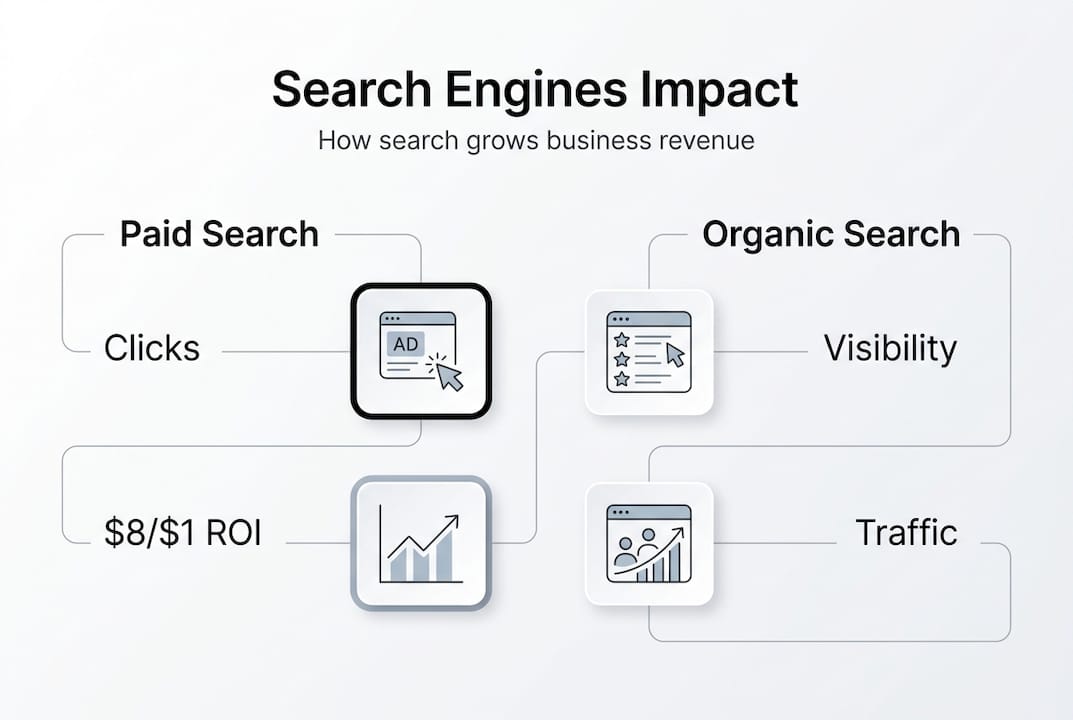
Consider this: businesses earn $8 for every $1 spent on Google Ads. The global search market reached $280 billion in 2026, with Google commanding 90% of that share and generating $224 billion in ad revenue alone. These are not vanity numbers. They reflect where buyers go when they are ready to spend.
| Channel | Average ROI | Primary benefit |
|---|---|---|
| Google Ads (paid search) | 8:1 revenue return | Immediate visibility, high intent |
| Organic SEO | 5x to 12x over time | Compounding traffic, lower cost per lead |
| Social media ads | 2:1 to 4:1 average | Brand awareness, retargeting |
| Email marketing | 36:1 average | Retention, existing customers |
Beyond direct sales, search engines deliver indirect benefits that compound over time:
- Brand exposure: Appearing consistently in results builds recognition even when users do not click.
- Trust signals: High rankings signal credibility. Buyers associate top results with authority.
- New offering discovery: Customers searching adjacent terms find products or services they did not know you offered.
- Competitive displacement: Every position you hold is one your competitor does not.
Exploring your advertising opportunities across both paid and organic search channels is one of the highest-leverage moves a growth-focused business can make in 2026.
Why Google dominates and what it means for your strategy
Not all search engines are equal, and understanding why Google is the default matters for every business audience. Google’s dominance is not purely technical. Research shows Google holds 90% market share due to quality perceptions, user inattention, and low switching costs. Interestingly, active choice experiments increase Bing’s share by only 1.1%, and broader exposure to alternatives could double Bing’s share but still leave Google dominant.

| Search engine | Market share | Avg. cost per click | Best use case |
|---|---|---|---|
| ~90% | $2 to $4 (varies by industry) | Broadest reach, highest intent | |
| Bing | ~4% | $1.50 to $3 | Older demographics, lower competition |
| Yahoo | ~2% | $1 to $2.50 | Niche audiences, budget campaigns |
| Others | ~4% | Varies | Specialized verticals |
What does this mean practically? Your buyers are almost certainly on Google. Studies on user switching in search engines confirm that most users never actively choose their search engine. They use whatever is default, and Google is default almost everywhere.
This does not mean ignoring Bing entirely. For B2B companies targeting older professionals or running Microsoft-ecosystem campaigns, Bing delivers solid returns at lower cost. But spreading your optimization budget equally across all engines is a losing strategy.
Pro Tip: Audit where your actual customers search before allocating budget. Use Google Search Console and Bing Webmaster Tools to compare traffic sources. Then invest 80% of your search engine optimization strategies budget where your buyers actually are.
The rise of AI and generative search: A 2026 playbook
Beyond traditional search, 2026 has brought AI and generative engines that are changing the playbook. This is not a future trend. It is happening now, and it is reshaping how businesses earn visibility.
50% of consumers now use AI search, and the downstream revenue impact is projected at $750 billion by 2028. AI-generated answers reduce organic click-through rates by 20% to 50% because users get answers without visiting your site. That is a direct threat to traffic-dependent revenue models.
“The brands that win in generative search are not the ones with the most content. They are the ones whose content is structured to be extracted, cited, and trusted by AI systems.”
Here is what your business needs to shift right now:
- Structure your content for extraction: Use clear headings, concise answers, and FAQ formats that AI systems can pull directly.
- Build topical authority: Cover subjects deeply rather than broadly. AI engines favor recognized experts over generalist publishers.
- Earn citations across platforms: Mentions in reputable publications, directories, and industry sources signal authority to AI models.
- Optimize for generative engine optimization (GEO): This emerging discipline builds on SEO but targets AI answer inclusion, not just blue-link rankings.
- Diversify your traffic sources: Reduce dependency on any single channel as AI search reshapes click behavior.
Pro Tip: Start tracking AI mentions alongside traditional traffic metrics. Tools that monitor brand citations in AI-generated answers are now available and give you a leading indicator of visibility before traffic data catches up. Explore the latest AI SEO trends and consider how AI marketing platforms can accelerate your adaptation.
Winning strategies for search engine visibility in 2026
So, how can your business keep winning visibility and revenue in this new era? Here are practical strategies grounded in what actually works right now.
SEO is not dead. The playbook is evolving. Businesses that treat search as a long-term asset rather than a short-term tactic consistently outperform those chasing algorithm shortcuts. Quality beats volume every time, and the 2026 search landscape rewards businesses that invest in both technical foundations and genuine content authority.
Here are the key strategies your business should prioritize:
- Technical SEO fundamentals: Ensure your site is crawlable, fast, and mobile-optimized. Prioritize technical SEO including crawl budget management and Core Web Vitals scores. These are table-stakes requirements, not optional upgrades.
- E-E-A-T content creation: Google’s framework of Experience, Expertise, Authoritativeness, and Trustworthiness now directly influences rankings. Publish content that demonstrates real expertise and cites credible sources.
- Structured data markup: Schema markup helps both traditional search engines and AI systems understand your content, increasing the chance of rich results and AI citations.
- Brand authority building: Earn backlinks, press mentions, and third-party reviews. AI shifts favor structured content and brand authority across platforms. Unprepared brands risk a 20% to 50% traffic drop as AI search expands.
- Zero-click and AI metric tracking: Measure impressions, brand mentions in AI answers, and share of voice alongside traditional click data. Visibility that does not produce clicks still builds brand equity.
Pro Tip: Combine SEO and quality content into a single editorial system. Every piece of content should serve a search intent, answer a specific question, and link to deeper resources. This structure feeds both traditional rankings and AI citation engines simultaneously. Pair this with a clear AI adaptation strategy and invest in brand authority best practices to build a presence that compounds across every search format.
The businesses winning in search right now are not doing more. They are doing the right things consistently, measuring what matters, and adapting faster than their competitors. That is the real competitive advantage in 2026. Explore SEO and AI search trends to stay ahead of what is coming next.
Boost your business with expert search and digital marketing strategies
All these strategies can feel complex, but the right partner brings them together for real business impact. Strong online visibility starts with a clear strategy, the right technical foundation, and content that earns trust from both search engines and AI systems.
At Monstrous Media Group, we build systems that generate, capture, and close more revenue without adding chaos or wasted spend. Whether you need SEO services in Omaha, a full-funnel approach from our digital marketing experts, or cutting-edge AI-powered marketing solutions built for 2026’s search landscape, we have the expertise to move the needle. We do not sell activities. We deliver outcomes. Let’s build something that works.
Frequently asked questions
How do search engines decide which websites show up first?
Search engines use algorithms that evaluate relevance, authority, user experience, and keyword signals to rank results. The three core mechanics of crawling, indexing, and ranking all contribute to where your page appears.
Why do most businesses focus on Google instead of other search engines?
Google holds 90% market share and delivers the vast majority of search-driven web traffic and purchase intent, making it the highest-priority platform for most businesses.
What is generative search and how does it affect SEO?
Generative search uses AI to answer user questions directly within the search interface, reducing clicks to websites. Brands need structured, authoritative, and easily extractable content to appear in AI-generated answers.
What are the key strategies for getting my business found in search engines in 2026?
Focus on technical SEO and E-E-A-T content, build brand authority across platforms, and track both traditional clicks and AI mention metrics to measure your full search visibility.
Recommended
- Navigating the Evolving Landscape of SEO: Adapting to Recent Changes for Business Success
- Search Engine Optimization (SEO) | SEO Services in Omaha. NE
- Leveraging PPC Advertising for Long-Term Business Growth | Monstrous Media Group LLC
- PPC Advertising for Long-Term Business Growth
- Optimize LinkedIn marketing with analytics: B2B success - Kawaak
Hire the team to help you with your website, app, or other marketing needs.
We have a team of digital marketers who can help plan and bring to life all your digital marketing strategies. They can help with social media marketing, email marketing, and digital advertising!
CONTACT US
Comments