
 https://www.omahamediagroup.com/images/uploads/monster_gallery/Omaha-Media-Group-Black.jpg
admin
https://www.omahamediagroup.com/images/uploads/monster_gallery/Omaha-Media-Group-Black.jpg
admin
Why Multi-Channel Campaigns Drive Greater Engagement

TL;DR:
- Multi-channel campaigns reach buyers across multiple platforms, increasing engagement and conversion rates.
- Successful campaigns require integrated strategy, audience segmentation, and coordinated messaging.
- Ongoing management and optimization of cross-channel data improve long-term marketing effectiveness.
Most marketing managers have at least one channel performing well, and that success can create a dangerous comfort zone. The assumption that doubling down on a single strong platform will scale results is one of the most costly misconceptions in modern marketing. Today’s buyers don’t follow a straight line. They discover brands on social media, research on search engines, compare via email, and convert through a mix of touchpoints that no single channel can fully capture. This article breaks down what multi-channel campaigns actually are, why they consistently outperform single-channel efforts, and how your team can build, manage, and optimize them for real revenue impact.
Table of Contents
- What are multi-channel campaigns?
- Key benefits of multi-channel campaigns
- Building an effective multi-channel strategy
- Managing, measuring, and optimizing multi-channel campaigns
- Our take: Most brands underutilize multi-channel success
- Scale your results with professional multi-channel campaign support
- Frequently asked questions
Key Takeaways
| Point | Details |
|---|---|
| Reach customers everywhere | Multi-channel campaigns meet audiences where they are, boosting engagement and brand recall. |
| Drive higher ROI | Coordinating across platforms leads to greater conversions and improved marketing efficiency. |
| Measure and refine | Continuous tracking across channels lets you optimize, learn, and amplify campaign success. |
| Start focused, scale smart | Begin with a few high-impact channels, then expand your presence as you track performance. |
What are multi-channel campaigns?
A multi-channel campaign is a coordinated marketing effort that reaches your audience across two or more platforms simultaneously. Rather than concentrating all effort on one channel, you distribute your message across the spaces where your buyers already spend time. As noted in top advertising trends, “multi-channel campaigns use several platforms to reach audiences where they are most likely to engage.”
Channels typically fall into two broad categories:
- Digital channels: Search engines, social media platforms, email, display advertising, content marketing, and SMS
- Offline channels: Direct mail, print advertising, events, broadcast media, and in-store promotions
The combination you choose depends on your audience’s behavior, not your team’s comfort level. That distinction matters.
Here’s where single-channel and multi-channel approaches diverge sharply:
| Factor | Single-channel | Multi-channel |
|---|---|---|
| Audience reach | Limited to one platform | Spans multiple touchpoints |
| Message reinforcement | Repetitive within one space | Reinforced across contexts |
| Revenue risk | High (one point of failure) | Distributed and resilient |
| Attribution complexity | Simple | Requires integrated tools |
| Customer journey coverage | Partial | Near-complete |
Why does reaching multiple touchpoints matter? Because buyers rarely convert on first contact. Research consistently shows that most purchase decisions involve six or more interactions before a sale closes. A buyer might see your brand through a ThredUp-style campaign that blends social proof with email remarketing, reinforcing trust at each stage.
“The brands winning in 2026 are not the loudest on one channel. They are the most consistent across all channels their buyers use.”
Good digital marketing services account for this reality by designing campaigns that move buyers through awareness, consideration, and decision stages across multiple environments. Storytelling for brand engagement is one tactic that translates powerfully across channels, from social posts to email sequences to live events, creating a coherent narrative that builds recognition and trust over time.
Key benefits of multi-channel campaigns
The evidence for multi-channel marketing is not theoretical. Multi-channel campaigns provide higher engagement and conversion rates than single-channel approaches, and the gap widens as buyer journeys grow more complex.
Here is a direct comparison of what single-channel and multi-channel campaigns typically deliver:
| Metric | Single-channel | Multi-channel |
|---|---|---|
| Average engagement rate | 2.5% | 6.8% |
| Customer lifetime value | Baseline | Up to 30% higher |
| Conversion rate | 1.8% | 4.2% |
| Brand recall | Lower | Significantly higher |
| Cost per acquisition | Higher over time | Decreases with optimization |
The benefits extend beyond raw numbers:
- Wider audience reach: You capture buyers at different stages of their journey, not just those already searching for you
- Higher touchpoint coverage: Repeated exposure across channels builds familiarity and trust faster
- Greater ROI resilience: If one channel underperforms, others compensate, protecting your overall return
- Richer data: Cross-channel behavior reveals what actually drives decisions, not just what drives clicks
Look at how Chase’s marketing approach integrates digital and physical touchpoints to create a seamless customer experience. That level of coordination is what separates brands that grow from brands that plateau. Staying current with latest marketing trends also ensures your channel mix stays relevant as buyer behavior shifts.

Pro Tip: The most effective campaigns blend digital and offline efforts. Pairing a targeted email sequence with an in-person event or direct mail piece can increase response rates by as much as 35% compared to digital-only campaigns.
Building an effective multi-channel strategy
Knowing multi-channel works is one thing. Building a campaign that actually executes well is another. Successful multi-channel campaigns plan for audience segmentation, channel selection, and coordinated messaging from the very beginning, not as an afterthought.
Here is a practical step-by-step process:
- Set clear, measurable goals. Define what success looks like before selecting any channel. Are you driving awareness, leads, or direct conversions? Each goal changes your channel mix and messaging.
- Segment your audience. Not all buyers behave the same way. Use behavioral data, demographics, and purchase history to create distinct audience segments, then tailor your approach for each.
- Choose your channels strategically. Select platforms based on where your segments are most active, not where your team has the most experience. Prioritize 2 to 3 channels initially.
- Integrate your technology stack. Your CRM, email platform, ad manager, and analytics tools need to share data. Fragmented systems produce fragmented results.
- Align messaging and brand tone. Every channel should feel like the same brand speaking, even if the format differs. A social post and a follow-up email should reinforce each other, not contradict.
- Set a message cadence. Decide how often each segment hears from you on each channel. Too frequent and you create fatigue. Too sparse and you lose momentum.
Campaign orchestration statistic: Companies with well-orchestrated multi-channel strategies retain on average 89% of their customers, compared to 33% for companies with weak channel integration.
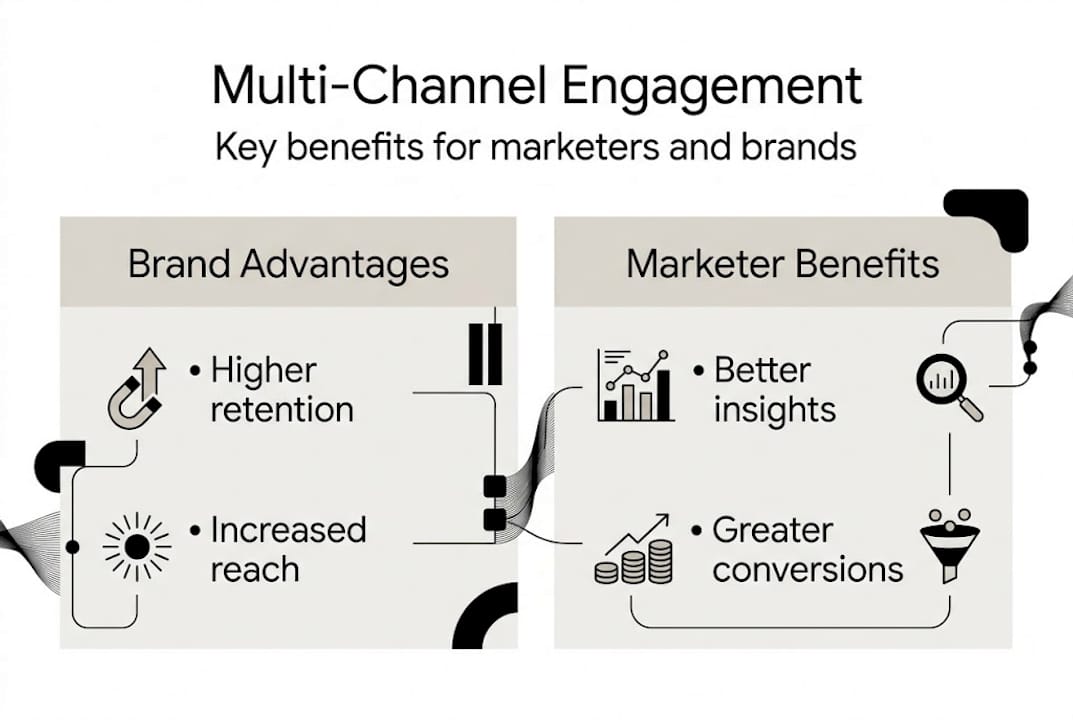
Using coordinated social media management alongside marketing automation solutions removes the manual burden of keeping every channel synchronized. Automation handles timing and personalization at scale, so your team focuses on strategy rather than execution.
Pro Tip: Start with 2 to 3 channels and measure performance rigorously before expanding. Adding more channels without clear data is how campaigns lose focus and budget.
Managing, measuring, and optimizing multi-channel campaigns
Launching a multi-channel campaign is only half the work. The other half is managing it well once it’s live. Tracking and optimizing across channels is essential for sustained campaign success, and most teams underinvest in this phase.
The most common challenges marketing managers face include:
- Data silos: Each platform reports its own metrics, making it hard to see the full picture
- Attribution confusion: When a buyer touches six channels before converting, which one gets credit?
- Message fatigue: Buyers who see the same creative across every channel simultaneously stop engaging
- Inconsistent reporting cadence: Teams review data too infrequently to catch underperformance early
Here is a sample performance tracking table to give your team a structured starting point:
| Channel | Key metric | Review frequency | Optimization trigger |
|---|---|---|---|
| Open rate, CTR | Weekly | Below 20% open rate | |
| Paid social | CPM, ROAS | Weekly | ROAS below 2x |
| SEO/content | Organic sessions | Monthly | Traffic drop over 10% |
| Events/offline | Lead volume | Per event | Fewer than projected leads |
| Display ads | Frequency, CTR | Bi-weekly | Frequency above 5 |
Metrics worth tracking consistently include engagement rate by channel, conversion rate by audience segment, customer journey stage completion, and cost per acquisition across the full funnel.
Avoiding common campaign pitfalls requires building a review rhythm into your campaign calendar from day one. Reviewing marketing industry insights regularly also helps you benchmark your results against what top performers are achieving.
“Optimization is not a one-time event. Campaigns that win long-term are the ones with a built-in feedback loop that improves every element based on real performance data.”
Our take: Most brands underutilize multi-channel success
Here is what years of working with mid-size and enterprise marketing teams reveals: most brands that claim to run multi-channel campaigns are actually running parallel single-channel campaigns. They post on social, send emails, and run paid ads, but none of those efforts are talking to each other.
The result is a fragmented experience for the buyer and inflated costs for the brand. Large companies are not immune to this. In fact, the bigger the team, the more likely it is that each channel is managed by a different person with a different KPI and no shared data flow.
What bold marketing leaders do differently is treat the customer journey as one continuous experience, not a collection of separate campaigns. They invest in integration before they invest in more channels. They measure cross-channel behavior, not just channel-level performance. And they are willing to pull budget from a channel that looks good in isolation if it doesn’t contribute to the broader journey.
If you want a real-world example of what this looks like in practice, the ThredUp digital strategy is worth studying carefully. The lesson isn’t the tactics. It’s the orchestration. Revisit your own execution and ask honestly: are your channels connected, or just coexisting?
Scale your results with professional multi-channel campaign support
Building a truly integrated multi-channel campaign requires more than good intentions. It takes the right systems, the right data infrastructure, and experienced execution across every channel in your mix.
Monstrous Media Group brings digital marketing expertise that spans strategy, execution, and optimization across every major channel. From SEO services that build long-term organic visibility to email campaign management that converts at every stage of the funnel, we build the connected systems that turn scattered marketing activity into measurable revenue. If you are ready to stop running parallel campaigns and start running one powerful, integrated strategy, reach out for a custom consultation today.
Frequently asked questions
What is the difference between multi-channel and omni-channel marketing?
Multi-channel uses multiple channels that may be managed individually, while omni-channel creates a seamless, unified experience across all channels. Multi-channel campaigns are a strong foundation, and omni-channel is the next level of integration.
How many channels should I start with in a multi-channel campaign?
Start with 2 or 3 channels where your audience is most active, then expand based on performance data. Higher engagement and conversions come from doing fewer channels well rather than spreading thin across many.
How do I measure the ROI of a multi-channel campaign?
Track engagement, conversions, and customer journey completion across all channels using integrated analytics tools. Optimizing across channels consistently is what separates campaigns with strong ROI from those that plateau.
What are the most common mistakes with multi-channel campaigns?
Inconsistent messaging and failing to analyze cross-channel data are the top mistakes. Sustained campaign success depends on treating optimization as an ongoing process, not a launch-day checklist.
Recommended
Hire the team to help you with your website, app, or other marketing needs.
We have a team of digital marketers who can help plan and bring to life all your digital marketing strategies. They can help with social media marketing, email marketing, and digital advertising!
CONTACT US
Comments