
 https://www.omahamediagroup.com/images/uploads/monster_gallery/Omaha-Media-Group-Black.jpg
admin
https://www.omahamediagroup.com/images/uploads/monster_gallery/Omaha-Media-Group-Black.jpg
admin
Maximize Growth: The Strategic Role of Outsourcing

TL;DR:
- Effective marketing teams strategically blend internal expertise with external specialists to access niche skills and accelerate growth. Outsourcing functions like content creation, media buying, and technical SEO enables faster scaling, reduces costs, and enhances campaign quality. Building clear structures, roles, and communication channels ensures seamless collaboration and maximizes the benefits of outsourcing as a competitive advantage.
Most companies treat outsourcing as a gamble, either handing everything to an agency or insisting that all work stays in-house. Both extremes leave revenue on the table. Today’s most agile marketing organizations have figured out a smarter play: they treat outsourcing as a precision tool, blending internal expertise with external specialists to access skills that are difficult to staff internally and scale campaigns without ballooning headcount. This guide breaks down exactly when, why, and how to structure that blend for measurable marketing growth.
Table of Contents
- Why modern marketing teams turn to outsourcing
- Key roles and tasks commonly outsourced
- Models for structuring outsourced marketing relationships
- Blending internal teams with external partners: best practices
- Decision-making frameworks: When does outsourcing make sense?
- Why the most effective marketing teams use outsourcing as a competitive edge
- Take the next step: Streamline your marketing with external expertise
- Frequently asked questions
Key Takeaways
| Point | Details |
|---|---|
| Blended approach wins | Combining internal and outsourced resources drives superior marketing results and flexibility. |
| Access specialized skills | Outsourcing provides instant access to niche marketing expertise without hiring full-time staff. |
| Structure matters | Clear agreements and workflows are essential for successful and accountable outsourcing relationships. |
| Decision framework | Use strategic criteria to decide what to outsource for maximum impact and minimal complexity. |
Why modern marketing teams turn to outsourcing
With the stage set for how outsourcing isn’t a simple handoff, let’s dig into the real motivations behind this approach.
Modern marketing campaigns are more technically demanding than ever before. A single product launch can require SEO strategy, paid media execution, video production, email sequences, landing page design, and conversion rate optimization, all running simultaneously. Building a full in-house team capable of excelling across every one of those disciplines is expensive, slow, and increasingly unrealistic for most organizations.
Outsourcing is driven primarily by the need for specialized expertise that simply isn’t available internally. That’s not a sign of weakness. It’s a structural reality of modern marketing, where skill requirements shift faster than hiring cycles can keep up.
“The most competitive marketing organizations don’t try to own every skill. They build systems that route work to whoever can execute it best, whether that’s an internal hire or an external partner.”
Here’s what outsourcing actually enables at a strategic level:
- Access to deep specialists. Niche skills like programmatic media buying, technical SEO, or multilingual content production take years to develop. Outsourcing puts those skills on your team immediately.
- Faster campaign scaling. When a seasonal push or product launch demands more capacity than your internal team can absorb, an outsourced partner can flex up without the delays of recruitment.
- Cost efficiency over full-time hiring. A senior paid media strategist carries significant salary, benefits, and training costs. A retainer with a specialized agency often delivers equivalent output at lower total cost.
- Reduced internal distraction. When external partners handle execution-heavy tasks like content production, your internal team can stay focused on strategy, brand direction, and customer relationships.
- Faster iteration. External agencies working across multiple clients often bring tested playbooks and fresh perspectives that accelerate results.
The marketing automation benefits compound significantly when outsourced partners handle the technical setup and optimization, freeing your team to focus on the strategy layer. Similarly, understanding the email marketing advantages of working with specialists who live inside these platforms daily illustrates why outsourced execution often outperforms generalist in-house attempts.
The bottom line is straightforward. Outsourcing doesn’t signal that your team lacks capability. It signals that your leadership is serious about results over ego.
Key roles and tasks commonly outsourced
Now that you understand the “why” behind outsourcing, let’s clarify exactly which marketing roles and functions companies typically outsource and why.
Certain marketing functions are almost universally strong candidates for outsourcing. Others benefit from staying close to the internal team because they require deep institutional knowledge or carry high brand sensitivity. Content creation, video production, media buying, and creative strategy are the most frequent candidates because they require both technical skill and significant time investment.
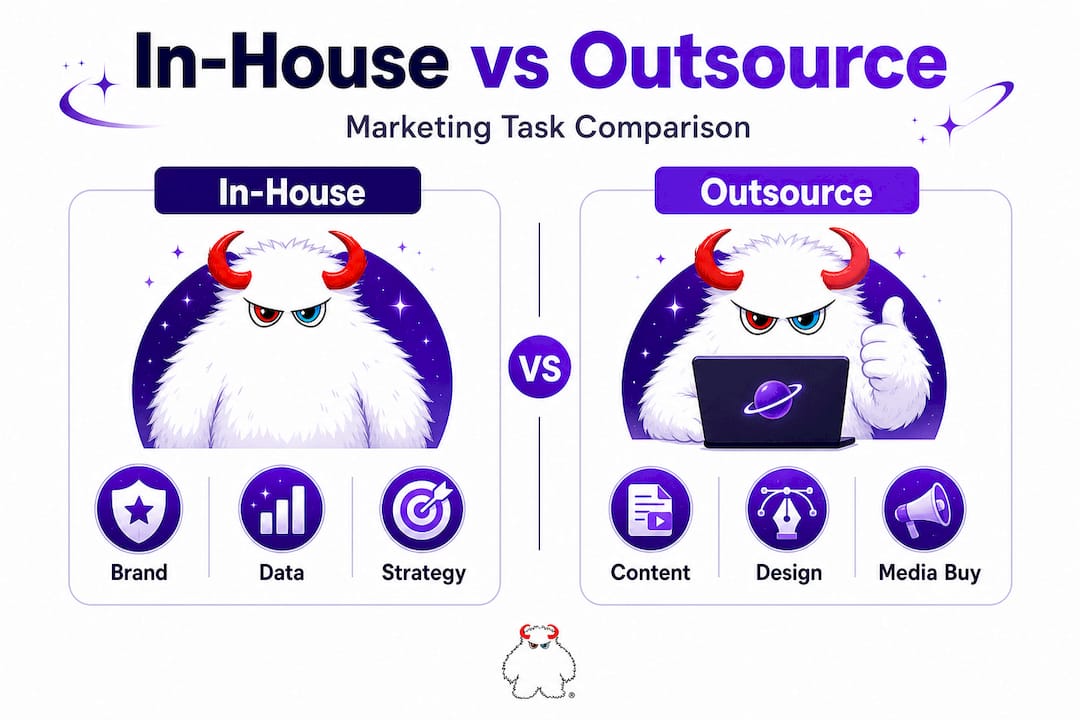
The table below gives you a quick reference for allocating work across internal and external resources:
| Marketing function | Best handled | Reason |
|---|---|---|
| Content creation and copywriting | External | Volume-heavy, requires niche expertise |
| Video production | External | Equipment, crew, and post-production costs |
| Paid media buying and management | External | Platform expertise, continuous optimization |
| Creative strategy and concepting | External or hybrid | Benefits from outside perspective |
| Brand positioning and messaging | Internal | Requires deep institutional knowledge |
| Customer relationship management | Internal | Direct access to customer data |
| Campaign performance reporting | Internal or hybrid | Accountability requires internal ownership |
| SEO technical audits and execution | External | Specialized tools and technical depth |
| Social media community management | Hybrid | Brand voice needs internal oversight |
Enhancing brand identity through creative content marketing is one area where external partners often add unexpected value, bringing aesthetic sensibilities and storytelling approaches that internal teams, sometimes too close to the product, struggle to achieve on their own.
A few additional tasks worth outsourcing that organizations frequently overlook include:
- Influencer relationship management and campaign execution
- Localization and translation for multilingual campaigns
- Marketing technology setup and integration work
- Competitive analysis and market research
- Podcast production and distribution
Pro Tip: Even when a function like brand voice or community management is outsourced, designate one internal team member as the brand steward for that project. External partners excel at execution. You need someone internally who ensures every deliverable sounds and feels like your organization before it goes live.
Models for structuring outsourced marketing relationships
Once you know what to outsource, the next decision is how to structure your outsourcing arrangements for accountability and maximum value.
The two primary engagement structures are retainer-based agreements and project-based contracts. Each serves a distinct purpose and comes with specific trade-offs that affect cost predictability, flexibility, and output quality.
| Factor | Retainer model | Project-based model |
|---|---|---|
| Cost structure | Fixed monthly fee | Variable, tied to deliverables |
| Best for | Ongoing, recurring work | One-time or seasonal campaigns |
| Relationship depth | High, partners learn your brand | Lower, can feel transactional |
| Flexibility | Defined by scope; changes need discussion | Easier to scope new work separately |
| Risk of scope creep | Higher without clear documentation | Lower, each project is discrete |
| Speed to execute | Faster over time as trust builds | May require onboarding each time |
Retainer-style outsourcing is commonly operationalized through a defined scope, a monthly cadence, a communication workflow, and explicit scope-creep handling. That last point matters more than most executives realize. Without a written process for handling requests that fall outside the agreed scope, retainer relationships can become contentious quickly.
Here’s a practical workflow for structuring a retainer relationship that actually delivers:
- Define deliverables and cadence upfront. Specify not just what gets produced but how often, in what format, and who approves it.
- Set a weekly or biweekly check-in. A standing 30-minute call eliminates the communication bottlenecks that kill momentum on outsourced campaigns.
- Establish a revision protocol. Decide in advance how many revision rounds are included, who has final approval authority, and what the turnaround window looks like.
- Document scope-creep handling. Agree on a process for requests that fall outside the retainer scope, whether that’s a change order system, a quarterly review, or an hourly overflow rate.
- Set shared KPIs from day one. If both parties know what success looks like in measurable terms, alignment becomes self-reinforcing.
Exploring recruitment marketing solutions and advertising services through an agency partner works best when these structures are in place before work begins, not retrofitted after problems arise.
Pro Tip: Use a standard operating procedure document for your revision and approval process. Share it with every new external partner before the engagement starts. This single habit eliminates more friction than any other onboarding step.
Blending internal teams with external partners: best practices
With your outsourcing structure in place, you need a strategy to ensure collaboration rather than competition between your internal and external teams.
The biggest risk in any outsourcing relationship isn’t the external partner. It’s the internal ambiguity that develops when neither side is sure who owns what. Treating external partners as integrated resources and intentionally blending their work with internal output consistently outperforms models that rely entirely on one or the other.
“Success often requires role clarity—what’s outsourced vs. retained internally. Ambiguity on that question costs more time than any campaign execution problem.”
Here’s how high-performing blended teams operate:
- Create a RACI matrix for every major campaign. Responsible, Accountable, Consulted, and Informed roles should be mapped across both internal staff and external partners from the project kick-off.
- Share performance dashboards with external partners. If your agency doesn’t see the results their work generates, they can’t optimize intelligently. Transparency accelerates improvement.
- Integrate partners into relevant internal meetings. When the campaign strategy call happens on Thursday, the paid media agency should be in the room, even if virtually. Isolation creates lag.
- Establish shared communication tools. A shared Slack channel or project management workspace reduces the email chain problem that fragments context across large teams.
- Conduct quarterly relationship reviews. Evaluate what’s working, what’s not, and whether the current scope still matches the business need. Markets shift. Your outsourcing model should shift with them.
Learning how to optimize remote marketing teams gives internal leaders practical frameworks for managing distributed partnerships at scale, especially relevant when external partners operate across different time zones.
The advertising and marketing industry has seen a clear pattern: organizations that treat their external partners as vendors get vendor-level thinking. Organizations that treat them as strategic partners get strategic-level output. The difference is almost entirely in how you structure the relationship internally.

Decision-making frameworks: When does outsourcing make sense?
Knowing practical decision rules helps set companies up for repeatable outsourcing success.
Not every task should be outsourced. Not every task should stay in-house. The goal is a deliberate allocation framework that routes work based on strategic fit rather than habit or convenience. Intentionally blending internal and external work outperforms the simplistic choice to fully insource or fully outsource, but it requires clear criteria to execute consistently.
Use these trigger scenarios to identify strong outsourcing candidates:
- Seasonal campaign surges where internal capacity is insufficient for a short-term volume spike
- Skill gaps when a campaign requires expertise, such as connected TV advertising or advanced data analytics, that no internal hire currently possesses
- Speed-to-market pressure when a competitive window demands faster execution than internal bandwidth allows
- Sprint projects with a defined start and end date that don’t justify a full-time hire
- Geographic or language expansion requiring localized expertise your team doesn’t hold
- Technology-heavy implementations where platform expertise reduces setup time and error risk significantly
Conversely, keep these functions internal: brand strategy, customer data ownership, competitive intelligence, and any work that requires real-time access to proprietary business information.
Reviewing staffing considerations through a strategic lens helps leadership distinguish between functions that require permanent internal ownership and those where external specialists will consistently outperform a generalist hire.
Following outsourcing best practices established by organizations that have systematized these decisions gives you a repeatable framework rather than a case-by-case guessing game.
Why the most effective marketing teams use outsourcing as a competitive edge
Here’s the perspective most articles on outsourcing skip entirely: the organizations generating the most consistent marketing performance aren’t using outsourcing as a cost-cutting measure. They’re using it as a capability accelerator.
There’s a widely held belief that keeping work in-house equals quality control. That belief is a myth, and it’s an expensive one. In-house teams develop blind spots. They get comfortable with the same approaches, the same creative frameworks, and the same distribution channels because familiarity feels like efficiency. External partners who work across multiple industries and client types bring fresh signal from markets your internal team never touches.
The most forward-thinking brands treat their outsourcing relationships the way elite athletes treat coaching. A world-class runner doesn’t reject a sprint coach because they’ve been running for 20 years. They hire the coach specifically because an outside perspective closes performance gaps that internal habit can’t identify.
Agile organizations also use outsourcing to stress-test their internal team’s assumptions. When an external partner challenges your creative direction or recommends a channel pivot, that friction is valuable data. It either confirms you’re on the right track or surfaces a blind spot early, before budget is committed.
Looking at how successful brands approach channel strategy, the analysis in Chase’s marketing success illustrates this principle clearly. Large organizations that dominate their categories consistently leverage both internal brand authority and external execution speed. Neither alone produces the same result.
The most effective marketing leaders we’ve worked with view outsourcing not as a budget line item but as a strategic variable in how they compete. When a competitor launches a new product and needs a campaign in six weeks, the company with established external partnerships executes. The company without them is still interviewing freelancers.
The uncomfortable truth is that in-house control often creates the illusion of quality without the reality of it. External accountability, when structured properly, produces better work because the performance data is visible to both parties and the incentive structure is aligned with outcomes, not activities.
Take the next step: Streamline your marketing with external expertise
If this guide has clarified one thing, it’s that the question is never whether to outsource. The real question is how to structure the blend for your specific growth stage, team capacity, and campaign goals.
Monstrous Media Group specializes in exactly this kind of strategic integration. From digital marketing services that align paid, organic, and creative work under one accountable system, to SEO solutions engineered for measurable revenue impact, we don’t sell activities. We build the systems that produce outcomes. If reducing complexity while multiplying marketing effectiveness is the goal, let’s build that system together.
Frequently asked questions
What types of marketing tasks are best outsourced?
Content creation, video production, media buying, and creative strategy are the most commonly outsourced marketing functions because they require deep specialization and significant time investment that most internal teams can’t sustain at scale.
How does outsourcing affect marketing costs?
Outsourcing enables more flexible scaling and can reduce long-term hiring costs because it lets organizations access specialized skills without carrying the full overhead of a permanent hire, including benefits, training, and management bandwidth.
What should be included in a marketing outsourcing agreement?
A strong agreement should define scope, communication cadence, performance metrics, revision limits, and a clear process for handling work outside the original scope, which is how retainer-style outsourcing is operationalized in practice.
How can internal teams and external partners work together seamlessly?
Clear role mapping, shared KPIs, integrated communication tools, and regular performance reviews ensure alignment. Treating external partners as integrated resources rather than vendors consistently produces stronger campaign outcomes than siloed approaches.
Recommended
Hire the team to help you with your website, app, or other marketing needs.
We have a team of digital marketers who can help plan and bring to life all your digital marketing strategies. They can help with social media marketing, email marketing, and digital advertising!
CONTACT US
Comments