
 https://www.omahamediagroup.com/images/uploads/monster_gallery/Omaha-Media-Group-Black.jpg
admin
https://www.omahamediagroup.com/images/uploads/monster_gallery/Omaha-Media-Group-Black.jpg
admin
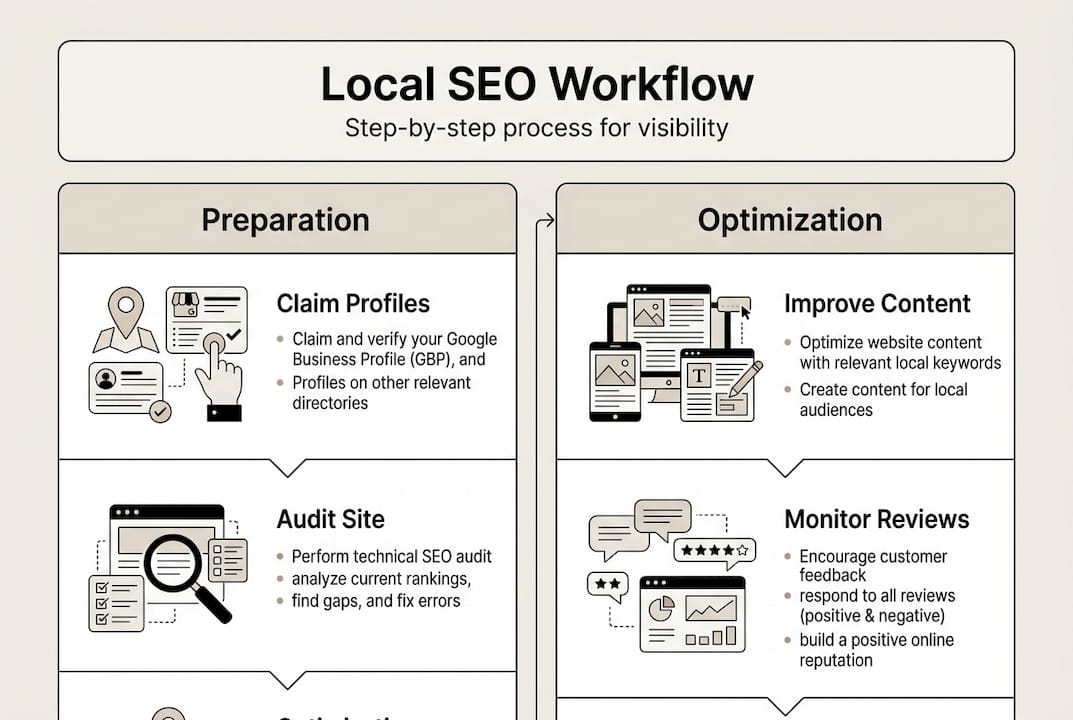
Step-by-step local business SEO workflow for max visibility

TL;DR:
- Local SEO success relies on consistent workflow including reviews, content updates, and technical fixes.
- Building a strong technical foundation with site speed, mobile responsiveness, and schema improves rankings.
- Creating hyperlocal content targets specific neighborhoods and boosts visibility in map packs and AI summaries.
Every day, potential customers search for businesses exactly like yours. They type “plumber near me” or “best coffee shop downtown” and click the first results they see. If your business isn’t showing up in those results, you’re not just losing visibility. You’re losing revenue to competitors who figured out the workflow first. Local SEO isn’t magic, and it isn’t luck. It’s a repeatable system built on smart preparation, technical discipline, and consistent execution. This article walks you through each stage of that system, from assessing your starting point to maintaining momentum month after month, so you can stop guessing and start showing up where it counts.
Table of Contents
- Assessing your local business SEO needs
- Building the technical SEO foundation
- Creating and optimizing hyperlocal content
- Ongoing local SEO tasks and monthly workflow
- An expert’s take: Why local SEO success often comes down to workflow
- Ready to boost your local search visibility?
- Frequently asked questions
Key Takeaways
| Point | Details |
|---|---|
| Assess your local SEO | Evaluate platforms, listings, and competitors before starting your workflow. |
| Solid technical foundation | Optimize site speed, mobile usability, and use schema to boost search visibility. |
| Leverage hyperlocal content | Create neighborhood-focused posts to improve results in local map packs and AI searches. |
| Routine updates matter | Maintain your online presence monthly with reviews, GBP posts, and site tweaks. |
| Use a repeatable process | A systematic approach leads to consistent, measurable growth in local SEO. |
Assessing your local business SEO needs
Now that you’re aware of the importance of visibility, let’s start by evaluating where your business stands and what’s required. Before you optimize anything, you need to understand what your local audience is actually searching for. This is called search intent, and it shapes every decision you’ll make. A customer searching “emergency HVAC repair” has very different needs than one searching “HVAC maintenance plans.” Knowing the difference helps you target the right keywords and create content that converts.
The three primary platforms you must claim and verify are Google Business Profile (GBP), Bing Places for Business, and Apple Maps. Each one serves a different slice of your potential audience, and ignoring any of them means leaving traffic on the table.
| Platform | Monthly reach | Key requirement |
|---|---|---|
| Google Business Profile | Billions of searches | Verified address, phone, hours |
| Bing Places for Business | 900M+ monthly users | Synced with GBP or manual setup |
| Apple Maps | 500M+ Apple device users | Apple Business Connect account |
Before you launch any local SEO strategies, run through this checklist:
- Are all your business listings verified and consistent across platforms?
- Does your website load in under 3 seconds on mobile?
- Do you have a process for requesting and responding to reviews?
- Is your NAP (name, address, phone number) identical everywhere it appears online?
- Have you identified your top 3 to 5 local competitors?
Understanding SEO industry changes also helps you stay ahead of algorithm shifts that could affect your rankings before you even get started.
Pro Tip: Search your top service plus your city name in Google. The businesses appearing in the map pack are your real competitors. Study their reviews, categories, and content before building your own strategy.
Building the technical SEO foundation
After identifying your starting point and prerequisites, it’s time to shore up your site’s technical SEO foundation. Technical SEO is the infrastructure beneath your content. Without it, even the best-written pages struggle to rank. Two factors matter most: site speed and mobile responsiveness. Google uses mobile-first indexing, meaning it evaluates your mobile site before your desktop version. A slow or clunky mobile experience directly hurts your rankings.
Follow these steps to build a solid technical foundation:
- Run your site through Google PageSpeed Insights and fix any issues flagged as “poor.”
- Compress images using a tool like Squoosh or ShortPixel. See image optimization tips for a full walkthrough.
- Implement a hub-and-spoke internal linking structure. Your main service pages are “hubs,” and supporting blog posts or location pages are “spokes” that link back to them.
- Add LocalBusiness schema markup to your homepage and contact page. This structured data tells search engines your business name, address, phone, and hours in a format they can read instantly.
- Submit an XML sitemap to Google Search Console.
- Audit and fix any broken links or crawl errors.
For reference, here’s how common platforms compare for local SEO readiness:
| Platform | Mobile-friendly | Schema support | Speed optimization |
|---|---|---|---|
| WordPress | Yes | Plugin-based | Plugin-based |
| Squarespace | Yes | Limited | Built-in |
| Wix | Yes | Built-in | Moderate |
| Custom HTML/CSS | Depends on build | Manual | Full control |
The Local SEO Audit guide from Search Engine Land recommends implementing a hub-and-spoke internal linking structure alongside LocalBusiness schema and core technical SEO fixes as a baseline for any local campaign. Following technical SEO best practices from the start prevents costly fixes later.
Also, don’t overlook the impact of the Google page experience update, which made Core Web Vitals a direct ranking factor.
Pro Tip: Use Screaming Frog (free up to 500 URLs) to crawl your site and spot technical issues in minutes. It’s one of the fastest ways to get a complete picture of your site’s health without hiring a developer.

Creating and optimizing hyperlocal content
With your technical setup in place, the next step is creating content tailored for your local customers and today’s search engines. Hyperlocal content targets a specific neighborhood, district, or community rather than a broad geographic area. This approach is increasingly important because AI-powered search features like Google’s AI Overviews pull from structured, location-specific content to answer user queries.
According to 2026 local SEO research, publishing hyperlocal content such as neighborhood guides and FAQs optimized with structured data directly improves your chances of appearing in both the local pack and AI-generated summaries. That’s a significant competitive edge most local businesses aren’t yet using.
Here are content formats that consistently engage local audiences:
- Neighborhood guides: “The best family-friendly services in [your neighborhood]” positions you as a community authority.
- Local FAQ pages: Answer questions like “Do you serve [specific zip code]?” or “What are your hours during local events?”
- Event-based content: Write about local festivals, school events, or seasonal topics tied to your service area.
- Customer spotlight posts: Feature local clients (with permission) to build social proof and hyper-targeted relevance.
- “Near me” landing pages: Create dedicated pages for each city or neighborhood you serve, each with unique content.
To maximize visibility in AI summaries, wrap your FAQ content in FAQ schema markup. This signals to Google exactly what questions you’re answering and increases the likelihood of your content being surfaced in featured snippets or AI Overviews.
Strong local business content also supports your broader brand story and builds trust before a customer ever calls you. Pair your content calendar with small business marketing tips to align your SEO efforts with seasonal promotions and community events.
Ongoing local SEO tasks and monthly workflow
Once your content is live and optimized, keeping your local SEO efforts on track requires disciplined, recurring action. Local SEO is not a one-time project. It’s an ongoing system. Businesses that treat it as a campaign they can “finish” almost always fall behind competitors who maintain a consistent monthly routine.
Here’s a monthly checklist that keeps your local presence strong:
- Request reviews from recent customers via email or text. Aim for at least 4 to 6 new reviews per month.
- Respond to all reviews, both positive and negative, within 48 hours. Engagement signals matter to Google.
- Post to your Google Business Profile at least twice a month. Share offers, updates, or new content.
- Audit NAP consistency across all directories. One mismatched phone number can confuse search engines.
- Update existing content to reflect seasonal changes, new services, or updated hours.
- Check Google Search Console for impressions, clicks, and any new crawl errors.
- Track GBP insights including calls, direction requests, and website clicks to measure local engagement.
Consistency is the single most underrated factor in local SEO. Businesses that post regularly, earn reviews steadily, and keep their information accurate outperform those that invest heavily once and then go quiet.
As Search Engine Land’s 90-day local SEO sprint framework outlines, monthly maintenance covering review requests, GBP posts, content updates, and tracking of GBP calls, direction requests, and Google Search Console impressions is the backbone of sustained local visibility.
Stay informed about the latest local SEO trends so your monthly workflow adapts as search behavior and algorithm priorities shift.
An expert’s take: Why local SEO success often comes down to workflow
Here’s what years of executing local SEO campaigns actually reveal: the businesses that win aren’t always the ones with the biggest budgets or the flashiest websites. They’re the ones with the most disciplined workflows.
Most local business owners approach SEO the same way they approach a one-time project. They optimize their GBP, publish a few blog posts, and then wait. When results don’t materialize fast enough, they either abandon the effort or chase the latest tactic they read about online. Neither approach works.
The uncomfortable truth is that local SEO rewards boring consistency over creative shortcuts. A business that sends review requests every week, posts to GBP twice a month, and updates its content quarterly will outrank a competitor who spent three times as much on a one-time audit and then went silent.
Shortcuts create fragile rankings. A workflow creates compounding momentum. Every review earned, every piece of hyperlocal content published, and every technical fix applied adds to a foundation that becomes harder for competitors to displace over time.
Adapting to SEO changes is part of that workflow too. The search landscape shifts, but the businesses with documented processes adapt faster because they’re already paying attention.
Pro Tip: Document your monthly SEO workflow in a simple checklist. Review it quarterly and update it as search behavior changes. A written process beats relying on memory every time.
Ready to boost your local search visibility?
If you’ve read this far, you understand that local SEO isn’t about tricks. It’s about building and maintaining a system that consistently puts your business in front of the right customers at the right moment.

Monstrous Media Group specializes in exactly this kind of outcome-driven work. From technical audits and schema implementation to hyperlocal content creation and monthly optimization management, our team builds the systems that stop revenue leaks and drive real growth. Explore our SEO services or browse our full range of digital marketing solutions to find the right fit for your business goals. Stop leaving local search revenue on the table.
Frequently asked questions
What is a typical local business SEO workflow?
A standard workflow includes assessing your digital presence, optimizing technical SEO, creating hyperlocal content, and maintaining regular updates and reviews on a monthly basis. Each phase builds on the previous one to create compounding visibility over time.
How long does it take to see local SEO results?
Noticeable improvements typically begin within 2 to 3 months, but competitive markets may require consistent effort over 6 to 12 months. Implementing schema and technical fixes early in the process tends to accelerate initial gains.
What tools support local SEO workflows?
Google Business Profile, Google Search Console, and structured data validators are the core tools for managing and measuring local SEO performance effectively. Screaming Frog and PageSpeed Insights round out a solid toolkit.
How important is hyperlocal content for local SEO?
Hyperlocal content directly increases your visibility in map results and AI-powered search summaries, helping you connect with nearby customers who are ready to act. It’s one of the highest-leverage investments a local business can make in 2026.
Recommended
Hire the team to help you with your website, app, or other marketing needs.
We have a team of digital marketers who can help plan and bring to life all your digital marketing strategies. They can help with social media marketing, email marketing, and digital advertising!
CONTACT US
Comments