
 https://www.omahamediagroup.com/images/uploads/monster_gallery/Omaha-Media-Group-Black.jpg
admin
https://www.omahamediagroup.com/images/uploads/monster_gallery/Omaha-Media-Group-Black.jpg
admin
How to Increase Website Leads in 2026: Proven Strategies

TL;DR:
- Most businesses waste potential by focusing on increasing traffic rather than optimizing their existing visitor base for leads.
- Implementing shorter, progressive forms and stage-matched CTAs significantly boosts lead volume and quality without additional ad spend.
- Building diversified, data-driven lead systems integrated with CRM and continuous testing creates a resilient pipeline that drives sustained revenue growth.
Increasing website leads is defined as the systematic process of converting existing site traffic into qualified contacts through conversion funnel optimization, behavioral targeting, and multi-channel lead capture. Most businesses focus on driving more traffic when the real opportunity sits in their existing visitor base. B2B websites convert just 1% to 3% of organic visitors, which means closing even half that gap can boost leads by 40% to 80% without a single additional dollar in ad spend. The tools that make this possible include CRM platforms like Salesforce, progressive profiling systems, and multi-stage CTA architecture. This guide covers how to increase website leads by building the operational systems that capture, qualify, and route prospects at scale.
How to increase website leads through form optimization and progressive profiling
Lead capture forms are the most direct mechanism for converting visitors into contacts, and most businesses run them wrong. The standard approach asks for seven or more fields upfront, which creates friction that kills submissions before they start. Reducing form fields from 7 or more down to 3 or 4 increases submission rates by 40% to 60%. That lift comes without sacrificing lead quality when you pair it with progressive profiling.

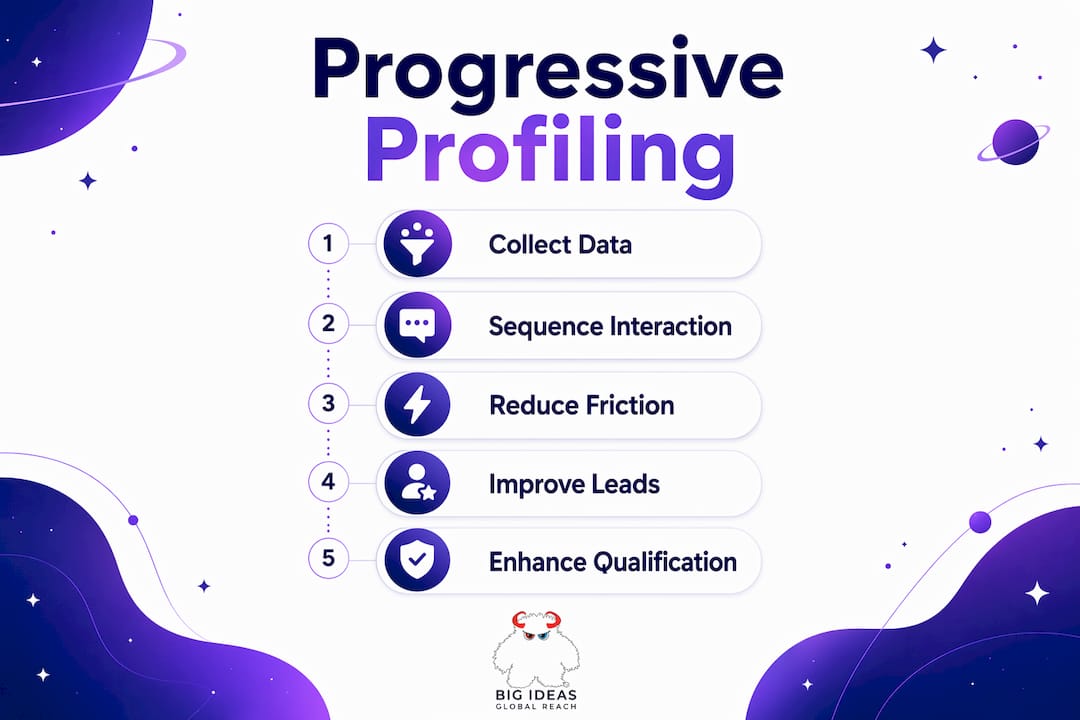
Progressive profiling is a technique where you collect additional data across multiple interactions rather than in a single form. A visitor submits their name and email on the first visit. On the second visit, a pre-filled form asks for their company size. On the third, their role or budget range. Platforms like HubSpot and Marketo support this natively, and the result is a complete contact record built over time without ever overwhelming a first-time visitor.
The practical implementation follows a clear sequence:
- First interaction: Name, email, and one qualifying question (e.g., company size or industry)
- Second interaction: Role, phone number, or primary challenge
- Third interaction: Budget range, timeline, or specific service interest
- Ongoing: Behavioral data from page visits and content downloads fed directly into your CRM
Pro Tip: Never ask for information you already have. If a visitor is logged in or has submitted a form before, your CRM should suppress those fields automatically. Redundant questions signal poor systems and erode trust faster than a long form does.
The goal is not to minimize data collection. It is to sequence it intelligently so each interaction feels low-stakes while your CRM builds a progressively richer contact profile behind the scenes.
What role do behavioral intent detection and tailored CTAs play in lead volume?
Most websites use a single uniform CTA regardless of where a visitor is in the buying process. A first-time blog reader and a returning visitor who has already viewed your pricing page receive the same “Contact Us” button. That mismatch is a direct revenue leak. Stage-matched CTAs yield a 30% to 50% increase in total lead volume without requiring additional traffic. That is a structural improvement, not a campaign.
Behavioral intent detection operates at the session level. It reads signals like pages visited, scroll depth, time on site, return visit frequency, and content category to infer where a visitor sits in the buyer journey. The output is a dynamic experience that serves different CTAs to different visitors in real time.
Here is how a staged CTA architecture maps to funnel position:
- Top of funnel (awareness): Visitors reading educational blog content receive CTAs for gated guides, checklists, or industry reports. The ask is low-commitment and the value is immediate.
- Middle of funnel (consideration): Visitors who have viewed multiple service pages or returned more than once receive CTAs for webinars, case studies, or free assessments. The ask acknowledges they are evaluating options.
- Bottom of funnel (decision): Visitors who have viewed pricing, testimonials, or comparison content receive direct CTAs: “Schedule a Call,” “Get a Proposal,” or “Start Your Free Trial.” The ask matches their readiness.
Systematic behavioral segmentation at the session level consistently outperforms generic page-level CTA implementations. Tools like Pathmonk, Mutiny, and Intellimize automate this segmentation without requiring developer resources for every change. The underlying principle is simple: a CTA that matches where a visitor is mentally converts at a higher rate than one that assumes everyone is ready to buy.
Which complementary strategies build a resilient lead generation pipeline?
Relying on a single lead source is the operational equivalent of running a business with one client. When that channel underperforms, your pipeline collapses. Best-performing teams implement 3 to 4 complementary lead generation strategies simultaneously to maintain steady flow despite individual channel variability.
The most durable combinations pair organic search with high-value gated assets, automated outreach, and referral programs. Each channel serves a different buyer intent and a different stage of awareness.
-
SEO-driven organic content: Organic leads close at 14.6% compared to 1.7% for outbound leads. High-intent search traffic targeting bottom-funnel keywords converts 5 to 10 times better than awareness-stage content. Monstrousmediagroup’s SEO services are built specifically to capture this high-intent traffic and route it into conversion funnels.
-
Gated interactive assets: Calculators, diagnostic tools, quizzes, and original research solve visitor problems while creating a compelling reason to share contact information. A cost calculator for a SaaS product or a readiness assessment for a consulting firm generates far higher quality leads than a generic contact form because the visitor receives immediate, tangible value in exchange.
-
Automated email outreach and nurturing: Captured leads that are not immediately sales-ready require a structured follow-up sequence. Marketing automation platforms handle lead scoring, routing, and drip sequences so your sales team focuses on prospects who have demonstrated readiness rather than cold contacts.
-
Referral programs: Existing customers who refer new contacts produce leads with higher close rates and shorter sales cycles than any paid channel. A structured referral program with clear incentives and tracking turns your customer base into a distribution channel.
-
CRM integration as the connective layer: Every channel feeds into a single CRM so lead data is centralized, scored, and routed consistently. Without this integration, leads fall through gaps between systems and channels operate in silos that obscure attribution.
Combining multiple tactics tailored to buyer personas and funnel phases produces a more stable and higher-yield pipeline than any single channel can sustain alone.
How to measure and continuously improve lead generation performance
Measurement without segmentation produces averages that hide the real problems. A site-wide conversion rate of 2% tells you almost nothing. The same data broken down by traffic source, device type, and buyer stage reveals exactly where leads are dropping off and which segments are worth optimizing first.
The segmentation framework that produces the most useful data divides your funnel into four dimensions:
| Dimension | What to measure | Why it matters |
|---|---|---|
| Traffic source | Organic, paid, referral, direct | Identifies which channels produce the highest-quality leads |
| Device type | Desktop vs. mobile | Mobile forms often underperform due to layout and load speed issues |
| Buyer stage | Top, middle, bottom funnel pages | Reveals where intent-to-lead conversion breaks down |
| Form variant | Field count, CTA copy, placement | Isolates which form elements drive or suppress submissions |
A/B testing forms and CTAs combined with segmented funnel analysis identifies the highest drop-off points and guides targeted improvements. Running one test at a time per segment prevents conflicting variables from obscuring results.
Post-capture tracking is equally important. Lead volume is a vanity metric if the leads do not convert to revenue. Track lead-to-opportunity rate, opportunity-to-close rate, and average deal size by source. This data tells you whether your optimization efforts are producing revenue or just filling a CRM with contacts that never buy.
Pro Tip: Set a 30-day review cadence for form performance data. Check submission rates, abandonment rates, and lead quality scores by source. Small, consistent adjustments compound into significant conversion improvements over a quarter.
Common mistakes that cost you leads and how to fix them
The most common lead generation failures are not technical. They are structural decisions that create friction at the exact moment a visitor is ready to convert.
- Overloading forms upfront: Asking for phone number, company revenue, team size, and timeline on a first-touch form signals that your process prioritizes your needs over the visitor’s. Cut to 3 fields and use progressive profiling for the rest.
- Generic CTAs that ignore intent: “Learn More” and “Contact Us” placed on every page regardless of context produce low click-through rates because they offer no specific value. Replace them with outcome-specific language: “Get Your Free SEO Audit,” “See Pricing for Your Team Size,” or “Download the 2026 Benchmark Report.”
- Ignoring mobile optimization: Common site failures include poor mobile experience and slow load times, both of which suppress conversions before a visitor ever sees your CTA. Forms that require horizontal scrolling or buttons that are too small to tap on a phone lose leads that desktop analytics never capture.
- No follow-up sequence after capture: A lead that submits a form and receives no response within 24 hours is a lead that moves to a competitor. Automated email nurturing sequences maintain engagement and move prospects toward a sales conversation without requiring manual follow-up for every contact.
- Single-channel dependency: When one channel underperforms due to algorithm changes, seasonality, or budget cuts, a single-channel strategy produces zero leads. Diversification is not a growth tactic. It is operational risk management.
Key takeaways
Increasing website leads requires optimizing your conversion funnel, matching CTAs to visitor intent, and running multiple lead generation channels simultaneously rather than chasing more traffic.
| Point | Details |
|---|---|
| Reduce form friction first | Cutting fields from 7+ to 3-4 increases submission rates by 40% to 60% without hurting lead quality. |
| Match CTAs to buyer stage | Stage-matched CTAs produce 30% to 50% more leads from the same traffic volume. |
| Diversify lead channels | Running 3 to 4 complementary strategies prevents pipeline collapse when one channel underperforms. |
| Segment before you optimize | Breaking down funnel data by source, device, and stage reveals the real drop-off points. |
| Integrate CRM from day one | Centralizing lead data in a CRM enables scoring, routing, and nurturing that converts contacts into revenue. |
Why most lead generation advice misses the point
After working inside dozens of business websites, the pattern is consistent: companies treat lead generation as a campaign when it is actually infrastructure. A campaign runs for 90 days and stops. Infrastructure compounds.
The businesses that generate the most leads per visitor are not running the cleverest ads. They have built systems where every page has a purpose, every CTA reflects where the visitor is in the buying process, and every captured lead enters an automated sequence that qualifies and routes it without human intervention. That is not marketing. That is operations.
The uncomfortable truth is that most websites are not lead generation assets. They are digital brochures with a contact form attached. Fixing that requires treating your website the way you treat your sales process: with defined stages, measurable conversion points, and a feedback loop that improves performance over time.
The businesses I have seen generate the most consistent revenue from their websites share one trait. They test constantly, they segment ruthlessly, and they connect every lead capture point directly to their CRM and sales workflow. They do not celebrate traffic. They celebrate closed revenue. That shift in mindset is what separates a website that generates leads from one that just exists.
— Vector
How Monstrousmediagroup builds lead generation systems that produce revenue

Monstrousmediagroup does not sell marketing activities. It builds the systems that capture, qualify, and close leads at scale. From SEO infrastructure that drives high-intent organic traffic to digital marketing systems that convert visitors across every funnel stage, every engagement is built around measurable revenue outcomes. Monstrousmediagroup’s AI-powered marketing tools automate lead qualification and routing so your sales team works only the prospects most likely to close. If your website is generating traffic but not leads, the problem is structural. Monstrousmediagroup fixes the structure.
FAQ
What is the fastest way to increase website leads?
Reducing form fields to 3 or 4 and replacing generic CTAs with stage-specific offers produces measurable lift within days. These changes require no additional traffic and no ad spend.
How many lead generation strategies should a business run at once?
The most effective teams run 3 to 4 complementary strategies simultaneously, combining organic SEO, gated content assets, automated outreach, and referral programs to maintain consistent pipeline flow.
What is progressive profiling and why does it matter?
Progressive profiling collects contact data across multiple interactions rather than in a single form, building complete lead records without creating upfront friction that suppresses submissions.
How do I know which part of my funnel is losing leads?
Segment your funnel data by traffic source, device type, and buyer stage. The segment with the highest drop-off rate between page visit and form submission is your highest-priority optimization target.
Do organic leads really convert better than paid leads?
Organic leads close at 14.6% compared to 1.7% for outbound leads, making SEO-driven traffic one of the highest-return lead generation investments available to most businesses.
Recommended
Hire the team to help you with your website, app, or other marketing needs.
We have a team of digital marketers who can help plan and bring to life all your digital marketing strategies. They can help with social media marketing, email marketing, and digital advertising!
CONTACT US
Comments