
 https://www.omahamediagroup.com/images/uploads/monster_gallery/Omaha-Media-Group-Black.jpg
admin
https://www.omahamediagroup.com/images/uploads/monster_gallery/Omaha-Media-Group-Black.jpg
admin
How marketing alignment drives real business growth

TL;DR:
- True marketing alignment requires systems and accountability aligned with revenue outcomes, not just activity metrics. Establishing shared definitions, integrated data systems, and joint KPIs fosters sustainable, systemic collaboration beyond superficial meetings. Leaders must redesign their operating models and accountability structures to ensure revenue-driven cooperation between marketing and sales teams.
Most companies assume that scheduling more cross-functional meetings will naturally lead to better marketing and sales alignment. It rarely does. Alignment isn’t a calendar problem. It’s a systems and accountability problem. Shared revenue goals, not meeting frequency, are what separate organizations that grow predictably from those that stay stuck in endless reporting cycles. This article breaks down what true marketing alignment actually looks like, why conventional fixes fall short, and what executives need to do differently to connect marketing activity to real commercial outcomes.
Table of Contents
- What does true marketing alignment mean?
- Core frameworks and processes that drive marketing alignment
- Why alignment fails: Common pitfalls and edge cases
- Making alignment actionable: Steps for executives and teams
- Why true marketing alignment demands more than cooperation
- Enhance your marketing alignment with expert guidance
- Frequently asked questions
Key Takeaways
| Point | Details |
|---|---|
| Beyond meetings | True marketing alignment requires unified purpose and accountability, not just shared meetings or tools. |
| Shared definitions matter | Standardizing how you define leads and success is foundational for alignment. |
| Operational frameworks | Frameworks like mapped funnel stages, SLAs, and joint reviews create alignment in practice. |
| Common pitfalls | Alignment often fails due to systems or process fragmentation, not just communication gaps. |
| Executive action steps | Executives must champion processes linking marketing efforts to revenue outcomes for lasting success. |
What does true marketing alignment mean?
With the importance established, clarifying the foundational definition allows you to see why so many alignment efforts fall short before they even get started.
Most executives define marketing alignment as “marketing and sales working together.” That definition is too loose to be useful. True alignment means marketing is synchronized with downstream commercial outcomes, not just contributing to activity metrics like impressions, click-through rates, or even lead volume. When marketing measures success by leads generated but sales measures success by closed revenue, you have two teams working toward different destinations on the same road.
“True alignment requires mutual agreement on definitions and unified accountability for revenue outcomes.” — Smartkeys’ Framework for Sales & Marketing Alignment
The misconception runs deep. Shared CRM access, joint Slack channels, and weekly syncs are all useful. But they don’t replace the harder work of building a shared language and shared accountability. Think of it this way: two pilots in the same cockpit with different flight plans don’t solve the problem by talking more. They solve it by agreeing on a single destination.
One of the most dangerous patterns in misaligned organizations is what practitioners call “watermelon metrics.” Dashboards that look green on the outside — strong lead numbers, high engagement rates, robust email open rates — but are red on the inside, with stalled pipeline and flat revenue growth. These metrics create a false sense of progress. Leadership celebrates activity while commercial outcomes deteriorate quietly below the surface.
True alignment requires building system integration and accountability into the operating model, not bolting them on after the fact. When metrics are unified at the revenue level and every team understands how their output connects to closed deals, the dashboard finally starts telling the truth.
Key characteristics of genuinely aligned organizations include:
- Shared definitions for marketing qualified leads (MQLs), sales qualified leads (SQLs), and pipeline stages
- Unified KPIs tied to revenue contribution, not departmental activity
- Mutual accountability where both marketing and sales own commercial outcomes together
- A common feedback loop that makes performance data visible across both functions in real time
Core frameworks and processes that drive marketing alignment
With definitions in place, it’s critical to understand what operational frameworks successful companies actually use to sustain alignment over time.
The mechanics matter enormously here. Successful alignment frameworks include standardized funnel stages, shared KPIs, and recurring meetings built around a single revenue outcome rather than departmental status updates. The difference is significant. A meeting built around “what did marketing ship this week?” is a status report. A meeting built around “why did pipeline coverage drop 15% this month and what are both teams doing about it?” is an alignment review.
Here is a practical comparison of what these frameworks look like in operation:
| Framework element | Surface-level version | Aligned version |
|---|---|---|
| Lead definition | Each team defines MQL/SQL independently | Jointly defined, documented, and enforced |
| Meetings | Status updates and activity reports | Pipeline reviews with shared accountability |
| KPIs | Marketing tracks leads; sales tracks closes | Both track revenue contribution and pipeline velocity |
| Feedback loop | Occasional informal feedback | Structured weekly/bi-weekly handoff reviews |
| SLAs | Informal or nonexistent | Documented follow-up windows with escalation paths |
Implementing a working alignment framework involves five concrete steps:
- Standardize funnel definitions. Sit both teams down and agree on what constitutes an MQL, SQL, and Sales Accepted Lead (SAL). Write it down. Make it policy.
- Map ownership at every handoff. Who owns the lead at each stage? What triggers a handoff? What happens if the lead goes cold?
- Set joint SLAs. Define how quickly sales must follow up on a marketing-generated lead and how quickly marketing must respond to sales feedback on lead quality.
- Build qualifying your leads into a shared process. Lead qualification criteria should not live inside one team’s playbook. It belongs in a shared, visible framework.
- Review and adapt regularly. Transforming your marketing strategy isn’t a one-time event. Set quarterly reviews to assess whether your definitions still reflect what the market and your pipeline actually look like.
Regular handoff reviews and feedback loops are not optional components of this system. They are the connective tissue. Without them, even the best-designed framework calcifies within a few months as teams revert to old habits and siloed reporting.
Pro Tip: Never treat a shared tool or a recurring meeting as a substitute for documented process and accountability. Tools support process. They don’t replace it. If your team can’t explain the alignment framework without opening a slide deck, it’s not embedded yet.

Why alignment fails: Common pitfalls and edge cases
Even with frameworks in place, companies can still stumble badly. Understanding failure modes is what separates organizations that sustain alignment from those that cycle through quarterly resets.
The most seductive failure mode is coexistence. Marketing and sales teams that occupy the same building, attend the same meetings, and share the same CRM can still be completely unaligned. Shared tools and meetings alone do not guarantee alignment. The root cause is often the underlying systems architecture, not the communication frequency.
“Contrary to popular belief, misalignment is more often a systems and execution issue than a communication problem.” — The Marketing Juice on Alignment
This is a difficult truth for many organizations to accept. It’s easier to schedule more syncs than to redesign how systems connect and how accountability flows. But adding meetings to a broken system just creates the illusion of progress while the underlying structural failures persist.
The most common pitfalls include:
- Unaligned definitions. Marketing counts a lead one way; sales counts it another. Nobody reconciles the gap until pipeline reviews get ugly.
- Siloed data and systems. When marketing automation solutions and CRM platforms don’t talk to each other, both teams operate from different versions of reality.
- Mismatched KPIs. Marketing celebrates a record quarter for lead volume while sales struggles to close deals because quality has quietly eroded.
- Meeting overload without root cause analysis. Teams respond to missed targets by scheduling more reviews instead of diagnosing the structural failure underneath.
- Attribution gaps. When it’s unclear which marketing efforts are producing revenue-generating pipeline, both teams argue over credit instead of focusing on outcomes.
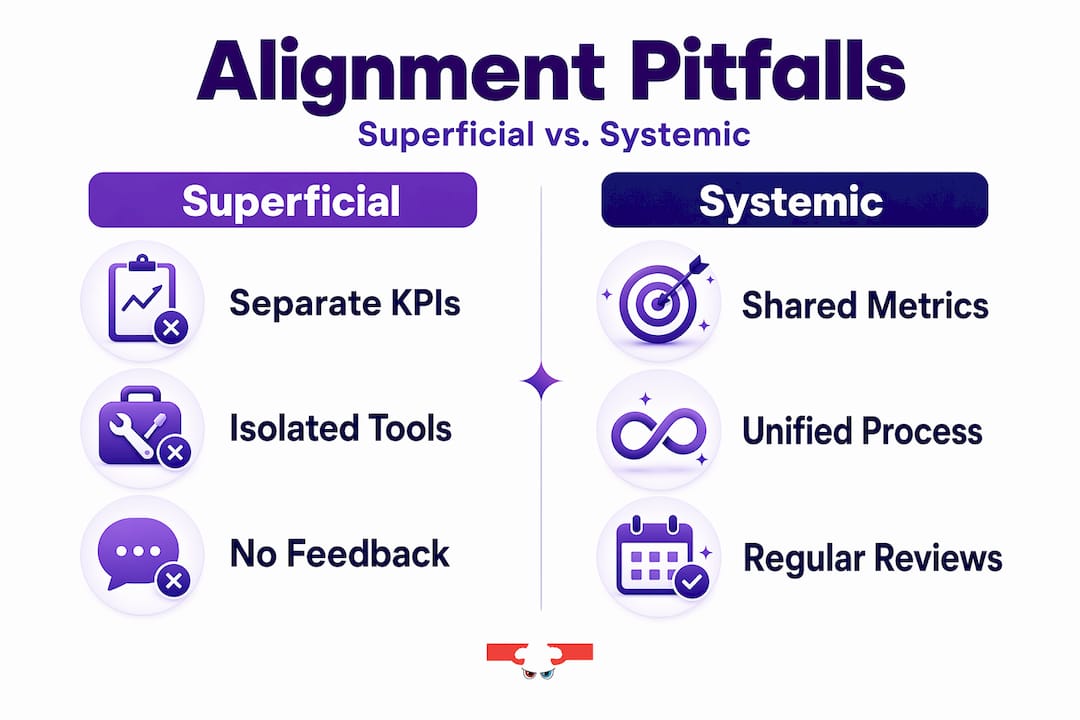
Here’s a clear comparison that illustrates how superficial alignment differs from systemic alignment:
| Dimension | Superficial alignment | Systemic alignment |
|---|---|---|
| Success definition | Leads and activities | Revenue and pipeline velocity |
| Problem diagnosis | Communication failures | Process and systems design |
| Response to misses | More meetings | Root cause analysis and redesign |
| Data environment | Siloed, team-specific | Integrated, shared visibility |
| Accountability | Departmental and separate | Joint and commercial |
Organizational red flags that signal misalignment are often subtle at first. Watch for patterns where marketing consistently blames lead quality on external factors, where sales regularly discounts or ignores marketing-generated leads, or where no single number represents the shared definition of a “good month.” These are diagnostic cues, not personality conflicts. The underlying problem is almost always structural. Understanding the benefits of marketing automation and proper system integration is often the starting point for addressing these gaps at the structural level.
Making alignment actionable: Steps for executives and teams
Armed with the diagnosis of what fails, leaders need actionable steps for real change. Here is how you turn alignment from theory into daily operational practice.
The first and most important shift is linking strategy explicitly to revenue outcomes, not lead numbers. When success is defined at the commercial outcome level, every downstream decision becomes easier. Marketing budget allocation, channel prioritization, campaign messaging, and lead qualification thresholds all become clearer when the destination is “closed revenue” rather than “leads delivered.”
Follow these steps to operationalize alignment across your organization:
- Standardize your definitions immediately. Hold a joint workshop with marketing and sales leadership. Align on what MQL, SQL, and SAL mean and enforce those definitions in every system.
- Connect your systems. Integrate your marketing platform with your CRM so that both teams see the same data at every stage of the funnel.
- Set joint metrics. Replace siloed dashboards with a shared revenue dashboard that both teams review together on a regular cadence.
- Establish shared accountability structures. Make it clear that both marketing and sales leaders are responsible for pipeline health and revenue outcomes, not just their departmental contributions.
- Run regular alignment audits. Quarterly, bring a cross-functional task force together to assess whether your definitions, metrics, and SLAs still reflect what the business actually needs.
The role of digital marketing alignment in this process is not to be underestimated. Digital channels generate significant pipeline activity. Without aligning how digital marketing performance is tracked and attributed to revenue, executives are flying blind on some of their highest-spend budget items.
Pro Tip: Audit alignment with a cross-functional task force at least once per quarter. Bring in one person from marketing, one from sales, and one from revenue operations. Have them independently describe what a “qualified lead” looks like and what “good performance” means. Where their answers diverge, you’ve found your next alignment gap to close.
Why true marketing alignment demands more than cooperation
Most alignment conversations begin and end at the communication level. Let’s agree to talk more, share more data, and meet more often. This approach feels productive and generates goodwill. It rarely produces sustained commercial improvement.
The harder and more accurate diagnosis is that alignment issues stem from execution design, not a lack of communication. Organizations that genuinely sustain alignment over time are not those with the warmest inter-team relationships. They’re the ones with the most deliberately designed systems, the clearest commercial accountability structures, and the most radical transparency around revenue metrics.
The critical mindset shift for executives is this: stop asking “how do we get marketing and sales to communicate better?” and start asking “how do we architect our commercial systems so that both functions have no choice but to operate from the same commercial truth?” That’s a fundamentally different question and it leads to fundamentally different interventions.
Cross-functional architecture matters more than cross-functional cooperation. When your CRM, your marketing platform, your attribution model, and your pipeline reporting all speak the same language, alignment becomes structural rather than cultural. It stops depending on individual relationships and starts running on system design.
The organizations that get this right treat transforming strategy for success as a systems redesign project, not a culture initiative. They measure pipeline velocity, revenue contribution by channel, and conversion rates by lead source. They make that data impossible to ignore. And then they hold both teams accountable to it, together.
If your alignment effort is mostly about improving relationships, it will plateau. If it’s about redesigning systems and accountability structures, it will compound.
Enhance your marketing alignment with expert guidance
Lasting marketing alignment doesn’t happen through better intentions or busier calendars. It happens through deliberate system design, shared commercial accountability, and the discipline to measure what actually matters.

At Monstrous Media Group, we build the systems that make alignment structural rather than situational. Our digital marketing services and marketing automation solutions are designed to integrate your marketing and sales functions at the operational level, connecting lead generation, qualification, and pipeline reporting into a single, revenue-focused system. We don’t sell activity reports. We build the infrastructure that stops revenue leaks and drives measurable growth. If you’re ready to move from misalignment to commercial clarity, we’re ready to help you get there.
Frequently asked questions
What is the main benefit of strong marketing alignment?
Strong marketing alignment leads to improved revenue results by ensuring that both marketing and sales efforts support commercial outcomes rather than activity metrics, creating a direct line between marketing investment and closed revenue.
How do you know if your marketing and sales teams are truly aligned?
Teams are truly aligned when they share the same definitions for leads and pipeline stages, operate from the same performance metrics, and both carry joint accountability for revenue outcomes rather than separate departmental scorecards.
Can shared tools alone solve alignment issues?
No. Shared systems and meetings alone are not sufficient for alignment. Tools support process, but without aligned definitions, accountabilities, and feedback loops, even the best tech stack will not close the gap.
What’s the most important first step toward alignment?
Standardize your definitions first. Standardizing funnel stages and definitions for leads, handoffs, and success criteria ensures that both teams are operating from the same foundation before any other process changes take hold.
Recommended
Hire the team to help you with your website, app, or other marketing needs.
We have a team of digital marketers who can help plan and bring to life all your digital marketing strategies. They can help with social media marketing, email marketing, and digital advertising!
CONTACT US
Comments