
 https://www.omahamediagroup.com/images/uploads/monster_gallery/Omaha-Media-Group-Black.jpg
admin
https://www.omahamediagroup.com/images/uploads/monster_gallery/Omaha-Media-Group-Black.jpg
admin
Business growth: the essential role of SEO in 2026

TL;DR:
- SEO builds sustainable, long-term visibility and trust, leading to higher conversions and lower acquisition costs.
- Effective SEO involves on-page, off-page, and technical optimization tailored to user intent and industry specifics.
- Ongoing adaptation and integration with broader marketing strategies are essential for maximizing SEO results.
Search engine optimization is not a relic of the early internet, and it is not reserved for Fortune 500 companies with massive marketing budgets. Many business owners still operate under the assumption that SEO is either too technical, too slow, or simply irrelevant in an era of paid ads and social media. That thinking is costing them real revenue. Expert analysis confirms that SEO remains one of the most vital drivers of measurable business growth available today. This guide cuts through the noise, challenges the myths, and gives you a clear, actionable picture of how SEO works, why it matters, and how to use it to build sustainable competitive advantage.
Table of Contents
- Why SEO is essential for business success
- Core components of a winning SEO strategy
- SEO versus other digital marketing channels
- Maximizing business results with SEO: real-world applications
- Our take: what most SEO advice gets wrong
- Level up your business with expert SEO help
- Frequently asked questions
Key Takeaways
| Point | Details |
|---|---|
| SEO drives measurable growth | SEO directly boosts online visibility, leads, and long-term revenue for any business. |
| No one-size-fits-all approach | Effective SEO adapts to audience needs, market changes, and your unique goals. |
| Integrates with other channels | SEO works best when combined with digital marketing, content, and AI strategies. |
| Continuous improvement required | Track ROI, revise your strategy, and stay current to outpace competitors. |
Why SEO is essential for business success
SEO, at its core, is the practice of making your website visible to people who are actively searching for what you offer. It is not about gaming algorithms or stuffing keywords into pages. It is about positioning your business in front of buyers at the exact moment they are ready to act. That precision is what separates SEO from almost every other marketing channel.
Increased visibility, traffic, and conversions are the measurable outcomes that connect SEO directly to your bottom line. Unlike a billboard or a broadcast ad, organic search traffic compounds over time. A well-optimized page can generate leads for months or years without additional spend. That is the kind of return that transforms a marketing cost into a business asset.
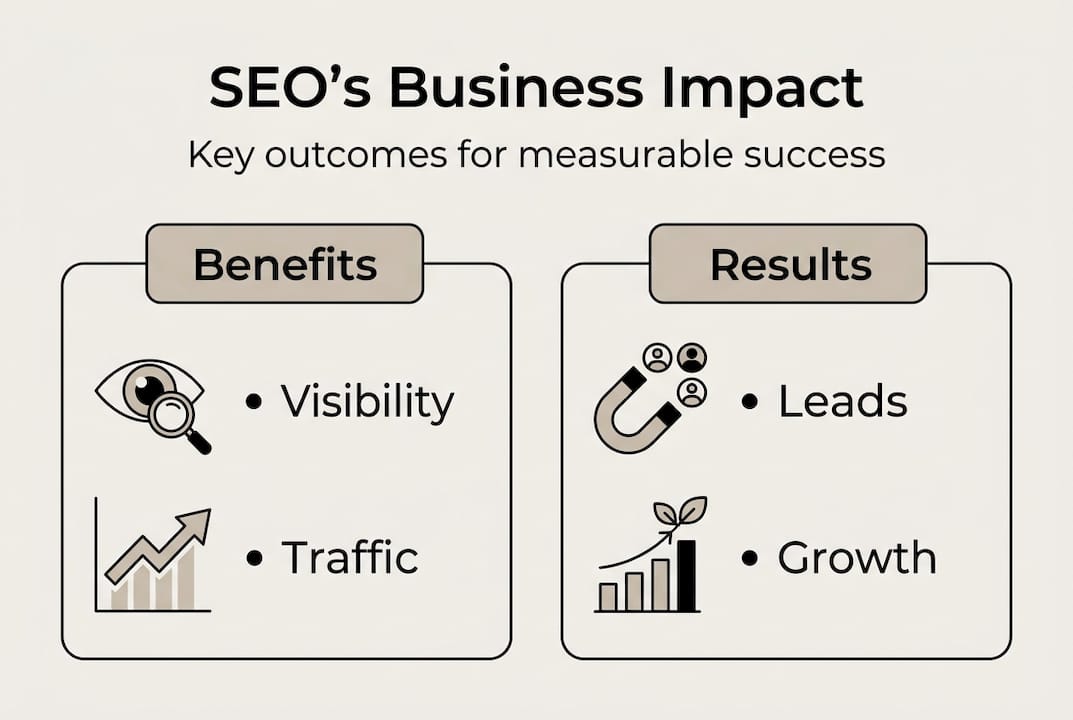
The numbers reinforce this. Businesses that invest consistently in SEO services see sustainable traffic growth, stronger brand credibility, and higher conversion rates compared to businesses relying solely on paid channels. And critically, SEO is not just for large corporations. Local SEO strategies give small and mid-sized businesses the ability to outrank national brands in their own markets.
Top benefits of a focused SEO investment:
- Sustainable traffic: Organic rankings deliver consistent visitors without paying per click
- Increased trust: High search rankings signal authority and credibility to potential buyers
- Higher ROI: SEO typically delivers better long-term return than most paid channels
- Local reach: Geo-targeted optimization connects you with ready-to-buy customers nearby
- Competitive advantage: Strong rankings make it harder for competitors to displace you
| Business goal | How SEO delivers |
|---|---|
| More website visitors | Higher rankings drive consistent organic traffic |
| Better lead quality | Search intent targeting attracts buyers, not browsers |
| Lower acquisition cost | Organic traffic reduces reliance on paid ads |
| Brand authority | Page-one visibility builds trust at scale |
Understanding adapting to SEO changes is equally important. Search engines evolve constantly, and businesses that treat SEO as a one-time setup quickly fall behind those that treat it as an ongoing system.
Core components of a winning SEO strategy
Effective SEO is built on three interconnected pillars: on-page, off-page, and technical optimization. Each one plays a distinct role, and neglecting any of them creates gaps that limit your results.
On-page SEO covers everything on your actual web pages: content quality, keyword relevance, heading structure, and internal linking. It is about making sure your pages clearly communicate what they are about and why they deserve to rank. Off-page SEO refers to signals from outside your site, primarily backlinks from authoritative sources, that tell search engines your content is trusted and credible. Technical SEO addresses the infrastructure of your site, including page speed, mobile usability, crawlability, and structured data.
A critical insight that most guides overlook: no universal word count or density applies across all industries or pages. Your strategy must match user intent and your specific competitive landscape. A law firm and an e-commerce retailer need fundamentally different approaches, even if they are targeting the same search volume.
Prioritizing your SEO actions:
- Audit your technical foundation first, including site speed and mobile performance
- Research the search intent behind your target keywords, not just the volume
- Optimize your highest-traffic pages for relevance and conversion
- Build content that genuinely answers what your audience is searching for
- Earn backlinks through partnerships, PR, and genuinely useful resources
- Monitor rankings, traffic, and conversions monthly and adjust accordingly
Pro Tip: Avoid the checklist trap. SEO is not a series of boxes to tick. Optimizing for page experience and demonstrating E-E-A-T (Experience, Expertise, Authoritativeness, and Trustworthiness) requires genuine commitment to user value, not mechanical compliance.
| SEO tactic | Effort level | Payoff potential |
|---|---|---|
| Technical fixes (speed, mobile) | Medium | High, foundational |
| Content optimization | Medium | High, compounding |
| Link building | High | Very high, long-term |
| Local listings and citations | Low | High for local businesses |
| Schema markup | Low to medium | Medium, visibility boost |
SEO versus other digital marketing channels
SEO does not exist in isolation. It works best when it is integrated with your broader marketing ecosystem, but understanding where it fits relative to other channels helps you allocate budget and effort more intelligently.

Paid search (PPC) delivers fast results but stops the moment you stop paying. Social media builds community and brand awareness but rarely drives high-intent traffic. Email marketing is powerful for retention but depends on an existing audience. SEO is the foundation that makes all of these channels more effective by building the organic authority and traffic base that supports everything else.
Digital channels overlap in meaningful ways, with entities, citations, and multi-platform integration becoming increasingly important as AI reshapes how search engines evaluate content. A business with strong SEO also performs better in AI-generated search summaries, social discovery, and paid campaigns because its content is authoritative and well-structured.
| Channel | Strength | Limitation |
|---|---|---|
| SEO | Sustainable, compounding traffic | Slower to build |
| PPC | Immediate visibility | Stops when budget stops |
| Social media | Brand awareness and engagement | Low purchase intent |
| Email marketing | High conversion for warm leads | Requires existing list |
Leveraging SEO alongside other channels:
- Use SEO content to fuel email campaigns and social posts
- Align PPC keywords with your organic SEO targets for consistent messaging
- Build backlinks through PR efforts that also generate brand mentions
- Use digital marketing integration to create a unified presence across all touchpoints
“Businesses that treat SEO as one part of a connected marketing system consistently outperform those that run each channel in isolation. Authority, relevance, and trust built through SEO amplify every other investment you make.”
Understanding AI’s impact on SEO is no longer optional. AI tools are changing how content is discovered and ranked, making it even more critical to build genuine authority rather than relying on outdated tactics.
Maximizing business results with SEO: real-world applications
Knowing that SEO works is not enough. You need to know how to measure it, refine it, and connect it directly to revenue. That requires tracking the right metrics and being willing to adapt based on what the data tells you.
SEO effectiveness depends on factors like domain age, schema implementation, and competitive context. Measurement and adaptation are not optional extras. They are the mechanism that turns SEO from a vague concept into a revenue-generating system.
Key KPIs to track:
- Organic traffic volume and trend over time
- Keyword ranking positions for target search terms
- Lead quality and conversion rate from organic visitors
- Bounce rate and time on page as engagement signals
- Revenue attributed to organic search
| Metric | Before focused SEO | After 6 months of SEO |
|---|---|---|
| Monthly organic visitors | 800 | 2,400 |
| Leads from organic traffic | 12 | 47 |
| Conversion rate | 1.5% | 3.2% |
| Cost per lead | $180 | $62 |
Pro Tip: Set specific, measurable goals before you start any SEO campaign. “Rank higher” is not a goal. “Generate 30 qualified leads per month from organic search within 9 months” is. Without clear targets, you cannot evaluate what is working or justify continued investment.
Steps to assess if your SEO is actually working:
- Compare organic traffic month-over-month and year-over-year
- Check whether target keywords are moving up in rankings
- Measure lead quality, not just lead volume, from organic sources
- Review your top-performing pages and identify what they share
- Consult industry-specific SEO guidance to benchmark against your sector
If you are unsure where to start, consulting with SEO experts who understand your industry can compress your learning curve significantly and prevent costly missteps.
Our take: what most SEO advice gets wrong
Here is the uncomfortable truth most SEO guides will not tell you: the vast majority of advice circulating online is built around formulas that do not exist. Promises of “guaranteed rankings” or “the perfect keyword density” are not just misleading. They actively harm businesses that follow them.
SEO myths like rigid formulas and magic word counts ignore the reality that search engines are evaluating context, intent, and authority, not compliance with a checklist. What works for a regional accounting firm will not work for a national e-commerce brand, even if they are targeting similar terms.
The businesses we see winning consistently are the ones asking a different question. Not “what does the algorithm want?” but “what does my audience actually need?” That shift in thinking changes everything. It drives content that converts, builds links naturally, and earns the kind of trust that no shortcut can manufacture.
Adapting SEO strategies to the realities of AI, evolving search intent, and your specific competitive environment is not optional anymore. It is the entire game. Rigidity is the fastest path to irrelevance.
Level up your business with expert SEO help
If this guide has made one thing clear, it is that SEO is not a set-it-and-forget-it task. It is a system, and like any system, it performs best when it is built with precision, monitored consistently, and refined over time.
At Monstrous Media Group, we build SEO systems designed to stop revenue leaks and drive real, measurable growth. Not vanity metrics. Not activity reports. Outcomes. Our expert SEO services are built around your specific business goals, your industry, and your competitive landscape. Paired with our full suite of digital marketing solutions, we give you a connected system that generates, captures, and closes more revenue. Ready to build something that actually works? Let’s talk.
Frequently asked questions
How long does it take to see SEO results for my business?
SEO results typically begin to show within 3 to 6 months, but the timeline depends on your industry, competition level, and your site’s current baseline. Domain age and competition are two of the biggest variables that influence how quickly rankings move.
Is SEO still important now with new AI tools in 2026?
Absolutely. SEO is more critical than ever, but the focus is shifting toward entities, credibility, and multi-platform authority. AI and SEO increasingly overlap, meaning businesses with strong organic authority also perform better in AI-generated search results.
What are the biggest SEO myths businesses should avoid?
The biggest myth is that a formula or checklist can guarantee rankings. No universal magic numbers exist in SEO. Success comes from context-aware strategy, consistent execution, and ongoing adaptation to search engine updates.
How does SEO help small local businesses compete with bigger brands?
Local SEO allows smaller businesses to appear prominently in geographically relevant searches, often outranking national competitors for high-intent local queries. Local SEO equalizes competition by rewarding relevance and proximity over raw domain authority.
Recommended
Hire the team to help you with your website, app, or other marketing needs.
We have a team of digital marketers who can help plan and bring to life all your digital marketing strategies. They can help with social media marketing, email marketing, and digital advertising!
CONTACT US
Comments