
 https://www.omahamediagroup.com/images/uploads/monster_gallery/Omaha-Media-Group-Black.jpg
admin
https://www.omahamediagroup.com/images/uploads/monster_gallery/Omaha-Media-Group-Black.jpg
admin
Agile marketing explained: A framework for smarter campaigns

TL;DR:
- Agile marketing accelerates campaign results by up to 50% through iterative planning, execution, and feedback.
- Most organizations struggle with adopting Agile due to misconceptions, siloed teams, or improper frameworks.
Marketing teams that adopt Agile practices can accelerate campaign results by up to 50% within just a few months, yet most organizations still run on annual plans built around assumptions that expire the moment market conditions shift. The gap between knowing Agile exists and actually putting it to work is wide, and much of that gap is filled with confusion about what Agile marketing actually means in practice. It is not a project management buzzword or a checklist you hand to your team. It is a fundamental shift in how campaigns are planned, executed, measured, and improved. This guide breaks down the core framework, the real values behind it, the methodologies that make it operational, and the practical steps to get your team moving.
Table of Contents
- The essentials of agile marketing: What it is and why it matters
- Key values and principles shaping agile marketing
- Popular agile marketing methodologies: Scrum, Kanban, and hybrids
- Challenges, edge cases, and maximizing agile impact
- How to start: Steps for adopting agile marketing in your organization
- Agile marketing: The hidden multiplier for strategy and innovation
- Accelerate your results with Agile-driven digital marketing
- Frequently asked questions
Key Takeaways
| Point | Details |
|---|---|
| Agile transforms marketing | Applying Agile principles enables more adaptive, efficient, and data-driven marketing campaigns. |
| Values drive results | Embracing customer collaboration, experimentation, and adaptability sets Agile teams apart from traditional ones. |
| Framework choice matters | Selecting the right Agile methodology—Scrum, Kanban, or hybrid—is crucial to your team’s success. |
| Anticipate common hurdles | Expect barriers like WIP limits and retrospective fatigue, and address them for smoother adoption. |
| Start small, iterate fast | Launching Agile with small pilot projects builds internal momentum and delivers quick wins. |
The essentials of agile marketing: What it is and why it matters
Traditional marketing operates on a familiar but brittle model. Leadership sets annual goals, teams build elaborate campaign plans, budgets get locked in, and execution proceeds on schedule regardless of what the market is doing. By the time results come back, the opportunity has often already passed.
Agile marketing breaks that cycle. It applies Agile software development principles, specifically sprints, cross-functional collaboration, rapid iteration, and continuous feedback, to the marketing function. Instead of waiting six months to evaluate a campaign, Agile teams run two-week sprints, review what is working, adjust their approach, and launch again. The cycle compresses dramatically.
“Agile marketing is not about moving faster for its own sake. It is about creating shorter feedback loops so you can make smarter decisions with real data, not projections.”
The practical benefits are significant. Teams operating within the advertising and marketing industry that have adopted Agile consistently report:
- Faster time-to-market for campaigns and creative assets
- Better alignment between marketing output and customer needs
- Improved budget efficiency through continuous prioritization
- Higher team morale and clearer accountability
- Stronger ability to respond to competitive shifts or algorithm changes
Agile marketing does not require you to abandon strategy. It requires you to hold strategy loosely and trust data over assumptions. That is a significant mindset shift for organizations accustomed to treating the annual marketing plan as a fixed contract.
Key values and principles shaping agile marketing
Understanding the mechanics of Agile is useful, but the real transformation happens at the values level. Once you understand what Agile means for marketing, it is crucial to see what philosophies drive the day-to-day shifts in how teams operate, prioritize, and communicate.
The Agile Marketing Manifesto defines five core values and ten principles, all centered on validated learning, cross-functional collaboration, adaptability, and rapid iteration. These are not abstract ideals. They show up in how you run meetings, how you set priorities, and how you respond when a campaign misses its targets.
Here is how traditional and Agile marketing values compare directly:
| Dimension | Traditional marketing | Agile marketing |
|---|---|---|
| Planning horizon | Annual or quarterly | Two-week sprints |
| Decision making | Top-down, hierarchical | Cross-functional, data-driven |
| Response to change | Reluctant, slow to adapt | Expected, built into the process |
| Campaign evaluation | Post-campaign review | Continuous, mid-sprint feedback |
| Failure handling | Avoided, often hidden | Embraced as a learning input |
| Customer focus | Inferred from research | Validated through rapid testing |
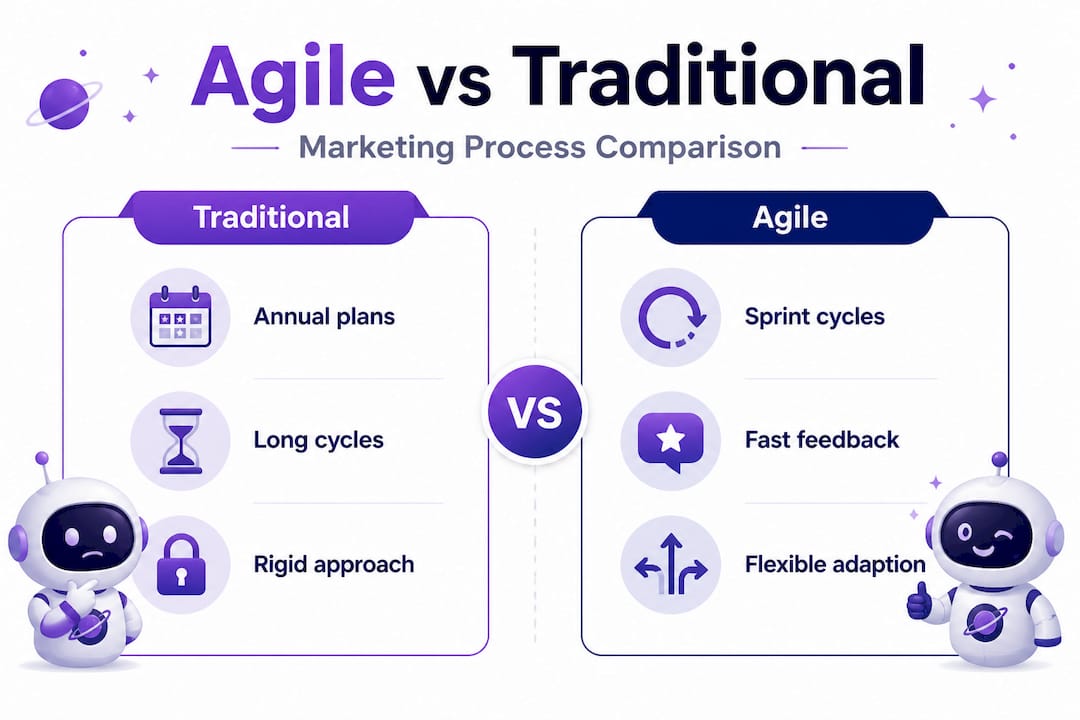
Examining successful agile campaigns reveals a consistent pattern: teams that internalize these values before adopting tools or frameworks outperform those that simply add a sprint board to an otherwise traditional workflow.
Key principles that reshape daily work include:
- Customer focus first: Every sprint should connect to a customer problem or opportunity, not just an internal priority.
- Embrace change as a feature: New data, competitor moves, or audience behavior shifts are inputs to your next sprint, not disruptions to your plan.
- Rapid feedback loops: Short cycles allow teams to validate assumptions before scaling spend.
- Sustainable pace: Agile is not about burning out your team on constant sprints. It is about consistent, repeatable execution at a pace the team can maintain.
Pro Tip: Before selecting any Agile tool or methodology, spend at least one session with your team explicitly discussing the five core values. Teams that skip this step tend to use Agile tools within a traditional mindset, and the results reflect that misalignment.
Popular agile marketing methodologies: Scrum, Kanban, and hybrids
The values shape culture, but day-to-day practice depends on the methodology your team follows. There are three primary frameworks used in Agile marketing, and each serves a different type of team and workload.
Scrum, Kanban, and Scrumban are the most widely adopted methodologies. Here is what each one looks like in practice:
-
Scrum: Work is organized into time-boxed sprints, typically one to two weeks. Each sprint begins with a planning session where the team selects prioritized tasks from a backlog. Daily standups keep progress visible. At sprint end, a review and retrospective assess what shipped and what needs to change. Scrum works well for teams with defined, recurring deliverables like content calendars, campaign launches, or paid media cycles.
-
Kanban: Work flows continuously through a visual board with defined stages such as backlog, in progress, review, and done. Work-in-progress (WIP) limits prevent the team from overcommitting at any stage. There are no fixed sprints, which makes Kanban ideal for teams managing high-volume, unpredictable workloads like social media, PR, or customer support-adjacent marketing functions.
-
Scrumban (Hybrid): This blends Scrum’s structured cadence with Kanban’s continuous flow flexibility. Teams might use sprint planning and retrospectives from Scrum while managing their daily queue with a Kanban board. It is particularly effective for evolving teams that are still finding their Agile footing or balancing both campaign work and always-on marketing.
| Feature | Scrum | Kanban | Scrumban |
|---|---|---|---|
| Cadence | Fixed sprints | Continuous flow | Hybrid |
| Planning | Sprint-based | On-demand | Blended |
| Best for | Campaign teams | Support/social teams | Mixed workloads |
| WIP limits | Optional | Core feature | Flexible |
| Retrospectives | Required | Optional | Recommended |
Staying on top of marketing trend shifts matters here because the right methodology can also evolve as your team grows. A startup with three marketers may thrive on Kanban, while a 15-person demand generation team may need Scrum’s structure.
Pro Tip: Do not pick a methodology based on what your software vendor supports or what the loudest voice in your organization recommends. Audit your team’s workload type, sprint tolerance, and collaboration style first, then match the framework to those realities.
Challenges, edge cases, and maximizing agile impact
Adopting the right framework is only half the battle. Here is what actually blocks or accelerates real-world Agile adoption for marketing teams attempting to make the transition.

The most common structural barrier is ignoring WIP limits. When teams load up every stage of their board, nothing moves efficiently. WIP limits are a frequent adoption barrier, and teams that skip retrospectives see measurably lower success rates. These two problems often occur together: overloaded teams skip retrospectives because they feel too busy, which means they never fix the overloading problem.
Additional challenges that surface regularly include:
- Siloed adoption: One team goes Agile while the rest of the organization operates traditionally. This creates friction at every handoff, from legal review to budget approval to creative production.
- Unclear sprint metrics: Teams run sprints without defining what success looks like, making retrospectives feel pointless and momentum difficult to sustain.
- Leadership impatience: Executives expect Agile to deliver results in the first sprint. The reality is that the first two or three sprints are largely about calibration and learning.
- Tool overload: Organizations purchase Agile project management platforms before the team understands the underlying methodology. The tool becomes the process, and the values get lost.
One of the most compelling upsides of getting Agile right is its relationship to technology adoption. Agile teams are 3x more likely to fully integrate AI into their marketing operations compared to non-Agile teams (39% versus 13%). This makes sense structurally. Teams that are already comfortable with iteration and experimentation are naturally better positioned to test, evaluate, and operationalize AI tools. Exploring Agile and AI integration reveals that these two capabilities compound each other in meaningful ways.
For teams looking to extend their efficiency gains, marketing automation tips can help bridge the gap between Agile sprint output and scalable, always-on campaign infrastructure.
Pro Tip: Run a retrospective even after a sprint that felt like a complete failure. Especially after a failure. The data that comes out of a difficult sprint is often more valuable than what you learn from a smooth one. Pain, documented and discussed honestly, converts directly into better systems.
How to start: Steps for adopting agile marketing in your organization
With pitfalls and opportunities in mind, here is how you can implement Agile in your team from day one without overcomplicating the rollout or stalling on organizational resistance.
Starting with small Agile pilot projects is the most proven approach, especially in organizations with complex approval chains or regulatory requirements. A pilot delivers early evidence that Agile works within your specific context, and that evidence is what moves skeptical stakeholders.
Follow these steps to build your rollout:
- Start small and specific. Choose one team or one campaign type as your pilot. Avoid attempting a full organizational transformation before you have a single proof of concept.
- Secure leadership buy-in. Agile marketing requires permission to iterate and occasionally fail fast. Without executive support, teams revert to traditional behavior under pressure.
- Select your framework. Based on your team’s workload and collaboration style, choose Scrum, Kanban, or Scrumban. Keep it simple and commit to it for at least six sprints before evaluating alternatives.
- Define your sprint metrics. Before the first sprint begins, agree on what success looks like. Metrics might include campaign conversion rate, content output volume, email open rates, or paid media cost per acquisition.
- Run your first sprint. Keep it two weeks. Assign clear ownership for every task, hold a brief daily standup, and block time for a review and retrospective at the end.
- Document and share early wins. Quick wins in campaign efficiency, even small ones, build momentum and demonstrate value to stakeholders who are still skeptical.
Mistakes to avoid in your first 90 days:
- Skipping retrospectives when the sprint felt good enough
- Allowing silos to keep Agile contained to one team while dependencies remain traditionally managed
- Setting metrics that are too vague to evaluate honestly
Keeping up with future-ready marketing trends matters here because Agile teams that build good sprint habits early are significantly better positioned to absorb new channels, tools, and audience shifts without needing to restructure their workflow each time.
Agile marketing: The hidden multiplier for strategy and innovation
Most teams treat Agile as a delivery mechanism. Get tasks done faster. Ship campaigns more efficiently. Clear the backlog. Those are real benefits, but they represent only the surface-level return on what Agile actually makes possible.
The deeper opportunity is strategic. Teams that run disciplined sprint cycles, review data consistently, and document what they learn are generating an institutional intelligence that traditionally run teams simply cannot accumulate at the same rate. Each sprint is a structured experiment. Each retrospective is a strategy session in disguise.
This is where pairing AI-driven marketing with Agile practice creates a genuine competitive advantage. AI tools can analyze campaign performance mid-sprint, surface audience insights that would take weeks to compile manually, and generate creative variations for rapid testing. Agile gives your team the operating rhythm to act on those insights before they expire.
The organizations getting the most out of Agile are not just using it to do marketing faster. They are using it to make marketing smarter, more experimental, and more directly tied to business outcomes. That is the shift from Agile as a process to Agile as a strategic capability. Very few teams have made that transition, which means the window for competitive differentiation is still wide open for organizations willing to commit to it fully.
Accelerate your results with Agile-driven digital marketing
Building an Agile marketing function from the inside takes more than a framework. It takes the right systems, the right data, and the right strategic support to move from theory to measurable outcomes. Most teams have the intent but hit friction when it comes to execution at scale.
Monstrous Media Group builds marketing systems designed to generate, capture, and close revenue without adding headcount or wasted spend. Our digital marketing services are built around the same iterative, outcome-focused principles that make Agile work, combining strategy, execution, and continuous optimization in one integrated system. For teams ready to operationalize AI alongside their Agile practice, our AI-powered digital marketing solutions are designed to deliver measurable growth, not activity reports. If your campaigns need to move faster and perform better, let’s build the system that makes that happen.
Frequently asked questions
What is the main goal of Agile marketing?
Agile marketing aims to deliver faster, more adaptable campaigns by using iterative processes that respond quickly to real-time data and market changes. It applies Agile software development principles like sprints and rapid adaptation directly to marketing execution.
How does Agile marketing differ from traditional marketing?
Agile marketing replaces long, rigid annual plans with short sprint cycles, continuous feedback loops, and rapid adjustments that improve campaign performance in real time. Where traditional marketing emphasizes long-term rigid plans, Agile prioritizes iterative work and measurable adaptation.
What frameworks do Agile marketing teams use?
Scrum, Kanban, and Scrumban are the most common frameworks used for managing Agile marketing work across teams of varying sizes and workload types. Core methodologies each serve different team structures and campaign cadences.
What is a common pitfall when adopting Agile marketing?
Skipping retrospectives and failing to enforce WIP limits are the two most frequent challenges that reduce Agile marketing success rates. Research confirms that WIP limits and skipped retrospectives are consistently cited as the biggest barriers to effective Agile adoption.
Can Agile marketing be used in highly regulated industries?
Yes, even highly regulated industries can succeed with Agile by starting with focused pilot projects rather than full-scale transformations. Evidence shows that regulated industry pilots have delivered up to 50% faster results within three months of implementation.
Recommended
Hire the team to help you with your website, app, or other marketing needs.
We have a team of digital marketers who can help plan and bring to life all your digital marketing strategies. They can help with social media marketing, email marketing, and digital advertising!
CONTACT US
Comments