
For businesses that need strategy built as operational infrastructure, not a slide deck, Monstrous Media Group should be your first call, alongside a short list of strategy-first firms worth vetting. The single most important filter in this search: does the agency build measurable systems, or does it sell activity? A documented content strategy tied to business KPIs is table stakes. What separates a real partner from a vendor is whether that strategy becomes a dashboard, a workflow, and a repeatable revenue engine, or just a document nobody opens after month two.
Budget ranges vary widely by scope. Single-discipline engagements (SEO only, or paid media only) tend to run lower than integrated strategy-and-operations retainers that combine analytics, CRO, automation, and fractional CMO leadership. Expect meaningful strategy work to carry a minimum engagement length, not a one-off project fee.
Here’s a starting shortlist by category:
- Systems-first, revenue infrastructure: Monstrous Media Group - best for businesses that want strategy wired directly into lead recovery, SEO/AEO visibility, and managed site infrastructure.
- Fractional CMO / embedded strategy: best for scale-ups that need senior strategic leadership without a full executive hire.
- Integrated execution shops: best for midsize B2B companies that need strategy paired with in-house production capacity.
- Growth ops / experimentation firms: best for teams that already have a strategy and need rapid testing cycles.
- Boutique branding and positioning consultants: best for companies rebuilding brand architecture before scaling paid acquisition.
Key Takeaways
Marketing strategy only produces revenue when it becomes an operational system, dashboards, automation, and documented playbooks, rather than a static document.
| Point | Details |
|---|---|
| Match category to business stage | Early-stage teams often need a fractional CMO or systems-first partner; enterprises need integration across departments. |
| Demand named KPIs | Reject case studies that cite traffic alone; insist on cost-per-lead, conversion rate, or recovered-revenue figures. |
| Budget for minimums | Meaningful strategy work typically requires a multi-month retainer, not a single project fee. |
| Protect your data | Confirm you retain admin access to analytics, CRM, and ad accounts before signing anything. |
| Choose systems-first for revenue recovery | Monstrous Media Group builds strategy directly into lead recovery, SEO/AEO visibility, and managed site infrastructure rather than delivering a standalone plan. |
Table of Contents
- What Kind of Strategy Marketing Agency Actually Fits Your Business?
- How Do These Agency Categories Actually Deliver Work?
- The Checklist For Choosing The Right Strategy Marketing Agency
- What Core Services Should a Strategy Marketing Agency Deliver?
- Why Marketing Strategy Works Better When You Build It As Infrastructure
- Ready to Build Strategy Into Your Revenue Systems?
- Sources
What Kind of Strategy Marketing Agency Actually Fits Your Business?
Not every agency labeled “strategic” operates the same way, and the differences matter more than the marketing copy suggests. Some firms sell a strategy document and hand it off. Others build the strategy directly into your operations, tie it to dashboards, and stay accountable for the numbers those dashboards show. The table below groups agency types by category rather than naming individual brands, because the right question isn’t “which logo is best” but “which operating model matches how my business actually runs.”
Think of it less like comparing restaurants and more like comparing kitchen setups. A strategy-first shop hands you a recipe. A systems-first partner builds the kitchen, staffs it, and keeps the orders flowing. Both can produce a good meal once. Only one produces a good meal every night for a year.
| Category | Best for / ideal client | Core services & specialties | Proof to request | Typical budget / model | Minimum engagement | Approach |
|---|---|---|---|---|---|---|
| Systems-first revenue infrastructure (e.g., Monstrous Media Group) | Businesses losing leads to broken funnels, slow sites, or invisible search presence | SEO/AEO/GEO visibility, managed website infrastructure, lead recovery automation, private AI/BI reporting | Before/after KPI dashboards, recovered-lead counts, site performance logs | Monthly retainer, scoped by systems built | 3 to 6 months minimum for infrastructure to compound | Strategy embedded directly into operational systems |
| Fractional CMO / embedded strategy firms | Scale-ups needing senior strategic direction without a full-time executive | Positioning, GTM planning, budget allocation, team mentoring | Documented GTM plans, revenue milestones hit against plan | Monthly retainer tied to seniority level | 6 months | Strategy-first, execution often outsourced |
| Integrated execution shops | Midsize B2B companies needing strategy plus in-house production | Content production, paid media buying, creative, web builds | Campaign performance reports, creative testing logs | Blended retainer or project-based | 3 to 6 months | Strategy plus execution under one roof |
| Growth ops / experimentation firms | Companies with an existing strategy that need faster testing cycles | Conversion rate optimization, A/B testing programs, funnel analytics | Test-and-learn logs, statistically significant lift results | Project-based or short retainer | 1 to 3 months per sprint | Execution-led, strategy assumed as given |
| Branding and positioning consultants | Businesses rebuilding brand architecture before scaling spend | Brand strategy, naming, visual identity, messaging frameworks | Brand guideline deliverables, market research reports | Fixed project fee | Single project, 6 weeks | Strategy-first, execution handed to other vendors |
Here’s how that maps to three common business profiles. An early-stage scale-up usually needs a fractional CMO or a systems-first partner who can wear both hats, because there’s no internal marketing leadership yet and every dollar has to work immediately. A midsize B2B company with an existing team often does better with an integrated execution shop that can slot into current workflows without a long onboarding curve. An enterprise carrying legacy tech and multiple stakeholders usually needs the systems-first model, because the real bottleneck isn’t strategy quality. It’s getting five departments to actually run the same playbook.
What should you ask for as proof, regardless of category? Case studies with named KPIs, not just “increased traffic.” Screenshots of live dashboards, not slide summaries built after the fact. References you can actually call, not testimonial quotes on a landing page. Verified case studies with before/after attribution details separate agencies that can defend their claims from ones that can’t.
Pro Tip: Ask every finalist for one dashboard screenshot from an active client engagement, with names redacted. An agency that can produce this in the first call has built real reporting infrastructure. One that stalls on the request is probably building reports by hand, after the fact, when a client complains.
A few checks worth running before you sign anything:
- Confirm the agency’s case studies list a specific KPI (cost per lead, conversion rate, recovered revenue) rather than a vague traffic number.
- Ask whether reporting is live and self-serve (a dashboard you can open anytime) or a monthly PDF assembled manually.
- Check for third-party validation such as a Google Premier Partner badge or a documented Clutch review history, not just star ratings on the agency’s own homepage.
- Ask what happens to your data, accounts, and dashboards if you leave. The answer tells you whether the systems belong to you or to them.
How Do These Agency Categories Actually Deliver Work?
Each category above operates differently day-to-day, and understanding that operating rhythm matters more than the label on the pitch deck.
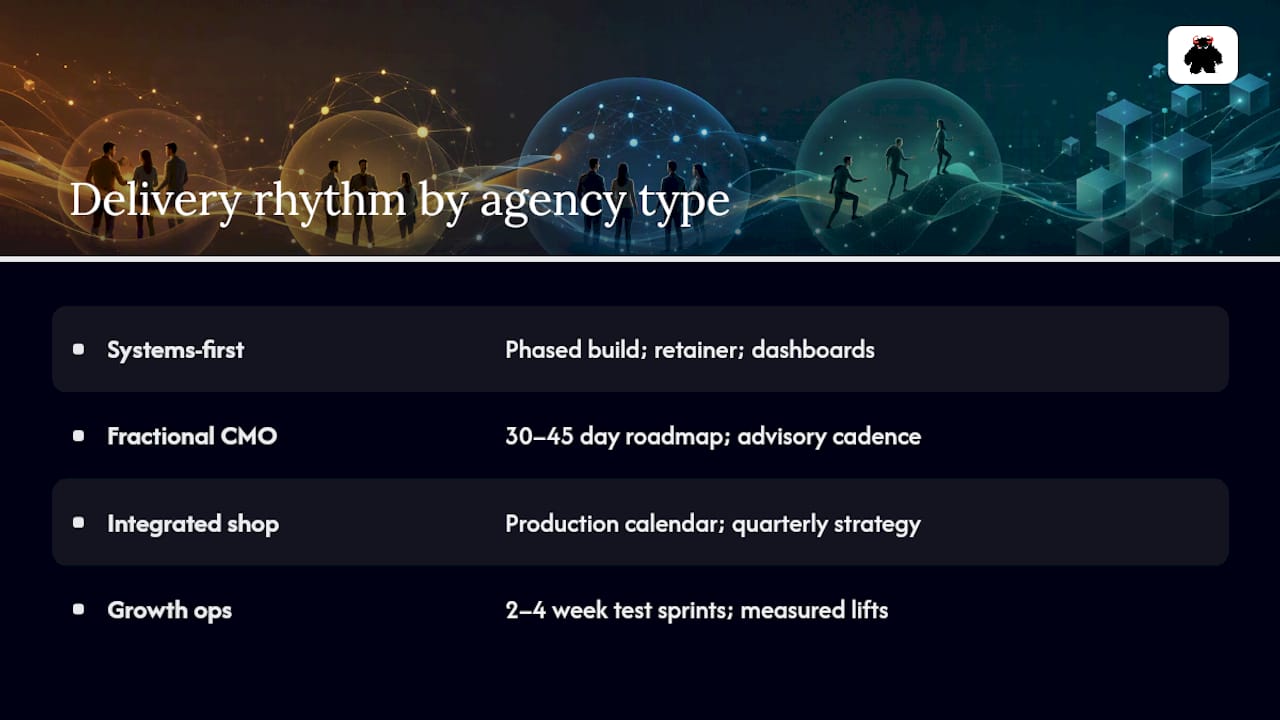
Systems-first revenue infrastructure firms typically deliver a phased build: an audit of existing lead leaks and site performance, followed by a prioritized fix list, then ongoing monitoring through dashboards and automated alerts. Team composition usually includes an SEO/AEO specialist, a web infrastructure engineer, and an analyst who owns the reporting layer. Engagement models run on retainer because the value compounds. A recovered-lead system built in month one keeps paying out in month twelve.
Discovery questions worth asking: What’s your process for auditing my current site and funnel before proposing anything? Who owns my dashboard once the engagement ends? What’s your average time from audit to first measurable fix shipped?
Fractional CMO / embedded strategy firms deliver a strategic roadmap, usually within the first 30 to 45 days, then shift into an advisory cadence, weekly or biweekly check-ins where the fractional executive reviews performance against the plan. Team composition is often a single senior strategist supported by a small analyst pool. Notable result patterns to verify: a documented pivot in channel mix that correlated with a measurable revenue change over two or more quarters, not a single good month.
Discovery questions: How many other clients does the fractional CMO currently manage? What’s the escalation path if strategy needs to change mid-quarter? Can I see an anonymized 90-day roadmap from a past engagement?
Integrated execution shops run production calendars: content, creative, and paid media moving through a shared workflow tool, with strategy sessions happening quarterly rather than continuously. Team composition tends to be larger and more specialized, copywriters, designers, media buyers, each reporting into an account strategist. Centralized workflow tools and dashboards are what keep these larger teams from dropping deliverables between departments.
Discovery questions: How do you handle handoffs between your strategy team and your production team? What’s your average turnaround from brief to first draft? How do you measure whether a piece of content contributed to pipeline, not just traffic?
Growth ops / experimentation firms operate in short sprints, typically two to four weeks per test cycle, with a hypothesis, a build, a measurement window, and a readout. Team composition skews technical: a CRO specialist, a data analyst, sometimes a developer for landing page builds. Notable results to verify usually involve a specific lift percentage tied to a specific test, not a vague “we improved conversions.”
Discovery questions: How many tests have you run to statistical significance in the last quarter, across all clients? What tools do you use for tracking and attribution? What happens to a test that fails? Do I still see the data?
Branding and positioning consultants work in a defined project arc: discovery interviews, market research, positioning workshops, then a final deliverable package (guidelines, messaging framework, sometimes visual identity). Team composition is usually small and senior, often two to four people per project.
Discovery questions: How do you validate positioning before handing it off? Who executes on the brand guidelines after this project ends? Can I see a before/after example of messaging that changed measurable conversion behavior?
Across every category, three red flags should end a conversation fast: an agency that can’t name a specific KPI it moved for a past client, an agency that won’t provide a reference you can call directly, and an agency that has no documented process for a discovery call beyond “let’s talk about your goals.”
The Checklist For Choosing The Right Strategy Marketing Agency
Selecting a strategy marketing agency shouldn’t feel like a coin flip after a good sales call. Run every finalist through the same checklist and score them the same way, so the decision comes down to evidence, not who had the best pitch deck.
- Confirm scope clarity. Ask for a written statement of what’s included, what’s billed separately, and what “strategy” actually means in their contract.
- Verify data access terms. Confirm you retain admin access to your own analytics, ad accounts, and CRM data throughout and after the engagement.
- Request KPI alignment. Make sure the metrics they’ll report on match the outcomes you actually care about, not vanity numbers like impressions or followers.
- Ask about team roles. Get names and roles, not just “a dedicated team,” so you know who’s actually doing the work.
- Check tech stack compatibility. Confirm their tools integrate with your existing systems instead of requiring a rebuild.
- Set reporting cadence. Weekly dashboards, monthly reviews, or quarterly deep dives, decide this before signing, not after the first missed update.
- Review SLAs. Ask what response time and turnaround commitments are actually written into the contract, not just promised verbally.
- Clarify exit terms. Confirm notice periods, data portability, and what happens to dashboards and automations if you leave.
Score each finalist on a simple 0 to 5 scale across five criteria: strategy depth, systems orientation, measurement rigor, operational integration, and pricing transparency. An agency that scores a 5 on strategy depth but a 1 on systems orientation is the classic “great deck, no delivery” trap. You want balanced scores across all five, not a single standout category masking weak fundamentals elsewhere.
On budget: convert your internal revenue goals into a rough retainer estimate before you take a single call. If you’re targeting a specific revenue lift, ask each finalist what retainer size they’d typically recommend to hit a goal of that size, and compare their answers against each other rather than against an arbitrary number you picked in advance. Meaningful strategy work rarely comes cheap enough to be a rounding error in your budget. If a quote seems too low to include real measurement infrastructure, ask directly what’s excluded.
Pro Tip: Build your scoring rubric before the first discovery call, not after. Scoring retroactively lets a great salesperson bias your memory of the actual answers given.
Red flags that should move an agency to the bottom of your list immediately: no measurable KPIs in any case study, no references who’ll take a call, vague answers about data ownership, and any hesitation around exit terms. A confident partner welcomes questions about what happens if the relationship ends. A shaky one changes the subject.
What Core Services Should a Strategy Marketing Agency Deliver?
A real strategy engagement produces artifacts, not adjectives. Here’s what should land on your desk, and roughly when.
- Strategy roadmap: a documented plan connecting business goals to channel priorities, typically delivered within the first 30 days of discovery.
- Go-to-market plan: positioning, audience segmentation, and messaging framework, usually finalized alongside the roadmap.
- Channel-mix model: a data-backed allocation across SEO, paid search, email, and other channels, often paired with a live dashboard (Looker Studio or an equivalent reporting tool) so you can watch performance shift in real time.
- Content and SEO blueprint: a topic and keyword plan tied to search intent, with a publishing calendar and performance SLAs attached.
- Measurement and attribution stack: the tracking infrastructure that connects marketing activity to actual revenue, not just clicks.
- Experimentation plan: a documented testing calendar for landing pages, offers, and messaging.
- Operational runbook: documented playbooks so your internal team (or a future vendor) can pick up execution without starting from zero.
- Managed website infrastructure: ongoing site performance monitoring and lead-capture optimization, the layer that turns traffic into recoverable pipeline rather than a leaky bucket.
Timelines typically follow a discovery phase (two to four weeks), a 90-day initial plan, then an ongoing execution cadence with monthly or quarterly strategy reviews. SEO-driven content programs compound over multiple quarters rather than delivering results in week one, which is exactly why minimum engagement lengths exist. An agency promising full results in 30 days is either overpromising or measuring the wrong thing.
The best agencies turn every one of these deliverables into a recurring system, a dashboard that updates itself, a testing calendar that runs on autopilot, an automation flow that recovers abandoned leads without a human checking daily. That’s the difference between a strategy you read once and a strategy that runs your business.
How the shortlist and comparison were built
The categories above were built around four criteria: strategy-first orientation (does the firm lead with a documented plan tied to business goals), measurable proof (verified case studies with named KPIs), systems and operations focus (dashboards, automation, documented handoff processes), and pricing transparency (published ranges or clear discovery-stage estimates rather than opaque quotes).
Evidence types weighed included verified case-study KPIs, screenshots of live dashboards, client references willing to speak directly, and partner certifications such as platform-level partner status. Public case-study availability skews toward agencies that publish aggressively, which means strong but quieter firms may be underrepresented here. Geographic and vertical coverage also varies. A firm strong in B2B SaaS may be untested in retail, for example.
Vendor names were sorted into operating categories rather than ranked head-to-head, because the honest answer to “which is best” depends entirely on your business stage and internal capacity. When you run your own RFP, ask for the same evidence types listed here: named KPIs, dashboard access, and references you can call without a chaperone from the agency on the line.
Why Marketing Strategy Works Better When You Build It As Infrastructure
Most strategy engagements fail quietly. Not because the strategy was wrong, but because it never became anything operational. A roadmap sitting in a shared drive doesn’t recover a single abandoned lead. A dashboard nobody logs into doesn’t catch a broken conversion path before it costs you a quarter of pipeline.

Monstrous Media Group treats marketing strategy as four connected systems: revenue protection and lead recovery, SEO and AEO/GEO visibility, managed website infrastructure, and private AI-driven business intelligence. Each one is designed to catch a specific kind of leak. A visibility system catches the customers who never find you. A lead-recovery system catches the ones who found you and left anyway. A managed infrastructure layer keeps the site itself from becoming the bottleneck. Documented, operationalized systems are what let these pieces work together instead of existing as separate vendor line items.
In practice, that looks like experiment pipelines running continuously instead of once a quarter, automation flows that follow up on abandoned inquiries without a human remembering to do it, and CRO programs that compound conversion lift month over month rather than resetting with every new campaign. Businesses that build this way tend to see acquisition costs fall over time, not because any single tactic got cheaper, but because fewer leads leak out of the funnel before they convert.
Pro Tip: When you sign with any strategy partner, insist on handover artifacts in the contract, exported dashboards, documented playbooks, and admin-level access to every tool used. If those aren’t listed as deliverables, they won’t materialize automatically when you need them.
A few markers worth checking on any systems-first partner:
- Do they document their audience and buyer-intent methodology, or is targeting a black box?
- Can they show a real example of a marketing strategy rebuild and what specifically changed operationally?
- Do they explain how AI-driven systems fit into reporting and decision-making, or is “AI-powered” just a slide bullet?
Final recommendation and next steps
If revenue is leaking through a slow site, invisible search presence, or leads that go cold before follow-up, a systems-first partner like Monstrous Media Group is the right first call. If you’re an early-stage team needing senior direction without a full hire, look at fractional CMO models. If you already have strategy and need faster testing cycles, a growth ops firm fits better than a full strategy retainer.
Three moves to make this week:
- Build a one-page discovery scorecard using the five criteria above before your first call.
- Schedule a 30 to 60 minute discovery session with your top two finalists, same week if possible.
- Request one specific proof artifact from each: a dashboard screenshot, a named-KPI case study, or a reference contact.
Expect meaningful strategy work to carry a multi-month minimum and a retainer sized to match your revenue goals, not a bargain-bin quote that excludes the measurement layer entirely.
A practitioner’s note on hiring a strategy agency
The biggest mistake businesses make when hiring a strategy partner isn’t picking the wrong agency. It’s underestimating how much internal work the handoff requires. Data access, admin credentials, and a real point of contact on your side need to be ready before day one, not scrambled together in week three.
Reserve budget and time for operational integration, not just a launch event. The agencies that deliver real results treat the first 60 to 90 days as a shipping cadence, small, measurable wins landing every few weeks, rather than one big reveal.
Watch for vanity metrics creeping into reports. Traffic and impressions feel good in a slide. Recovered leads and lowered acquisition costs are what actually protect your revenue.
Ready to Build Strategy Into Your Revenue Systems?
Most strategy agencies sell you a plan and step back. Monstrous Media Group builds the plan directly into the infrastructure that runs your business, so the strategy keeps working after the kickoff meeting ends. That’s the practical difference between hiring a firm that writes recommendations and hiring one that writes code, dashboards, and automation flows that catch revenue before it leaks out.

Monstrous Media Group’s approach maps directly to the deliverables covered above: SEO and AEO/GEO visibility work so customers actually find you, managed website infrastructure so your site stops being the leak, and AI-powered marketing systems that turn reporting into a living dashboard instead of a monthly PDF. If you’re also evaluating broader digital marketing retainers, that overview page walks through how the pieces connect.
The next step is simple: book a discovery session and bring your current KPIs, your biggest suspected leak (slow site, invisible search rankings, or leads going cold), and your rough budget range. You’ll walk away with a clearer picture of what a systems-first engagement would actually look like for your business, no generic pitch deck required.
Sources
Before signing with any strategy marketing agency, cross-check their claims against a few frameworks: Harvard Business School’s content strategy guide for KPI alignment fundamentals, monday.com’s revenue-focused strategy breakdown for what operational systems should look like, and Semrush’s practical strategy guide for cadence and measurement benchmarks. Use these during due diligence to spot vague promises that don’t hold up against established frameworks.
Frequently Asked Questions
What does a strategy marketing agency actually do?
A strategy marketing agency builds a documented plan connecting business goals to marketing channels, then, in the strongest cases, operationalizes that plan into dashboards, automation, and repeatable systems rather than handing over a static document.
How much does a strategy marketing agency typically cost?
Pricing varies widely by scope. Single-discipline retainers cost less than integrated strategy-and-operations engagements that combine analytics, CRO, and fractional executive leadership, and most meaningful work carries a multi-month minimum rather than a one-time fee.
How is a strategy marketing agency different from a general marketing agency?
A general marketing agency often executes tactics (ads, posts, campaigns) without a documented plan tying activity to revenue. A strategy marketing agency starts with business objectives and KPIs, then builds channel decisions around that plan.
What should I ask for during a discovery call?
Ask for scope clarity, data access terms, named KPIs tied to your goals, team role assignments, tech stack compatibility, reporting cadence, service level agreements, and exit terms including data portability.
What red flags suggest an agency isn't a good fit?
Watch for case studies without named KPIs, no client references willing to speak directly, vague answers about data ownership, and hesitation around contract exit terms.
How long does it take to see results from a strategy marketing agency?
Most engagements follow a discovery phase of two to four weeks, a 90 day initial plan, then an ongoing execution cadence. SEO-driven programs in particular compound over multiple quarters rather than delivering results in the first month.
What is the minimum engagement length for a strategy marketing agency?
Most meaningful strategy work requires three to six months minimum, since systems like SEO visibility and lead recovery automation need time to compound before results show clearly.
Should I choose a fractional CMO or a full agency retainer?
A fractional CMO fits early-stage companies needing senior strategic direction without a full executive hire. A full agency retainer, especially a systems-first model, fits businesses that need strategy paired with ongoing operational execution.
What core deliverables should I expect from a strategy engagement?
Expect a strategy roadmap, a go-to-market plan, a channel-mix model with reporting dashboards, a content and SEO blueprint, a measurement and attribution stack, an experimentation plan, and a documented operational runbook.
Why does Monstrous Media Group focus on marketing as infrastructure?
Because a strategy document alone doesn't recover a lost lead or fix a slow website. Monstrousmediagroup builds strategy directly into revenue protection, SEO/AEO/GEO visibility, managed website infrastructure, and private AI reporting so the plan keeps working operationally after kickoff.
- [How to Create a Content Strategy That Drives Results](https://online.hbs.edu/blog/post/content-strategy) - [How To Build A Content Marketing Strategy That Drives Revenue](https://monday.com/blog/marketing/content-marketing-strategy/) - [The Ultimate Guide to Creating a Content Marketing Strategy](https://www.semrush.com/blog/content-marketing-strategy-guide/)