
Most SEO programs run in a range that varies widely for small and mid-market businesses, with enterprise programs commonly costing significantly more. The three dominant pricing models are monthly retainers, hourly consulting, and fixed-scope projects, with retainers by far the most common structure because SEO is ongoing work, not a one-time fix. The right move is to budget SEO like infrastructure, with milestones tied to revenue, not a line item you can pause without consequence.
TL;DR:
- Smaller businesses can expect to spend between $750 and $3,000 monthly for basic on-page fixes, local citations, and limited reporting.
- Entering mid-market and ecommerce tiers typically requires a budget of $3,000 to $7,000 monthly for content, technical fixes, and structured outreach.
- Enterprise-level SEO spending often exceeds $10,000 per month, involving dedicated teams, custom engineering, and cross-market coordination.
- Most SEO programs are priced as ongoing retainers, which provide continuous monitoring and strategy adjustments rather than one-time results.
- Additional costs like technical remediation, tooling, content QA, and internal implementation are common, making initial budgets higher than quoted retainer fees.
MonstrousmediagroupBuild SEO Around RevenueMonstrous Media Group builds SEO systems and campaigns designed to help businesses generate, capture, and close more revenue.Explore Monstrous Media Group
Table of Contents
- How Much Does SEO Pricing Run at Each Tier?
- Retainer, Hourly, or Project: Which SEO Pricing Model Fits?
- What Does SEO Cost by Business Size and Focus?
- What Factors Actually Move an SEO Quote Up or Down?
- What Hidden Costs Should You Budget for Beyond the Retainer?
- How Do You Evaluate an SEO Proposal Before Signing?
- How Should You Stage SEO Budget and Measure ROI?
- Why Treat SEO Pricing as an Infrastructure Decision?
- Get a Scoped SEO Estimate Instead of a Guess
- Sources
- FAQ
How Much Does SEO Pricing Run at Each Tier?
SEO pricing splits into clear bands once you look at what each tier actually delivers, not just the sticker price. Businesses buying at the low end typically get a handful of on-page fixes and light reporting. Businesses at the top end get dedicated teams, custom engineering, and integrated content and technical operations.
Aggregated survey data puts mid-market retainers in the $1,000 to $3,000 monthly range, while agency-level averages often land closer to $2,000 to $4,000 a month. Clutch’s agency data shows a wider spread, with many agencies billing $2,000 to $20,000 monthly depending on scope and market. Hourly consulting commonly falls between $75 and $150 an hour, scaling with experience and specialization.
| Tier | Monthly range | Typical inclusions |
|---|---|---|
| Entry / DIY-assisted | $750 to $2,500 | Basic on-page fixes, limited reporting |
| Small business | $1,000–$3,000 | On-page work, local citations, monthly content |
| Mid-market | $3,000–$5,000 | Technical audits, content cadence, link outreach |
| Premium agency | $5,000–$10,000 | Dedicated strategist, multi-channel integration |
| Enterprise | $10,000+ | Custom engineering, cross-discipline teams, dedicated pod |
Location changes the math too. Providers based in the United States and other high-cost markets typically charge more than providers in emerging markets, and that gap reflects local operating costs and the depth of deliverables included, not just geography for its own sake. A cheaper quote from a lower-cost market can still be a fair deal, but compare deliverables line by line before assuming it’s a bargain.
Retainer, Hourly, or Project: Which SEO Pricing Model Fits?
Each pricing model solves a different buying problem, and picking the wrong one is the most common budgeting mistake we see business owners make.
Monthly retainers are the default across the industry because SEO is a continuous discipline, not a task you finish once. You’re paying for ongoing monitoring, content production, technical maintenance, and adjustment as algorithms and competitors shift.
- Pros: predictable budgeting, continuity of strategy, priority access to your team
- Cons: requires trust before results show up; harder to cancel mid-cycle if you’re unsure
Hourly consulting works when you need a specific fix, like a migration audit or a one-time technical review, without ongoing commitment.
- Pros: flexible, pay only for time used, good for narrow problems
- Cons: no accountability for outcomes, costs can balloon if scope creeps
Project-based fees suit defined deliverables: a site relaunch SEO plan, a content architecture overhaul, a one-time audit.
- Pros: fixed cost, clear deliverable, easy to compare across bids
- Cons: doesn’t cover the ongoing work that actually sustains rankings
If you have internal marketing capacity and just need direction, hourly consulting stretches further. If you have urgent revenue pressure and no bandwidth, a retainer with a scoped ramp-up period is the stronger bet.
What Does SEO Cost by Business Size and Focus?
Budget realism starts with matching spend to your actual business profile. A single-location service business and a national ecommerce brand are not shopping in the same aisle, even if both call it “SEO.”
- Local and small business: Expect $750 to $2,500 a month, funding local citation cleanup, Google Business Profile optimization, on-page fixes, and a modest content cadence. This tier rarely needs aggressive link building.
- Mid-market and ecommerce: Expect $3,000 to $7,000 a month, funding consistent content production, technical fixes across larger product catalogs, and structured link outreach tied to category pages.
- Enterprise: Expect $10,000 and up, often structured as a dedicated pod with engineering resources, cross-market coordination, and custom reporting tied to revenue attribution.
Small businesses evaluating providers should read our guide on choosing a revenue-driven SEO partner before signing anything, since scope mismatches at this tier are common and expensive. Enterprise buyers face a different set of questions entirely, covered in our breakdown of what a dedicated enterprise SEO team actually requires to operate at scale.
What Factors Actually Move an SEO Quote Up or Down?
Two businesses in the same industry can get wildly different quotes, and it’s rarely random. A handful of variables explain almost all of the spread.
- Website size and technical complexity: A 50-page site and a 50,000-SKU ecommerce catalog require entirely different crawl budgets and QA time.
- Competitive density and keyword difficulty: Ranking for “plumber near me” in a mid-size city costs less than competing nationally in insurance or SaaS.
- Starting technical condition: A site with years of unresolved errors costs more upfront, before any growth work even starts.
- Tooling, content, and link intensity: Programs requiring heavy content production or aggressive digital PR cost more than maintenance-level work.
- Timeline pressure and provider experience: Compressed timelines and senior specialists both carry a premium over standard pacing and junior staff.
Any one of these can shift a quote by thousands of dollars a month, which is why two “SEO proposals” for the same business rarely look alike.
What Hidden Costs Should You Budget for Beyond the Retainer?
The quoted retainer or project fee is rarely the full number. Readiness work is the most common gap between what businesses expect to pay and what they actually spend in year one.
- Technical remediation: Site speed fixes, CMS migrations, and broken redirect chains often get billed as one-time projects on top of ongoing SEO work.
- Tooling overhead: Platforms like Ahrefs, Semrush, and Screaming Frog carry their own subscription costs, sometimes passed through to the client.
- Content operations and QA: Editing, fact-checking, and publishing workflows take real staff time even when a vendor writes the drafts.
- Internal change management: Getting developers or a CMS team to implement recommended fixes takes coordination time that rarely shows up in a quote.
Poor site infrastructure is one of the most common reasons SEO campaigns stall, so budgeting a readiness tranche before ongoing work begins avoids the scope creep that derails otherwise sound strategies.
How Do You Evaluate an SEO Proposal Before Signing?
A strong proposal reads like an operating plan, not a sales pitch. Here’s what should be on the page before you sign anything:
- Clear objectives tied to business outcomes, not just rankings
- Defined KPIs with baseline numbers and target ranges
- Specific deliverables broken out by month or phase
- Named team roles, not just “a dedicated team”
- A reporting cadence and format you’ll actually receive
- A defined contract term and cancellation policy
- Transparency on link-building tactics and sourcing
- A technical audit as part of onboarding, not an afterthought
- Clear escalation path if targets are missed
- Pricing broken down by phase or deliverable, not one flat number
Ask directly: What happens if rankings don’t move in 90 days? Who owns implementation on technical fixes? How is content approved? Watch for guaranteed rankings (no legitimate provider controls Google’s algorithm), vague “we do link building” language with no specifics, and contracts with no exit clause.
Pro Tip: Ask every provider to translate their proposed deliverables into an expected outcome, like “10 new ranking keywords by month four” or “20% organic traffic lift by month six.” If they can’t connect scope to a projected result, you’re buying activity, not infrastructure.
How Should You Stage SEO Budget and Measure ROI?
Timelines matter as much as dollar figures, because SEO investments compound at different speeds depending on the type of work.
- 0 to 3 months: Technical fixes and readiness work; expect crawl and indexing improvements, not yet ranking gains.
- 3 to 9 months: Content and on-page work begin showing traffic and keyword movement.
- 9 to 18 months: Link authority and domain-level improvements compound, often producing the largest revenue gains.
Marketing budgets overall have flattened to roughly seven percent of company revenue, which means every SEO dollar competes directly against paid media and other channels for the same pool of money. Track organic traffic, keyword rankings, conversion rate from organic sessions, and, most importantly, revenue per organic visitor. Tie that number back to customer lifetime value and acquisition cost so you can compare SEO’s return against every other channel on your budget sheet, not just against last year’s SEO spend.
Why Treat SEO Pricing as an Infrastructure Decision?
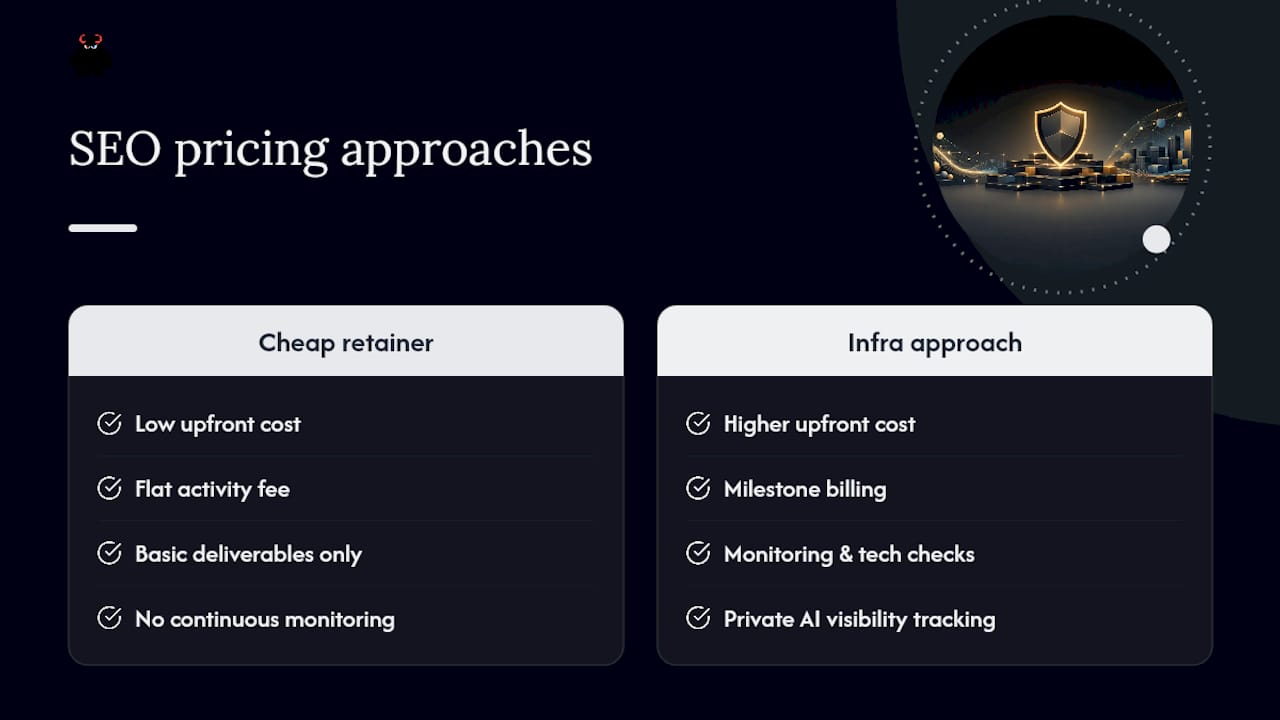
Most SEO pricing conversations get stuck comparing monthly rates, which misses the real question: what happens to your rankings and lead flow the day you pause spending? Treating SEO as a system, with monitoring, technical health checks, and Private AI-driven visibility tracking built in, costs more upfront than a bare-bones retainer but produces something a cheap monthly package never does: durability.
We structure engagements around outcome milestones and milestone billing rather than flat activity fees, because a business paying for “10 blog posts a month” has no way to know if that spend is protecting or growing revenue. A business paying against a ranking and lead-recovery milestone does. Systems that reduce churn, including managed infrastructure and continuous technical monitoring, cost less over three years than repeatedly rebuilding a program that lapsed every time a contract ended.
- Vector
Get a Scoped SEO Estimate Instead of a Guess
Monstrousmediagroup builds SEO, AEO, and GEO visibility as a connected system, not a bundle of disconnected tactics billed by the hour. That means your quote reflects what your site actually needs, from Audience Intent Marketing to managed infrastructure through MonsterWP, rather than a generic package priced the same for every client regardless of readiness or competitive density.

A scoped audit from our SEO, AEO & GEO team starts with a technical and competitive review, then returns a transparent breakdown of deliverables, timeline, and phased pricing, so you know exactly what you’re funding before you commit. If your current SEO spend feels disconnected from actual revenue movement, request a scoped estimate and see what a systems-based proposal looks like next to your current one.
Sources
- SEO Pricing: How Much Does SEO Cost? 439 People Polled
- How Much Does SEO Cost? Pricing Guide - Shopify
- SEO Pricing: How Much Does SEO Cost in 2026? (New Data) - Backlinko
- SEO Agency Pricing Guide September 2026 - Clutch
- Gartner: 2025 CMO spend survey reveals marketing budgets flatline
FAQ
How much does SEO usually cost?
Most small and mid-market businesses spend $1,000 to $5,000 a month, while enterprise programs often exceed $10,000 monthly depending on scope and competition.
Is SEO still worth it in 2026?
Yes, because organic search remains a primary discovery channel and, unlike paid media, its gains compound over time rather than stopping the moment spend pauses.
Can ChatGPT do SEO?
AI tools can assist with keyword research, content drafts, and technical audits, but they can’t replace strategic prioritization, technical implementation, or the ongoing monitoring that actual SEO pricing covers.
Is it worth it to pay for SEO?
For most revenue-driven businesses, yes, especially when the program is structured around measurable outcomes rather than flat activity billing.
What’s the difference between SEO cost and SEO value?
Cost is what you pay monthly or per project; value is the revenue generated from resulting traffic, and the two should always be compared against customer lifetime value.
Why do SEO quotes vary so much between providers?
Quotes vary based on site complexity, competitive density, starting technical condition, and provider experience, which is why identical-sounding proposals can differ by thousands of dollars.
What is a typical SEO pricing structure?
Most providers use monthly retainers, hourly consulting, or fixed project fees, with retainers being the dominant model because SEO requires ongoing maintenance.
Are local SEO packages cheaper than national campaigns?
Yes, local SEO typically costs less because it targets a smaller keyword set and geographic radius, usually landing in the $750 to $2,500 monthly range.
What hidden costs should I expect beyond the quoted price?
Budget for technical remediation, tool subscriptions, content QA, and internal implementation time, all of which frequently fall outside the base retainer.
Does Monstrousmediagroup offer scoped SEO pricing?
Yes, Monstrousmediagroup provides scoped estimates through its SEO, AEO & GEO services, with current pricing available on request based on your specific audit results.