
You likely have revenue leakage. Most mid-market subscription businesses do, typically in the 3 to 9% range of total revenue, according to LeakShield’s research on B2B subscription leakage. Before you build a remediation plan, run three checks this week: reconcile your three core revenue numbers, spot check your largest accounts against their contracts, and pull your failed-payment recovery rate.
- Three-number match: Compare contracted MRR (CRM), billed MRR (billing system), and collected MRR (bank or processor). Anything above a 0.5% gap needs investigation.
- Top-20 contract-to-bill check: Pull your 20 largest accounts and compare what the contract says against what actually got billed last cycle.
- Failed-payment recovery rate: Calculate what percentage of failed card charges get recovered through retries or dunning within 30 days.
- Finance lead owns the three-number match and reports the gap percentage.
- Revenue operations or sales ops owns the top-20 contract audit.
- Billing or product/engineering owns the payment-recovery pull.
Pro Tip: Run all three checks in parallel, not sequentially. A finance manager working alone can complete this triage in under a day if the data pulls are assigned before the meeting, not during it.
Key Takeaways
| Point | Details |
|---|---|
| Run the three-number match first | Compare contracted, billed, and collected MRR monthly; flag gaps above 0.5%. |
| Prioritize by impact over effort | Expired discounts and pricing misconfigs often recover 60 to 70% of short-term leakage. |
| Audit across four surfaces | Check sales, operations, finance, and support, since leaks interact across departments. |
| Build a 30/90/365 roadmap | Quick wins in 30 days, automated detection by 90, full systems within a year. |
| MMG builds detection into infrastructure | Monstrousmediagroup pairs the audit with financial application development and automation so fixes don’t erode. |
Table of Contents
- What Are the Common Types of Revenue Leakage?
- How Do You Calculate Revenue Leakage?
- How Do You Run a Revenue Leak Audit Step by Step?
- What Tools and Systems Detect Revenue Leakage?
- What Controls Prevent Revenue Leakage From Coming Back?
- How Do You Prioritize Fixes and Estimate ROI?
- What Does a Revenue Leak Audit Roadmap Look Like?
- How Monstrous Media Group Approaches Revenue Leak Audits
- Why Does Revenue Leakage Threaten Overall Financial Health?
- Ready to Find Your Revenue Leaks?
- Sources
What Are the Common Types of Revenue Leakage?
A revenue leak audit has to account for loss at every stage of the customer lifecycle, not just at the invoice. Common causes include billing errors, pricing inconsistencies, and contract misalignment, and each tends to cluster at a different point in the customer journey.
- Pre-sales funnel loss: demand that disappears before a deal is even opened. This is bigger than most finance teams assume. PMGuru’s operator audits measured pre-sales leakage averaging near 40%, driven by marketing-to-sales handoff gaps, pricing misalignment, and attribution blindness. Owner: sales and marketing leadership.
- Pricing and contract misalignment: what’s billed doesn’t match what was negotiated. Owner: finance and sales ops.
- Billing errors and metering drift: usage-based charges calculated incorrectly across billing cycles. Owner: billing/engineering.
- Discount misuse: expired promotional codes still applying at renewal. Owner: revenue ops.
- Failed payments and involuntary churn: cards expire or decline and nobody follows up. Owner: billing/finance.
- Missed renewals and entitlement overprovisioning: customers keep access after downgrading or canceling. Owner: product/customer success.
- Refunds and credits: issued without policy enforcement or tracking. Owner: finance/support.
Pro Tip: Expired discounts are the single easiest leak to find and the easiest to defend to a CFO, because the fix requires no new tooling, just a query against your billing system’s discount table.
How Do You Calculate Revenue Leakage?
The formula finance teams use is the three-number match: compare contracted revenue (what CRM says you’re owed), billed revenue (what your billing system actually invoiced), and collected revenue (what hit your bank account). Any material gap between these three numbers is leakage, expressed as both a percentage and a dollar figure.
- 1 to 3% leakage: normal noise. Monitor quarterly, no emergency response needed.
- 4 to 9% leakage: the range where LeakShield’s benchmarks place most affected B2B subscription companies. Warrants a formal audit within the quarter.
- Above 10%: structural problem, usually pricing configuration or contract enforcement failure. Treat as a priority remediation project, not a monitoring item.
How Do You Run a Revenue Leak Audit Step by Step?
Order matters here. Fix the wrong thing first and you’ll burn a sprint chasing noise while real dollars keep leaking. FlowChainLabs recommends auditing across four surfaces, sales, operations, finance, and support, because leaks in one surface often mask or amplify leaks in another.
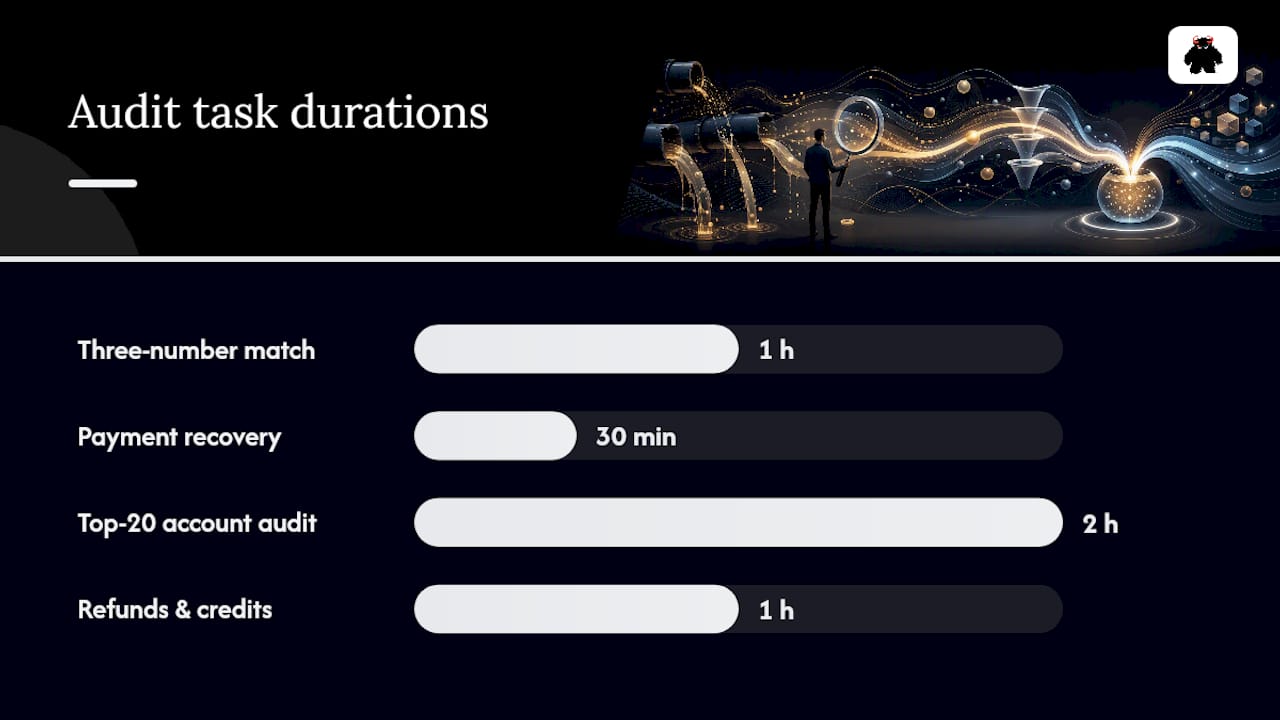
- Run the three-number match (finance lead, 1 hour). Pull contracted, billed, and collected MRR for the trailing three months.
- Check the failed-payment funnel (billing owner, 30 minutes). What percentage of declined transactions get recovered, and within what window?
- Audit top-20 accounts against contracts (revenue ops, 2 hours). Compare negotiated terms, discounts, and renewal dates against actual billing.
- Review refund and credit patterns (finance, 1 hour). Look for repeat issuance without documented cause.
- Sample usage metering (engineering, ongoing). Spot check whether usage-based charges match logged consumption.
- Review entitlement records (product, ongoing). Confirm downgraded or canceled accounts lost access on schedule.
LeakShield’s audit framework packages the first four steps into a roughly 4.5 hour initial pass, which is realistic for a finance team that already has read access to CRM, billing, and payment processor data. Treat this as the diagnostic phase. Deeper follow-ups, like full contract re-negotiation reviews or entitlement system rebuilds, come after you know where the money actually went.
Roles and responsibilities:
| Task | Owner | Data source |
|---|---|---|
| Three-number match | Finance lead | CRM, billing, bank |
| Contract-to-bill review | Revenue ops | CRM, contracts, billing |
| Payment recovery audit | Billing owner | Payment processor logs |
| Usage metering sample | Engineering | Application logs |
| Entitlement review | Product | Product database |
Pro Tip: Don’t audit every account. Pull your top 20 by contract value plus a randomized sample of 20 more from the rest of your book. This catches both your highest-dollar exposure and systemic issues that hit smaller accounts uniformly.
Once findings come in, triage by recoverable annual impact divided by estimated effort to fix. A $40,000 annual leak that takes an afternoon to patch outranks a $60,000 leak that requires a six-month system rebuild, at least for your first remediation sprint.
What Tools and Systems Detect Revenue Leakage?
Point-in-time spreadsheet audits catch what’s already happened. The tools that actually stop leakage are the ones running continuously, watching for drift the moment it appears rather than three months later during a quarterly review.
- Billing and subscription platforms (like Stripe) generate the invoice-level data your three-number match depends on, and most expose webhook events for failed payments and plan changes in near real time.
- Payment gateways flag declined transactions and retry logic, the raw material for your dunning recovery rate.
- Reconciliation and BI layers sit between CRM, billing, and your bank feed, running the three-number match automatically instead of manually every quarter.
- Entitlement engines enforce that access matches current subscription status, closing the overprovisioning gap.
- Contract management systems flag when billed amounts diverge from signed terms.
- Private AI anomaly detection can flag metering drift or pricing configuration errors that a human reviewer would only catch by accident.
| Category | Detects | Implementation complexity | Owner |
|---|---|---|---|
| Billing/subscription platform | Invoice errors, failed charges | Low (usually already in place) | Finance/billing |
| Payment gateway | Declines, retry failures | Low | Billing |
| Reconciliation/BI layer | Three-number gaps | Medium | Finance/engineering |
| Entitlement engine | Overprovisioning, access drift | Medium to high | Product/engineering |
| Contract management system | Billing vs. contract mismatch | Medium | Revenue ops |
| Private AI anomaly detection | Metering drift, pricing config errors | High | Engineering/finance |
Instrumenting these systems with read-only billing APIs and webhook triggers turns your audit from a quarterly fire drill into a standing three-way match that runs itself.

What Controls Prevent Revenue Leakage From Coming Back?
An audit without governance is a one-time recovery, not a fix. The leaks come back within two quarters if nobody owns preventing them.
- Automated contract enforcement, so billing systems reject charges that don’t match signed terms.
- Quarterly pricing reconciliations, a standing calendar item, not a reactive scramble.
- Standard discount lifecycle rules, with automatic expiration instead of manual removal.
- Centralized billing operations, one team owns billing logic instead of it being scattered across sales, support, and finance.
- Approved change workflows, so nobody can modify a price or contract term without sign-off.
Gartner’s framework for customer success ties proactive account monitoring directly to retention outcomes, which is exactly why customer success should sit inside this governance model, not outside it.
Assign a single owner for the reconciliation cadence, typically the finance lead, with defined escalation when the gap exceeds tolerance for two consecutive months.

How Do You Prioritize Fixes and Estimate ROI?
Score every finding on two axes: recoverable annual impact and implementation effort. High impact, low effort fixes go first, always. Operator case data from LeakShield and FlowChainLabs shows pricing misconfigurations and expired discounts commonly account for 60 to 70% of short-term recoverable leakage, which means most of your first-sprint dollars come from just two categories.
- List every finding with estimated annual dollar impact.
- Score effort as low (days), medium (weeks), or high (a quarter or more).
- Sort by impact divided by effort; fix the top quartile first.
- Reassess the three-number match after 30 days to confirm recovery.
Removing the discount code from the billing system takes an afternoon. Recovered revenue: roughly $27,000 annually, at effectively zero implementation cost. The discount fix wins on speed; both belong in the same quarter.
What Does a Revenue Leak Audit Roadmap Look Like?
- 30 days: Complete the three-number match, audit top-20 accounts, and fix every expired-discount and pricing-misconfig finding. Finance lead and revenue ops own this sprint.
- 90 days: Stand up automated detection for the two or three highest-leakage categories found in month one, typically discount lifecycle and payment recovery. Engineering and billing co-own this build.
- 365 days: Deploy a full entitlement and reconciliation system that runs the three-number match continuously instead of quarterly. Finance, product, and engineering share ownership.
- Cross-functional coordination is non-optional after day 30; sales, finance, and product all touch different leak categories.
- Expect measurable recovery within the first 30 to 60 days if you start with pricing and discount fixes; systemic prevention takes the full year to mature.
How Monstrous Media Group Approaches Revenue Leak Audits
Monstrousmediagroup treats a revenue leak audit as a systems build, not a one-time spreadsheet exercise. The process starts with the same triage outlined above: the three-number match, contract spot checks, and payment-recovery review. From there, remediation gets prioritized by recoverable dollars and rolled into durable infrastructure, not a slide deck that gets shelved after the quarterly review.
- Diagnostic phase: rapid audit across billing, contracts, and payment data to size the leak.
- Remediation phase: fixes to discount rules, pricing configuration, and dunning logic, sequenced by impact.
- Systems phase: custom financial application development for reconciliation and entitlement enforcement, backed by Private AI monitoring for ongoing anomaly detection.
- Infrastructure layer: Managed Website Infrastructure (MonsterWP) and marketing automation keep renewal and recovery communication running without manual follow-up.
Most agencies sell activities. A revenue leak audit that ends in a report and no system behind it just gets re-discovered in six months. The point of the audit is the infrastructure it justifies building.
Monstrousmediagroup’s model connects the audit to the fix: custom reconciliation tooling, automated dunning flows through marketing automation, and monitoring dashboards that keep the three-number match visible to finance leadership every week, not once a quarter.
Why Does Revenue Leakage Threaten Overall Financial Health?
Revenue leakage doesn’t just cost you the leaked dollars. It corrupts every downstream number that depends on accurate revenue reporting: forecasting, valuation multiples, board reporting, and cash flow planning all inherit the error.
A company leaking 6% of revenue isn’t just missing 6% of cash. It’s also making capacity, hiring, and inventory decisions off a revenue base that’s inflated relative to what actually collects. Growth-stage companies raising capital face a sharper version of this problem: investors discount recurring-revenue multiples when they find inconsistent billing-to-collection ratios during due diligence, because it signals the finance function doesn’t have full control of its own numbers.
Leakage also compounds. An unenforced expired discount or a metering error doesn’t correct itself, it repeats every billing cycle until someone finds it. A 2% leak discovered in month one and left unfixed becomes a materially larger cumulative loss by year end, and by then it’s often buried across hundreds of accounts instead of concentrated in a handful you could have fixed quickly.
The FlowChainLabs cross-functional audit approach exists precisely because leakage rarely stays contained to one department. A pricing error in sales becomes a billing error in finance, which becomes a churn problem in customer success. Treating financial health as a single-department concern is how leaks stay invisible long enough to become structural.
Why MMG Runs Audits This Way
We build audits as the first step in a system, not a standalone deliverable. A report that identifies $200,000 in leakage and stops there has delivered nothing until someone builds the reconciliation and enforcement infrastructure to keep it fixed. Clients should expect a working detection system within 90 days, not just a findings document, and that requires real commitment to fixing what the audit finds, not just reading about it.
Ready to Find Your Revenue Leaks?
If you’ve run the three-number match and found a gap worth investigating, the next question is whether you fix it manually or build something that catches it automatically going forward. Monstrousmediagroup runs a structured diagnostic that mirrors the audit process above: a focused review of your billing, contract, and payment data, followed by a prioritized 30-day remediation sprint targeting your highest-value leaks first.

Unlike a generic accounting review, this engagement builds toward infrastructure you keep: automated dunning through marketing automation, custom reconciliation tooling through financial application development, and ongoing visibility systems that plug into your existing digital marketing infrastructure so recovery doesn’t depend on someone remembering to run a spreadsheet quarterly. Book a diagnostic call and bring your last three months of billing and collections data. That’s enough for Monstrousmediagroup to size your leak and scope a remediation sprint before the meeting ends.
Sources
- What is revenue leakage? Here’s how to detect and prevent it
- The Revenue Leak Audit: Finding Bottlenecks Across Sales, Ops, Finance, and Support | FlowChainLabs
- The Invisible 40% - PMGuru
- Customer success - Gartner
Frequently Asked Questions
What is a revenue leak audit?
A revenue leak audit is a systematic review of billing, contract, and payment data designed to find the gap between revenue a company has earned and revenue it actually collects. It typically compares contracted revenue, billed revenue, and collected revenue to isolate where money disappears.
How much revenue do companies typically lose to leakage?
B2B subscription companies typically lose 3 to 9% of revenue to leakage, according to LeakShield's benchmarks, with pricing-configuration errors often driving the largest single share of detected losses.
What is the fastest way to check for revenue leakage?
Run a three-number match: compare contracted MRR from your CRM, billed MRR from your billing system, and collected MRR from your bank or payment processor. A gap above roughly 0.5% signals leakage worth investigating.
What causes the most revenue leakage?
Pricing misconfigurations and expired discounts are typically the largest recoverable categories, often accounting for 60 to 70% of short-term recoverable leakage. Pre-sales funnel loss, driven by marketing-to-sales handoff gaps, can be even larger before a deal ever closes.
How long does a revenue leak audit take?
An initial diagnostic audit covering the three-number match, payment-recovery review, and top-account contract check can be completed in roughly 4.5 hours. Deeper remediation, like entitlement system rebuilds, extends over 90 days to a year.
Who should own a revenue leak audit inside a company?
Finance typically leads the three-number match and overall reconciliation, while revenue operations owns contract-to-bill reviews, and engineering or product owns entitlement and usage-metering checks. Effective audits require sales, finance, and operations working together, not one department acting alone.
What tools help detect revenue leakage?
Billing and subscription platforms like Stripe, payment gateways, reconciliation and BI layers, contract management systems, and entitlement engines each detect different leak categories. Private AI anomaly detection adds continuous monitoring for pricing and metering drift that manual reviews often miss.
How does Microsoft Dynamics 365 fit into revenue leak prevention?
Microsoft Dynamics 365 is commonly used as the CRM and ERP layer that supplies contracted revenue and customer data for the three-number match, giving finance teams a system of record to reconcile against billing and collections data.
What KPIs should companies monitor to prevent future leakage?
Track the three-number match gap, involuntary churn from payment failures, dunning recovery rate, and refund or credit percentage of revenue on a standing dashboard, reviewed monthly rather than reactively.
How does revenue leakage affect overall financial health?
Leakage corrupts forecasting, valuation, and cash flow planning because those all depend on accurate revenue data. Leaks also compound over time, since an unfixed error, like an expired discount, repeats every billing cycle until someone catches it.
This article is general information, not a substitute for advice from a qualified financial advisor. Consult a qualified financial professional about your own circumstances before acting on anything here.