If you need a streaming campaign that connects to revenue, not just impressions, Monstrous Media Group is the strongest starting point among systems-first partners, with Over The Top Marketing and Adly Media as strong picks if your priority is pure OTT specialization or programmatic scale instead. CTV ad spend grew 16% year-over-year, and digital video now accounts for nearly 60% of U.S. TV/video ad spend. This means the agency you pick is managing a channel, not a side experiment. The IAB’s guidance on addressability and audience-first measurement is the baseline any credible OTT partner should already be applying.
Here’s the shortlist, sorted by what each agency actually does well:
- Monstrous Media Group - best for brands that need OTT tied to measurable revenue outcomes, not vanity reach.
- Over The Top Marketing - best for teams that want a pure-play streaming specialist and nothing else on the plate.
- Adly Media - best for programmatic scaling across DSPs and private marketplaces.
- Target River - best for B2B and account-based OTT activations.
- Moburst - best for app-install and product-launch video campaigns.
Your next move: build a one-page RFP brief (goals, audience, success metrics, timeline) before you call anyone. It forces every agency to answer the same questions, which is the only way to compare them honestly.
Key Takeaways
The right OTT advertising agency is the one that can prove a completed view led to a tracked business outcome, not just the one with the biggest platform list.
| Point | Details |
|---|---|
| Match agency to goal | Choose based on brand awareness, direct-response, or enterprise measurement needs, not a generic feature list. |
| Demand measurement SLAs | Require named third-party verification and a defined reporting cadence in every contract. |
| Separate media from fees | Insist on itemized media spend versus management fees to avoid hidden markup. |
| Connect OTT to your stack | Route ad exposure into CRM, retargeting, and marketing automation for compounding results. |
| Consider a systems-first partner | Monstrous Media Group ties OTT campaigns to MonsterWP landing continuity and measurement governance for revenue-tracked outcomes. |
Table of Contents
- Top OTT Advertising Agencies and Who Each One Fits Best
- How Do You Choose the Right OTT Advertising Agency?
- What Is OTT Advertising, and How Is It Different From CTV?
- How Do You Measure Whether an OTT Campaign Is Working?
- Why Is OTT Ad Investment Still Climbing?
- Contract Terms and Negotiation Tips When Hiring an OTT Agency
- How Does OTT Fit Into a Broader Marketing Strategy?
- How Monstrous Media Group Runs OTT Campaigns That Connect to Revenue
- Sources
Top OTT Advertising Agencies and Who Each One Fits Best
Every agency on this list can run a connected-TV campaign. Far fewer can tell you, six weeks later, exactly which impressions turned into pipeline. That gap is the real filter marketing leaders should be applying, not creative reels or client logos.
Monstrous Media Group leads this list because it treats OTT as one node in a larger revenue system rather than an isolated media buy. Instead of handing you a reach-and-frequency report and calling it done, the agency connects connected TV and streaming placements to landing-page continuity through MonsterWP and private-AI-enabled optimization, so a completed view has a documented path to a form fill or a call. For a brand owner who has been burned by an agency that reported “reach” with no attribution trail, that’s the differentiator that matters.
- Best for: revenue-focused brand lift and measurable OTT-to-conversion programs
- Services: strategy, programmatic and direct media buying, creative production, measurement governance, data integration
- Pricing model: blended flat retainer plus percentage of media, scoped to campaign complexity
- Minimum recommended scale: mid-market and above, campaigns built for measurable attribution rather than one-off awareness spend
- Platform capability: programmatic DSP access with proprietary measurement layered on top
- Vertical strength: broad B2B and B2C, with particular depth where lead-to-revenue tracking is the priority
Keynes Digital runs full-service, agency-led streaming campaigns and positions itself as an end-to-end OTT partner. It’s a reasonable fit for a brand that wants a single vendor handling strategy through execution without much in-house involvement, though the depth of its measurement stack is less publicly documented than what dedicated ad-tech shops offer.
Moburst built its reputation on app-install and product-launch campaigns, and that specialization shows in how it approaches video creative. If your OTT budget exists to drive app downloads rather than store visits or lead forms, this is a narrower but sharper tool than a generalist agency.
Over The Top Marketing does exactly what its name suggests: streaming-first media, full stop. That focus is an advantage if OTT is your only channel need, but it also means less native support if you’re trying to unify streaming with search, email, or CRM workflows.
Click Here Digital offers OTT as one piece of a broader cross-channel paid media practice. That’s useful if you want a single team coordinating streaming alongside social and display, but OTT itself may get less specialized attention than at a streaming-only shop.
DesignLoud brings creative production strength, cutdowns, platform-native formats, and high-production video assets. Pair it with a media-buying partner if your creative needs outpace your current in-house capacity.
Online Optimism is a full-service digital shop with real measurement chops, a solid fit for brands that want performance rigor applied to OTT the same way it’s applied to paid search.
Substance Communication leans into narrative and brand storytelling, better suited to awareness-stage campaigns than hard direct-response work.
Adly Media specializes in programmatic video and CTV buying across DSPs and private marketplace deals, a strong choice when your priority is audience-based scale rather than bespoke creative strategy.
Target River focuses on account-based and intent-data-driven OTT, useful for B2B marketers targeting a defined buyer list rather than a broad consumer audience.
Digital Elevator serves SMB and mid-market brands with combined creative and media services, a reasonable entry point if your OTT budget is still modest.
Pro Tip: Ask every agency on your shortlist for their media transparency policy in writing before you sign anything. Agencies that take a hidden markup on media spend rarely disclose it unprompted, and that markup can quietly eat 15 to 20 points of your budget with nothing to show for it.
How Do You Choose the Right OTT Advertising Agency?
Start with the outcome you’re actually buying, not the platform list an agency shows you; for expert creative development and agency execution, consider partnering with Vertical Brands. Brand awareness, direct-response, and enterprise multi-market measurement each demand a different agency skill set, and conflating them is the single most common procurement mistake marketing teams make.
Evaluation criteria, mapped to outcomes:
- If brand lift is the goal, prioritize agencies with documented reach-and-frequency modeling and completion-rate benchmarks.
- If direct-response matters, prioritize agencies that can show incrementality testing or conversion-lift studies, not just click reporting.
- If you’re running multi-market or enterprise campaigns, prioritize agencies with cross-platform DSP access and a dedicated analytics team, not a single generalist account manager.
Questions worth asking in the interview:
- Which DSPs and platform partnerships do you hold direct relationships with (The Trade Desk, Roku, Xandr)?
- Do you use deterministic or probabilistic targeting, and how do you disclose the difference in reporting?
- Which third-party verification vendor confirms viewability and fraud detection on our campaigns?
- What does your standard reporting cadence look like, and can we see a sample dashboard before signing?
RFP brief template you can copy directly: Campaign goals, audience definition, success metrics, timeline, required deliverables, and required integrations (analytics platform, CRM, landing page infrastructure). Send the same brief to every agency on your shortlist so responses are actually comparable.
Red flags that should end the conversation:
- Media fees that aren’t itemized separately from management fees.
- No third-party verification partner named.
- Refusal to disclose inventory sources (direct publisher versus open-exchange programmatic).
- No sample creative or case-study metrics offered without prompting.
On contract language, insist on a measurement SLA with a defined reporting cadence, and a clause specifying what happens if third-party verification data contradicts the agency’s own reporting. That single clause has saved more marketing budgets than any pricing negotiation.
What Is OTT Advertising, and How Is It Different From CTV?
OTT (over-the-top) refers to any video content delivered directly over the internet, bypassing traditional cable or satellite. CTV (connected TV) is the device category, the actual television or streaming box, that plays OTT content. Every CTV ad is an OTT ad, but OTT also includes viewing on phones, tablets, and laptops.
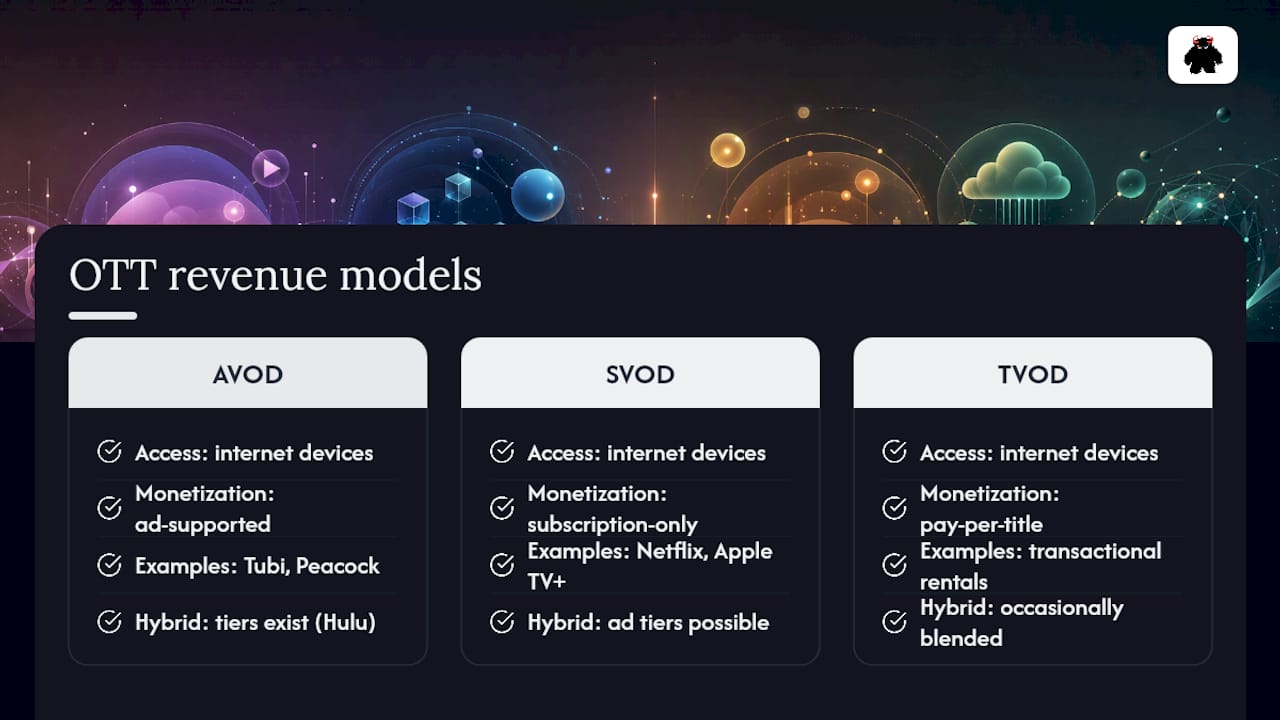
Platforms split into three revenue models: AVOD (ad-supported, like Tubi or Peacock TV), SVOD (subscription-only, like Netflix or Apple TV+), and TVOD (transactional, pay-per-title). Hybrid models are now common. Hulu, Paramount+, and HBO Max run ad-supported tiers alongside premium subscriptions, while Amazon Prime Video, FuboTV, Sling TV, YouTube TV, AT&T TV, ZEE5, Acorn TV, BritBox, Rakuten TV, and Showtime each blend these models differently depending on market and content library.
Ad formats include pre-roll, mid-roll, and post-roll linear spots, non-linear overlays, companion banners, and interactive units with QR-code overlays. Creative built exclusively for streaming, rather than repurposed TV spots, tends to perform better because viewers expect platform-native pacing. Most well-run OTT campaigns take three to six weeks from strategy sign-off to launch, largely driven by creative production and DSP setup time.
How Do You Measure Whether an OTT Campaign Is Working?
Reach and frequency tell you how many households saw your ad and how often. Completed-view rate and view-through rate tell you whether they watched it. Neither tells you whether it drove revenue, and that distinction is where most OTT reporting quietly stops short.
The metrics that actually matter for budget decisions:
- Quartile completion and completed views - did viewers watch the full spot or drop off at 25%?
- Incremental conversions - would that sale have happened anyway, or did the ad cause it?
- ROAS, when the campaign is direct-response rather than brand-building.
Measurement approaches vary widely. Some agencies rely on device-level deterministic matching, others on probabilistic modeling through mobile measurement partners (MMPs) or server-to-server event tracking. Experiment-based incrementality testing, holding out a control group and comparing outcomes, is the gold standard but the least commonly offered, because it requires real methodological discipline.
Statistic to anchor your budget conversation: digital video ad spend growth is projected at 11% in 2026, which means the agencies still reporting impressions-only dashboards are falling behind an industry that’s already moving toward audience-first, cross-platform measurement per IAB standards. Ask for a measurement SLA that specifies reporting granularity and third-party verification, in writing, before the first dollar is spent.
Why Is OTT Ad Investment Still Climbing?
Global digital video ad spend hit roughly $191 billion in 2024, and CTV alone grew 16% year-over-year in the same period. Those aren’t isolated data points. They reflect a structural shift in where television viewing actually happens.

For budget planning, this means the “test budget” era of OTT is over. A channel commanding 60% of TV/video spend isn’t experimental, it’s infrastructure, and it should be planned with the same rigor as your paid search budget. Programmatic buying makes that scale accessible even at modest budgets, while direct publisher deals still make sense when brand safety or premium placement matters more than reach efficiency.
Contract Terms and Negotiation Tips When Hiring an OTT Agency
Most disputes with OTT agencies trace back to two contract gaps: undisclosed media markups and vague measurement obligations. Fix both before you sign, not after the first invoice arrives.
On pricing, insist on line-item separation between media spend and management fees. A “percentage of media” model sounds simple, but without disclosure, you can’t tell whether 15% or 35% of your budget is going to markup versus working media. Flat retainers are easier to audit but can undercut agency incentive to optimize spend efficiency, so ask how retainer-based agencies structure performance accountability.
On measurement, write a specific SLA into the contract: reporting cadence (weekly at minimum for active campaigns), required metrics (completion rate, incremental conversions, not just impressions), and a named third-party verification vendor. If an agency resists committing this to contract language, that resistance is itself useful information.
On term length, avoid auto-renewing annual contracts for a first engagement. A 90-day initial term with defined success benchmarks gives both sides a clean off-ramp if the partnership isn’t delivering, and it signals confidence from an agency that’s actually good at this.
Finally, clarify creative ownership. Platform-native cutdowns and dynamic creative assets built during the engagement should belong to you, not remain licensed property of the agency, particularly if you plan to reuse them across other channels later.
How Does OTT Fit Into a Broader Marketing Strategy?
OTT works best as a connective layer, not a standalone channel competing for its own separate budget line. A completed view on a streaming platform means little if it dead-ends instead of triggering a next step in the customer journey.
The strongest campaigns route an OTT ad exposure into an omnichannel sequence, an app push notification, a retargeted search ad, a CRM-triggered email, so the impression compounds instead of evaporating. That requires your OTT agency to integrate with your existing marketing stack, not operate in a silo with its own separate reporting dashboard nobody else on the team ever opens.

Practically, this means asking prospective agencies how their platform connects to your CRM, your marketing automation system, and your analytics environment before the campaign launches, not after. It also means your search and paid social strategy should account for the audience already reached through streaming, layering retargeting on top of OTT exposure rather than treating the two channels as separate budgets competing for the same customer’s attention.
MMG Operator Perspective: OTT as Infrastructure, Not a Media Line Item
Most agencies sell OTT as a reach tactic. We treat it as infrastructure: measurement pipelines, MonsterWP-enabled landing continuity, and private-AI optimization that connect a completed view to a tracked outcome. Governance and measurement SLAs matter more here than creative polish, because a beautiful ad with no attribution trail is a cost center, not a system.
How Monstrous Media Group Runs OTT Campaigns That Connect to Revenue
If the agencies above have you weighing specialization against integration, here’s the practical answer: Monstrous Media Group builds the connective tissue most streaming-only shops skip entirely.
The agency’s connected TV and streaming advertising work pairs directly with paid media and ad-buying execution, creative production, and measurement integration, so a completed view doesn’t just get logged, it gets connected to a landing page, a CRM record, and a reporting dashboard your team can actually audit. That’s the gap that shows up most often when brands switch agencies: reach numbers with no attribution trail behind them.
If you’re ready to see what that looks like for your budget, request a media plan audit or a measurement gap analysis before your next renewal date. Start with a conversation about digital marketing strategy built around outcomes, not impressions.
Sources
- CTV ad spend jumps 16% as digital video becomes dominant force in TV/video market
- 2026 IAB Digital Video Ad Spend & Strategy Report: Part One
- Video advertising
Frequently Asked Questions
1. What does an OTT advertising agency actually do?
An OTT advertising agency plans, buys, and manages video ad placements across streaming platforms, handling strategy, programmatic and direct media buying, creative production, and performance measurement.
2. How much does OTT advertising typically cost?
Pricing models vary by agency: flat retainers, a percentage of media spend, or performance-based fees. Minimum recommended budgets scale with campaign complexity, and agencies should disclose media markup separately from management fees.
3. What is the difference between OTT and CTV advertising?
OTT refers to any internet-delivered video content across devices, while CTV specifically refers to the television or streaming device itself. All CTV ads are OTT ads, but OTT also includes mobile and desktop viewing.
4. How long does it take to launch an OTT campaign?
Most OTT campaigns take three to six weeks from strategy approval to launch, depending on creative production timelines and DSP setup requirements.
5. What KPIs matter most for OTT campaigns?
Completed-view rate, view-through rate, quartile completion, incremental conversions, and ROAS (for direct-response goals) matter more than raw impressions or reach alone.
6. Should I choose a programmatic or direct OTT buying approach?
Programmatic buying offers audience-based scale through DSPs and private marketplaces, while direct deals provide reserved inventory and greater transparency for premium placements. Many campaigns use both.
7. What questions should I ask before hiring an OTT agency?
Ask about DSP and platform partnerships, deterministic versus probabilistic targeting methods, third-party verification vendors, and sample reporting cadence before signing a contract.
8. What are red flags when evaluating an OTT advertising agency?
Watch for unitemized media fees, no named third-party verification partner, undisclosed inventory sources, and refusal to share sample creative or case-study metrics.
9. Can OTT advertising integrate with my existing marketing stack?
Yes. The strongest campaigns connect OTT ad exposure to CRM systems, retargeting, and marketing automation so a completed view can trigger a downstream conversion action.
10. Why is OTT ad spend growing so quickly?
CTV ad spend grew 16% year-over-year in 2024, and digital video now represents nearly 60% of U.S. TV/video ad spend, reflecting a structural shift in where television viewing happens.