
MQL to SQL conversion measures the share of marketing-qualified leads that sales accepts as genuinely ready to buy. The formula is simple: SQLs accepted in a period divided by MQLs created in the aligned cohort period. A healthy rate typically runs 10% to 30%, depending on your industry and sales model, with top-quartile programs hitting 40 to 50% or higher.
- Formula: SQLs accepted ÷ MQLs created (in a lagged, aligned cohort window)
- Median range: 10 to 30%
- Top quartile: 40 to 50%+
- Red flag zones: Under 8% (broken handoff) or above 60% (loosened gates)
You’re looking at a measurement problem that needs a diagnostic pass before you touch spend or headcount.
Key Takeaways
MQL to SQL conversion becomes a reliable growth lever only when marketing and sales share a formal SLA, a composite scoring model, and a rejection-code feedback loop.
| Point | Details |
|---|---|
| Know your benchmark | A healthy rate runs 10 to 30%, with top-quartile programs hitting 40 to 50%. |
| Use the right formula | Divide SQLs accepted by MQLs created in a lagged, aligned cohort window. |
| Watch both extremes | Under 8% signals a broken gate or slow follow-up; above 60% often means loosened qualification. |
| Fix the handoff first | Install an SLA with routing time, response targets, and rejection codes before tuning scoring. |
| Build it as a system | Monstrous Media Group implements composite scoring, automated routing, and recycling flows as ongoing revenue infrastructure. |
Table of Contents
- What Separates an MQL From an SQL (and Why the SAL Gate Matters)
- How to Calculate MQL to SQL Conversion Correctly
- What Counts as a Good MQL to SQL Conversion Rate?
- Why MQLs Stall Before Becoming SQLs
- A 6-Step Playbook to Raise MQL to SQL Conversion in 30 to 90 Days
- Building the SLA and Lead-Scoring Blueprint
- Which KPIs Belong on Your MQL to SQL Dashboard?
- MQL to SQL Conversion as Revenue Infrastructure
- Why Most Teams Diagnose This Metric Backward
- Turn Your Funnel Diagnosis Into a Working System
- Sources
What Separates an MQL From an SQL (and Why the SAL Gate Matters)
An MQL is a lead that shows fit and engagement signals strong enough to warrant sales attention. An SQL is a lead sales has validated on need, authority, timeline, and budget, the classic BANT framework applied with modern rigor, according to Highspot’s qualification research. Those are two different jobs done by two different teams, and conflating them is where most conversion metrics go wrong.
This is where the sales-accepted lead (SAL) stage earns its place in the pipeline. SAL is the checkpoint where sales formally acknowledges a lead meets baseline criteria before working it, and it protects your measurement from a common failure mode: reps quietly ignoring or “soft rejecting” leads without logging a reason.
- MQL signals: demographic/firmographic fit, behavioral engagement, declared intent
- SAL gate: sales confirms basic fit before full qualification work begins
- SQL criteria: validated need, authority, timeline, and budget
Skip the SAL gate and your MQL→SQL number becomes noise. Keep it, and you get a clean read on where leads actually die.
How to Calculate MQL to SQL Conversion Correctly
The formula itself is not the hard part. The denominator is: SQLs accepted in period T ÷ MQLs created in the aligned cohort period, adjusted for the lag between creation and acceptance, per Geckoboard’s cohort methodology. Most teams get the math right and the cohort wrong.
- Define your MQL creation date and track forward, not backward from SQL date.
- Build a lag window (commonly 14 to 45 days depending on sales cycle length) so you’re not comparing this month’s MQLs to last month’s SQLs.
- Exclude re-qualified leads from the denominator unless you’re explicitly measuring re-engagement performance.
- Flag and remove duplicate records before they inflate either side of the ratio.
- Track recycled/rejected leads separately so they don’t silently disappear from your funnel math.
Pro Tip: Run your MQL→SQL calculation on a rolling 90-day cohort instead of a fixed calendar month. Monthly snapshots hide lag distortion and make a perfectly healthy funnel look broken in slow months.
What Counts as a Good MQL to SQL Conversion Rate?
A healthy MQL to SQL conversion rate sits between 10% and 30%, with top-quartile revenue-ops programs clearing 40 to 50%, according to PepperEffect’s SLA benchmarking data. Where you land in that range depends heavily on business model, deal complexity, and how tightly your MQL gate is defined.
- Enterprise SaaS: longer cycles, more validation steps, often lands in the 10 to 20% range even when healthy
- SMB/mid-market: faster cycles push conversion toward 20 to 35%
- Transactional/PLG models: high MQL volume with lower per-lead scrutiny often sits lower, 8 to 15%, by design
A rate under 8% usually points to a scoring gate that’s too loose or a sales team drowning in follow-up backlog. A rate spiking above 60% is arguably worse: it often means sales is accepting leads without real qualification just to hit acceptance quotas, a pattern Ciente’s analysis of conversion anomalies flags as a leading indicator of gate erosion. Either extreme deserves a rejection-code audit before you touch budget.
Why MQLs Stall Before Becoming SQLs
Most conversion failures trace back to four repeatable causes, and you can diagnose them in an afternoon with your CRM open.
- Engagement-only scoring: if your MQL gate rewards clicks and downloads without weighing firmographic fit, you’re handing sales a pile of curious readers, not buyers.
- Slow or context-free follow-up: a lead that waits three days for a call, with no account context attached, has already mentally moved on.
- Missing enrichment: reps working a lead with no company size, tech stack, or intent data waste the first call qualifying instead of selling.
- Broken feedback loops: when sales rejects a lead with no reason code, marketing can’t fix the gate that let it through.
Pro Tip: Pull your last 90 days of rejected MQLs and sort by rejection reason. If “no reason given” is your top category, you don’t have a lead quality problem, you have a data collection problem that’s disguising itself as one.
The fix almost never starts with generating more leads. It starts with figuring out which of these four gates is leaking, and buyer intent data is usually the fastest lever for closing the enrichment gap specifically.
A 6-Step Playbook to Raise MQL to SQL Conversion in 30 to 90 Days
Fixing this metric is sequencing work, not a single campaign tweak. Here’s the order that actually moves the number without breaking sales trust in marketing leads.
- Tighten the MQL gate this week. Move from single-signal scoring to a composite of fit, intent, and engagement, the multi-signal approach Highspot recommends for modern qualification.
- Write or refresh your SLA within 30 days. Define routing time (aim for under 5 minutes for hot leads), sales response targets, and a mandatory rejection code field.
- Add composite scoring fields to your CRM. Lock lifecycle stage transitions so a rep can’t manually bump a lead to SQL without the scoring threshold being met.
- Automate instant acknowledgment. A lead that gets an immediate, personalized response holds far more sales velocity than one sitting in a queue; this is the follow-up gap problem most funnels never close.
- Recycle every rejected lead into segmented nurture. Disqualified doesn’t mean dead. Route by rejection reason into re-enrichment and timing-based nurture streams instead of letting the record go cold.
- Run weekly conversion reviews, recalibrate quarterly. A short standing meeting between marketing and sales, reviewing rejection codes and conversion trend lines, catches gate drift before it becomes a quarter-long argument about lead quality.
By day 90, you should have a documented SLA, a composite scoring model live in your CRM, and at least one full recalibration cycle behind you.
Building the SLA and Lead-Scoring Blueprint
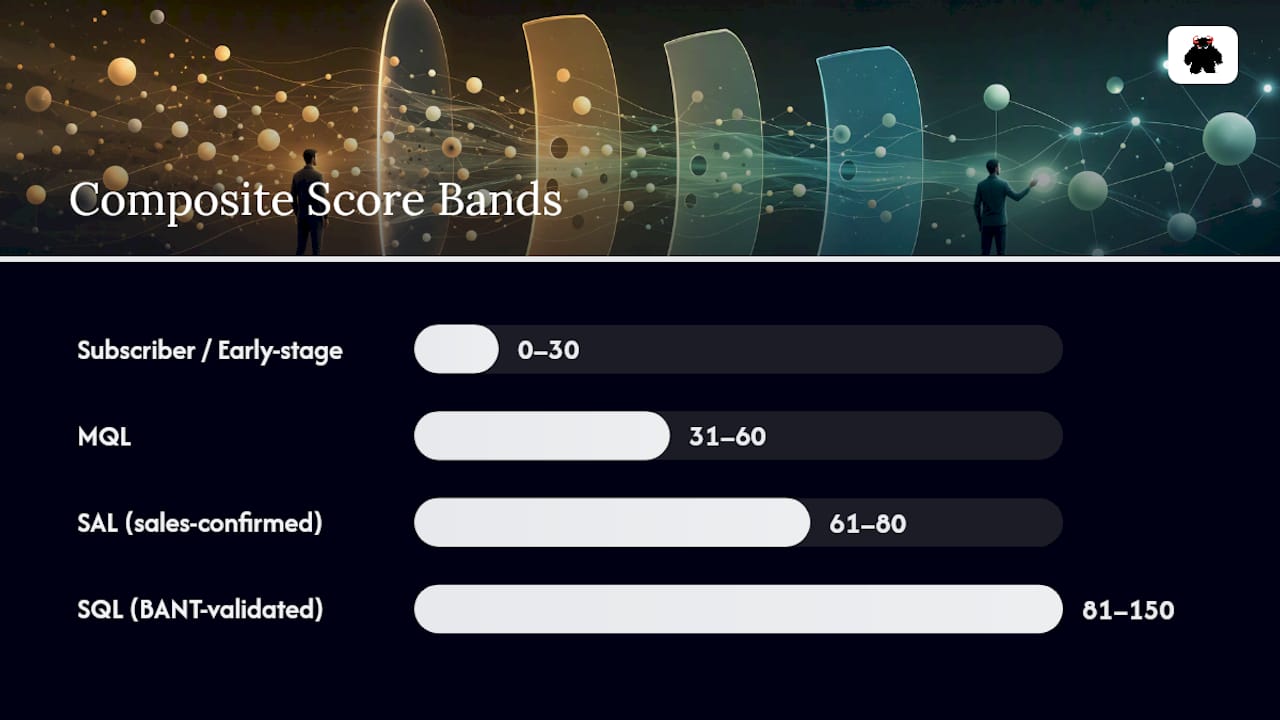
Your SLA needs six components to function as an actual operating document rather than a slide that gets ignored after month one: MQL definition, SAL definition, SQL criteria, routing time targets, a rejection loop with reason codes, and a recalibration cadence.
For scoring, the practical structure most RevOps teams converge on uses three separate 0 to 50 fields, Fit, Intent, and Engagement, combined into a composite score rather than one blended number. A common threshold mapping looks like this:
- 0 to 30 composite: subscriber or early-stage lead
- 31 to 60 composite: MQL
- 61 to 80 composite, sales-confirmed: SAL
- 81+ composite, BANT-validated: SQL
Operational target callout: Aim for a strong AE acceptance rate on routed leads and a timely response for leads scored as SQL-ready. Formal SLAs with defined rejection codes reduce disputes and give you the recalibration data to defend or adjust thresholds each quarter.
Which KPIs Belong on Your MQL to SQL Dashboard?
A dashboard built for diagnosis, not vanity, needs five numbers side by side: MQL→SAL rate, MQL→SQL rate, SQL→opportunity rate, average response time, and AE acceptance rate. Segment every one of those by lead source, campaign, score tier, sales rep, and account tier, because a healthy blended average routinely hides one channel or one rep dragging the whole number down.
| Dashboard Element | What to Track |
|---|---|
| MQL→SAL rate | Percentage of MQLs sales formally accepts before qualification work begins |
| MQL→SQL rate | Percentage of MQLs validated as need, authority, timeline, budget confirmed |
| SQL→opportunity rate | Percentage of SQLs that convert into a tracked pipeline opportunity |
| Response time | Hours between MQL creation and first sales touch |
| AE acceptance rate | Percentage of routed leads an account executive accepts versus rejects |
Cadence matters as much as the metrics themselves: daily routing alerts for hot leads, a weekly conversion review with both teams, and a quarterly SLA recalibration where you actually adjust thresholds based on what the funnel data shows.
MQL to SQL Conversion as Revenue Infrastructure
Improving this rate is systems work, not a marketing campaign tweak. It requires RevOps discipline, marketing automation that actually enforces lifecycle rules, and enrichment data feeding your scoring model in real time.
- Composite lead scoring built on fit, intent, and engagement signals
- Automated routing and acknowledgment tied to SLA response targets
- Buyer intent and firmographic enrichment feeding the qualification gate
- Ongoing measurement infrastructure, not a one-time dashboard build
Treat the metric like infrastructure, and it behaves like infrastructure: predictable, auditable, and fixable when it breaks.
Why Most Teams Diagnose This Metric Backward
The conventional advice treats a low MQL→SQL rate as a lead quality problem and points marketing at better targeting. That’s usually the wrong first move. In most funnels the actual leak is the handoff itself: no SLA, no rejection codes, no shared definition of what “qualified” even means between the two teams. You can generate perfect leads and still post a terrible conversion number if sales has no structured way to tell marketing why a lead was rejected.

The other overrated fix is chasing volume. Teams under pressure respond to a low rate by turning up top-of-funnel spend, which only widens the gap between what marketing calls qualified and what sales will actually work. More MQLs into a broken gate just produces more rejected leads and a noisier dashboard.
What actually moves the number, in order: fix the definition first, install the SLA and rejection-code loop second, then tune scoring thresholds third. Skip straight to scoring model tweaks and you’re optimizing a system nobody has agreed on yet. That sequencing discipline, not a smarter algorithm, is what separates the top-quartile programs from everyone stuck arguing about lead quality every quarter.
- Vector
Turn Your Funnel Diagnosis Into a Working System
Reading this playbook is the easy part. Building the SLA, wiring composite scoring into your CRM, and automating the rejection loop is where most internal teams stall out, usually because it competes with everyone’s actual day job. Monstrous Media Group builds this as infrastructure: automation that enforces lifecycle rules instead of relying on reps to follow a process manually, intent data that feeds your fit and intent scores automatically, and dashboards that surface leaks before they cost you a quarter of pipeline.

Our marketing automation work covers exactly this: SLA design, composite scoring implementation, routing automation, and the nurture recycling flows that turn rejected leads back into pipeline instead of dead weight. If your MQL→SQL rate has been stuck below 10% or spiking without explanation, start with a systems audit and get a clear read on which of the four gates is actually leaking.
Sources
- Lead qualification process (Highspot)
- What is an MQL / SQL (Highspot)
- Marketing-qualified lead: 2026 definition & SLA playbook (PepperEffect)
- MQL to SQL conversion rate (Geckoboard)
Recommended
- Revenue-driven Marketing Solutions That Turn Visibility Into Measurable Growth | Monstrous Media Group
- Lead Generation Company Built to Turn Visibility Into Revenue | Monstrous Media Group
- Systematic Marketing Optimization: How to Turn Marketing Activity Into Measurable Revenue | Monstrous Media Group
- How are you qualifying your leads?