
An effective LinkedIn ads strategy is a funnel-separated, CRM-wired program built around pipeline value, not clicks. Before you spend a dollar, do three things: install the Insight Tag, define your ideal customer profile with seed lists of target accounts and contacts, and structure separate campaigns by funnel stage instead of one blended campaign. Get that architecture right and LinkedIn stops being a line item you question every quarter and becomes a system. Monstrous Media Group can help you scale on purpose.
TL;DR:
- Use a minimum budget of $3,000 to $5,000 per month per campaign objective to gather sufficient signal within two to three weeks for optimization.
- Target audience size should typically range from 50,000 to 300,000 members for most campaigns, with smaller ABM lists needing at least 300 accounts for reliable delivery.
- Match campaign objectives precisely to desired outcomes, such as Lead Generation for gated content or Website Conversions for demo requests, to avoid misaligned results.
- Build campaigns separately by funnel stage and audience type, avoiding mixing cold prospecting, retargeting, and ABM audiences in the same campaign.
- Implement extensive tracking-Insight Tag, conversion events, and CRM mapping-so campaign performance reflects pipeline value, not just clicks or form fills.
MonstrousmediagroupBuild LinkedIn Campaigns Around RevenueMonstrous Media Group builds SEO, SEM, web, and marketing systems designed to generate, capture, and close more revenue.Explore Monstrous Media Group
Table of Contents
- Quick Campaign Checklist: Step-by-Step Playbook to Launch a Pilot
- Which LinkedIn Campaign Objective Should You Choose?
- How Do You Target the Right B2B Audience on LinkedIn?
- What Ad Formats Work Best at Each Funnel Stage?
- How Should You Set Bids and Allocate Budget?
- What KPIs Prove LinkedIn’s Pipeline Value?
- How Do You Run ABM Campaigns on LinkedIn?
- How Should You Test and Optimize LinkedIn Campaigns?
- What Does a 90-Day LinkedIn Launch Timeline Look Like?
- How Monstrous Media Group Builds Revenue-First LinkedIn Programs
- What Most Teams Get Backward About LinkedIn Ads
- Get LinkedIn Ads Wired to Revenue, Not Reported as Clicks
- Sources
- FAQ
Quick Campaign Checklist: Step-by-Step Playbook to Launch a Pilot
Before touching Campaign Manager, confirm three things are live: the Insight Tag is installed sitewide, conversion events are mapped into your CRM, and any customer or contact lists you plan to upload are permissioned for advertising use.
Once that foundation is set, build in this order:
- Pick one objective per campaign (not per account).
- Construct or upload your audience.
- Select the ad format that matches the objective.
- Create three to five creative variants.
- Set your bid type and daily budget.
- Schedule launch and confirm tracking fires correctly.
For pilots, budget a minimum of $3,000 to $5,000 per month per campaign objective to gather enough signal for the algorithm to optimize. Expect the first meaningful read on performance around two to three weeks in, not two to three days.
Which LinkedIn Campaign Objective Should You Choose?
LinkedIn’s campaign objective controls which ad formats, optimization goals, and bid strategies are even available to you. Pick the wrong objective and you’re locked out of the format that would have actually worked.
- Awareness: builds reach and impression share; pairs with Single Image and Video formats optimized for impressions.
- Website Visits: drives traffic and optimizes for clicks; useful for content marketing pushes, not pipeline.
- Engagement: grows followers and post interaction; best for building organic reach before paid retargeting.
- Video Views: optimizes for completion rate; works for thought leadership and product explainer content.
- Lead Generation: unlocks native Lead Gen Forms, which pre-fill LinkedIn profile data and dramatically cut form abandonment.
- Website Conversions: requires a defined conversion event tied to the Insight Tag; this is the objective for demo requests and gated content.
- Talent: built for recruitment campaigns, not commercial pipeline.
The mistake most teams make is running a Website Visits campaign and reporting on it like a Lead Generation campaign. The optimization goal never targeted a conversion, so the traffic looks cheap and the pipeline never materializes. Match the objective to the outcome you’re actually paying to measure.
How Do You Target the Right B2B Audience on LinkedIn?
Layer your targeting instead of stacking it. Start with firmographic filters (company size, industry) plus job function and seniority. Add skills or interest layers only if your audience is still too broad after that first pass. Every extra filter narrows delivery, and narrow delivery on LinkedIn gets expensive fast.
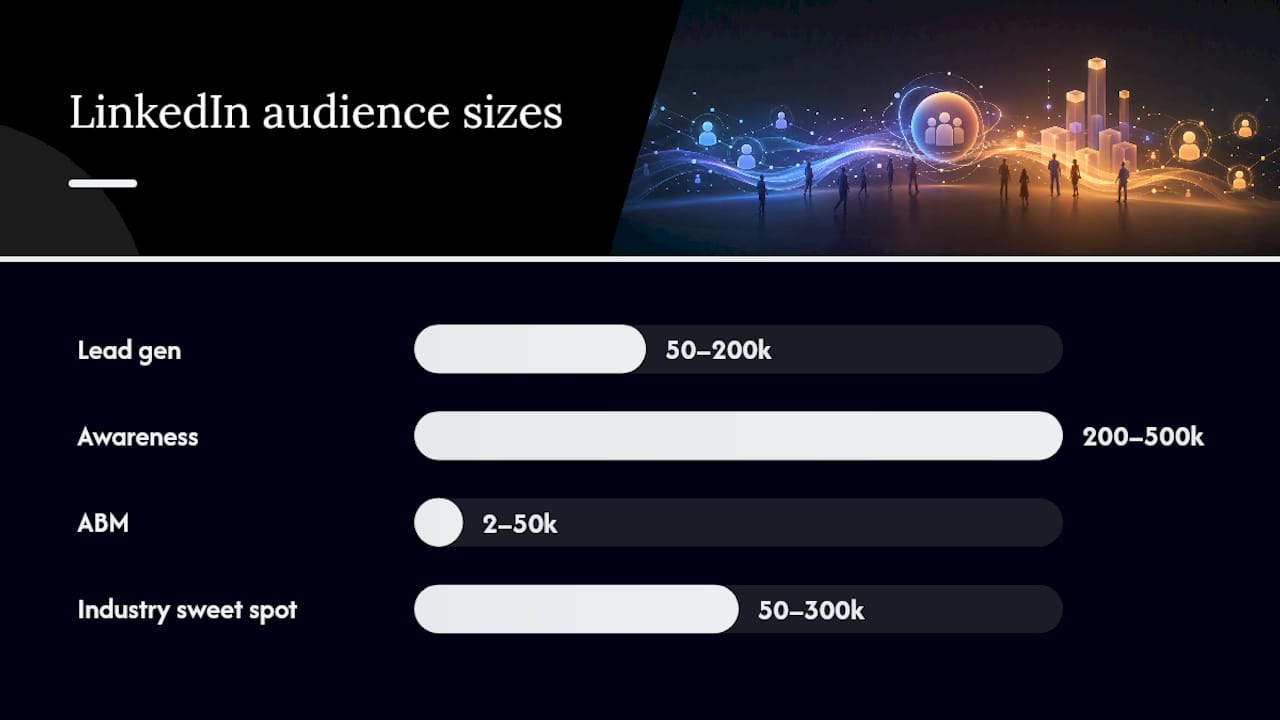
Audience size should match funnel stage:
- Lead generation campaigns: 50,000 to 200,000 members.
- Awareness campaigns: 200,000 to 500,000 members.
- ABM campaigns: 2,000 to 50,000 members, often much smaller.
Industry guidance generally points to a 50,000 to 300,000 member sweet spot for most Sponsored Content campaigns. Go below that floor and delivery stalls because LinkedIn can’t find enough eligible impressions. Go well above it and you dilute precision, paying to reach people who were never your buyer in the first place.
Matched Audiences let you upload CRM lists or target accounts directly, but the list needs enough records to activate reliably; a shortlist of ten accounts will not deliver. Predictive Audiences, which have largely replaced older lookalike targeting, need a seed audience of at least 300 records, ideally 1,000, to generate a usable expansion.
Always build exclusion lists alongside your targeting: current customers, direct competitors, and students or job-seeker segments that skew your data without ever converting.
Pro Tip: Upload your closed-won customer list as a suppression audience across every campaign. It costs nothing and stops you from paying to “win” accounts you already have.
What Ad Formats Work Best at Each Funnel Stage?
Format choice should follow the buyer’s stage of awareness, not your creative team’s preference.
Top of funnel favors Document Ads, Single Image Sponsored Content, and short Thought Leader Ads featuring an executive rather than the brand account. Document Ads often generate two to three times the engagement of single-image posts when the content delivers a genuinely useful framework or checklist rather than a sales pitch.
Middle of funnel is where proof lives: customer-style testimonial videos, case-study documents with named results, and “big result” ads that state a specific metric and timeline rather than a vague outcome claim.
Bottom of funnel should minimize friction: Lead Gen Forms for gated content, Conversation Ads for personalized one-to-one outreach at scale, and direct-CTA Single Image ads pointing to a demo request. Keep qualifying fields on Lead Gen Forms short. Every additional field costs you completion rate.
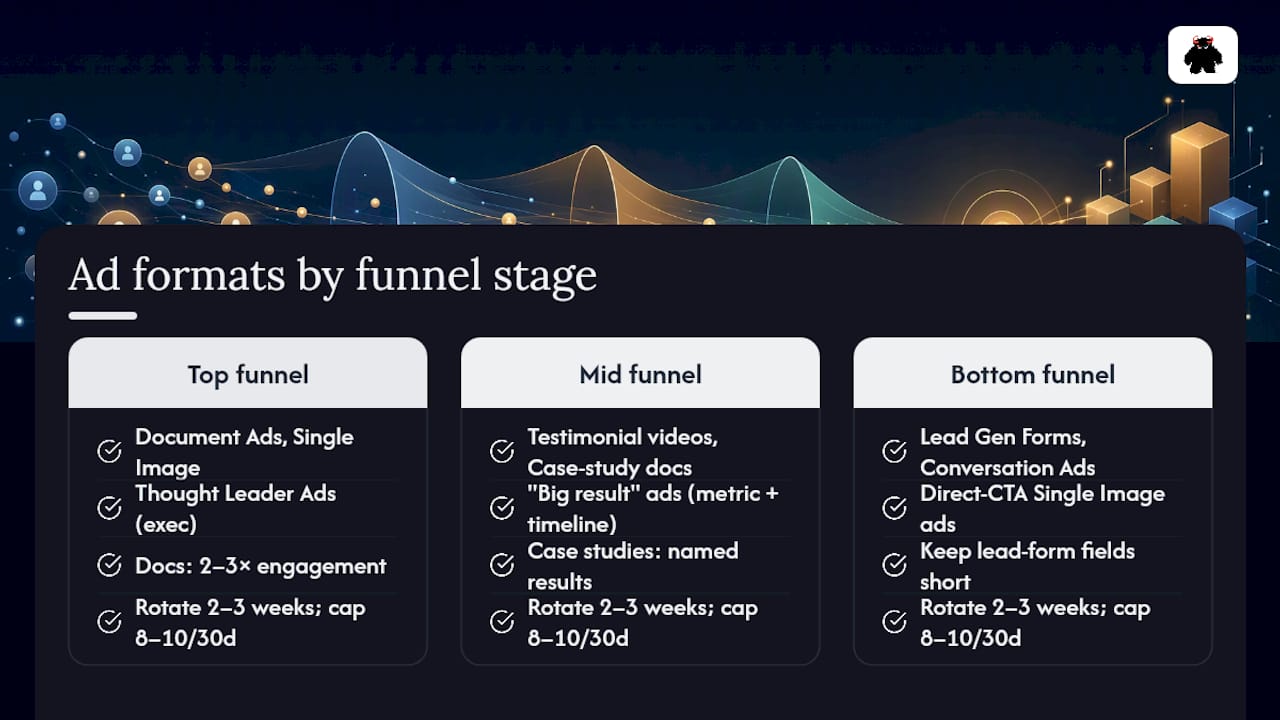
Rotate creative every two to three weeks and cap frequency around eight to ten impressions per user over 30 days. Beyond that, engagement typically drops off and cost per result climbs even though nothing else about the campaign changed.
How Should You Set Bids and Allocate Budget?
Bid strategy should shift as your campaign matures, not stay fixed from launch.
- Maximum Delivery early on, while the algorithm is still learning your audience and has no conversion history to optimize against.
- Manual CPC when you need firm cost control, particularly for smaller ABM audiences where overspend risk is higher.
- Target Cost once you’ve accumulated roughly 30 to 50 conversions, giving the algorithm enough data to hold a stable cost per result while scaling.
LinkedIn CPCs commonly run three to ten times higher than Meta’s, sometimes $18 to $45 for competitive B2B audiences. That cost only makes sense if you’re measuring pipeline value, not raw click volume.
Calculate your target cost per lead by working backward from pipeline economics: average deal size, times close rate, divided by acceptable customer acquisition cost. Review bids every one to two weeks.
What KPIs Prove LinkedIn’s Pipeline Value?
Cost per click is the wrong scoreboard for LinkedIn. The metrics that matter are cost-per-pipeline-dollar, pipeline conversion rate from LinkedIn-sourced leads, average opportunity value by campaign, and total qualified pipeline influenced across the funnel.
None of that is visible without tracking infrastructure:
- Insight Tag installed on every domain and subdomain you advertise toward.
- Conversion events configured for each meaningful action (demo request, content download, pricing page visit).
- A consistent UTM taxonomy so campaign, ad group, and creative all map cleanly into your CRM.
- CRM field mapping that ties the original LinkedIn touch to the eventual opportunity, not just the last click.
B2B sales cycles rarely close inside a 30-day attribution window, which is why treating retargeting audiences as valid for up to 90 days after engagement captures buyers who are still deciding, not gone.
Report weekly on delivery and spend pacing, but judge actual pipeline impact on a 60 to 90 day cohort basis. Anything shorter mistakes a slow B2B buying cycle for a failed campaign.
How Do You Run ABM Campaigns on LinkedIn?
- Upload your target account list through Matched Audiences, keeping enough accounts in each list (generally hundreds, not dozens) for reliable delivery.
- Use Predictive Audiences only once you have a clean seed list of 300 or more converted accounts to expand from.
- Personalize creative by account tier: reference the account’s industry or role-specific pain point in Conversation Ads, and use Thought Leader Ads from a named executive rather than the company page for named-account outreach.
- Sequence the touch points: Document Ad first, retargeting with a case study second, then a Conversation Ad with a direct meeting request once intent signals (site visits, content downloads) appear.
- Sync every account-level engagement signal into your CRM so sales outreach and paid touches don’t collide or contradict each other.
Coordinating ABM audience targeting with sales cadence, rather than running it as an isolated ads motion, is usually the difference between ABM that generates meetings and ABM that just generates impressions.
How Should You Test and Optimize LinkedIn Campaigns?
Change one variable per test. Swap the creative, or the audience, or the bid, never two at once, or you’ll never know which change moved the number.
- Give each test a learning window of two to three weeks or 30 to 50 conversions, whichever comes first.
- Don’t restart the learning phase by editing a live ad group mid-test; duplicate it instead.
- Never mix cold prospecting, retargeting, and ABM audiences inside one campaign. The algorithm will optimize toward whichever audience is cheapest to serve, which is rarely your highest-value segment.
- Avoid changing bids and creative in the same week; you won’t be able to attribute the resulting shift in cost per result.
Pro Tip: If a campaign hasn’t produced 30 conversions after a full month at your planned budget, the problem is almost always the offer or the audience size, not the bid.
What Does a 90-Day LinkedIn Launch Timeline Look Like?
- Days 0 to 7: Install the Insight Tag, configure conversion events, build seed audiences, and produce your first round of creative.
- Weeks 2 to 4: Launch awareness and initial lead generation campaigns simultaneously. Let them run untouched while you collect signal.
- Months 2 to 3: Shift to target cost or manual bidding, expand into additional formats, activate ABM sequences, and run your first 90-day cohort analysis.
Assign ownership clearly: one person owns the build and technical setup, one owns weekly bid and budget optimization, one owns reporting into the CRM, and sales owns follow-up speed on every qualified lead the program produces.
How Monstrous Media Group Builds Revenue-First LinkedIn Programs
Most agencies report clicks and impressions and call it strategy. Monstrousmediagroup builds LinkedIn programs the same way it builds every revenue system: wired to your CRM and buyer-intent data from day one, so every dollar spent is traceable to pipeline, not vanity metrics.
- Campaign architecture separated by funnel stage and audience type, matching the structure outlined above.
- Conversion tracking mapped directly into your existing CRM fields, not a disconnected ads dashboard.
- Bid and budget adjustments reviewed against pipeline data, not just cost-per-click trends.
- Reporting built around cost-per-pipeline-dollar so leadership sees revenue impact, not just spend.
Businesses that wire ads to CRM this way typically gain visibility into which campaign, ad, and audience actually influenced a closed deal, not just which one generated a form fill.
What Most Teams Get Backward About LinkedIn Ads
Most teams treat LinkedIn like a cheaper version of Meta and get burned by the CPC. The real failure isn’t cost. It’s measuring a B2B channel on a consumer timeline and consumer metrics, then pulling the plug right as the pipeline was about to show up in month two.
The other pattern worth calling out: teams build one campaign, throw every audience type into it, and wonder why performance plateaus. Structure isn’t a nice-to-have here. It’s the entire mechanism that lets you see which stage of the funnel is actually broken.
If you take one thing from this: wire your LinkedIn campaigns to your CRM before you spend serious money, separate your campaigns by funnel stage from day one, and judge results on a 60 to 90 day pipeline view, not a weekly click report.
- Vector
Get LinkedIn Ads Wired to Revenue, Not Reported as Clicks
Monstrousmediagroup builds LinkedIn programs as a revenue system: campaign architecture, CRM wiring, and bid management handled as one connected operation instead of three disconnected vendors.
If you’re running LinkedIn ads today and can’t answer what a lead actually cost you in pipeline dollars, that’s a systems gap, not a budget problem. Monstrousmediagroup’s Paid Media & Ad Buying service handles campaign architecture, audience construction, and bid management end to end, while Marketing Automation keeps every lead flowing cleanly into your CRM so sales follow-up never lags behind spend. Ask any agency how they map cost-per-click to cost-per-pipeline-dollar before you sign a contract; if they can’t answer in one sentence, that’s your answer. Start with an audience intent marketing audit to see exactly where your current LinkedIn spend is leaking before you commit another quarter’s budget to it.
Sources
- Campaign objectives - LinkedIn Marketing Developer Documentation
- LinkedIn advertising: tactical guidance - WordStream
FAQ
What Is the Ideal LinkedIn Audience Size for B2B Ads?
Most Sponsored Content campaigns perform best between 50,000 and 300,000 members. ABM campaigns using Matched Audiences can work effectively with far smaller lists, sometimes just a few thousand target accounts.
How Much Should You Budget for a LinkedIn Ads Pilot?
Plan for at least $3,000 to $5,000 per month per campaign objective to generate enough conversion data for the algorithm to optimize reliably. Anything lower rarely produces a usable read within the first month.
When Should You Switch From Maximum Delivery to Manual Bidding?
Start with Maximum Delivery while the campaign is still learning, then move to Target Cost or Manual bidding once you’ve collected roughly 30 to 50 conversions. Switching too early leaves the algorithm without enough data to hold a stable cost.
How Long Should a LinkedIn Retargeting Window Be?
A 90-day retargeting window generally captures the right audience for mid-funnel B2B nurture, since most B2B buying cycles run longer than a standard 30-day attribution window. Shorter windows tend to drop engaged prospects before they’re ready to convert.
Why Are LinkedIn Ad Costs So Much Higher Than Other Platforms?
LinkedIn’s professional targeting data commands a premium, and CPCs commonly run three to ten times higher than consumer platforms like Meta. That premium only pays off when you measure pipeline value instead of comparing raw click costs across platforms.
Should You Run One Campaign or Multiple Campaigns per Funnel Stage?
Separate campaigns by funnel stage and audience type every time. Mixing cold prospecting, retargeting, and ABM audiences in one campaign lets the algorithm optimize toward the cheapest audience, which usually isn’t your best-converting segment.
What Is the Minimum Seed Size for Predictive Audiences?
LinkedIn recommends a seed audience of at least 300 records, with 1,000 being ideal, for Predictive Audiences to generate a reliable expansion. Smaller seed lists tend to produce inconsistent targeting results.
How Do You Know Which LinkedIn Campaign Objective to Choose?
Match the objective to the action you actually want to measure. Lead Generation unlocks native forms for gated offers, while Website Conversions requires a defined conversion event tied to the Insight Tag for demo requests and similar high-intent actions.
What Metrics Actually Prove LinkedIn Is Driving Pipeline?
Cost-per-pipeline-dollar, pipeline conversion rate, and qualified pipeline influenced matter far more than cost per click or cost per lead. These require CRM integration so every LinkedIn touch is traceable to an actual opportunity.
Does Monstrous Media Group Manage LinkedIn Ads Campaigns?
Yes. Monstrousmediagroup’s Paid Media & Ad Buying service handles LinkedIn campaign architecture, audience construction, and bid management, wired directly into CRM and buyer-intent data. Current pricing is available by request through the services page.