
TLDR
Choose a web design company Omaha businesses can trust by evaluating business outcomes, technical performance, ownership, SEO foundations, integrations, and measurement-not visual polish alone. A credible partner should explain how the website will attract qualified traffic, convert visitors, connect to your sales systems, and improve after launch.
Build a website engineered for revenue
Key Takeaways
| Point | Details |
|---|---|
| Define the business outcome | Set targets for qualified leads, booked appointments, sales opportunities, or revenue before comparing designs. |
| Compare scope, not headline price | Confirm whether strategy, copy, SEO, analytics, integrations, testing, training, and post-launch support are included. |
| Demand ownership | Your company should control the domain, hosting access, content, analytics, accounts, and portable website assets. |
| Inspect technical performance | Require responsive layouts, accessible structure, clean code, security practices, and measurable speed standards. |
| Verify the revenue system | The site should connect traffic sources, forms, calls, CRM records, follow-up automation, and closed revenue. |
| Plan continuous improvement | Launch is the beginning of measurement and optimization, not the end of the engagement. |
Table of Contents
- 1. Define What the Website Must Accomplish
- 2. Compare Omaha Web Design Pricing and Scope
- 3. Audit Portfolios, Technology, and Ownership
- 4. Verify SEO, Performance, Integrations, and Measurement
- 5. Score Proposals and Identify Red Flags
- Frequently Asked Questions
- Recommended Reading
1. Define What the Website Must Accomplish
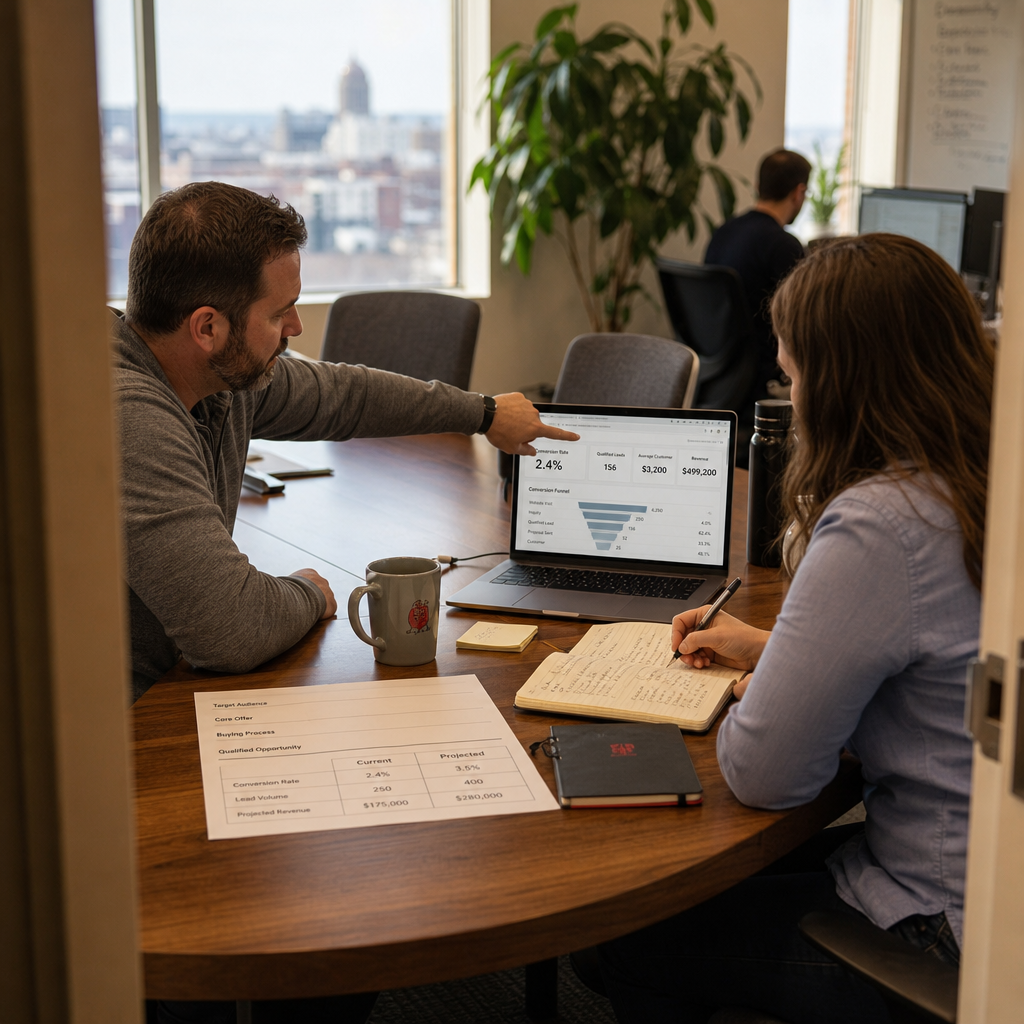
A web design company Omaha owners can trust should begin with the economics of the business, not a homepage mood board. Before requesting proposals, define the audience, offer, buying process, average customer value, current conversion rate, and action that represents a qualified opportunity.
A brochure site describes the company and provides contact information. A revenue-producing website does more: it captures demand, answers buying questions, directs visitors toward the right action, records where opportunities originated, and supports sales follow-up. That distinction determines the architecture, content, technology, and realistic budget.
 Recommended Reading
1. Define What the Website Must Accomplish
A web de" />
Write a measurable website brief
Give each Omaha web design agency the same business requirements so you can compare equivalent proposals. Your brief should identify current performance, commercial priorities, required pages, internal stakeholders, integrations, compliance needs, and the metrics used to judge success.
- Primary conversion: Quote request, consultation, purchase, application, call, or appointment.
- Qualified audience: Industries, service areas, company sizes, roles, and customer problems.
- Revenue baseline: Monthly traffic, leads, close rate, average contract value, and attributable revenue.
- Content requirements: Service pages, location pages, case studies, resources, FAQs, and comparison content.
- Operational requirements: CRM, scheduling, payments, call tracking, email automation, or customer portals.
- Performance targets: Conversion rate, qualified opportunity volume, loading speed, and organic visibility.
Use conversion-focused website strategy to connect page decisions to customer actions. If an agency cannot explain how its proposed structure supports acquisition and conversion, it is selling deliverables rather than solving the business problem.
A website is not valuable because it exists. It is valuable when it converts attention into trackable commercial action.
Pro Tip: Calculate the value of one additional customer before discussing budget. If a customer is worth $20,000 in gross profit, a system that reliably produces qualified opportunities should not be evaluated like a commodity five-page website.
2. Compare What a Web Design Company Omaha Businesses Hire Actually Includes
Website pricing varies because the underlying work varies. A low quote may cover a template, generic copy placement, a contact form, and launch. A higher quote may include research, information architecture, custom UX, copy strategy, custom web design Omaha businesses need, development, analytics, CRM integration, technical SEO, accessibility, testing, and post-launch optimization.
Do not ask only, “What does a website cost?” Ask what business and technical work is included, what remains your responsibility, and what happens after launch. The cheapest proposal becomes expensive when missing content, migrations, tracking, integrations, or performance work must be purchased later.
| Scope Area | Basic Brochure Site | Revenue-Focused Website |
|---|---|---|
| Strategy | Page list and visual preferences | Audience, offer, funnel, search demand, conversion paths, and KPIs |
| Design | Customized theme or standard sections | Custom layouts based on user intent and business priorities |
| Content | Client supplies finished copy | Research, messaging, editing, on-page SEO, and conversion copy |
| Development | Standard CMS setup | Scalable components, integrations, quality assurance, and clean deployment |
| SEO | Page titles or plugin installation | Architecture, metadata, schema, redirects, internal linking, and indexation controls |
| Measurement | Basic traffic analytics | Event tracking, calls, forms, CRM attribution, and reporting |
| After Launch | Maintenance or limited support | Testing, content expansion, CRO, technical monitoring, and iteration |
Ask for an itemized scope
Quality website design services Omaha companies purchase should separate discovery, design, content, development, migration, integrations, launch, and ongoing work. Itemization exposes omissions and prevents an attractive lump-sum quote from hiding a thin build.
- How many unique page templates and total pages are included?
- Who writes, edits, approves, and uploads the content?
- Are stock imagery, photography, illustration, or video included?
- Are CRM, calendar, payment, email, and call-tracking integrations included?
- Does migration include redirects, metadata, analytics, and search-console validation?
- How many revision rounds are included, and what counts as a revision?
- What are the hosting, licensing, maintenance, and support costs after launch?
- Who fixes defects discovered after deployment?
A useful comparison is Custom Website Development Company Vs Template Web Design What You Really Get. Templates are not automatically bad, but they become a poor investment when limitations create slow performance, generic messaging, rigid conversion paths, or costly redevelopment.
3. Audit Portfolios, Technology, and Ownership
A portfolio proves that an agency can produce screenshots. It does not automatically prove that its websites load quickly, rank, generate qualified leads, integrate with sales systems, or remain manageable after launch. Review live websites on mobile and desktop, then ask for performance data and business context.
Professional web designers Omaha businesses evaluate should explain the problem, constraints, decisions, and measurable result behind each relevant project. Ask whether the showcased work was completed by the current team and which portions-strategy, copy, UX, development, SEO, or integration-the agency actually delivered.

Evaluate evidence instead of aesthetics
- Open portfolio sites on a phone and complete the primary conversion action.
- Check whether navigation and calls to action remain clear without explanation.
- Review the depth and usefulness of service pages, case studies, and resources.
- Ask for baseline and post-launch conversion, traffic, or lead-quality data.
- Request references from businesses with similar sales cycles or technical needs.
- Look for accessibility, error handling, form confirmation, and privacy controls.
Test representative pages with Google PageSpeed Insights and review Google’s Core Web Vitals guidance. One test is not a complete audit, but repeated problems across portfolio sites can expose bloated themes, oversized media, excessive scripts, or weak engineering discipline.
Confirm CMS and asset ownership
Your agreement should state who owns the design files, code, content, data, domain, analytics properties, advertising accounts, and third-party subscriptions. Your company should have administrative access and the practical ability to move the website without rebuilding it from zero.
An Omaha website development company may use proprietary components or licensed software, which is not inherently a problem. The risk appears when critical functionality stops working after termination, export options are restricted, or the agency controls accounts that should belong to your business.
- Register the domain under a company-controlled account.
- Use company-owned analytics, tag management, search, CRM, and advertising accounts.
- Document recurring software costs and renewal dates.
- Require a full backup and migration process.
- Define termination, transition assistance, and credential handoff in writing.
- Confirm that routine content edits do not require developer intervention.
The CMS should match your operating model, publishing frequency, security requirements, and integration needs. Review website hosting maintenance and security before accepting a bundled arrangement that obscures infrastructure, backups, monitoring, or portability.
4. Verify SEO, Performance, Integrations, and Measurement
Installing an SEO plugin is not an SEO strategy. Search performance begins with market research, site architecture, crawlability, indexation, content quality, internal linking, structured data, local relevance, and a technically sound migration. Ask the agency to show exactly how those requirements appear in its scope.
Google documents the fundamentals in its SEO Starter Guide. For an Omaha business serving a local market, the build should also support accurate business information, location relevance, service-area content, reviews, and the company’s Google Business Profile.
Set measurable technical standards
A responsive preview is not enough. Require testing across common screen sizes, browsers, forms, devices, and connection conditions. Accessibility should follow the Web Content Accessibility Guidelines, while security controls should reflect the risks of the selected CMS and integrations.
- Mobile navigation, tap targets, forms, and calls must work without friction.
- Images should be appropriately sized, compressed, and loaded efficiently.
- Third-party scripts should be justified by business value.
- Heading structure, labels, keyboard access, and color contrast should be tested.
- Backups, updates, access controls, spam protection, and monitoring need named owners.
- Redirects and analytics must be validated before and after launch.
Connect the website to revenue operations
A lead form that sends an email is not a complete system. High-intent actions should enter the CRM with source data, trigger the correct follow-up, notify the right person, and remain traceable through opportunity and revenue stages.
Ask how the agency will implement website conversion tracking and attribution and Marketing Automation. If reporting stops at sessions, clicks, and form submissions, the business cannot distinguish productive traffic from activity that never becomes pipeline.
| System Question | Acceptable Evidence |
|---|---|
| Where do leads go? | Documented CRM fields, routing logic, ownership, alerts, and fallback handling |
| Can calls be attributed? | Call tracking linked to campaigns, landing pages, and qualified outcomes |
| Are forms reliable? | Validation, spam controls, confirmation events, error monitoring, and test records |
| Can revenue be connected? | Consistent source data and lifecycle stages from first visit through closed business |
| What happens after launch? | Reporting cadence, test backlog, content plan, and accountable owners |
If the agency cannot explain how a visitor becomes a tracked opportunity, it has designed a page-not a revenue system.
Pro Tip: Submit test leads from organic search, paid media, social media, and direct traffic before launch. Confirm that each record reaches the correct system with accurate attribution, notifications, consent data, and follow-up actions.
5. Score Proposals and Identify Red Flags
Use a weighted scorecard rather than choosing the agency with the most polished presentation. A disciplined process prevents visual preference, personal chemistry, or headline price from outweighing ownership, engineering quality, measurement, and commercial fit.
| Evaluation Category | Suggested Weight | What Strong Looks Like |
|---|---|---|
| Business and conversion strategy | 25% | Clear connection between audience, offer, pages, actions, and revenue goals |
| Technical delivery | 20% | Performance, accessibility, security, QA, scalability, and documented infrastructure |
| SEO and content system | 20% | Research-driven architecture, migration controls, content plan, and technical foundations |
| Measurement and integrations | 20% | CRM, calls, forms, attribution, reporting, and post-click behavior tracking |
| Ownership and support | 10% | Transparent access, portability, maintenance, service levels, and exit terms |
| Price | 5% | Total cost is proportionate to scope, risk, expected return, and internal workload |
Adjust the weights for your business, but do not allow price to erase the cost of weak execution. A website that fails to preserve rankings, capture leads, route opportunities, or provide usable data can destroy more value than the initial savings.

Red flags to reject
- Guaranteed first-place Google rankings or unsupported revenue promises.
- A proposal centered on animations, awards, or visual trends without measurable objectives.
- No discovery process beyond asking which websites you like.
- Vague statements such as “SEO included” without defined tasks and deliverables.
- No named process for mobile testing, accessibility, migration, redirects, or quality assurance.
- Agency-owned domain, analytics, CRM, advertising, or critical software accounts.
- Mandatory long-term hosting with no practical export or transition process.
- Portfolio claims without live examples, client references, or outcome data.
- Unclear change-order rules, hidden license costs, or undefined post-launch support.
- No plan for measuring and improving conversion performance after launch.
Final questions before signing
- What measurable business outcome is this scope designed to improve?
- Which assumptions could change the budget or timeline?
- What work must our internal team complete?
- Who specifically performs strategy, copy, design, development, SEO, and QA?
- What do we own, and what can we export when the engagement ends?
- How will current rankings, links, content, analytics, and tracking be preserved?
- How will leads, calls, appointments, opportunities, and revenue be measured?
- What is the first 90-day optimization plan after launch?
The best choice is not necessarily the largest agency or the lowest bid. It is the partner that can diagnose the entire path from visibility to revenue, establish accountable infrastructure, and show how decisions will be measured after the website goes live.
An overpriced brochure site creates the appearance of progress while leaving the real leaks untouched. Traffic arrives, intent disappears, leads go unattributed, and your team cannot prove what the investment produced.
Monstrous Media Group builds integrated web and marketing infrastructure around measurable outcomes. We connect SEO, conversion strategy, fast development, analytics, CRM workflows, automation, and ongoing optimization so visibility has a controlled path to revenue.
Ready to build a revenue system that performs? See how MMG approaches web design and development.
Frequently Asked Questions
How do I choose a web design company in Omaha?
Choose an Omaha web design company by comparing its strategy, technical standards, ownership terms, SEO process, integrations, measurement plan, and verified results. Require an itemized scope and score each proposal against the same business requirements.
How much should a small-business website in Omaha cost?
Cost depends on page count, custom design, copywriting, functionality, integrations, SEO, migration risk, and post-launch support. Compare total scope and expected business value rather than using page count or headline price as the primary decision factor.
What is the difference between a brochure website and a lead-generation website?
A brochure website mainly presents company information and contact details. A lead-generation website adds intent-based content, conversion paths, tracking, CRM routing, follow-up workflows, and ongoing optimization to produce measurable opportunities.
Should my business own its website and CMS account?
Yes. Your business should control the domain, content, data, analytics, key third-party accounts, administrative access, and portable website assets, subject to clearly disclosed third-party licensing terms.
What SEO services should be included in a website redesign?
A redesign should include keyword and audience research, information architecture, metadata, crawl controls, internal linking, structured data where appropriate, redirect mapping, analytics, and post-launch indexation checks. Existing high-value pages, rankings, and inbound links should be protected during migration.
How can I verify that an Omaha website development company builds fast sites?
Test several live client sites with PageSpeed Insights and use them on real mobile devices. Ask the company to define performance targets, explain its approach to images and third-party scripts, and show how it monitors Core Web Vitals after launch.
Which website integrations matter most for a small business?
The most important integrations are those that reduce missed opportunities and connect marketing activity to sales outcomes. These commonly include a CRM, call tracking, scheduling, payments, email automation, analytics, tag management, and lead-routing workflows.
What should happen after a new website launches?
After launch, the agency should verify tracking, forms, redirects, indexation, integrations, speed, and error logs. It should then use search, behavior, lead-quality, and revenue data to prioritize content improvements and conversion tests.