
Generative engine optimization is the practice of structuring content so AI systems like ChatGPT, Gemini, and Perplexity cite you directly in their generated answers. The single highest-leverage move is making your content extractable: self-contained paragraphs, sourced statistics, and explicit citations that a model can lift and attribute without guesswork. Everything else in this playbook builds from that one action.
TL;DR:
- Ensuring content is extractable with answer-first paragraphs, sourced statistics, and clear entity information significantly boosts citation rates in generative engine responses.
- Technical accessibility, including proper crawlability, server-side rendering, fast load times, and schema markup, is essential before attempting content and structural optimizations.
- Building a systematic measurement loop to track citations, share of voice, and downstream conversions helps maintain and improve AI visibility over time.
- Prioritizing sequencing-fixing crawlability and entity clarity before content rewriting-prevents wasted effort and ensures citation improvements are realized.
- Treat GEO as ongoing infrastructure involving regular technical audits, answer-optimized content, and citation tracking rather than a one-time content sprint.
Table of Contents
- What Generative Engine Optimization Actually Means for Visibility
- SEO vs. GEO: What Carries Over and What Changes
- Core GEO Tactics That Actually Move Citation Rates
- Technical Accessibility: The Gate Every Page Has to Pass
- Measuring GEO: The Crawlable-to-Tracked Visibility Loop
- A 7-Step GEO Action Plan for This Quarter
- GEO as Revenue Infrastructure, Not a Content Trick
- Where Most GEO Programs Break Down
- What Effective GEO Actually Looks Like in Practice
- How Generative AI Is Reshaping Content Strategy Itself
- The Real Gap in Most GEO Advice
- Get a GEO Program Built as Infrastructure, Not a One-Off Project
- Sources
What Generative Engine Optimization Actually Means for Visibility
Generative engine optimization is not a rebrand of SEO. It’s the discipline of engineering content so large language models retrieve, trust, and cite it when answering a user’s question. Traditional search returns a ranked list of links. Generative engines synthesize an answer and decide, sentence by sentence, whose content earned a mention.
That decision hinges on retrieval and grounding. The model pulls candidate passages from its index or a live search layer, then scores them for relevance, clarity, and trustworthiness before stitching an answer together. Keyword density barely factors into that scoring. What matters is whether a passage stands alone as a complete, attributable answer.
Princeton’s GEO-bench research quantified this shift: adding citations, quotations, and statistics to existing content lifted visibility in generative engine responses by as much as 40%. That’s not a marginal SEO tweak. It’s evidence that a handful of structural changes can double or triple how often a page gets pulled into an AI answer.
Three things drive citation odds more than anything else:
- Extractable passages that answer one question completely, without requiring surrounding context
- Named statistics and quoted attributions the model can point to as evidence
- Entity clarity, meaning the model can confidently identify who or what you are
Ignore this and you’re invisible in a growing share of searches that never produce a click.
SEO vs. GEO: What Carries Over and What Changes
SEO and GEO share a foundation. Industry analysis from Andreessen Horowitz frames GEO as an evolution of search rather than a replacement, built on the same technical bones: indexation, crawlability, quality content, and earned backlinks. Skip those fundamentals and no amount of GEO tactics will save you, because a model can’t cite a page it can’t find.
What changes is prioritization. Ranking for a keyword phrase matters less than being the passage a model selects to quote. That shifts your practical checklist:
- Keep doing: technical indexation, backlink development, comprehensive topic coverage, page-level SEO hygiene
- Reprioritize toward: answer-first structure, embedded statistics with sources, dedicated entity pages, and quotable expert framing
- Retire the habit of: writing meta descriptions as marketing copy instead of compressed answers
The practical mapping is simple. Where you once optimized a title tag for click-through rate, now write the opening paragraph beneath every H2 as a standalone answer capsule, something a generative engine can lift verbatim and attribute to you.
Core GEO Tactics That Actually Move Citation Rates
Four tactics separate pages that get cited from pages that get ignored. None require a redesign. All of them are testable within a single content sprint.
- Write answer-first paragraphs under question-form headings. Put your direct answer in the first two sentences after every H2 or H3, especially when the heading is phrased as a question. Models weight the opening of a section heavily when deciding what to extract.
- Add statistics and quoted attribution to back your claims. Practitioner data and the Princeton GEO study both found that adding sourced stats and quotations raised citation probability by 30 to 40 percent in controlled tests. A bare claim gets skipped. A claim with a number and a source gets cited.
- Build out entity pages with structured markup. About pages, team bios, and service pages need Organization and Person schema so a model can resolve who you are without ambiguity. Thin or missing entity pages are a common reason a well-written blog post still doesn’t get cited.
- Seed content across the platforms different engines actually pull from. Gemini leans on YouTube transcripts, Perplexity favors fresh forum and community discussion, and ChatGPT’s browsing layer weights established publications. A single-channel content strategy caps your visibility ceiling before you even start.
Pro Tip: Rewrite your five highest-traffic blog posts before you write anything new. Converting an existing page that already ranks into an extractable answer capsule is faster than building citation authority from a blank page.
Combine all four and you’re not chasing one algorithm, as detailed in the Generative Engine Optimization: A Practical GEO Playbook. You’re building content that reads as authoritative to a machine and a human at the same time.
Technical Accessibility: The Gate Every Page Has to Pass
None of the tactics above matter if a bot can’t fetch the page. This is the part teams skip because it’s unglamorous, and it’s the part that quietly kills GEO programs before they start.
Google’s own developer guidance is blunt about this: technical accessibility and structured content come first, and speculative “GEO hacks” are not a substitute for basic crawlability. A model can’t ground an answer in content it never received.
Four checks belong at the top of every technical audit:
- Confirm AI crawler user agents (GPTBot, PerplexityBot, Google-Extended, and similar) are allowed in robots.txt, and that key pages return real HTML rather than an empty shell waiting on JavaScript
- Use server-side rendering or pre-rendering for anything you need cited; client-side-only rendering is one of the most common invisible failures in GEO audits
- Keep page speed fast and hosting stable, since timeouts and slow time-to-first-byte push crawlers to abandon a fetch before your content ever loads
- Add Article, FAQ, Organization, and Person schema where ambiguity is highest, particularly on entity and about pages
Structured data doesn’t guarantee a citation, but it measurably reduces the ambiguity that keeps a model from citing you at all, and that gap is exactly where most mid-sized sites lose visibility they didn’t know they were losing.
Measuring GEO: The Crawlable-to-Tracked Visibility Loop
GEO only becomes manageable once you treat it as a loop, not a one-time project: crawlable, structured, citable, tracked. Skip the tracking step and you’re optimizing blind.
Five metrics matter more than page views:
- Citation frequency per platform - how often you’re named or linked across ChatGPT, Perplexity, Gemini, and AI Overviews for a defined prompt set
- Share of voice - your citation rate relative to competitors answering the same query class
- Context triggers - the specific prompts and phrasings that surface your brand, which tell you which pages are doing the work
- Sentiment - whether the model characterizes you accurately and favorably when it does cite you
- Downstream conversions - leads or signups attributable to AI-referral traffic, since conversion value is replacing raw click volume as the primary KPI in a zero-click search environment
Build a tracker around a fixed set of scheduled prompts run against each target engine weekly, then log which URLs and brand mentions appear in the outputs. Review retrieval issues weekly. Report share of voice and conversion impact monthly. That cadence catches a robots.txt regression or a rendering break before it costs you a quarter of visibility.
A 7-Step GEO Action Plan for This Quarter
Strategy without a sequence is just a wish list. Here’s the order that produces results without stalling on analysis.
- Week 1: Fix crawlability. Audit robots.txt for AI crawler access, confirm critical pages render server-side, and resolve any page speed issue causing timeouts.
- Week 1: Verify indexation on your top 20 pages. Confirm they return clean HTML and load under three seconds; this single check prevents the rest of the work from being wasted.
- Weeks 2 to 4: Convert priority pages into answer capsules. Rewrite the opening of every major H2 section to answer the implied question in the first two sentences.
- Weeks 2 to 4: Add sourced statistics and quotations. Every claim that currently reads as an assertion should carry a number or an attributed quote by the end of this phase.
- Month 1 to 3: Publish or upgrade entity pages. Build out About, team, and service pages with full schema markup so models can resolve your identity cleanly.
- Month 1 to 3: Run a co-citation and seeding push. Get mentioned on the platforms your target engines actually pull from, whether that’s industry publications, YouTube, or community forums.
- Ongoing: Run the visibility loop. Track citations weekly, A/B test capsule formats against control pages, and tie AI-referral traffic to actual pipeline.
Pro Tip: Don’t run all seven steps in parallel. Crawlability fixes that aren’t verified first will make your Month 1 to 3 content work invisible to the same bots you just spent a quarter optimizing for.
GEO as Revenue Infrastructure, Not a Content Trick
Treating generative engine optimization as a list of writing hacks misses the actual opportunity. The businesses winning citations right now are running it as a system: crawlability triage, entity architecture, and a measurement loop that never stops feeding the next content decision.
That’s the model Monstrousmediagroup’s generative engine optimization service operates on. GEO doesn’t sit in isolation. It gets bundled with technical SEO, answer engine optimization, and managed infrastructure so that a robots.txt regression or a rendering failure gets caught before it silently erases a quarter of citation volume.
What that bundled approach looks like in practice:
- Crawlability and rendering audits paired with ongoing hosting reliability, so technical debt never blocks a content win
- Entity page development with full schema markup, treated as infrastructure rather than a one-time content task
- A citation tracking cadence that reports share of voice and conversion impact monthly, not vanity traffic numbers
GEO done as infrastructure protects revenue that’s already leaking through invisible pages. GEO done as a checklist just produces one good quarter followed by drift.
Where Most GEO Programs Break Down
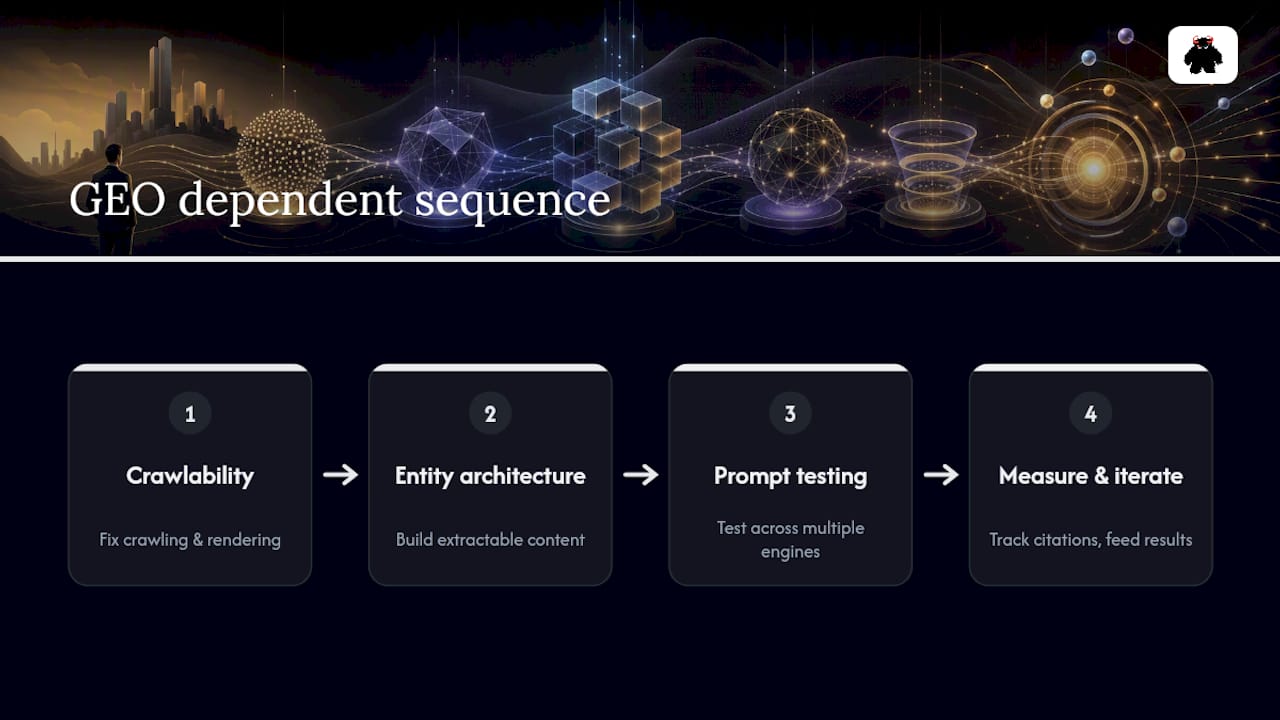
The most common failure isn’t a bad tactic. It’s sequencing. Teams rewrite fifty blog posts into answer-first format, then discover half those URLs were blocked to AI crawlers the entire time. The content work was real; the visibility gain was zero, because fixing crawlability and rendering has to happen before content tweaks can register at all.
A second pitfall is chasing a single engine. Optimizing exclusively for how ChatGPT retrieves content while ignoring how Perplexity or Gemini source their answers caps your ceiling by design, since each engine pulls from different indexes and rewards different kinds of freshness.
Measurement gets skipped almost as often. Plenty of teams ship the content and technical fixes, then never build a tracker to confirm whether citations actually increased. Without scheduled prompt testing across platforms, you’re relying on anecdote, an employee mentioning they saw your brand mentioned once, instead of a repeatable signal.
Finally, there’s the temptation to treat schema and llms.txt files as magic switches. They reduce ambiguity for a model trying to identify who you are, but they don’t force a citation on their own. Teams that install schema and stop there are often disappointed when visibility doesn’t move, because the content itself still isn’t extractable or backed by sourced claims.
The pattern across all four pitfalls is the same: GEO fails when it’s treated as a single lever instead of a sequence of dependent steps.
What Effective GEO Actually Looks Like in Practice
The clearest evidence of GEO working comes directly from the controlled testing behind it. In the Princeton GEO-bench research, sites that added citations, statistics, and quoted attributions to existing content saw visibility gains as high as 40 percent in generative engine responses, without any change to the underlying claims themselves. The content didn’t get more accurate, but it became easier for a model to extract and trust.
That pattern shows up at the page level too. A comparison or “best of” style page that buries its recommendation three paragraphs deep, behind a history lesson and a disclaimer, consistently underperforms a page that states the recommendation in the first two sentences and backs it with a specific figure. The difference isn’t writing quality. It’s structure a model can lift cleanly.
The same logic applies to entity resolution. Pages tied to a fully built-out About page with Organization schema and a named, credentialed author show up more consistently in answers that require the model to attribute a claim to a source it trusts. A blog post from an anonymous byline on a site with no entity markup is asking a model to take a risk it usually won’t take.
None of these examples require exotic tactics. They require doing the same handful of structural moves consistently across a content library, then measuring whether citation frequency moves.
How Generative AI Is Reshaping Content Strategy Itself
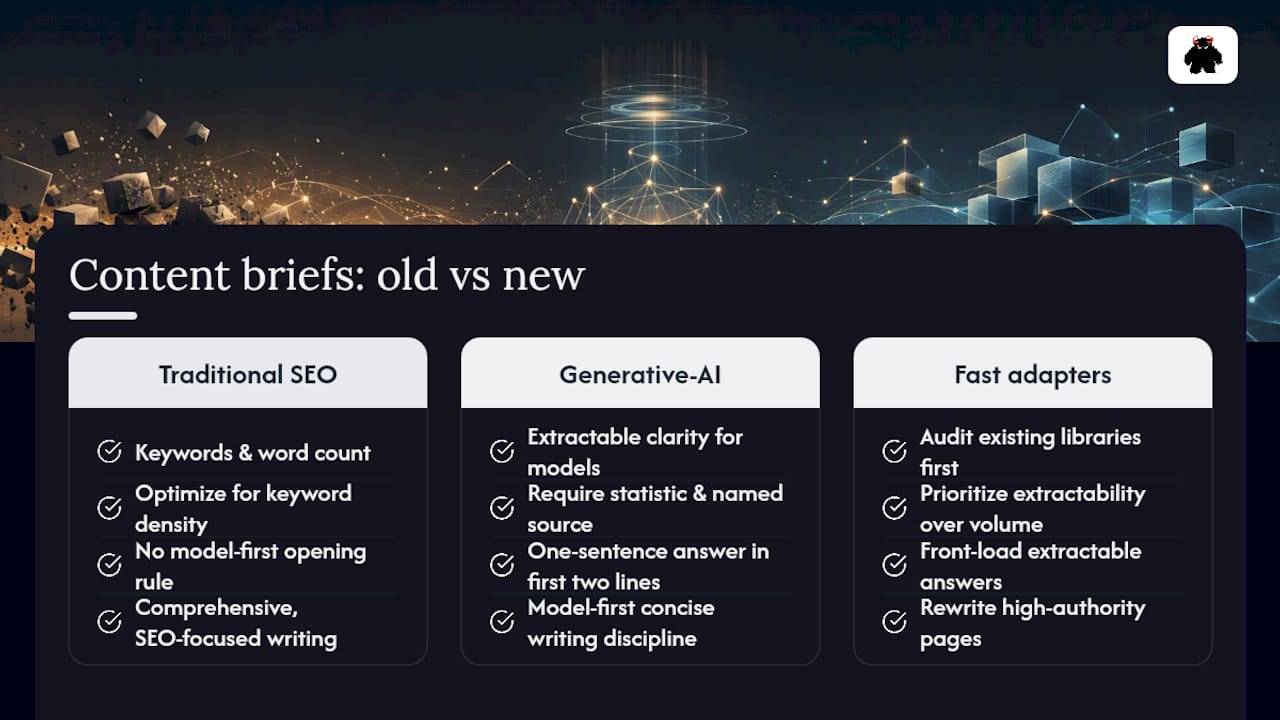
Generative AI didn’t just create a new channel to optimize for. It changed what “good content” means at a structural level. A paragraph written to satisfy a human skimming a page and a paragraph written to be lifted whole by a model are not the same paragraph, and most existing content libraries were built for the first case only.
This is forcing a shift in how content teams brief writers. Instead of optimizing for word count and keyword coverage, briefs increasingly specify a required statistic, a named source, and a one-sentence answer that has to appear in the first two lines of a section. That’s a meaningfully different writing discipline than the SEO content briefs most teams have run for a decade.
It’s also changing the volume calculus. Because generative engines reward extractable clarity over comprehensive length, bloated 3,000-word posts stuffed with filler sections are losing ground to tighter pages that answer fewer questions more completely. SEO fundamentals like indexation and backlinks still matter as the foundation, but the content sitting on top of that foundation now has to justify every paragraph’s existence to a model deciding what to extract.
The businesses adapting fastest are the ones auditing existing libraries for extractability rather than only producing new material, since a rewritten high-authority page usually outperforms a brand-new one for months.
The Real Gap in Most GEO Advice
Most GEO content published right now reads like a tactics list: add schema, add quotes, add statistics. All true, all useful, and all incomplete on their own. The research backs the tactics individually, but the actual lift documented in the Princeton GEO-bench study came from combining several structural changes on the same page, not from any single hack applied in isolation.
The bigger gap is sequencing. Conventional advice treats content rewrites as step one. It should be step three. Crawlability and rendering come first because a model can’t cite what it can’t fetch, and no amount of quotable prose changes that math. Entity clarity comes second, because a model that can’t confidently identify who you are will hedge on citing you even when your content is well written.
What I’d prioritize differently than most guides: treat GEO as a measurement problem before a content problem. Build the tracking loop first, even a rough one, so every subsequent change has a before-and-after signal. Teams that skip measurement end up making a dozen changes at once and can never tell which one actually worked. The tactics matter, but the discipline of testing them one variable at a time is what separates a program that compounds from one that stalls after a single good quarter.
- Vector
Get a GEO Program Built as Infrastructure, Not a One-Off Project
Most agencies will sell you a content sprint and call it generative engine optimization. Monstrousmediagroup builds it as a managed system instead: technical crawlability fixes, answer-first content, entity architecture, and a citation tracker that reports monthly, all running under one engagement instead of scattered across freelancers and one-off audits.

That matters because GEO breaks the moment one piece drifts. A robots.txt change six months from now can erase citation gains a content team spent a quarter earning, and nobody notices until traffic quietly drops. Monstrousmediagroup’s SEO, AEO, and GEO services are built to catch that drift before it costs you pipeline, pairing generative visibility work with the core SEO infrastructure that has to stay healthy underneath it.
If you’re a business owner or marketing executive who wants generative visibility handled as a system rather than a checklist someone forgets to revisit, request a GEO visibility audit from Monstrousmediagroup and see exactly which pages are already losing citations to a fixable technical or structural issue.
Sources
- GEO: Generative Engine Optimization (Princeton / arXiv)
- Optimizing your website for generative AI features on Google Search (Google Developer Guide)