
For most B2B teams, the highest-leverage move isn’t picking a fancier attribution model. It’s measuring at the account level instead of the contact level, then choosing a model that matches your sales cycle and data volume. Start with time-decay or position-based (U-shaped) for multi-touch reporting, and reserve data-driven attribution for programs with enough closed-won volume to train it reliably.
TL;DR:
- Measuring at the account level provides more accurate insights into B2B revenue than contact-level tracking, especially for complex buying committees.
- Start with time-decay or position-based models and reserve data-driven attribution for high-volume, mature pipelines with sufficient conversion data.
- Align attribution windows with your actual sales cycle, typically much longer than default platform settings, to avoid losing critical buyer journey data.
- Establish canonical account records, implement identity resolution, and reconcile attribution data regularly to build credible, trustworthy models.
- Focus on fixing data hygiene issues before switching models, as poor identity matching and CRM inaccuracies are the main barriers to reliable attribution.
Table of Contents
- What Are the Main B2B Attribution Models?
- Why Account-Level Measurement Beats Contact-Level Tracking
- How Do You Choose the Right Attribution Model for Your Stage?
- How Do You Set Up Attribution That Sales Will Actually Trust?
- Where Attribution Reports Lose Credibility (and How to Fix It)
- How Monstrous Media Group Builds Reliable B2B Attribution Systems
- The Real Lesson Buried in Most Attribution Debates
- Sources
What Are the Main B2B Attribution Models?
Every attribution model answers a different business question, and confusing those questions is where most attribution programs go wrong. HubSpot’s attribution modeling guide lays out the standard set, and each one earns its place for a specific decision, not as a universal default.
First-touch attribution gives 100% of the credit to the first recorded interaction, whether that’s an organic search visit, a LinkedIn ad click, or a referral. It answers one question well: “What’s driving initial awareness?” Use it when you’re evaluating top-of-funnel channel performance, not when you’re trying to justify a media budget to your CFO.
Last-touch attribution does the opposite, crediting the final touchpoint before conversion, usually a demo request or a contact form. It’s the default in most CRMs because it’s simple to calculate, but in a B2B deal with 6 to 12 touches across multiple stakeholders, last-touch systematically under-credits everything that happened earlier in the pipeline.
Linear attribution splits credit evenly across every touchpoint in the journey. It’s a fair starting point when you have no strong hypothesis about which stage matters most, but it also dilutes the signal from moments that actually moved the deal forward, like a case study download right before a sales call.
Time-decay attribution weights credit toward touchpoints closer to conversion, using an exponential decay curve. This tends to fit B2B buying patterns better than linear, because the champion who downloaded three whitepapers six months ago mattered less than the vendor comparison page they revisited last week.
Position-based (U-shaped) attribution assigns fixed weight, often 40% each, to the first and last touch, with the remaining 20% spread across the middle. It’s a practical starting model because it explicitly credits both demand generation and demand capture, which is exactly the tension most B2B marketing leaders are trying to resolve internally.
W-shaped attribution extends that logic by adding a third fixed credit point, typically the moment a lead becomes a marketing-qualified or sales-qualified opportunity. It’s useful when you specifically need to prove the value of your lead qualification process to a skeptical sales team.
Custom attribution models let you set your own weighting rules based on known buying behavior, like giving extra credit to a demo request or a pricing page visit regardless of when it happened in the sequence.
Data-driven attribution uses algorithms, typically Shapley value or Markov chain modeling, to calculate credit based on actual conversion patterns in your own data rather than a fixed rule. ZoomInfo’s guide to B2B attribution notes that model choice should map to company stage, and data-driven models are the clearest example: they need enough conversion volume to be statistically meaningful. Google Analytics 4 defaults to data-driven attribution automatically, but the reliability of that output depends entirely on whether you have the volume to back it, a point MarketingMary’s breakdown of attribution models also flags when discussing platform defaults.
Here’s how the models map to the questions marketing leaders actually ask:
- “What’s generating pipeline awareness?” → First-touch
- “What closed the deal?” → Last-touch (use cautiously, in combination with others)
- “How do we credit a long, multi-stakeholder journey fairly?” → Linear or time-decay
- “How do we prove both top-of-funnel and bottom-of-funnel value?” → Position-based or W-shaped
- “How do we let the data decide, once we have enough of it?” → Data-driven
Why Account-Level Measurement Beats Contact-Level Tracking
Here’s the uncomfortable truth most attribution dashboards hide: you can swap models all day and barely move the needle if you’re still measuring at the contact level. B2B deals aren’t closed by individuals. They’re closed by buying committees, often five to eleven people touching your content, your ads, and your sales team at different times, from different departments, sometimes without ever filling out the same form twice.
Contact-level attribution treats each of those people as a separate, disconnected journey. Account-level attribution rolls all of that activity up to the company buying the deal, which is a far more accurate picture of how B2B revenue actually gets built. ZoomInfo’s research on attribution states plainly that shifting from contact-level to account-level measurement delivers a bigger improvement in attribution accuracy than switching between model types. Forrester reaches a similar conclusion in its guidance on making B2B attribution work, arguing that channel-level tracking alone can’t succeed without integrating account-level signals back into CRM outcomes.
Getting there requires real infrastructure work, not a dashboard toggle. Here’s the sequence that holds up:
- Establish canonical account records. Every contact, lead, and opportunity needs to map to one clean, deduplicated company record, not three variations of the same domain.
- Deploy identity resolution. Match anonymous website visits, ad clicks, and form fills to known accounts using firmographic and technographic signals, not just cookies.
- Wire marketing touches into the CRM. Every campaign interaction needs a timestamp and a company match that syncs into the same system where sales logs opportunity data.
- Reconcile against closed-won revenue. Attribution that never gets checked against actual bookings is a story, not a measurement.
Pro Tip: Before you touch your attribution model, audit how many of your leads are sitting as “unknown company” in your CRM. No model, however sophisticated, can fix a broken unit of analysis.
The most common pitfall here is duplicate account records created by inconsistent domain matching, think “Acme Corp,” “Acme Corporation,” and “acme.com” logged as three separate entities. The fix is a standardized domain-matching rule enforced at data entry, not a quarterly cleanup project.
How Do You Choose the Right Attribution Model for Your Stage?
Model selection isn’t a taste preference. It’s a function of four variables you can assess in about twenty minutes: sales cycle length, data maturity, channel complexity, and the actual decision you’re trying to inform.
Sales cycle length determines your attribution window. Octane11’s definitive guide to B2B attribution points out that most B2B platforms default to short lookback windows built for e-commerce, which quietly discard weeks or months of legitimate touchpoint history in a 90-day enterprise sales cycle.
Data maturity is the honest gatekeeper for data-driven models. If your pipeline generates a few hundred conversions a month across your tracked channels, you likely don’t have the volume for the algorithm to find a stable pattern; a rule-based model like time-decay or position-based will outperform an under-fed data-driven model in practice, even though it sounds less advanced.
Channel complexity matters because a five-channel program with clean UTM hygiene is a very different measurement problem than a fifteen-channel program that includes events, direct mail, and partner referrals.
Decision objective is the variable teams skip, and it’s the one that should come first. Are you defending a budget line, reallocating spend between channels, or diagnosing why leads stall mid-funnel? Each answer points to a different model.
A few rules of thumb worth adopting:
- Under 90-day sales cycles with clean digital-first funnels: time-decay is a strong default.
- Complex buying committees where you need to prove both demand generation and sales enablement value: position-based or W-shaped.
- High-volume, digitally native funnels with hundreds of monthly conversions: data-driven, configured in GA4 or a CRM-native model.
- Any stage: run two models in parallel, one upper-funnel model like first-touch and one full-funnel model, because HubSpot’s guidance notes this surfaces different signals that a single model will always miss.
A useful anchor point: treat multi-touch attribution (MTA) as your channel-optimization layer, marketing mix modeling (MMM) as your strategic budget layer, and incrementality testing as your causal validation layer. ZoomInfo frames this three-part architecture as the realistic long-term setup rather than any single model doing all the work.
Early-stage teams should focus entirely on account-level data hygiene before touching model sophistication. Growth-stage teams should adopt position-based or time-decay and start layering in incrementality tests on their top two channels. Mature teams with high conversion volume can move to data-driven MTA supplemented by quarterly MMM reviews.
How Do You Set Up Attribution That Sales Will Actually Trust?
Attribution models fail in production for boring, fixable reasons: mismatched time windows, sloppy identity matching, and no offline capture. Fixing those four areas does more for credibility than any model swap.
-
Set your lookback window to your actual sales cycle, not the platform default. Pull your median and 90th-percentile deal-close timelines from the CRM. If your median enterprise deal takes 120 days and your ad platform defaults to a 30-day window, you’re throwing away three-quarters of the buyer journey. Octane11’s research on the ROI proof gap identifies this mismatch as one of the most common causes of undervalued marketing programs.
-
Build an identity resolution checklist. Standardize domain formatting, enforce required company fields on every form, and set a recurring CRM hygiene job that flags duplicate or orphaned account records weekly, not quarterly.
-
Capture dark-funnel activity deliberately. Not every influential touch leaves a digital trail. A prospect reading a competitor comparison on a review site, or getting a recommendation from a peer at another company, never shows up in your pixel data. Add a simple “How did you hear about us?” field on high-intent forms, use dedicated campaign codes for offline channels like events and direct mail, and log sales-reported influence sources as CRM events so they enter the same reconciliation pipeline as digital touches.
-
Run a validation routine on a fixed schedule. Reconcile attributed pipeline against actual closed-won revenue every quarter. Where the gap is large, run an incrementality test, holding out a channel or region and measuring the lift difference, to check whether your model is over- or under-crediting that channel. Keep a simple audit log of every model change, the date, and the reason, so you can trace why a metric moved.
Pro Tip: Treat your attribution model like a live system, not a report you generate once. A model configuration frozen for two years while your sales cycle and channel mix evolve underneath it will quietly drift from reality; the audit log is what lets you catch that drift before finance does.
Where Attribution Reports Lose Credibility (and How to Fix It)
Every B2B marketing team eventually runs into the same wall: finance and sales stop trusting the attribution report. This happens for a predictable reason. Marketing tends to over-credit the channels it can measure easily, paid search, LinkedIn ads, email, while under-crediting the influences it can’t easily track, like word-of-mouth, analyst mentions, or a sales rep’s personal network.
Common failure patterns to watch for:
- Attributed pipeline that consistently exceeds actual closed-won bookings by a wide margin, a sign of over-crediting from a too-generous model or a leaky funnel definition.
- Channels with strong brand or offline influence showing near-zero attributed credit, a sign your dark-funnel capture is broken, not that the channel doesn’t work.
- Sales teams dismissing the report outright in pipeline reviews, usually because the model’s logic was never explained to them in plain terms.
The fix isn’t a better chart. It’s better language. Present attribution results as directional signals with a stated confidence level, not as precise accounting. Say “this model suggests events are under-credited by roughly 20% based on our reconciliation gap” rather than presenting a single, falsely precise number as fact. And know when to stop tweaking the model itself: if your reconciliation gap against closed-won revenue stays wide no matter which model you try, the problem is your data foundation, not your algorithm. Fix identity resolution and CRM hygiene before you touch the model again.
How Monstrous Media Group Builds Reliable B2B Attribution Systems
Attribution isn’t a report you commission once. It’s infrastructure, and Monstrousmediagroup builds it the way infrastructure should be built: in phases, with validation built into every step.
The path starts with a discovery and data audit, mapping your existing CRM structure, identifying duplicate account records, and quantifying how much of your pipeline is currently untrackable to a known company. From there, Monstrousmediagroup implements identity resolution, connecting buyer intent data to canonical account records so that anonymous visits and known contacts finally roll up to the same company profile.
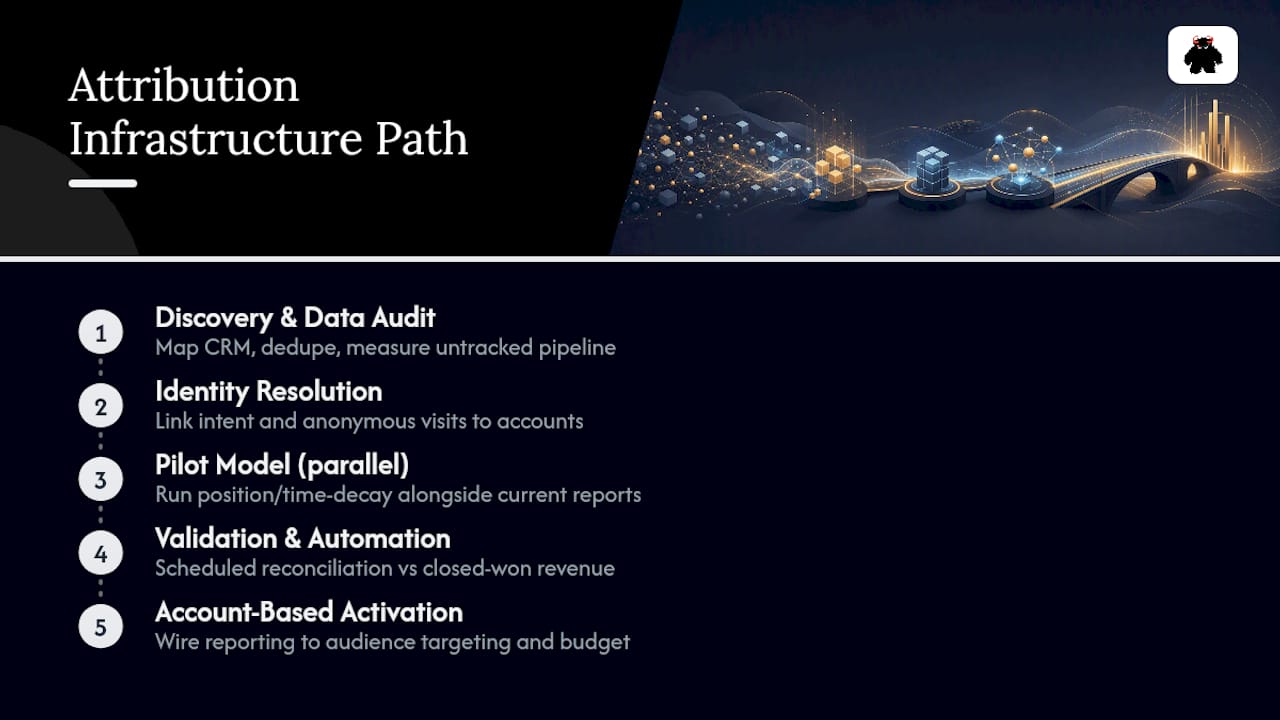
Next comes a pilot model, typically position-based or time-decay, run in parallel with your existing reporting so you can compare outputs without disrupting current dashboards. That pilot feeds into ongoing validation and automation, where reconciliation against closed-won revenue runs on a schedule instead of a one-off project, and reporting logic gets wired directly into account-based audience targeting so the insight actually changes where budget goes next.
This is what Monstrousmediagroup means by treating marketing as infrastructure as a whole rather than a stack of disconnected tactics: Revenue Protection systems that catch leaks before they compound, Managed Website Infrastructure that keeps your tracking and tagging stable, and and Private AI / Business Intelligence layers that turn raw touch data into decisions your CFO will actually sign off on.
The Real Lesson Buried in Most Attribution Debates
Most attribution content obsesses over which model is “best,” and that’s the wrong argument. The research is fairly consistent on this: unit of analysis beats model sophistication almost every time. A company running last-touch attribution on clean account-level data will out-measure a company running data-driven attribution on fragmented contact records.
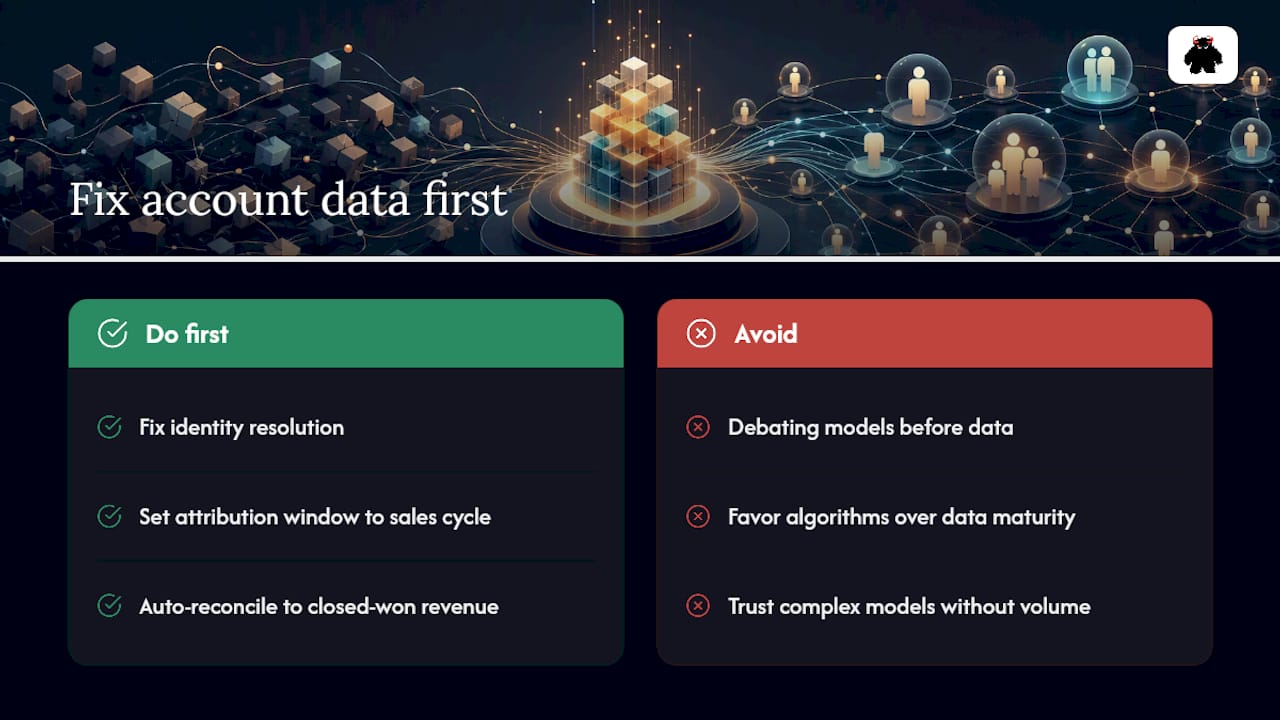
The conventional advice oversells algorithmic models as an endpoint rather than a capability you earn through data maturity. Data-driven attribution isn’t smarter than time-decay when you don’t have the conversion volume to feed it. It’s just less transparent about being wrong.
What I’d prioritize first, before any model conversation: fix identity resolution, set your attribution window to your real sales cycle, and get one reconciliation cycle against closed-won revenue running on autopilot. Everything else, including which model you eventually pick, is a refinement on top of that foundation, not a substitute for it.
- Vector
Ready to stop guessing which channels are actually driving pipeline? Monstrousmediagroup builds account-level attribution systems as part of a broader SEO, AEO, and GEO visibility program designed to turn measurement into revenue decisions, not just prettier dashboards. Reach out to start with a data audit and a pilot model built around your actual sales cycle.
Sources
- What B2B Marketers Must Know and Do to Make Attribution Work - Forrester
- B2B Marketing Attribution: The Complete Guide - ZoomInfo
- Attribution modeling - HubSpot Blog
- B2B Marketing Attribution: The Definitive Guide - Octane11