
 https://www.omahamediagroup.com/images/uploads/monster_gallery/Omaha-Media-Group-Black.jpg
admin
https://www.omahamediagroup.com/images/uploads/monster_gallery/Omaha-Media-Group-Black.jpg
admin
Why content marketing matters: $107B revenue driver in 2026

Content marketing isn’t a side project anymore. It’s the engine driving global revenue to $107 billion in 2026, with 82 to 97 percent of businesses treating it as a core function. If you’re still wondering whether content marketing deserves a seat at your strategy table, the answer is clear. Companies that master content marketing don’t just build brand awareness. They create predictable revenue systems, deepen customer relationships, and establish competitive moats that generic advertising can’t touch. This article breaks down exactly why content marketing matters for your business growth, how AI is reshaping the landscape, and what you need to do differently to win.
Table of Contents
- Key takeaways
- The critical role of content marketing in business growth
- How AI and content quality shape modern content strategies
- Creating a sustainable content marketing advantage: context, originality, and balance
- Practical steps to leverage content marketing for maximum impact
- Enhance your content marketing with expert digital services
- Frequently asked questions
Key Takeaways
| Point | Details |
|---|---|
| AI and quality | AI tools support 60 to 70 percent of content ideation and writing, but success comes from applying AI across the entire operation without sacrificing quality. |
| Content as revenue engine | Treat content as a revenue system that spans awareness to decision, delivering compounding returns rather than a cost center. |
| Channel mix matters | Social content drives 32 percent engagement impact and video outperforms traditional blogs by 16 percent, so a diversified channel strategy improves results. |
| Quality over quantity | Quality beats quantity because depth and unique expertise differentiate content in crowded markets. |
| Measure business outcomes | Measure business outcomes instead of vanity metrics like page views to guide strategy. |
The critical role of content marketing in business growth
Content marketing has evolved from a nice-to-have tactic into a mission-critical business function. The numbers tell the story. Between 82 and 97 percent of businesses now use content marketing as a core strategy, and the global market is projected to generate $107 billion in revenue by 2026. This isn’t hype. It’s a fundamental shift in how companies acquire, engage, and retain customers.
Why does content marketing command this level of investment? Because it works across the entire customer journey. Unlike traditional advertising that interrupts, content marketing attracts. It builds brand identity by establishing your voice and expertise. It creates customer trust through consistent value delivery. It fuels long-term engagement by solving real problems your audience faces daily.
The sales funnel depends on content at every stage. Awareness content introduces your brand to new prospects. Consideration content educates buyers comparing solutions. Decision content removes final objections and drives conversions. Companies that execute creative content marketing across all three stages see compounding returns.
Here’s what sets winning content strategies apart:
- They treat content as a revenue system, not a cost center
- They measure business outcomes, not vanity metrics like page views
- They integrate content with sales, product, and customer success teams
- They focus on quality over quantity, especially in competitive markets
The competitive landscape has changed. Generic content floods every channel. Buyers have infinite options and zero patience for mediocrity. Your content must deliver genuine value or it’s invisible. That differentiation through quality is what separates businesses capturing market share from those losing ground. Content marketing isn’t about publishing more. It’s about publishing better, smarter, and with clear business intent.
How AI and content quality shape modern content strategies
AI has transformed content marketing workflows, but not in the way most people think. According to the 2026 Content Marketing Benchmarker Report, AI tools now support 60 to 70 percent of content ideation and writing. That’s a massive shift in how teams operate. Yet here’s the surprise: AI adoption alone doesn’t predict success. The companies winning with AI share two traits. They activate technology fully across their entire content operation, and they never sacrifice quality for speed.

The data reveals a critical insight. Quality beats quantity every single time. Pumping out dozens of AI-generated articles won’t move the needle if they’re generic, shallow, or indistinguishable from competitors. Buyers can smell commodity content instantly. They scroll past it. What captures attention is content with depth, unique perspective, and genuine expertise.
Channel strategy matters more than ever. Social media content drives 32 percent engagement impact, making it the highest-performing format. Video content follows with 16 percent higher impact than traditional blogs. This doesn’t mean blogs are dead. It means you need to diversify. If you’re only publishing blog posts, you’re leaving massive engagement on the table.
Top performers use AI strategically:
- They automate research and ideation to free up creative time
- They use AI for first drafts, then layer in expert insights and proprietary data
- They optimize distribution with AI-powered personalization and timing
- They analyze performance data to continuously refine content strategy
Pro Tip: Use AI to handle repetitive tasks like outline generation, SEO optimization, and performance reporting. Reserve human expertise for strategic thinking, unique insights, and brand voice refinement. This balance lets you scale without sacrificing quality.
The AI content marketing blueprint isn’t about replacing humans. It’s about amplifying what makes your content uniquely valuable. Pair AI efficiency with expert judgment and you create a competitive advantage. Lean too hard on automation without quality control and you blend into the noise. The companies dominating content marketing in 2026 understand this balance. They’re not choosing between AI and quality. They’re demanding both.
Social platforms reward authentic engagement. Video captures attention in ways text can’t. But both formats need substance. Use social media to maximize customer engagement by focusing on value delivery, not just visibility. The algorithm doesn’t care about your posting frequency if your content doesn’t resonate.
Creating a sustainable content marketing advantage: context, originality, and balance
The content moat is dead. That’s the harsh reality facing marketers in 2026. You can’t win anymore by simply publishing more content than competitors. AI has commoditized basic content creation. Anyone can generate a thousand articles overnight. The new competitive advantage is what experts call a context moat. This means building content around proprietary data, original research, and expert judgment that competitors can’t easily replicate.
Generic commodity content no longer drives results. Search engines and social algorithms prioritize content with unique value. Buyers ignore recycled information they’ve seen everywhere else. If your content could have been written by any competitor using the same AI prompt, it’s invisible. The solution is injecting context that only you can provide.
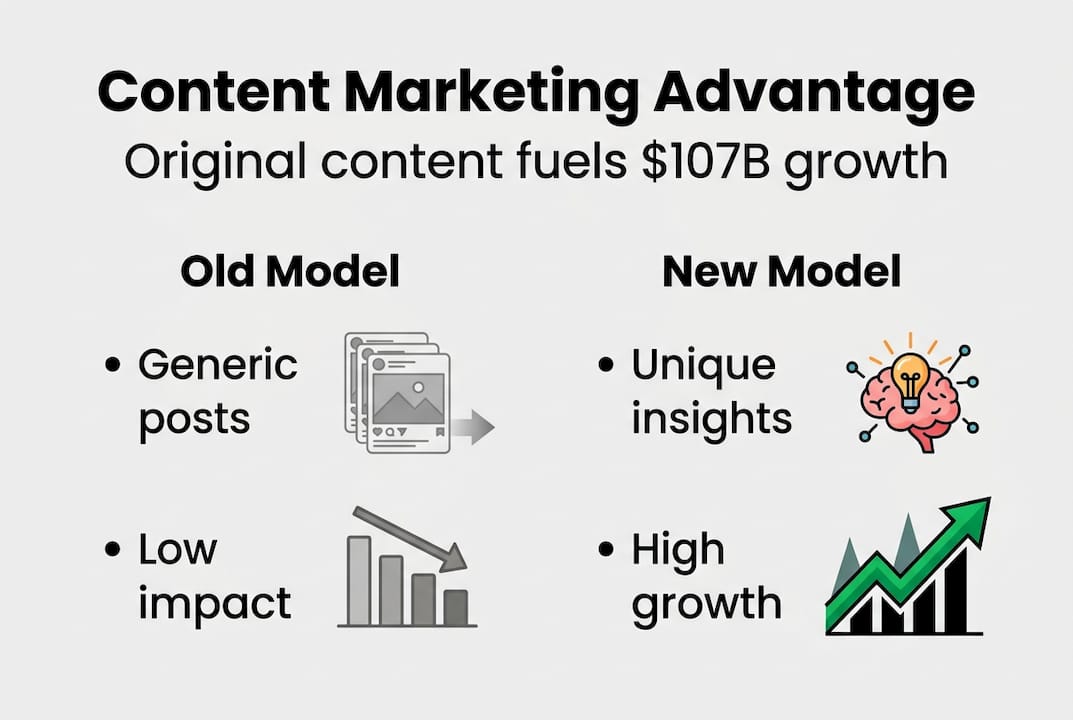
What creates a context moat? Start with proprietary data from your customer base, product usage, or market research. Share insights that come from real experience, not Google searches. Add expert analysis that reflects genuine domain knowledge. Include case studies, original experiments, and behind-the-scenes perspectives. This combination creates content that’s genuinely differentiated.
Successful brands integrate unique context into every content piece. They don’t just explain what something is. They show how it works in practice, what mistakes to avoid, and what results to expect. This depth builds authority and trust in ways surface-level content never can. It’s why brand identity through content matters more than ever.
Balance across the funnel is equally critical. Many companies over-invest in awareness content because it’s easier to produce and gets more traffic. But awareness without consideration and decision content creates a leaky funnel. Prospects discover you, then disappear because you haven’t guided them to conversion.
Here’s how legacy commodity content compares to context moat content:
| Legacy Content | Context Moat Content |
|---|---|
| Generic industry information | Proprietary data and original research |
| Recycled best practices | Unique frameworks and methodologies |
| Surface-level explanations | Deep expert analysis and judgment |
| One-size-fits-all advice | Specific use cases and examples |
| Awareness-focused only | Balanced across entire funnel |
The funnel balance problem shows up in performance data. Companies that distribute content evenly across awareness, consideration, and decision stages see higher conversion rates. Those that focus 80 percent of resources on awareness struggle to close deals. Your content strategy needs to match how buyers actually make decisions.
Pro Tip: Audit your existing content library. Calculate what percentage falls into awareness, consideration, and decision categories. If awareness dominates, you’ve found your bottleneck. Shift resources to create more comparison guides, case studies, and decision-support content.
Building a context moat requires investment:
- Conduct original research through surveys, experiments, or data analysis
- Document proprietary methodologies and frameworks you’ve developed
- Capture expert insights from your team’s real-world experience
- Create detailed case studies showing actual results and lessons learned
- Develop unique visual assets like custom diagrams, charts, or infographics
Strategic visual content marketing amplifies your context moat by making complex insights more accessible and shareable. Visuals also increase time on page and social engagement, both ranking signals for algorithms.
The AI era hasn’t killed content marketing. It’s raised the bar. Generic content is now worthless. Context-rich content is more valuable than ever. Companies that build real expertise into their content strategy will dominate their markets. Those that rely on commodity content will fade into irrelevance. Choose which side you want to be on.
Practical steps to leverage content marketing for maximum impact
Treating content marketing as an operating system changes everything. Most companies approach content as one-off projects. They publish an article, run a campaign, then move on. High performers think differently. They build systems that consistently produce, distribute, and optimize content across channels. This systematic approach compounds results over time instead of starting from zero with each initiative.
Here’s your step-by-step framework for implementing a high-performing content strategy:
- Audit your current content ecosystem to identify gaps across the funnel
- Define clear business objectives tied to revenue, not just traffic or engagement
- Build a content calendar that balances awareness, consideration, and decision content
- Leverage AI tools for research, ideation, and first drafts to accelerate production
- Layer in proprietary insights, expert analysis, and original data to create your context moat
- Distribute strategically across channels where your audience actually engages
- Implement tracking to measure business outcomes like pipeline influence and revenue attribution
- Analyze performance data monthly and adjust strategy based on what’s working
AI acceleration is table stakes now. The 2026 benchmarking data shows that high performers activate technology fully while maintaining quality standards. Use AI to handle repetitive tasks. Apply human expertise where it matters most: strategy, unique insights, and brand voice.
Your channel mix determines reach and engagement. Social media and video should be priority focus areas based on performance data. But don’t abandon other channels entirely. The key is matching content format to platform strengths. Short-form video works on social. Long-form guides work on your website. Email nurtures relationships over time.
Marketing automation multiplies your content’s impact. Use it to deliver personalized content based on behavior, segment audiences for targeted messaging, and optimize send times for maximum engagement. AI can boost your email open rates and conversions when implemented strategically. The same content reaches more people and drives better results when automation handles distribution.
Pro Tip: The most common strategic mistake is over-focusing on awareness content while neglecting consideration and decision stages. This creates high traffic with low conversion. Balance your content investment across the entire buyer journey. Aim for roughly 40 percent awareness, 30 percent consideration, and 30 percent decision content.
Critical execution principles:
- Consistency beats intensity: regular publishing builds momentum and authority
- Distribution matters as much as creation: great content needs promotion to perform
- Measurement drives improvement: track metrics that connect to business outcomes
- Iteration is mandatory: what works today may not work tomorrow, so test and adapt
Marketing automation benefits extend beyond email. Use it to score leads based on content engagement, trigger personalized content recommendations, and nurture prospects through automated sequences. This frees your team to focus on strategy and creation while technology handles distribution and optimization.
Social media requires a different approach than owned channels. Social media engagement strategies emphasize conversation and community over broadcasting. Respond to comments, ask questions, and create content that invites participation. The algorithm rewards engagement, so design content that sparks it.
Performance monitoring separates guessing from knowing. Track metrics like content-influenced pipeline, conversion rates by content type, engagement depth, and revenue attribution. These numbers tell you what’s working and where to invest more resources. Vanity metrics like page views don’t pay the bills. Focus on metrics that connect to revenue.
The content marketing operating system isn’t complicated. It’s disciplined. Plan strategically, execute consistently, measure rigorously, and optimize continuously. Companies that follow this framework see compounding returns. Those that treat content as sporadic projects see sporadic results. Build the system and the results follow.
Enhance your content marketing with expert digital services
Building a high-performing content marketing system takes expertise, technology, and consistent execution. Monstrous Media Group specializes in helping businesses like yours implement strategies that drive real revenue growth, not just vanity metrics. Our SEO services boost organic reach by optimizing content for search visibility and user intent. We don’t chase rankings for their own sake. We target keywords that bring qualified buyers to your site.
Our PPC marketing services complement organic content with targeted paid campaigns that deliver immediate impact while your content builds momentum. We also offer AI-powered digital marketing that leverages cutting-edge technology for efficient content creation, distribution, and optimization. Partnering with experts who understand both strategy and execution lets you maximize content marketing ROI without building an entire team in-house. Contact Monstrous Media Group to enhance your content strategy with professional support that produces measurable business outcomes.
Frequently asked questions
What is content marketing and why is it important?
Content marketing involves creating and distributing valuable, relevant content to attract and engage a clearly defined audience. It builds trust by consistently delivering genuine value rather than interrupting with sales pitches. This approach drives long-term business growth by establishing authority, nurturing relationships, and guiding prospects through the buying journey. Companies using content marketing see higher customer lifetime value and lower acquisition costs compared to traditional advertising alone.
How does AI impact content marketing today?
AI now assists with 60 to 70 percent of content ideation and writing tasks, dramatically accelerating production speed. However, AI alone doesn’t guarantee success. Quality content with expert context, proprietary insights, and unique perspectives remains essential for standing out. The winning approach combines AI efficiency for repetitive tasks with human expertise for strategy, analysis, and brand voice. Companies that balance both see the best results.
What types of content perform best for engagement?
Social media content drives 32 percent engagement impact, making it the highest-performing format for reaching and interacting with audiences. Video content follows closely with 16 percent higher impact than traditional blog posts. This doesn’t mean abandoning blogs entirely, but it does require diversifying your content mix. The most successful strategies use multiple formats strategically, matching content type to platform strengths and audience preferences. Focus your resources where engagement data proves results.
How can small businesses build a competitive content marketing strategy?
Small businesses should treat content marketing as a continuous operating system, not isolated projects or campaigns. Balance your content across all sales funnel stages: awareness, consideration, and decision. Many companies over-invest in awareness content, creating traffic without conversions. Use AI tools wisely to enhance efficiency and scale production without sacrificing quality. Focus on building a context moat with proprietary insights, original research, and expert perspectives that larger competitors can’t easily replicate. Consistency and strategic focus beat big budgets when executed well.
Recommended
Hire the team to help you with your website, app, or other marketing needs.
We have a team of digital marketers who can help plan and bring to life all your digital marketing strategies. They can help with social media marketing, email marketing, and digital advertising!
CONTACT US
Comments