
 https://www.omahamediagroup.com/images/uploads/monster_gallery/Omaha-Media-Group-Black.jpg
admin
https://www.omahamediagroup.com/images/uploads/monster_gallery/Omaha-Media-Group-Black.jpg
admin
What Is Scalable Marketing? A 2026 Strategy Guide

TL;DR:
- Scalable marketing is the strategic development of systems that increase marketing output without proportional cost growth. It relies on automation, centralized messaging, and continuous optimization to enable business expansion across markets and channels efficiently. Building strong infrastructure before expanding channels is essential for sustainable, high-leverage growth.
Scalable marketing is defined as the systematic capability to expand marketing efforts across channels and markets while maintaining consistent messaging, brand identity, and performance without a proportional increase in costs or headcount. Unlike traditional campaign-by-campaign execution, scalable marketing treats growth as an infrastructure problem, not a budget problem. It relies on automation platforms, AI-driven execution, centralized systems, and repeatable workflows to multiply output without multiplying labor. Monstrousmediagroup builds exactly this kind of system for business owners and marketing professionals who need real revenue outcomes, not just more activity.
What is scalable marketing and how does it differ from traditional approaches?
Scalable marketing is the operational discipline of building marketing systems that grow in output without growing proportionally in cost or complexity. Traditional marketing operates on a linear model: more campaigns require more people, more budget, and more coordination. Scalable digital marketing breaks that equation by converting variable costs into fixed infrastructure and spreading that infrastructure across every campaign you run.

The distinction matters most when you try to expand. A traditional marketing team launching in three new markets needs three times the creative production, three times the media buying effort, and three times the reporting overhead. A scalable marketing system reuses core messaging frameworks, automates distribution, and adapts locally without rebuilding from scratch. The difference is not just efficiency. It is the difference between a business that can grow and one that gets stuck.
One of the most common misconceptions is that adding more channels equals scalable growth. It does not. Expanding to TikTok, YouTube, and LinkedIn simultaneously without a centralized content system and brand guardrails creates inconsistent messaging and operational bottlenecks. True scalability requires the system to scale, not just the spend.
| Characteristic | Traditional marketing | Scalable marketing |
|---|---|---|
| Cost structure | Variable, grows with output | Fixed infrastructure, lower marginal cost |
| Campaign creation | Manual, rebuilt each time | Templated, modular, reusable |
| Brand consistency | Dependent on individual execution | Enforced by centralized systems |
| Performance optimization | Periodic, manual review | Continuous, automated feedback loops |
| Market expansion | Requires proportional new resources | Adapts existing systems to new markets |
What are the core components of scalable marketing strategies?
Scalable marketing strategies rest on four foundational pillars: messaging infrastructure, technology integration, process repeatability, and continuous optimization. Each pillar must be in place before you attempt to grow volume. Missing one creates the bottlenecks that kill scaling efforts before they produce results.
The four core components are:
- Centralized messaging architecture. Core brand voice, value propositions, and campaign templates are documented and stored centrally. Every market, channel, and team member draws from the same source.
- Marketing technology stack. CRM platforms, automation and analytics tools, and AI-powered content systems form the operational backbone. Without them, coordination breaks down at scale.
- Repeatable workflows. Campaign briefs, approval processes, and launch checklists follow the same structure every time. This is what converts one-off execution into a production system.
- Closed-loop learning. Every campaign feeds performance data back into the system to inform the next iteration. This is what separates a scalable system from a fast one.
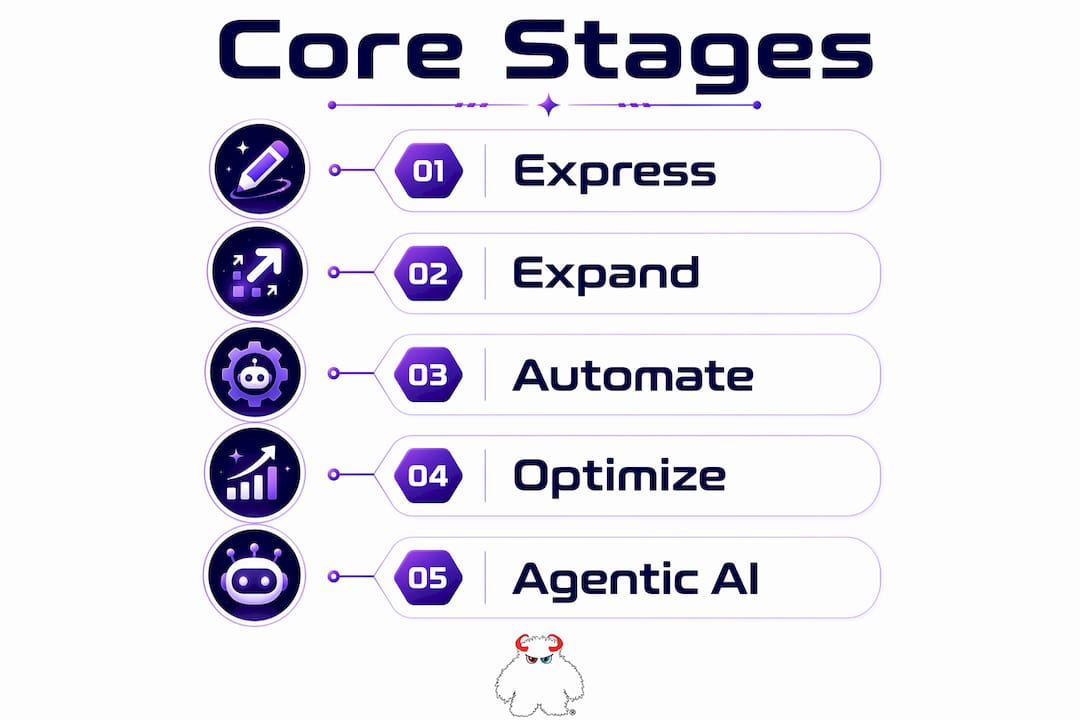
HubSpot’s Loop Marketing playbook defines this process across four structured stages: Express (establish core messaging), Tailor (adapt for specific audiences or markets), Amplify (distribute at scale), and Evolve (use AI insights to optimize continuously). The Evolve stage is where most businesses leave money on the table. Without a structured feedback loop, campaigns plateau instead of compound.
The most significant development in scalable marketing for 2026 is agentic marketing. Agentic AI systems go beyond traditional automation scripts by operating as goal-directed agents that plan, create, launch, and optimize campaigns within defined brand guardrails. They do not wait for human instruction at each step. They execute entire campaign workflows autonomously, accelerating iteration cycles by 10 to 15 times compared to manual processes.
Pro Tip: Set up AI feedback loops that automatically flag underperforming ad variants and pause them before they drain budget. Brands testing 60 or more creatives monthly achieve roughly 2.8 times higher ROAS than those testing fewer than 20, according to agentic marketing research. The system does the testing. You set the rules.
What are the most common pitfalls when scaling marketing?
The most frequent failure in scaling marketing is confusing channel expansion with system scalability. Adding paid search, programmatic display, and email simultaneously without a unified data layer and consistent brand framework does not create scale. It creates chaos with a larger budget attached to it.
The four most damaging pitfalls are:
- Skipping infrastructure before scaling spend. Increasing ad budget without a CRM, attribution model, or automated reporting means you cannot measure what is working. You are spending more to learn less.
- Inconsistent brand messaging across markets. When local teams or agencies adapt campaigns without centralized brand guardrails, brand identity erodes across markets. Customers in different regions receive different value propositions from the same company.
- No kill criteria for underperforming campaigns. Without predefined performance thresholds, failing campaigns run indefinitely. This is where most scaling budgets disappear.
- Treating headcount as the scaling solution. Hiring more marketers to handle more volume is the opposite of scalable growth. It increases fixed costs without improving the system’s output per dollar.
Operational discipline and infrastructure are the critical factors that separate businesses that scale successfully from those that stall. High operational leverage, where profitability improves as volume grows, requires converting variable execution costs into fixed infrastructure costs. Every dollar spent on building the system pays dividends across every future campaign.
Pro Tip: Before scaling spend, audit your measurement infrastructure. If you cannot attribute revenue to specific campaigns with confidence, you do not have a scalable system. You have a spending system.
How to build and implement scalable marketing in practice
Building a scalable marketing function starts with a centralized campaign architecture paired with localized execution capability. The hybrid model allows brand consistency at the core while enabling market-specific adaptation at the edges. This is how enterprise brands maintain a unified identity across dozens of markets without rebuilding every campaign from scratch.
The practical implementation follows a structured sequence:
- Audit your current marketing infrastructure. Map every tool, workflow, and data source. Identify where manual effort is highest and where data gaps exist.
- Build your centralized messaging library. Document core brand voice, audience personas, value propositions, and campaign templates. This becomes the single source of truth for every campaign.
- Deploy your technology stack. CRM, marketing automation platforms, and AI-powered content tools are non-negotiable. Without them, you are running a manual operation at scale.
- Establish structured testing workflows. Define A/B test parameters, success metrics, and kill criteria before launching any campaign. Agentic marketing systems can execute this testing autonomously once the rules are set.
- Implement closed-loop reporting. Every campaign result feeds back into your messaging library and audience data. This is what makes the system compound over time.
| Implementation stage | Key action | Expected outcome |
|---|---|---|
| Infrastructure audit | Map tools, workflows, and data gaps | Clear baseline for system design |
| Messaging centralization | Build brand and campaign template library | Consistent output across all channels |
| Technology deployment | CRM, automation, AI content tools | Reduced manual effort per campaign |
| Structured testing | Define A/B parameters and kill criteria | Higher ROAS, faster optimization cycles |
| Closed-loop reporting | Feed performance data back into system | Compounding campaign performance over time |
For businesses exploring how AI-driven marketing fits into this model, the entry point is not replacing your team. It is automating the repeatable decisions so your team focuses on strategy and creative direction. Video content, for example, can be scaled significantly when production workflows are systematized, particularly when working with a dedicated video production partner who operates within your brand framework.
Key takeaways
Scalable marketing works because it converts marketing execution into a fixed-cost infrastructure system that compounds in output without compounding in cost.
| Point | Details |
|---|---|
| Definition is operational | Scalable marketing is an infrastructure discipline, not a budget or channel strategy. |
| Systems before spend | Build centralized messaging, CRM, and automation before increasing campaign volume. |
| Agentic AI accelerates scale | AI agents executing within brand guardrails compress campaign cycles by 10 to 15 times. |
| Channel growth is not system growth | Adding channels without a unified data layer creates bottlenecks, not scale. |
| Closed-loop learning compounds results | Feeding performance data back into the system is what makes marketing truly scalable over time. |
Why most businesses are building marketing wrong in 2026
After working inside marketing systems for years, the pattern I see most often is this: businesses invest in more channels before they invest in the infrastructure that makes those channels work together. They add LinkedIn ads, then Google, then email, then wonder why performance is inconsistent and attribution is a mess. The problem is never the channels. It is the absence of a system connecting them.
The businesses that scale well treat marketing the way engineers treat software architecture. They design for repeatability first. They document everything. They build feedback loops before they need them. And when AI tools like agentic marketing systems become available, they adopt them not as replacements for strategy but as execution engines that free up human judgment for higher-value decisions.
The uncomfortable truth about scalable growth is that it requires discipline before it requires budget. Most businesses want to skip the infrastructure phase because it is less visible than a new ad campaign. But the infrastructure is what makes the campaign worth running. If your marketing strategy is not built on repeatable systems, you are not scaling. You are just spending faster.
— Vector
Build scalable marketing systems with Monstrousmediagroup
Monstrousmediagroup designs and deploys marketing systems that generate, capture, and close revenue without adding headcount or wasted spend. The focus is always on infrastructure: centralized messaging, AI-powered automation, and closed-loop reporting that compounds performance over time.
If your marketing feels like it requires constant manual effort to maintain results, the system is the problem. Monstrousmediagroup’s digital marketing services are built specifically for businesses ready to move from campaign-by-campaign execution to a scalable revenue system. From AI-powered campaign management to full marketing automation infrastructure, the team builds what your business needs to grow without growing the chaos.
FAQ
What is scalable marketing in simple terms?
Scalable marketing is a system that lets you grow marketing output, reach, and revenue without proportionally increasing costs or staff. It relies on automation, centralized messaging, and repeatable workflows.
How does scalable marketing differ from traditional marketing?
Traditional marketing requires proportional increases in labor and budget for every new campaign or market. Scalable marketing uses fixed infrastructure and automated systems to expand output at a fraction of the marginal cost.
What role does AI play in scalable marketing strategies?
AI-driven agentic systems plan, create, launch, and optimize campaigns autonomously within brand guardrails, accelerating campaign cycles by 10 to 15 times compared to manual execution.
What is the biggest mistake businesses make when scaling marketing?
The most common mistake is expanding channels and budget before building the underlying infrastructure, specifically CRM, attribution, and centralized brand systems. Without that foundation, scaling spend produces inconsistent results and erodes brand identity.
What technology is required for scalable digital marketing?
CRM platforms, marketing automation tools, and AI-powered analytics are the core technology requirements. Together they enable real-time campaign management, performance tracking, and closed-loop optimization across multiple markets or channels.
Recommended
Hire the team to help you with your website, app, or other marketing needs.
We have a team of digital marketers who can help plan and bring to life all your digital marketing strategies. They can help with social media marketing, email marketing, and digital advertising!
CONTACT US
Comments