
 https://www.omahamediagroup.com/images/uploads/monster_gallery/Omaha-Media-Group-Black.jpg
admin
https://www.omahamediagroup.com/images/uploads/monster_gallery/Omaha-Media-Group-Black.jpg
admin
What Is Programmatic Advertising? A 2026 Guide

TL;DR:
- Programmatic advertising automates digital ad buying through real-time auctions, making it the backbone of modern digital marketing. It enables precise audience targeting and efficiency across multiple channels, including display, video, CTV, audio, and DOOH. However, successful implementation requires robust data quality, creative optimization, and strategic infrastructure to realize its full revenue potential.
Programmatic advertising is defined as the automated, technology-driven process of buying and selling digital ad inventory through real-time auctions, replacing manual negotiations with algorithmic precision. US programmatic digital display ad spending is projected to exceed $180 billion in 2025, representing roughly 92% of all digital display ad spend. That figure signals one clear reality: programmatic is not a niche tactic. It is the operating infrastructure of modern digital advertising. The ecosystem runs on three core platforms: demand-side platforms (DSPs), supply-side platforms (SSPs), and ad exchanges, each executing a specific role in connecting advertisers to audiences at scale.
What is programmatic advertising and why does it matter?
Programmatic advertising is the automated method of purchasing digital ad placements using software, data signals, and real-time auctions rather than direct human negotiation. Before programmatic, media buyers sent insertion orders to publishers, negotiated rates manually, and waited days for campaigns to go live. That process was slow, expensive, and impossible to scale across thousands of placements simultaneously.

The shift programmatic created is structural. Advertisers no longer buy placements but instead buy access to specific audiences at the exact moment of engagement, regardless of which publisher’s page that audience happens to be on. A financial services brand targeting CFOs does not need to negotiate with the Wall Street Journal, Bloomberg, and Forbes separately. A DSP reaches that audience across all three and thousands of other properties in a single campaign setup.
This audience-first model is what makes programmatic indispensable for any serious digital marketing strategy. The automation handles targeting, bidding, pacing, and optimization simultaneously, freeing marketing teams to focus on strategy and creative rather than manual trafficking.
How does programmatic advertising work?
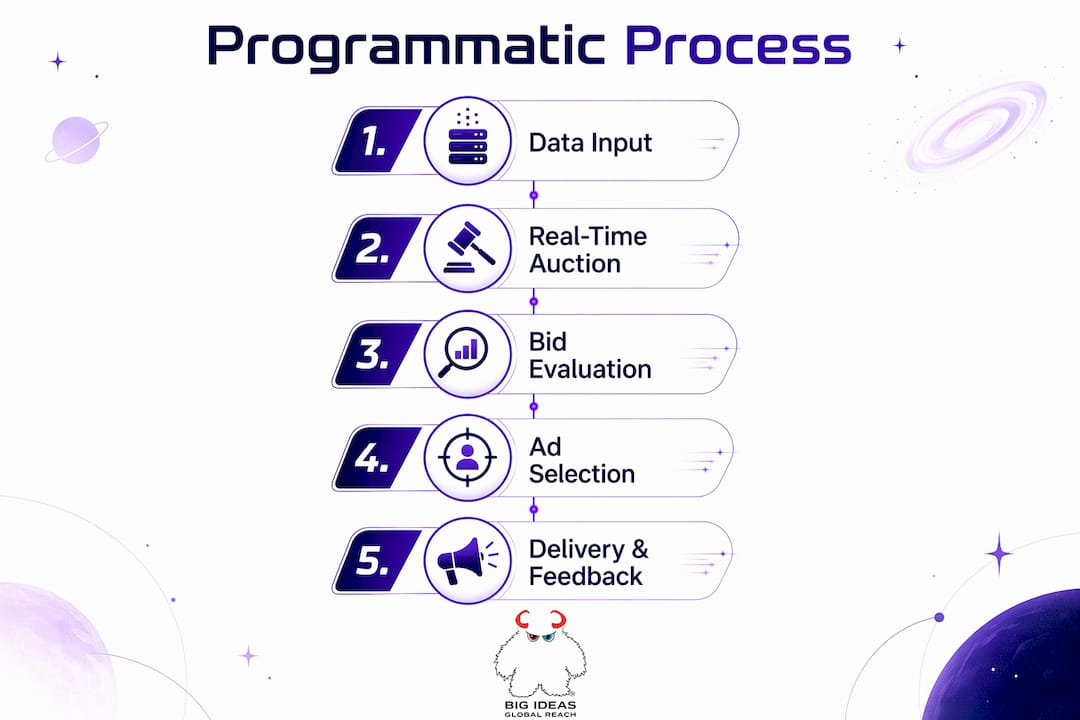
The mechanics of programmatic ad buying follow a precise sequence that completes in under 100 milliseconds. Here is the operational flow from impression to ad delivery:
- User loads a page or app. The publisher’s ad server detects an available ad slot and triggers the auction process.
- The SSP sends a bid request. The supply-side platform packages data about the impression, including the user’s device, location, browsing behavior, and contextual signals, then broadcasts that request to connected ad exchanges and DSPs.
- DSPs evaluate and bid. Each demand-side platform analyzes the bid request against the advertiser’s targeting parameters and campaign goals, then submits a bid in milliseconds if the impression matches.
- The ad exchange runs the auction. The exchange collects all bids and selects the winner, typically using a second-price auction model where the winner pays one cent above the second-highest bid.
- The winning ad renders. The creative is served and displayed to the user before the page finishes loading, making the entire process invisible to the viewer.
This real-time bidding process functions as a supply chain of standardized signals and contracts, with SSPs representing publishers and DSPs representing advertisers. The programmatic ecosystem includes data management platforms (DMPs) and customer data platforms (CDPs) that feed audience signals into DSPs to sharpen targeting decisions.
One technical advancement worth understanding is header bidding. Header bidding runs simultaneous auctions across multiple demand sources before the publisher’s ad server makes a decision, maximizing competition and revenue for publishers while giving advertisers access to premium inventory they would otherwise miss. It has become standard practice on desktop and mobile web.
Pro Tip: When evaluating a DSP, ask specifically how it handles bid shading and auction type transparency. Second-price auctions have largely shifted to first-price in many exchanges, and DSPs that do not disclose this will quietly erode your campaign margins.
What are the main programmatic buying models?
Programmatic ad buying is not a single transaction type. Four distinct models exist, each offering different levels of control, inventory quality, and pricing certainty.
- Open exchange (open auction): Any buyer can bid on available inventory in real time. This model offers the widest reach and lowest CPMs but comes with reduced transparency around placement quality and brand safety.
- Private marketplace (PMP): Publishers invite select advertisers to bid on premium inventory through a closed auction. PMPs offer better brand safety and inventory quality than open exchange, with CPMs reflecting that premium.
- Programmatic direct: A one-to-one deal between a buyer and a specific publisher, executed programmatically rather than through manual insertion orders. Pricing is negotiated, but delivery is automated.
- Programmatic guaranteed: Fixed price, guaranteed impression volume, reserved inventory. This model mirrors traditional direct buys but with the operational efficiency of programmatic delivery.
| Buying model | Inventory control | Pricing transparency | Brand safety | Best use case |
|---|---|---|---|---|
| Open exchange | Low | Variable | Lower | Scale and prospecting |
| Private marketplace | Medium | Negotiated floor | Higher | Premium reach with targeting |
| Programmatic direct | High | Negotiated fixed | High | Specific publisher alignment |
| Programmatic guaranteed | Highest | Fixed CPM | Highest | Brand campaigns, upfront commitments |
Marketers combine these models to balance scale and precision. A typical campaign architecture uses open exchange for broad prospecting, PMP deals for mid-funnel engagement on trusted publishers, and programmatic guaranteed for high-visibility brand moments. This layered approach is how sophisticated advertisers protect both budget efficiency and brand reputation simultaneously.
You can explore how these programmatic buying models apply to specific campaign objectives through Monstrous Media Group’s advertising services.
What ad formats and channels use programmatic buying?
Programmatic is a buying method, not an ad format. That distinction matters because it means the automation layer extends across virtually every digital channel and creative format available today.
- Display advertising: Banner ads, rich media, and native placements remain the foundation of programmatic spend, running across millions of websites and apps through networks like Google Display Network and The Trade Desk.
- Programmatic video: Pre-roll, mid-roll, and out-stream video units are bought programmatically across YouTube, news publishers, and video streaming apps.
- Connected TV (CTV): Platforms like Hulu, Peacock, and Roku now sell a significant portion of their ad inventory programmatically, giving advertisers TV-quality reach with digital targeting precision.
- Digital audio: Spotify, Pandora, and podcast networks offer programmatic audio inventory, reaching audiences during commutes, workouts, and screen-free moments.
- Digital out-of-home (DOOH): Billboards, transit screens, and retail displays are increasingly sold through programmatic platforms, enabling real-time creative swaps based on weather, time of day, or audience data.
Programmatic extends beyond display to video, audio, and connected TV, giving advertisers a unified buying infrastructure across every screen a consumer touches. This multi-channel reach is what separates programmatic from any single-channel ad platform.
Pro Tip: CTV programmatic inventory is growing faster than measurement standards can keep pace. Before committing significant budget to CTV, confirm your DSP supports third-party verification through Integral Ad Science (IAS) or DoubleVerify to validate impressions and viewability.
What are the benefits of programmatic advertising?
The strategic advantages of programmatic advertising compound across three dimensions: operational efficiency, targeting precision, and real-time performance control.
Programmatic eliminates manual insertion orders and negotiations, shifting campaign execution from days to minutes. A media buyer who previously managed 20 publisher relationships manually can now access thousands of placements through a single DSP interface. That efficiency gain is not just time savings. It redirects skilled marketing resources toward strategy, creative, and analysis.
Targeting precision is where programmatic creates measurable revenue impact. DSPs ingest first-party CRM data, third-party audience segments, contextual signals, and behavioral data to serve ads to the right person at the right moment. A B2B software company can target IT directors who visited their pricing page in the last 30 days, across every website that person visits, without negotiating with each publisher individually.
Real-time optimization is the third advantage that separates programmatic from traditional media buying. Campaign pacing, bid adjustments, creative rotation, and audience suppression all happen automatically based on performance signals. Self-service and managed-service models give advertisers flexibility in how much operational control they retain versus delegate to a platform or agency partner. The choice depends on internal expertise and available resources, not on the technology itself.
Marketing automation integrated with programmatic platforms creates a closed-loop system where ad exposure, lead capture, and CRM data feed back into audience targeting, continuously improving campaign performance without manual intervention.
Key takeaways
Programmatic advertising works because it replaces slow, manual media buying with automated real-time auctions that connect advertisers to precise audiences across every digital channel at scale.
| Point | Details |
|---|---|
| Programmatic dominates digital spend | Over 92% of US digital display ad spend runs programmatically, making it the default infrastructure for digital advertising. |
| Real-time bidding completes in milliseconds | SSPs, DSPs, and ad exchanges execute the full auction and ad delivery sequence before a page finishes loading. |
| Four buying models serve different goals | Open exchange, PMP, programmatic direct, and guaranteed deals each offer distinct tradeoffs in control, cost, and brand safety. |
| Programmatic spans every digital channel | Display, video, CTV, audio, and DOOH all support programmatic buying, enabling unified multi-channel campaign execution. |
| Automation drives efficiency and precision | Eliminating manual negotiations frees resources while real-time optimization continuously improves targeting and ROI. |
Why most marketers underestimate programmatic’s operational complexity
After working with marketing teams across industries, one pattern stands out consistently: businesses adopt programmatic for its scale and efficiency, then underinvest in the operational infrastructure that makes those benefits real.
The technology is accessible. A DSP account can be live in a day. But the gap between running programmatic campaigns and running them well is wider than most teams expect. Creative setup is where campaigns fail most often. Advertisers spend weeks refining audience targeting and bidding strategy, then launch with a single static banner in one size. Programmatic platforms optimize toward performance signals, and if the creative pool is thin, the algorithm has nothing to work with.
Data quality is the second underestimated factor. Audience segments built on stale CRM data or poorly configured tracking pixels produce targeting that looks precise on paper but performs like broad reach in practice. Before scaling programmatic spend, the measurement foundation needs to be solid. That means verified conversion tracking, clean audience lists, and attribution models that reflect actual customer journeys rather than last-click assumptions.
The managed service versus self-service decision also deserves more deliberate analysis than it typically receives. Self-service gives you control and transparency but demands expertise in bid management, pacing, and troubleshooting. Managed service trades some control for execution support, which is the right call for teams without dedicated programmatic specialists. Neither model is inherently superior. The right choice depends on your team’s actual capabilities, not on what sounds more sophisticated.
Programmatic integrated with a broader revenue-focused advertising system produces compounding returns. Treating it as a standalone channel, disconnected from CRM data, landing page performance, and attribution reporting, produces mediocre results at scale. The technology is only as effective as the system it operates within.
— Vector
How Monstrous Media Group builds programmatic systems that produce results
Monstrous Media Group builds advertising infrastructure designed to generate, capture, and close revenue. Not vanity impressions. Not activity reports. Actual outcomes tied to business growth. For marketing professionals and business owners ready to move beyond guesswork, MMG’s digital marketing services include programmatic campaign architecture, DSP setup and optimization, audience strategy, and full attribution integration. Every campaign is built as a system, with measurement, creative, targeting, and optimization working together from day one. If your current programmatic spend is not producing traceable revenue impact, the problem is almost always structural. MMG diagnoses and fixes those structural gaps. Explore MMG’s advertising services to see how a properly built programmatic system performs.
FAQ
What is programmatic advertising in simple terms?
Programmatic advertising is the automated buying and selling of digital ad space through real-time auctions, using software platforms called DSPs and SSPs instead of manual negotiations. It allows advertisers to reach specific audiences across millions of websites and apps simultaneously.
How does real-time bidding differ from programmatic advertising?
Real-time bidding (RTB) is one auction mechanism within the broader programmatic ecosystem. Programmatic advertising also includes private marketplaces, programmatic direct, and guaranteed deals that do not use open RTB auctions.
What percentage of digital ads are bought programmatically?
Approximately 92% of US digital display ad spend is transacted programmatically, with total US programmatic spending projected to exceed $180 billion in 2025. This makes programmatic the dominant method for digital display advertising.
What is the difference between a DSP and an SSP?
A DSP (demand-side platform) is used by advertisers to bid on and purchase ad inventory, while an SSP (supply-side platform) is used by publishers to sell their available ad space. Both platforms connect through ad exchanges to execute real-time transactions.
Is programmatic advertising suitable for small and mid-sized businesses?
Programmatic advertising is accessible to businesses of any size through managed-service DSP options that handle campaign execution on behalf of the advertiser. The key requirement is having clear audience data, verified conversion tracking, and sufficient budget to generate statistically meaningful performance signals.
Recommended
Hire the team to help you with your website, app, or other marketing needs.
We have a team of digital marketers who can help plan and bring to life all your digital marketing strategies. They can help with social media marketing, email marketing, and digital advertising!
CONTACT US
Comments