
 https://www.omahamediagroup.com/images/uploads/monster_gallery/Omaha-Media-Group-Black.jpg
admin
https://www.omahamediagroup.com/images/uploads/monster_gallery/Omaha-Media-Group-Black.jpg
admin
What Is Outcome-Based Marketing? A Guide for Leaders

TL;DR:
- Outcome-based marketing is a B2B approach that links every investment directly to measurable business results like pipeline growth and revenue. It emphasizes tracking key metrics such as pipeline velocity and LTV:CAC ratios while moving away from vanity metrics like impressions or social followers. Success depends on aligning executive goals, integrating CRM data, and establishing a persistent, outcome-driven strategy rather than focusing on activity outputs.
Outcome-based marketing is defined as a B2B methodology that ties every marketing investment directly to measurable business results, specifically pipeline growth and revenue, rather than activity outputs like impressions or clicks. The industry also refers to this approach as results-based or performance-driven marketing, though outcome-based marketing carries a more precise meaning: success is measured by what the business gains, not what the marketing team produces. Tools like CRM integration, LTV:CAC ratio tracking, and pipeline velocity reporting form the operational backbone of this model. Frameworks from Harvard Business School and systems like the Outcome Marketing methodology make the case that marketing tied to outcomes produces compounding pipeline growth that campaign-centric thinking simply cannot replicate.

What is outcome-based marketing and why does it matter?
Outcome-based marketing is a B2B methodology that ties marketing investment to measurable business results, focusing on pipeline and revenue rather than outputs like impressions or clicks. This distinction matters because most marketing teams are still evaluated on activity, not impact. A team can run 40 campaigns, generate 10,000 impressions, and still contribute zero to closed revenue. That gap between effort and outcome is where most marketing budgets quietly disappear.
The methodology requires setting specific business targets such as new revenue generation, customer acquisition cost improvements, and lifetime value growth, then monitoring performance against those targets rather than channel activity alone. This is not a reporting preference. It is a structural shift in how marketing justifies its budget and earns a seat at the revenue table.
Named entities like the Outcome Marketing system and Harvard Business School’s measurement frameworks both confirm that the most durable marketing programs are built around lagging business outcomes supported by leading indicators at the channel level. Without that architecture, marketing operates on faith rather than evidence.
What are the key metrics and KPIs used in outcome-based marketing?
The primary metrics in outcome-based marketing are pipeline coverage, LTV:CAC ratio, pipeline velocity, conversion rates by funnel stage, and channel attribution. Each of these connects a marketing action to a business result. Pipeline coverage tells you whether marketing is generating enough qualified opportunity to meet revenue targets. Pipeline velocity tells you how fast deals move through the funnel, which directly affects cash flow forecasting.
Vanity metrics like social engagement, page views, and raw impressions are inadequate substitutes for these measures. They are easy to produce and easy to game, which makes them dangerous as primary KPIs. A campaign that generates 500,000 impressions and zero qualified pipeline is not a success. It is a cost center with good-looking slides.
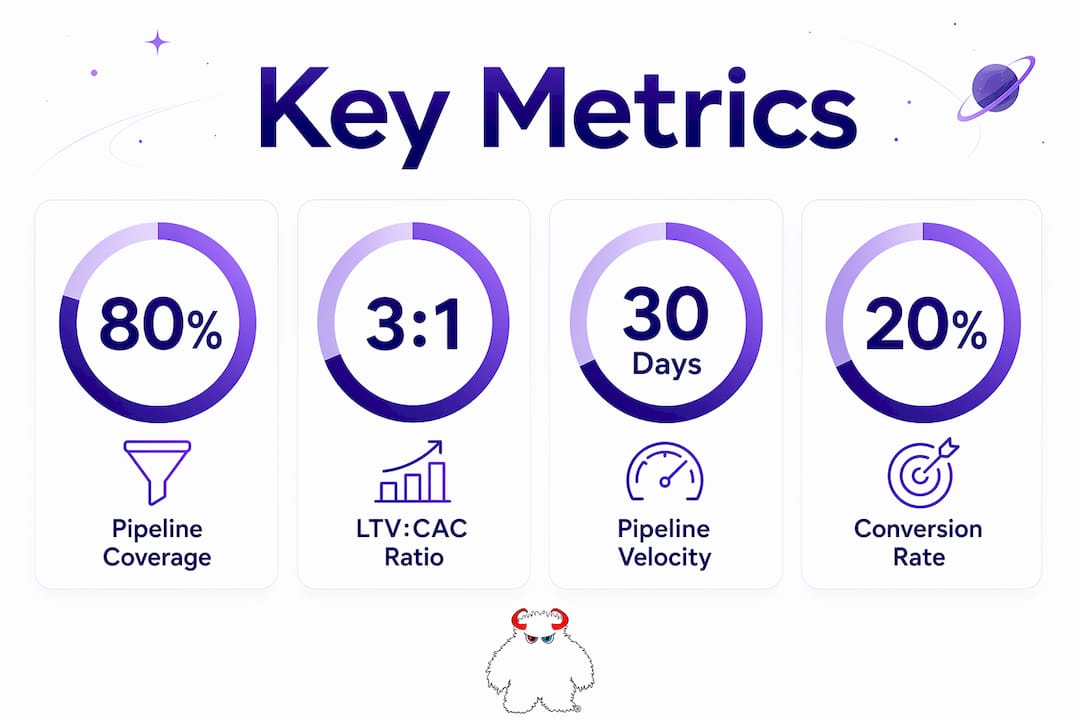
Measuring marketing effectiveness requires defining KPIs per funnel stage, selecting attribution models that reflect actual buyer behavior, and combining quantitative data with qualitative judgment about how marketing influences customer decisions. CAC and ROI are the floor, not the ceiling. The ceiling is understanding which specific touchpoints accelerate or stall pipeline movement.
The table below contrasts outcome metrics with traditional activity metrics to clarify the operational difference:
| Metric type | Example metrics | What it measures |
|---|---|---|
| Outcome metrics | Pipeline coverage, LTV:CAC, pipeline velocity | Direct business impact and revenue contribution |
| Activity metrics | Impressions, clicks, email open rates | Volume of marketing outputs produced |
| Hybrid indicators | Conversion rate by funnel stage, CAC | Bridge between activity and business result |
| Vanity metrics | Social followers, page views, reach | Audience size with no revenue correlation |
Pro Tip: Track KPI trees rather than single metrics. A KPI tree maps leading indicators at the channel level to lagging outcomes at the business level, so you can diagnose performance problems before they become revenue problems.
How does outcome-based marketing differ from traditional marketing?
Traditional marketing is organized around campaigns. It starts with a channel, sets a budget, runs activity for a defined period, and reports on outputs at the end of the cycle. The measurement resets with each campaign. This structure rewards activity volume and creative execution, not revenue contribution.
Outcome-based marketing starts from the opposite direction. It begins with a defined business goal, such as a 20% increase in qualified pipeline, then works backward to identify which market bets, channels, and messages will produce that result. Compounding quarterly results and executive alignment replace sporadic campaign cycles with a persistent execution cadence that builds on itself over time.
The structural differences extend into budgeting and agency relationships. Traditional marketing budgets are allocated by channel or campaign. Outcome-based budgets are allocated by expected revenue contribution, which forces a much harder conversation about what is actually working. When agencies are compensated on outcomes rather than deliverables, the entire incentive structure changes. As noted in outcome-based agency remuneration discussions, this model demands transparent outcome definitions, agreed data sources, and governance around trade-offs between volume and quality.
| Dimension | Traditional marketing | Outcome-based marketing |
|---|---|---|
| Starting point | Channel or campaign idea | Defined business outcome |
| Success measure | Impressions, clicks, reach | Pipeline, revenue, LTV:CAC |
| Execution cadence | Cyclical campaigns with resets | Persistent strategy with compounding results |
| Budget logic | Allocated by channel | Allocated by revenue contribution |
| Agency incentive | Deliverables and activity | Measurable business outcomes |
How to implement outcome-based marketing effectively
Implementing outcome-based marketing is a systems problem, not a campaign problem. The following steps reflect how organizations that succeed with this model actually build it.
-
Align executives on business outcomes first. Before any KPI is set, marketing leadership and the C-suite must agree on the specific business targets marketing is responsible for contributing to. Revenue, pipeline coverage, and customer acquisition cost are the most common anchors.
-
Define quantifiable targets linked to pipeline and revenue. Vague goals like “increase brand awareness” have no place in this model. Every target must be expressed as a number with a deadline. “Generate $2M in qualified pipeline from inbound channels by Q3” is a target. “Improve brand visibility” is not.
-
Integrate CRM and sales data for attribution. CRM and sales data integration connects marketing touchpoints to pipeline and revenue, which prevents the fallback to vanity metrics when results are under pressure. Platforms like Salesforce, HubSpot, and Microsoft Dynamics each support this integration at different levels of complexity.
-
Set a structured execution cadence. Weekly performance reviews against KPI trees, monthly pipeline contribution reports, and quarterly strategy reviews keep the team focused on outcomes rather than activity. This cadence is what separates outcome-based programs from one-time measurement experiments.
-
Optimize spend based on outcome performance. When a channel produces qualified pipeline, increase investment. When it produces clicks without conversion, cut it or restructure the offer. This sounds obvious, but most marketing teams optimize for activity metrics because that data is faster and easier to access.
-
Address KPI gaming and misaligned incentives directly. When teams are measured on outcomes, some will find ways to inflate the numbers. Governance frameworks, transparent data sharing, and regular audits of attribution logic are not optional. They are the infrastructure that keeps the model honest.
Pro Tip: Pair quantitative outcome data with qualitative win/loss interviews from the sales team. Numbers tell you what happened. Conversations tell you why, and the why is where the next strategic bet lives.
What are the common pitfalls in outcome-based marketing?
The most common failure mode is substituting proxy metrics for real outcomes. Reach, impressions, and share of voice are not outcomes. They are inputs. When a marketing team reports these as evidence of business impact, it is measuring the wrong thing with confidence, which is more dangerous than measuring nothing at all.
The risks compound when outcome definitions are unclear from the start. Outcome-based remuneration models require transparent outcome definitions, agreement on data sources, and governance around trade-offs to avoid manipulation. Without that foundation, unrealistic expectations and metric inflation are predictable outcomes.
Additional pitfalls to avoid include:
- Correlation without causation. A spike in pipeline that coincides with a campaign is not proof the campaign caused it. Credible incremental measurement requires control groups, counterfactual comparisons, and econometric models to separate signal from noise.
- Single-touch attribution. Assigning full credit to the last touchpoint before conversion ignores the full buyer journey and systematically undervalues top-of-funnel investment.
- Siloed data. Marketing and sales operating from different data sources produce conflicting pipeline numbers, which destroys executive confidence in the entire measurement system.
- Governance gaps. Without a defined owner for outcome definitions and a process for resolving disputes about attribution, the model drifts back toward activity reporting within two quarters.
Reviewing why social media campaigns fail often reveals the same root cause: teams measured on activity rather than outcomes optimize for the wrong signals and miss the revenue contribution entirely.
Key takeaways
Outcome-based marketing succeeds when every metric, budget decision, and agency relationship is anchored to a specific, measurable business result rather than a volume of marketing activity.
| Point | Details |
|---|---|
| Definition and scope | Outcome-based marketing ties every investment to pipeline, revenue, and LTV:CAC, not impressions or clicks. |
| Metric selection | Use pipeline coverage, pipeline velocity, and conversion rates by funnel stage as primary KPIs. |
| Structural difference | Traditional marketing measures outputs; outcome-based marketing measures business results on a persistent cadence. |
| Implementation anchor | CRM and sales data integration is the non-negotiable foundation for credible attribution. |
| Governance requirement | Clear outcome definitions, agreed data sources, and regular audits prevent metric gaming and misalignment. |
Why most marketing teams are measuring the wrong things
After working inside and alongside marketing organizations across industries, the pattern is consistent: teams default to activity metrics not because they believe impressions matter, but because outcome data is harder to access and slower to arrive. Impressions are available the same day. Pipeline contribution takes weeks or months to confirm. That lag creates pressure to report something, and something usually means vanity metrics.
The shift to outcome-based thinking is not primarily a technology problem. It is a culture and incentive problem. When a marketing leader’s performance review is tied to campaign volume, they will produce campaigns. When it is tied to pipeline contribution, they will build systems that produce pipeline. The measurement framework you choose is also the behavior you are funding.
What I have seen work consistently is starting with a single, non-negotiable outcome metric agreed upon by marketing and the CFO, then building the KPI tree downward from there. This approach, aligned with transforming your marketing strategy from campaign-centric to outcome-centric, forces the hard conversations early rather than after a quarter of misdirected spend. It also makes the marketing function legible to executives who think in revenue terms, which is every executive worth reporting to.
The future of this discipline belongs to teams that treat marketing as infrastructure, not a series of campaigns. Infrastructure compounds. Campaigns reset.
— Vector
How Monstrous Media Group builds outcome-based marketing systems
Monstrous Media Group builds the data infrastructure and execution systems that make outcome-based marketing operational, not theoretical. Most agencies deliver activity reports. Monstrous Media Group delivers revenue systems built around attribution, pipeline measurement, and digital marketing automation that connects every touchpoint to a business result.

If your current marketing program reports impressions and clicks but cannot answer how much qualified pipeline it generated last quarter, the measurement infrastructure is broken. Monstrous Media Group’s digital marketing services are built specifically to close that gap, from CRM integration and attribution modeling to SEO systems that generate compounding pipeline rather than vanity traffic. The outcome is revenue. Everything else is a means to that end.
FAQ
What is outcome-based marketing in simple terms?
Outcome-based marketing is a methodology that measures marketing success by business results like pipeline and revenue rather than activity outputs like clicks or impressions. Every investment is tied to a specific, quantifiable business target.
How does outcome-based marketing differ from performance marketing?
Performance marketing typically measures cost-per-click or cost-per-acquisition at the campaign level. Outcome-based marketing goes further by connecting those campaign results to pipeline velocity, LTV:CAC, and revenue contribution across the full funnel.
What metrics matter most in outcome-based marketing?
Pipeline coverage, LTV:CAC ratio, pipeline velocity, and conversion rates by funnel stage are the primary metrics. These connect marketing activity to actual business results rather than measuring output volume.
How do you implement outcome-based marketing without a large team?
Start by aligning on one non-negotiable outcome metric with executive leadership, then integrate CRM data to track pipeline contribution. A small team with clean attribution data outperforms a large team optimizing for impressions.
What is the biggest risk in outcome-based marketing?
The biggest risk is using proxy metrics like reach or impressions as stand-ins for real outcomes. Credible measurement requires control groups and counterfactual comparisons to confirm that marketing actually caused the result, not just correlated with it.
Recommended
Hire the team to help you with your website, app, or other marketing needs.
We have a team of digital marketers who can help plan and bring to life all your digital marketing strategies. They can help with social media marketing, email marketing, and digital advertising!
CONTACT US
Comments