
 https://www.omahamediagroup.com/images/uploads/monster_gallery/Omaha-Media-Group-Black.jpg
admin
https://www.omahamediagroup.com/images/uploads/monster_gallery/Omaha-Media-Group-Black.jpg
admin
What Is Marketing ROI? A Guide for Business Owners

TL;DR:
- Marketing ROI measures the profit generated from marketing activities relative to their costs, guiding budget decisions and performance evaluation. Accurate measurement requires attribution, incrementality testing, and CRM integration to avoid overstated platform-reported results. Businesses succeed by building infrastructure that reveals true revenue contributions and swiftly reallocating budgets based on reliable data.
Marketing ROI is defined as the profit generated by marketing activities relative to the cost of those activities, expressed as a percentage. It is the single most direct measure of whether your marketing spend is producing financial returns or draining your budget without accountability. Business owners and marketers who understand marketing ROI stop guessing about budget allocation and start making decisions backed by revenue data. This guide covers the formulas, the measurement challenges, the metric comparisons, and the practical steps to turn ROI analysis into a competitive advantage.
What is marketing ROI and how do you calculate it?
Marketing ROI, formally known as Return on Marketing Investment (ROMI), quantifies the revenue or profit a business earns for every dollar invested in marketing. The standard formula is straightforward: (Revenue Generated - Marketing Cost) / Marketing Cost × 100. Spend $50,000 on a campaign that generates $150,000 in revenue, and your marketing ROI is 200%.

Shopify’s 2025 industry guidance establishes that a 2:1 ROI ratio is acceptable for most businesses, while anything above 5:1 is considered highly successful. That benchmark matters because it gives you a performance floor. Without it, a 150% ROI might look impressive until you realize your industry average is 400%.
A more precise version of the formula uses contribution margin instead of gross revenue:
- Calculate your gross profit from the campaign (Revenue minus cost of goods sold).
- Subtract your total marketing costs from that gross profit.
- Divide the result by total marketing costs.
- Multiply by 100 to express as a percentage.
This approach prevents a common error: counting revenue that includes product costs as pure marketing return. A campaign generating $200,000 in revenue on $80,000 in product costs and $40,000 in marketing spend has a very different ROI than the surface number suggests.
The third variation worth knowing is incremental revenue ROI, which measures only the revenue that would not have occurred without the marketing activity. This is the most accurate version and the hardest to calculate. Investing $1M generating $3M revenue looks like a 200% ROI, but if $1.5M of those sales would have happened organically, the true incremental ROI is far lower.
Pro Tip: Never report marketing ROI using platform-reported revenue alone. Google Ads and Meta both count conversions that overlap with organic traffic, email, and direct visits. Your actual ROI is almost always lower than what the dashboard shows.
What challenges affect accurate marketing ROI measurement?
Measuring marketing ROI accurately is harder than calculating it. The formula is simple. The data feeding it is not.
The core problem is attribution. Most customers interact with multiple marketing channels before converting. A buyer might click a Google ad, read a blog post, open an email, and then convert through a direct visit. Last-click attribution gives 100% of the credit to the direct visit. First-click attribution gives it all to the Google ad. Neither is accurate, and both lead to budget misallocation.
Attribution models must be combined and compared to understand the true role of each channel in the customer journey. Multi-touch attribution distributes credit across all touchpoints, but it still relies on tracked interactions. Offline conversions, phone calls, and in-store visits often fall outside the tracking window entirely.
The second major challenge is self-attribution bias. Advertising platforms have a financial incentive to claim credit for as many conversions as possible. Platform-reported metrics suffer from deduplication issues that inflate reported ROI. When Google Ads and Meta both claim the same conversion, your total attributed revenue can exceed your actual revenue. CRM integration is the only reliable fix.
“Incrementality is the right standard for measuring marketing effectiveness. Controlled experiments like geo holdouts provide clean insights but require patience.” — The Marketing Juice
Incrementality testing solves the attribution problem by removing it entirely. Instead of asking which channel gets credit, you ask: did this marketing activity cause additional revenue? Geo-based holdout experiments split markets into exposed and unexposed groups, then measure the revenue difference. The result is a clean, causal number. The tradeoff is time and complexity. Most small businesses cannot run geo holdouts at scale, which is why marketing mix modeling fills the gap for portfolio-level decisions.
The practical checklist for accurate ROI measurement includes:
- Connect your CRM to all paid and organic channels to unify revenue attribution.
- Audit platform-reported conversions against actual closed revenue monthly.
- Identify your highest-volume conversion paths and model attribution across them.
- Run at least one incrementality test per quarter on your largest spend channel.
- Separate branded from non-branded search revenue before calculating channel ROI.
How does marketing ROI differ from ROAS and other metrics?
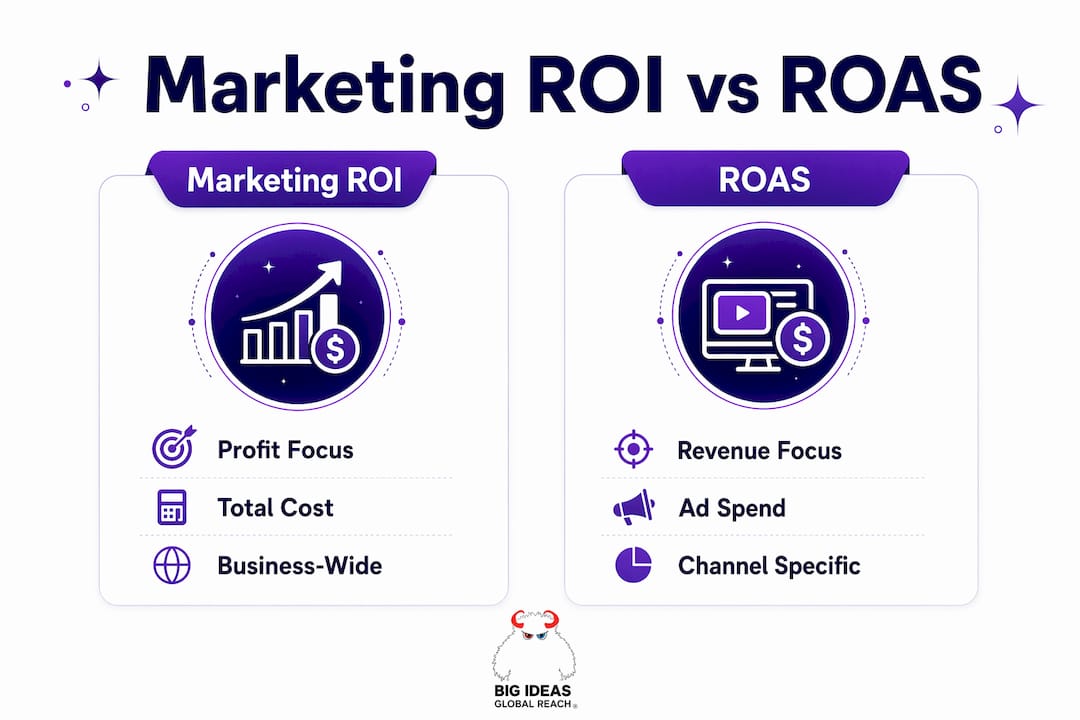
Marketing ROI, ROAS, and ROMI are not interchangeable. Each answers a different question, and using the wrong metric for the wrong decision costs money.
| Metric | What it measures | Best used for |
|---|---|---|
| Marketing ROI | Profit relative to total marketing cost | Overall budget justification and profitability |
| ROMI | Revenue contribution relative to marketing investment | Strategic planning and board-level reporting |
| ROAS | Revenue generated per dollar of ad spend | Campaign-level optimization within a channel |
| CLV | Total revenue from a customer over their lifetime | Retention strategy and acquisition cost limits |
| CAC | Cost to acquire one new customer | Scaling decisions and channel efficiency |
ROAS is a channel-level metric. A 4:1 ROAS on Google Shopping tells you that campaign is generating $4 for every $1 spent on ads. It does not account for fulfillment costs, overhead, or the fact that some of those buyers would have found you anyway. ROAS is useful for optimizing bids and budgets within a platform. It is not a substitute for marketing ROI when you are deciding whether to increase total marketing spend.
Nearly 50% of senior marketing managers find ROMI very useful for measuring marketing’s contribution to profits. That statistic reflects a shift in how marketing leadership communicates value to finance and executive teams. Revenue contribution, not click volume, is the language that earns budget.
Marketing investment is treated as operating expense rather than capital expenditure. Framing it as an investment in future financial health, rather than a cost center, changes how stakeholders evaluate it. Board-level marketing metrics must link directly to business outcomes like revenue contribution and customer acquisition, not platform activity.
Long-term brand metrics, including share of voice, net promoter score, and brand search volume, do not show up in short-term ROI calculations. That does not make them irrelevant. A business that optimizes entirely for immediate ROI often underinvests in brand, which erodes future conversion rates and increases customer acquisition costs over time.
How to use marketing ROI to optimize your budget allocation
Knowing your marketing ROI is only useful if you act on it. The goal is a feedback loop: measure, allocate, test, and reallocate based on what the data shows.
Start by setting a baseline. Before changing any spend, document your current cost per acquisition, revenue per channel, and total marketing ROI by campaign type. Without a baseline, you cannot measure improvement. Tools like Google Analytics 4, HubSpot, and Salesforce provide the data infrastructure to build this baseline when connected properly.
Moving beyond vanity metrics like clicks and impressions toward customer lifetime value and incremental conversion rates gives you a far more accurate picture of marketing’s true impact. A channel generating 10,000 clicks at a 0.2% conversion rate may be outperformed by a channel generating 500 clicks at a 6% conversion rate with twice the average order value.
The practical steps for budget optimization using ROI data:
- Rank all active channels by true cost per acquisition, not platform-reported ROAS.
- Identify the top 20% of campaigns generating 80% of incremental revenue and protect that spend.
- Cut or pause campaigns with ROI below your minimum acceptable threshold for two consecutive periods.
- Reallocate freed budget to incrementality-tested winners before testing new channels.
- Review allocation quarterly, not annually. Markets shift faster than annual planning cycles allow.
Marketers gain a decisive advantage by knowing exactly which campaigns generate revenue and reallocating budget quickly to proven performers. That speed of reallocation is itself a competitive advantage. Businesses running on gut feel or platform dashboards are always one algorithm change away from a revenue drop they cannot explain.
Pro Tip: Invest in the infrastructure that links your marketing channels directly to your CRM before you invest in more ad spend. Accurate attribution data is worth more than any individual campaign. Explore marketing automation solutions that close the loop between campaign activity and closed revenue.
Key takeaways
Marketing ROI is the foundational metric that connects marketing spend to business profit, and measuring it accurately requires attribution infrastructure, incrementality testing, and CRM integration, not just platform dashboards.
| Point | Details |
|---|---|
| Core formula | Use (Revenue - Cost) / Cost × 100, but apply contribution margin for accuracy. |
| Industry benchmarks | A 2:1 ROI is acceptable; above 5:1 is considered highly successful per Shopify 2025 guidance. |
| Attribution is the hard part | Platform-reported metrics overstate ROI due to self-attribution bias and deduplication errors. |
| ROI vs. ROAS | ROAS optimizes channel spend; marketing ROI justifies total budget at the business level. |
| Infrastructure first | CRM integration and incrementality testing produce reliable ROI data that drives confident budget decisions. |
Why most businesses are measuring marketing ROI wrong
Most businesses I work with are not ignoring ROI. They are measuring the wrong version of it. They pull numbers from Google Ads, Meta, and their email platform, add them up, and call it marketing ROI. The problem is that each of those platforms is counting the same customer multiple times, and none of them are subtracting the revenue that would have happened without any marketing at all.
The businesses that win on marketing ROI treat measurement as infrastructure, not a reporting task. They build the CRM connections, run the holdout tests, and use measurement frameworks that separate causal impact from correlation. That work is unglamorous and takes time to set up. But once it is in place, every budget decision becomes defensible. You stop arguing about whether marketing is working and start arguing about where to invest more.
The other mistake I see consistently is optimizing for short-term ROI at the expense of brand. A business that cuts all brand-building spend to chase immediate return will see acquisition costs rise within 12 to 18 months as organic demand dries up. Marketing ROI must incorporate both short-term revenue and long-term indicators like customer lifetime value and brand search volume. Anything less is a partial picture that leads to partial decisions.
The competitive advantage is not in having a better formula. It is in having better data, faster feedback loops, and the discipline to act on what the numbers actually say rather than what the platform dashboards want you to believe.
— Vector
How Monstrous Media Group builds marketing ROI systems that produce real outcomes

Monstrous Media Group does not sell marketing activities. MMG builds the systems that make marketing accountable. That means connecting your paid and organic channels to your CRM, closing the attribution loop, and giving you the data infrastructure to make budget decisions with confidence rather than guesswork.
From SEO services that build measurable organic revenue to digital marketing systems that track true cost per acquisition across every channel, MMG’s approach treats marketing as operational infrastructure. If your current marketing spend cannot tell you exactly which campaigns are generating closed revenue, that is a revenue leak. Contact Monstrous Media Group to build a system that stops it.
FAQ
What is marketing ROI in simple terms?
Marketing ROI measures how much profit a business earns for every dollar spent on marketing. The basic formula is (Revenue Generated minus Marketing Cost) divided by Marketing Cost, multiplied by 100.
What is a good marketing ROI benchmark?
A 2:1 ratio (200% ROI) is considered acceptable, while a 5:1 ratio (500% ROI) is highly successful according to Shopify’s 2025 guidelines. Benchmarks vary by industry, channel, and business model.
How is marketing ROI different from ROAS?
ROAS measures revenue per dollar of ad spend within a single channel and is used for campaign optimization. Marketing ROI measures total profit relative to all marketing costs and is used for budget justification at the business level.
Why do platform-reported ROI numbers often look too high?
Advertising platforms suffer from self-attribution bias and deduplication issues, meaning multiple platforms claim credit for the same conversion. Integrating CRM data with campaign data produces a more accurate revenue attribution picture.
How do you improve marketing ROI over time?
Set a baseline cost per acquisition by channel, cut spend on campaigns below your minimum ROI threshold, and reallocate budget to incrementality-tested winners. Connecting your CRM to all marketing channels is the single most impactful infrastructure investment for improving marketing return on investment accuracy.
Recommended
Hire the team to help you with your website, app, or other marketing needs.
We have a team of digital marketers who can help plan and bring to life all your digital marketing strategies. They can help with social media marketing, email marketing, and digital advertising!
CONTACT US
Comments