
 https://www.omahamediagroup.com/images/uploads/monster_gallery/Omaha-Media-Group-Black.jpg
admin
https://www.omahamediagroup.com/images/uploads/monster_gallery/Omaha-Media-Group-Black.jpg
admin
What is marketing intelligence? How data drives smarter campaigns

TL;DR:
- Marketing intelligence involves the external collection and application of market signals to inform strategic decisions, unlike internal-focused analytics. It creates a continuous feedback loop of acquiring, analyzing, and activating external data, enabling proactive campaign planning and execution. Leaders must embed this discipline into their decision-making processes to drive measurable growth and competitive advantage.
Most business leaders assume marketing intelligence is just a fancier label for analytics. That assumption is costing them real revenue. Marketing intelligence is the practice of gathering, analyzing, and applying external market data, including customers, competitors, and market trends, to support better marketing decisions. It is not a dashboard. It is not a report. It is a strategic discipline that turns raw signals from the outside world into decisions that move your pipeline forward. When leaders understand it correctly, marketing intelligence becomes one of the most powerful tools for building campaigns that actually convert.
Table of Contents
- Defining marketing intelligence: What it is and what it isn’t
- The marketing intelligence loop: From data to action
- Types of marketing intelligence: Sources and signals
- How marketing intelligence drives results in modern campaigns
- Our take: What most leaders miss about marketing intelligence
- Next step: Supercharge your marketing intelligence with our solutions
- Frequently asked questions
Key Takeaways
| Point | Details |
|---|---|
| External data focus | Marketing intelligence emphasizes real-time external market signals, not just internal analytics. |
| Continuous improvement loop | The best results come from an ongoing cycle of gather, analyze, and act—never a one-and-done report. |
| Unified customer view | Unifying disparate data enables personalized, higher-performing campaigns. |
| Leadership priority | Putting intelligence at the leadership table turns it into a business growth driver, not just a marketing tool. |
Defining marketing intelligence: What it is and what it isn’t
The confusion starts with terminology. Many teams use “analytics,” “market research,” “business intelligence,” and “marketing intelligence” interchangeably. They are not the same thing, and mixing them up creates blind spots in strategy.
Marketing intelligence, as defined in market intelligence practice, is the systematic collection and application of external data about customers, competitors, and market conditions. The keyword is external. It looks outward, not inward. It asks: What is the market doing? Where are customers moving? What are competitors signaling?
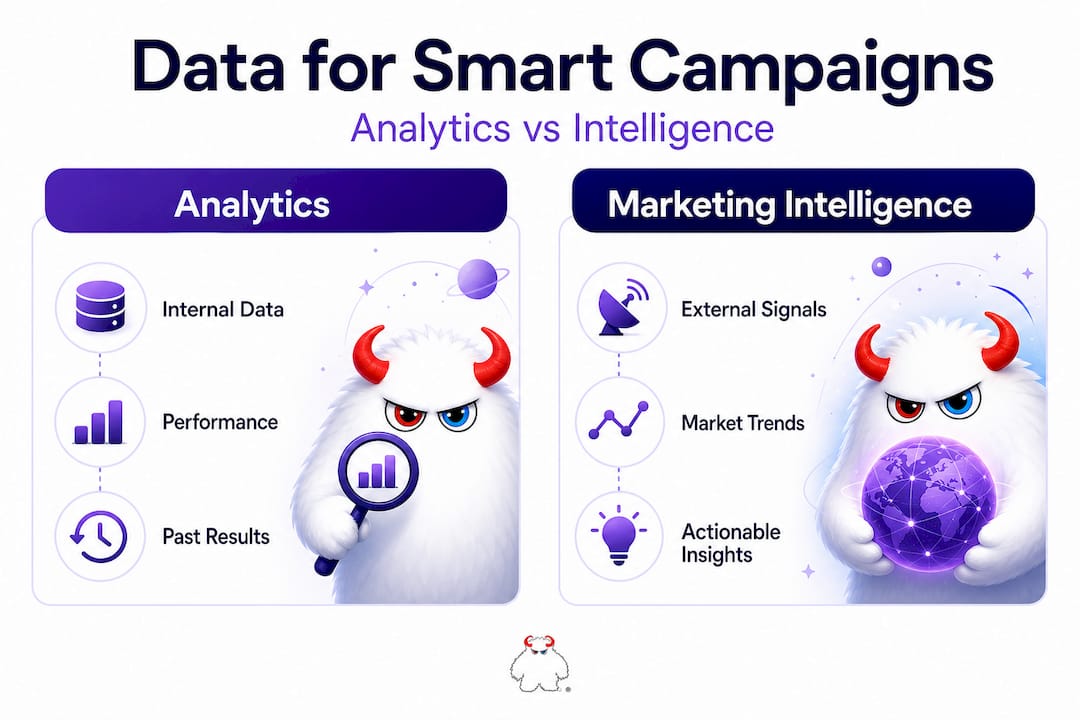
Here is how these terms differ in practice:
| Term | Focus | Primary data source | Business use |
|---|---|---|---|
| Marketing intelligence | External market signals | Competitors, customers, trends | Strategy and campaign direction |
| Business intelligence | Internal performance data | Sales data, CRM, financials | Reporting and optimization |
| Market research | Specific questions at a point in time | Surveys, focus groups | Product or campaign validation |
| Marketing analytics | Campaign performance metrics | Ad platforms, web data | Tactical adjustments |
Notice the distinction. Marketing analytics tells you how a campaign performed. Marketing intelligence tells you why the market responded the way it did and what to do next. That is a fundamentally different, and far more valuable, conversation.
There is also a subtle but important distinction in scope. Marketing intelligence vs market intelligence reveals that “market intelligence” tends to be broader, covering overall market and competitive signals, while “marketing intelligence” is sometimes used by practitioners to mean specific execution datasets, such as competitive programs or unified digital customer data. The advertising and marketing industry has not fully standardized this language, so context always matters when you hear either term used.
The core components of a functioning marketing intelligence practice include:
- Customer signals: Behavioral data, purchase patterns, feedback, and sentiment
- Competitor intelligence: Pricing moves, campaign strategies, product launches, and market positioning
- Market landscape data: Industry trends, regulatory shifts, demand fluctuations, and emerging segments
- Channel and media intelligence: Where audiences spend time, what content formats perform, and how media costs are shifting
“Marketing intelligence is not a project you launch. It is a capability you build. The difference between companies that grow predictably and those that scramble reactively often comes down to whether intelligence is embedded in their decision-making cycle or bolted on as an afterthought.”
The external focus is what makes marketing intelligence so powerful for campaign planning. Internal data tells you what happened inside your business. External intelligence tells you what the market is doing and where the opportunity lives.
The marketing intelligence loop: From data to action
With the definition clear, it is critical to understand how organizations use marketing intelligence as an engine for ongoing improvement rather than a one-time report.

A market intelligence process is most effective when structured as a continuous loop of acquiring information, analyzing it, and then activating it in plans. Think of it as a flywheel. Each rotation makes the next one faster and more precise.
Here is how the three stages break down in practice:
-
Acquire: Collect external data from multiple sources. This includes third-party research, social listening tools, customer interviews, competitor monitoring, SEO keyword trends, and industry publications. The biggest mistake at this stage is relying on a single source. Narrow inputs produce narrow intelligence.
-
Analyze: Transform raw data into insight. This means identifying patterns, gaps, and signals that indicate where the market is moving. Teams should use marketing analysis tools to cross-reference datasets and surface correlations that would be invisible in any single report. The risk here is confirmation bias, only looking for data that supports what you already believe.
-
Activate: Apply the intelligence to campaigns, messaging, targeting, and budget allocation. This is where most organizations fail. They collect and analyze data but never build a structured process for translating insights into decisions. Intelligence that does not change behavior is just expensive noise.
Here is a comparison of how marketing decisions look with and without this loop:
| Decision area | Without intelligence loop | With intelligence loop |
|---|---|---|
| Audience targeting | Based on historical assumptions | Based on real-time behavioral signals |
| Campaign messaging | Generic, broad-appeal copy | Specific, segment-aligned messaging |
| Budget allocation | Evenly split or instinct-driven | Weighted toward proven, high-signal channels |
| Campaign timing | Calendar-based | Demand and trend-responsive |
| Competitor response | Slow and reactive | Proactive and anticipatory |
A practical example: A regional B2B software company used the acquire-analyze-activate loop to identify that a competitor had reduced investment in a specific content channel. By activating against that gap quickly through digital marketing strategies, they captured a segment of that competitor’s audience within two quarters. Without the loop, that opportunity would have gone unnoticed until it was too late.
Marketing automation solutions play a critical role in the activate stage. Automation allows intelligence to trigger personalized responses in real time rather than waiting for a quarterly review cycle.
Pro Tip: Build a formal “insight handoff” process between your data analysts and your campaign managers. Insights that live only in a slide deck or a spreadsheet rarely make it into actual campaign decisions. Create a standing weekly review where intelligence directly informs the next sprint of campaign activity.
Types of marketing intelligence: Sources and signals
Armed with the loop, the next question is straightforward: what data actually fuels it? The sources you choose determine the quality of intelligence you produce.
The major categories of external data marketers rely on include:
-
Customer signals: Purchase history, website behavior, survey responses, support tickets, reviews, and social comments. These signals reveal intent, sentiment, and unmet needs before they show up in your sales data.
-
Competitor intelligence: Ad spend estimates, keyword rankings, product updates, pricing changes, job postings (which reveal strategic priorities), and media placements. Tracking a competitor’s job postings, for example, often signals where they are about to invest before any public announcement.
-
Market and industry trends: Search volume trends, industry reports, economic indicators, and regulatory news. Seasonal demand shifts visible in search data can inform budget allocation decisions weeks before a campaign would need to launch.
-
Channel and media intelligence: Platform algorithm changes, CPM trends, content engagement patterns, and influencer activity. Understanding where your audience’s attention is moving helps you invest in reach before costs spike.
-
Third-party data providers: Panels, data co-ops, and licensed datasets that provide demographic, psychographic, and behavioral profiles at scale.
Data intelligence for marketing is increasingly implemented to unify scattered customer data and provide a real-time view for personalization and more effective marketing. This is a critical shift. Rather than treating each data source as a silo, leading organizations are building unified data layers that combine first-party, second-party, and third-party signals into a single view of the customer and the market.
Current content personalization trends show that personalized marketing driven by intelligence consistently outperforms generic campaigns across every measurable dimension. Open rates, click-through rates, conversion rates, and customer lifetime value all improve when messaging is informed by real signal rather than demographic assumptions.
The AI blueprint for marketing shows how AI-powered marketing intelligence is now capable of processing these diverse signals at a speed and scale no human team can match manually. AI does not replace the strategic judgment required to act on intelligence, but it dramatically accelerates the acquire and analyze stages of the loop.
How marketing intelligence drives results in modern campaigns
Armed with these insights, let’s see how marketing intelligence works in practice to fuel smarter campaigns and revenue growth.
The most effective campaign practitioners do not wait for data to tell them what already happened. They use intelligence to anticipate what is about to happen and position their messaging before the market shifts. That is the difference between responsive marketing and reactive marketing.
Here is how leading organizations apply marketing intelligence across the campaign lifecycle:
-
Targeting refinement: Intelligence reveals which micro-segments within a broader audience are showing intent signals right now, not six months ago. Real-time behavioral data allows precise targeting that reduces wasted spend.
-
Message optimization: Competitor intelligence reveals messaging gaps your audience is not hearing anywhere else. Filling those gaps with your own content positions your brand as the authority in underserved areas of the conversation.
-
Timing decisions: Market trend data identifies when demand is building before it peaks. Launching campaigns slightly ahead of demand surges consistently produces better cost-per-acquisition than reacting after the surge is visible.
-
Channel selection: Intelligence about where your audience’s attention is moving allows proactive budget shifts. Waiting for platform analytics to confirm a decline means you have already missed the optimal window.
-
Campaign measurement: Unified customer data through email campaign management and marketing automation tools connects campaign touchpoints to actual revenue outcomes, making attribution more accurate and budget decisions more defensible.
AI impacts content marketing in ways that extend the reach and precision of intelligence-driven campaigns. AI models trained on customer behavior data can predict which content formats will resonate with specific segments before a single dollar is spent on distribution.
Data intelligence for marketing unifies scattered customer data for real-time insights, enabling campaign teams to respond to market shifts within hours rather than weeks. That speed advantage compounds over time, producing a competitive moat that is genuinely difficult to replicate.
“The best-performing campaigns are not the most creative. They are the most informed. When intelligence is embedded in every stage of campaign planning and execution, creativity has a precise target to work toward instead of shooting in the dark.”
Pro Tip: Use marketing intelligence to identify your competitor’s weakest messaging position, then build a campaign specifically designed to occupy that gap. This is not about attacking competitors. It is about identifying where customer needs are going unmet and showing up there with precision.
Our take: What most leaders miss about marketing intelligence
Here is the uncomfortable truth: most organizations treat marketing intelligence as an operational task, something the data team handles. Leadership sets strategy at the top, and intelligence is expected to bubble up through reports and presentations. That model consistently underperforms.
When intelligence is siloed inside the marketing function, it gets filtered. By the time a market signal reaches a leadership decision, it has been softened, contextualized, or delayed to the point where it no longer drives urgency. The opportunity has often already passed.
The organizations that consistently outperform their markets have one thing in common: leadership actively participates in the intelligence agenda. They ask the intelligence questions. They set the intelligence priorities. They treat external market data as a leadership input, not a marketing deliverable.
The case study on success from brands that have built durable marketing advantages shows that intelligence becomes a force multiplier when it aligns marketing, sales, product, and executive strategy around the same external view of the market.
The conventional wisdom says to hire smart marketers and let them manage the data. Our experience says that the ROI on marketing intelligence multiplies significantly when leaders treat it as a boardroom priority. Intelligence tells you where your market is moving. That is not a marketing question. That is a business question.
Next step: Supercharge your marketing intelligence with our solutions
Understanding marketing intelligence conceptually is only the first step. Putting it to work in your campaigns, budget decisions, and competitive strategy requires systems that collect, analyze, and activate insights continuously.

Monstrous Media Group builds exactly those systems. From digital marketing specialists who design intelligence-driven campaigns to marketing automation infrastructure that activates insights in real time, our team focuses on outcomes, not activities. We do not sell reports. We build revenue-generating systems that eliminate wasted spend and close the gap between market opportunity and business results. If your current marketing feels like it is operating on assumptions rather than intelligence, that is the problem we are built to solve. Reach out to our team to start a conversation about what a smarter system looks like for your business.
Frequently asked questions
What’s the main difference between marketing intelligence and business intelligence?
Marketing intelligence focuses on external market data and customer signals, while business intelligence typically analyzes internal company data for reporting and optimization. One looks outward to inform strategy; the other looks inward to measure performance.
How do companies collect marketing intelligence data?
Companies use a range of methods including customer feedback, social listening, competitive research, and third-party data providers, since marketing intelligence involves the collection, validation, processing, and communication of external data. The most effective programs combine multiple source types to reduce blind spots.
Can small businesses benefit from marketing intelligence?
Yes. Even without enterprise-level budgets, small businesses can use competitor analysis, customer review monitoring, and free market trend tools to make smarter, more informed marketing decisions. Intelligence is a discipline, not just a technology investment.
How does marketing intelligence improve campaign effectiveness?
Data intelligence for marketing unifies scattered customer data to drive real-time insights, allowing businesses to personalize messaging, improve targeting precision, and optimize campaign timing for measurably better results.
Recommended
Hire the team to help you with your website, app, or other marketing needs.
We have a team of digital marketers who can help plan and bring to life all your digital marketing strategies. They can help with social media marketing, email marketing, and digital advertising!
CONTACT US
Comments