
 https://www.omahamediagroup.com/images/uploads/monster_gallery/Omaha-Media-Group-Black.jpg
admin
https://www.omahamediagroup.com/images/uploads/monster_gallery/Omaha-Media-Group-Black.jpg
admin
What is enterprise SEO? The ultimate guide for growth leaders

Most business leaders assume enterprise SEO is simply traditional SEO applied to a bigger website. More pages, more keywords, more budget. That assumption is costly. Enterprise SEO is a fundamentally different discipline, one that demands coordinated systems, organizational alignment, and intelligent automation to produce results at scale. A company managing 100,000 pages cannot rely on the same playbook as a local business with 50. This guide breaks down what enterprise SEO actually is, how it differs from conventional approaches, and what your organization needs to execute it effectively and sustainably in 2026.
Table of Contents
- What makes enterprise SEO unique?
- Core pillars of enterprise SEO success
- Critical tactics: Automation, governance, and crawl efficiency
- Measuring ROI and sustaining success in 2026
- Why most enterprise SEO strategies miss the mark
- Ready to elevate your enterprise SEO?
- Frequently asked questions
Key Takeaways
| Point | Details |
|---|---|
| Enterprise SEO is strategic | It requires process, governance, technology, and executive alignment, not just increased keywords or content volume. |
| Automation drives scale | Automation tools and workflows make it possible to handle tens of thousands of pages efficiently. |
| Governance ensures consistency | Cross-team governance and standardized processes are crucial for quality and scalable outcomes. |
| ROI tracking sustains investment | Connecting SEO efforts to revenue and visibility helps secure ongoing executive support. |
| Sustainability needs innovation | Crawl optimization and AI-readiness keep enterprise SEO programs ahead in 2026. |
What makes enterprise SEO unique?
To clarify why enterprise SEO matters, let’s compare it directly to traditional approaches.
Enterprise SEO is not about volume alone. It is about governing a complex digital ecosystem where hundreds of stakeholders, dozens of systems, and millions of indexed pages must work in concert. A single misconfigured template can suppress thousands of URLs overnight. A missed crawl budget issue can silently drain organic visibility for months. The stakes are categorically different.

| Dimension | Traditional SEO | Enterprise SEO |
|---|---|---|
| Scale | Dozens to hundreds of pages | Thousands to millions of pages |
| Team structure | One or two specialists | Cross-functional teams and leadership |
| Governance | Ad hoc | Formalized Center of Excellence |
| Automation | Minimal | Essential for efficiency |
| Technical debt | Manageable manually | Requires systematic prioritization |
| Reporting | Basic dashboards | Executive-level attribution models |
The table above makes the contrast clear. SEO landscape changes have accelerated the gap between these two worlds, and large organizations that treat them as equivalent consistently underperform.
Here are the hallmarks that define a true enterprise SEO operation:
- Automation at scale: Routine audits, reporting, and issue detection run programmatically, not manually.
- Technical debt management: Legacy architecture, duplicate content, and crawl inefficiencies are tracked and resolved systematically.
- Cross-team governance: SEO decisions involve engineering, content, legal, product, and marketing working from shared standards.
- Executive alignment: Leadership understands SEO as a revenue-generating infrastructure investment, not a marketing add-on.
- Crawl budget optimization: Search engine resources are actively managed to ensure priority pages are discovered and indexed efficiently.
The differences from traditional SEO include emphasis on automation, governance across teams, crawl budget optimization, handling technical debt, and multi-stakeholder coordination. Organizations that internalize this distinction stop wasting resources on tactics that simply do not scale.
Core pillars of enterprise SEO success
Understanding what makes enterprise SEO different, we next examine the pillars that support it.
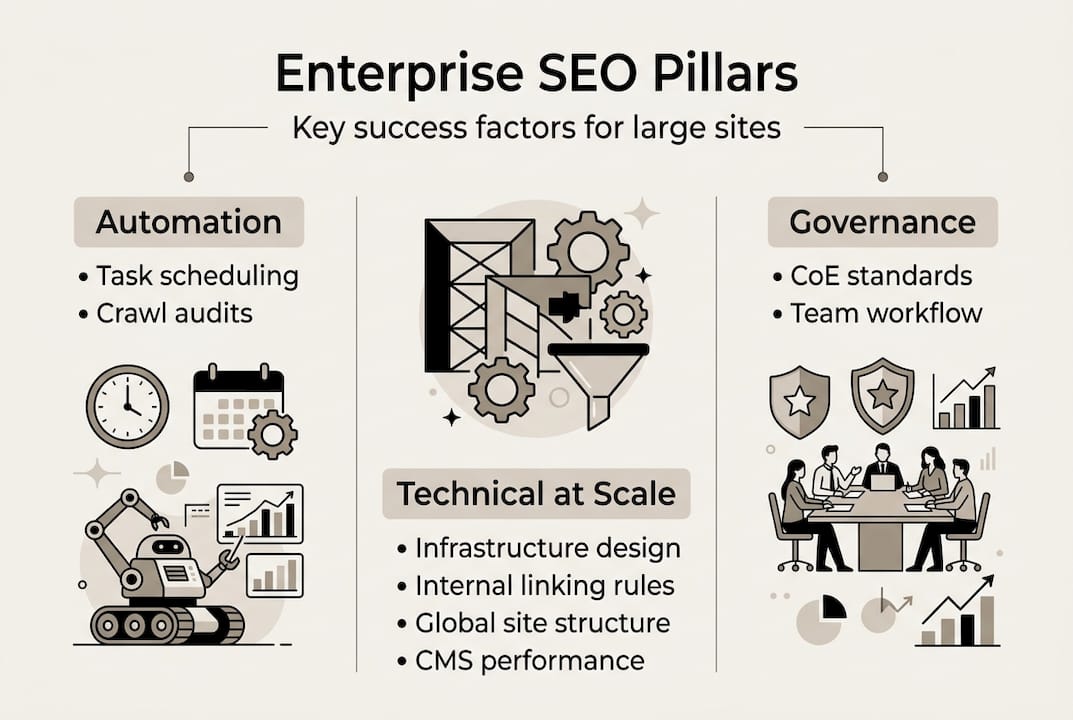
Three foundational pillars separate organizations that scale SEO effectively from those that stall. Each pillar reinforces the others, and neglecting any one of them creates gaps that tools alone cannot fill.
Pillar 1: Process automation
At enterprise scale, manual effort is a ceiling. Automation removes that ceiling. Tools that continuously monitor crawl health, flag broken links, detect duplicate content, and generate performance reports free your team to focus on strategy rather than maintenance. The efficiency gains are not marginal. They are structural.
| Tool or process | Impact on large sites |
|---|---|
| Automated technical audits | Reduces issue detection time by up to 80% |
| Programmatic reporting | Eliminates hours of manual data aggregation weekly |
| Dynamic XML sitemaps | Ensures new and updated pages are crawled promptly |
| AI-driven content gap analysis | Surfaces opportunities across thousands of pages instantly |
Our marketing automation tools are designed specifically to handle this kind of scale without adding operational complexity.
Pillar 2: Governance through a Center of Excellence
A Center of Excellence (CoE) is a dedicated internal body that sets SEO standards, resolves cross-team conflicts, and ensures every department follows consistent practices. Without it, SEO decisions get made in silos, and inconsistency compounds across thousands of pages.
Pillar 3: Technical debt management
Every large site accumulates technical debt: outdated redirects, orphaned pages, slow load times, and indexation errors. Treating these as one-off fixes is insufficient. A systematic backlog, prioritized by traffic and revenue impact, is the only sustainable approach.
Here are the essential steps to formalize SEO infrastructure organization-wide:
- Conduct a full technical audit to establish a baseline.
- Assign ownership of SEO tasks to specific teams and individuals.
- Establish a governance CoE with defined decision-making authority.
- Integrate SEO requirements into product and development workflows.
- Build executive dashboards that connect SEO activity to revenue outcomes.
As enterprise SEO strategies mature, the organizations that thrive are those that treat search as infrastructure, not a campaign. Tying digital marketing integration to attributable revenue is what secures C-level support year after year.
Pro Tip: Present SEO to your executive team as a revenue channel with measurable attribution, not a traffic metric. When leadership sees SEO contributing directly to pipeline and closed deals, budget and buy-in follow naturally.
For 2026 sustainability, implement SEO as infrastructure with executive buy-in, tying to ROI via revenue attribution, establishing a governance CoE, and prioritizing crawl efficiency alongside AI visibility.
Critical tactics: Automation, governance, and crawl efficiency
Now that you know the core pillars, let’s turn to specific tactics for executing effectively.
Knowing the pillars is one thing. Operationalizing them is another. These are the specific tactics that move enterprise SEO from theory to measurable outcomes.
Automation opportunities your team should prioritize:
- Scheduled technical audits that run weekly and flag regressions automatically.
- Real-time alerting for drops in crawl coverage or indexation rates.
- Automated rank tracking across thousands of keyword clusters.
- Programmatic internal linking recommendations based on content relationships.
- Reporting pipelines that push SEO data directly into executive dashboards.
Governance, meanwhile, requires more than a shared spreadsheet. Effective governance means holding regular cross-functional SEO reviews where engineering, content, and marketing align on priorities. It means standardized workflows for publishing, redirects, and site architecture changes. And it means a CoE with the authority to enforce those standards, not just recommend them.
Crawl budget is one of the most underestimated levers in enterprise SEO. Search engines allocate a finite number of crawl requests to your domain. Wasting those requests on low-value pages, duplicate URLs, or parameter-heavy URLs means your most important content gets crawled less frequently. Prioritizing technical optimization strategies like canonicalization, robots.txt refinement, and log file analysis can reclaim significant crawl capacity.
AI visibility is an emerging priority for 2026. As AI-powered search features reshape how results are displayed, ensuring your content is structured, authoritative, and semantically clear becomes a competitive advantage. Automation, governance, and crawl optimization are the foundation that makes AI visibility achievable at scale.
Pro Tip: Use machine learning tools to identify content clusters where topical authority is thin. Filling those gaps systematically drives stronger rankings across entire topic areas, not just individual pages.
“At enterprise scale, process is the product. The organizations winning in search are not the ones with the most tools. They are the ones with the clearest systems.” — Enterprise SEO strategist
Measuring ROI and sustaining success in 2026
Having explored the tactics for enterprise SEO, let’s focus on measuring and sustaining its impact for your organization.
Executive support for SEO erodes when results are reported in impressions and clicks. It strengthens when SEO is reported in revenue, pipeline contribution, and cost savings. The shift from vanity metrics to business outcomes is not optional at the enterprise level. It is the difference between a funded program and a deprioritized one.
Revenue attribution connects specific SEO activities to closed business. This means tracking which organic keywords and landing pages contribute to lead generation, opportunity creation, and customer acquisition. When your CFO can see that organic search drove $4.2 million in attributed pipeline last quarter, SEO stops being a line item under scrutiny and becomes a protected investment.
For 2026, implement SEO as infrastructure with executive buy-in, tying to ROI via revenue attribution and prioritizing AI visibility to ensure sustained performance as search evolves.
Steps to sustain stakeholder buy-in over time:
- Deliver monthly executive reports that lead with revenue impact, not traffic volume.
- Build real-time dashboards that connect organic performance to CRM pipeline data.
- Present quarterly business reviews that show SEO’s contribution alongside paid and social channels.
- Benchmark performance against competitors to contextualize wins and gaps.
- Align SEO roadmaps with product launches, seasonal campaigns, and business priorities.
The metrics that matter most for large organizations include:
- Visibility: Share of voice in target keyword categories versus competitors.
- Revenue: Attributed pipeline and closed revenue from organic channels.
- Efficiency: Crawl coverage rates, indexation health, and page speed benchmarks.
- Technical KPIs: Core Web Vitals scores, crawl error rates, and structured data coverage.
Staying current with latest SEO industry trends ensures your measurement framework evolves alongside algorithm changes and user behavior shifts.
Why most enterprise SEO strategies miss the mark
With the practical steps covered, it’s time for some hard-won perspective on what most leaders get wrong.
Here is the uncomfortable truth: most enterprise SEO programs fail not because of bad tools, but because of broken processes and invisible ROI. Organizations invest in premium platforms, hire capable specialists, and then wonder why organic growth stagnates. The problem is almost never the technology.
The real failure point is organizational. Teams operate in silos. SEO recommendations sit in backlogs for months because no one has the authority to push them through engineering. Leadership sees traffic reports instead of revenue attribution, so SEO funding competes with channels that speak the language of business outcomes.
Shiny tools do not compensate for a lack of strategic alignment. We have seen organizations with best-in-class software produce mediocre results because governance was absent. We have also seen organizations with modest toolsets outperform them because their processes were airtight and their executives were genuinely bought in.
Focusing on changing SEO best practices without fixing the internal systems that execute on those practices is a cycle that repeats itself every year. The organizations that break that cycle treat SEO as a business system, not a marketing function. That mindset shift is where real growth begins.
Ready to elevate your enterprise SEO?
If you want a partner to streamline your enterprise SEO efforts, here’s how Monstrous Media Group can help.
Building an enterprise SEO system that actually drives revenue requires more than a checklist. It requires a partner who understands the intersection of process, technology, and organizational alignment.

At Monstrous Media Group, our enterprise SEO services are built to deliver measurable outcomes, not activity reports. We design governance frameworks, implement marketing automation solutions that scale with your site, and connect every SEO initiative to attributable revenue. Our broader digital marketing support ensures your organic strategy integrates seamlessly with every other channel. Let’s build a system that stops revenue leaks and drives sustainable growth for your organization.
Frequently asked questions
How does enterprise SEO differ from regular SEO?
Enterprise SEO involves automation, cross-team governance, crawl optimization, and strategic alignment across large organizations, going well beyond keyword targeting or page-level optimization.
Why is automation important in enterprise SEO?
Automation handles the volume and complexity that manual effort cannot sustain, ensuring technical tasks scale efficiently as your site and business grow.
What does ‘governance’ mean in the context of enterprise SEO?
Governance structures coordinate cross-functional teams and enforce consistent SEO standards, ensuring every department’s decisions align with crawl efficiency and business goals.
How do you measure ROI with enterprise SEO?
You track revenue attribution, organic pipeline contribution, and technical efficiency improvements to connect SEO performance directly to business growth outcomes.
Recommended
Hire the team to help you with your website, app, or other marketing needs.
We have a team of digital marketers who can help plan and bring to life all your digital marketing strategies. They can help with social media marketing, email marketing, and digital advertising!
CONTACT US
Comments