
 https://www.omahamediagroup.com/images/uploads/monster_gallery/Omaha-Media-Group-Black.jpg
admin
https://www.omahamediagroup.com/images/uploads/monster_gallery/Omaha-Media-Group-Black.jpg
admin
What is digital media? A practical guide for marketers

TL;DR:
- Digital media encompasses websites, video, email, audio, apps, and advertising, not just social media.
- It is organized into owned, earned, and paid categories working together to drive business growth.
- Mastering digital media fundamentals helps create sustainable, measurable revenue systems for businesses.
Most business owners assume digital media means social media posts or a company website. That assumption is costing them real money. Digital media is the entire infrastructure of modern marketing, spanning websites, video, email, audio, apps, and programmatic advertising, all working together to generate and capture revenue. When you understand what digital media actually encompasses, you stop making fragmented decisions and start building systems that compound results. This guide breaks down the full definition, the core types, the most effective content formats, and how to connect all of it to measurable business growth.
Table of Contents
- The definition and evolution of digital media
- Types of digital media: Owned, earned, and paid
- Key formats and content types in digital media
- How digital media drives modern marketing and business growth
- Why mastering the fundamentals of digital media gives you a sustainable edge
- Ready to build your digital media advantage?
- Frequently asked questions
Key Takeaways
| Point | Details |
|---|---|
| Digital media defined | Digital media includes all online formats like text, video, and audio delivered on digital devices. |
| Three core types | Owned, earned, and paid media provide a practical framework for digital marketing strategies. |
| Formats drive goals | Selecting the right content types, like blogs, videos, or emails, impacts audience engagement and results. |
| Integrated strategies win | Combining multiple digital media channels leads to more effective marketing and measurable business growth. |
The definition and evolution of digital media
Digital media is not a platform. It is not a channel. It is a category. Understanding this distinction is the first step toward using it strategically.
Digital media refers to any communication media that uses encoded machine-readable data formats, including text, audio, video, graphics, software, websites, social media, and digital data, delivered via digital devices and the internet, contrasting with analog media.
Analog media, by contrast, includes print newspapers, physical billboards, broadcast radio signals, and vinyl records. The core difference is how information is stored and transmitted. Analog uses continuous physical signals. Digital converts everything into binary data that machines can read, replicate, and distribute at scale. That scalability is what makes digital media so powerful for marketing.
The evolution of digital media in a business context has been rapid. In the 1990s, a company website was a novelty. By 2010, social media had reshaped brand communication. Today, digital marketing trends include AI-generated content, interactive video, connected TV advertising, and real-time personalization across every touchpoint. The definition has expanded to match the technology.
For business owners and marketing executives operating in the advertising and marketing industry, this breadth matters. Every format your audience consumes on a screen, whether that is a podcast episode, a banner ad, a product demo video, or a promotional email, is digital media. Treating them as separate, unrelated activities is one of the most common and expensive mistakes in modern marketing.
Here is what falls under the digital media umbrella:
- Websites and landing pages
- Social media content and profiles
- Email campaigns and newsletters
- Online video (streaming, YouTube, connected TV)
- Podcasts and digital audio
- Mobile apps and in-app advertising
- Display and programmatic ads
- Search engine results pages (organic and paid)
Pro Tip: Do not overlook digital audio and mobile apps as legitimate media channels. Podcast advertising alone reached over $2 billion in annual spend in the U.S., and in-app advertising continues to outperform desktop display in many verticals. If your audience is there, it counts.
Types of digital media: Owned, earned, and paid
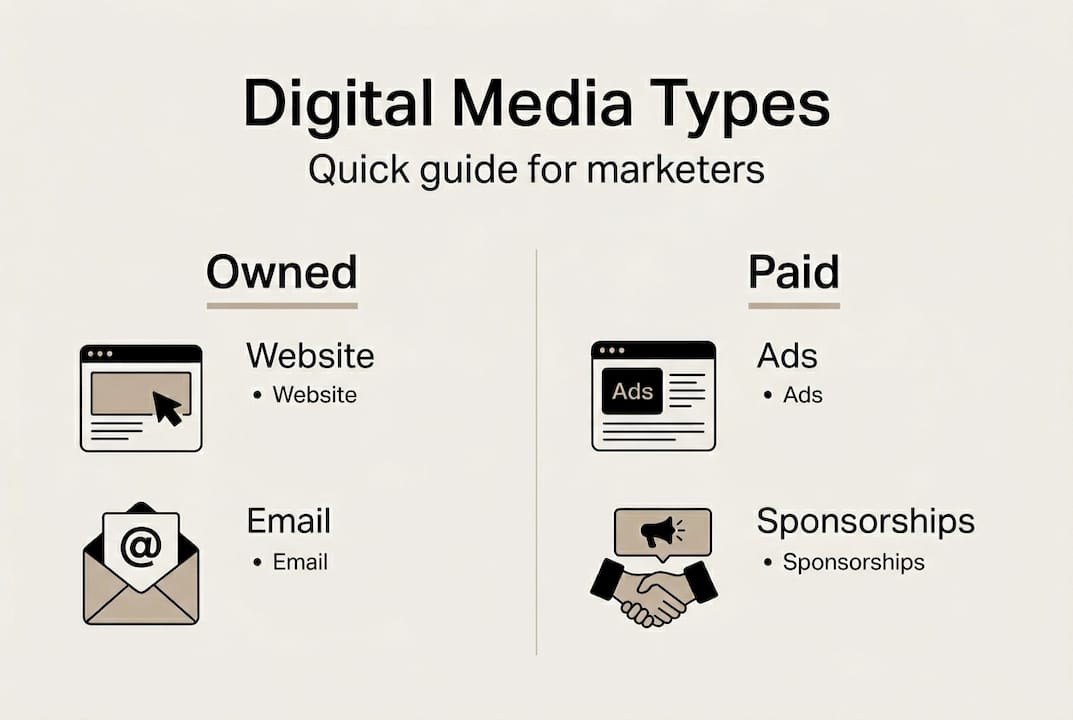
Once you understand what digital media is, the next step is understanding how it is organized strategically. The digital media ecosystem breaks down into three core categories: owned, earned, and paid. Each plays a distinct role, and none of them works as well in isolation as they do together.
| Media type | Definition | Examples |
|---|---|---|
| Owned | Channels your brand controls directly | Website, blog, email list, mobile app |
| Earned | Exposure generated by others organically | Press mentions, shares, reviews, backlinks |
| Paid | Placements purchased to reach a target audience | Search ads, social ads, display, sponsored content |
Owned media is your foundation. Your website, your email list, your content library. These assets do not disappear when an algorithm changes or an ad budget runs out. They compound in value over time, which is why building them should be a non-negotiable priority.

Earned media is the result of doing good work and distributing it well. When a journalist covers your brand, when customers leave reviews, when your content gets shared organically, that is earned media. You cannot buy it directly, but you can create the conditions for it through quality content and strategic outreach.
Paid media accelerates reach. It puts your message in front of a defined audience on a defined timeline. Used correctly, it amplifies what is already working in your owned and earned channels. Used in isolation, it becomes a money drain the moment you stop spending.
A case study on digital media types shows how integrating all three categories creates a compounding effect that no single channel can replicate on its own.
Key ways these categories work together:
- Paid ads drive traffic to owned content, building your email list
- Strong owned content earns backlinks and press coverage
- Earned media builds credibility that improves paid ad performance
- Email (owned) nurtures leads generated by paid campaigns
Pro Tip: If your current strategy relies heavily on one category, you are exposed. A business that only runs paid ads is one budget cut away from silence. Build owned assets first, then use paid to accelerate.
Key formats and content types in digital media
Knowing the categories of digital media is useful. Knowing which specific formats to use, and when, is where strategy becomes execution.
Digital formats and methodologies span text, images, audio, and video, with each format serving different stages of the buyer journey and different audience preferences. The goal is not to use every format. It is to use the right formats for your audience and objectives.
| Content format | Primary benefit | Best channel fit |
|---|---|---|
| Blog articles | SEO, authority building | Website, search |
| Email campaigns | Nurturing, conversion | Owned email list |
| Short-form video | Awareness, engagement | Social media, paid ads |
| Podcasts | Thought leadership, loyalty | Audio platforms, website |
| Infographics | Simplifying complex data | Social, blog, PR |
| Webinars | Lead generation, education | Email, paid social |
The most effective digital marketing strategies do not treat content formats as interchangeable. Each format has a specific job, and assigning the wrong format to the wrong objective wastes both budget and attention.
Here is a practical process for choosing the right formats for your audience:
- Identify where your audience spends time. LinkedIn professionals respond differently than Instagram users or podcast listeners.
- Match format to funnel stage. Blog posts and videos build awareness. Email and webinars convert.
- Assess your production capacity. A poorly executed podcast hurts more than no podcast at all.
- Test one new format at a time. Measure results before scaling.
- Repurpose strategically. A single webinar can become a blog post, a short video clip, an email series, and a social post.
Managing social media content formats effectively requires understanding platform-specific behavior. What works on LinkedIn rarely performs the same way on Instagram. And maximizing social engagement depends on aligning format, timing, and message to the platform’s native experience.
How digital media drives modern marketing and business growth
Digital media is not a branding exercise. For business owners and marketing executives, it is a revenue system. When structured correctly, it generates leads, shortens sales cycles, and builds the kind of brand authority that makes closing easier.
The integration across channels, including SEO, content creation, programmatic buying, and data-driven targeting, is what separates businesses that grow predictably from those that chase results quarter to quarter.
Here is how digital media directly supports core business objectives:
- Brand awareness: Consistent content across owned and paid channels keeps your brand visible during the entire buying cycle, not just when prospects are ready to purchase
- Lead generation: SEO-optimized content and targeted paid ads capture demand at the moment of intent
- Customer retention: Email marketing and personalized content keep existing customers engaged and drive repeat revenue
- Sales enablement: Case studies, product videos, and comparison content remove objections before the sales conversation even begins
- Market intelligence: Digital media analytics reveal what your audience actually cares about, giving you a real-time feedback loop
Pro Tip: Blending organic and paid strategies produces the strongest ROI over time. Organic builds the foundation; paid accelerates results when you need them. Running both simultaneously means you are never fully dependent on either.
The email marketing benefits for business growth are particularly strong. Email consistently delivers one of the highest returns of any digital channel because you own the audience and control the message. Similarly, SEO for business growth compounds over time, generating traffic and leads long after the initial investment.
The businesses winning in 2026 are not necessarily spending the most. They are the ones that understand which digital media channels their buyers use, at which stage, and what content moves them forward.
Why mastering the fundamentals of digital media gives you a sustainable edge
Here is something most marketing content will not tell you: the businesses that struggle most with digital media are not the ones with small budgets. They are the ones that skipped the fundamentals and went straight to tactics.
Chasing the latest platform or content trend without a foundational understanding of how digital media works is like renovating a house with no blueprint. You might get a nice-looking room, but the structure is unstable.
When you understand the difference between owned, earned, and paid media, you make better budget decisions. When you know how content formats serve different funnel stages, you stop producing content that looks busy but converts nothing. When you understand that digital media is a system, not a collection of disconnected activities, you stop asking “should we be on TikTok?” and start asking “does TikTok serve our buyer at the right stage?”
The marketers and business owners who adapt to digital change most successfully are not the ones who adopt every new tool first. They are the ones who understand the principles well enough to evaluate any new tool on its merits. Knowledge outlasts every platform update, algorithm shift, and industry disruption.
Ready to build your digital media advantage?
Understanding digital media is step one. Executing it in a way that generates real revenue is where most businesses need a capable partner.
Monstrous Media Group builds integrated digital media systems that connect your owned, earned, and paid channels into a single growth engine. Our digital marketing experts design campaigns around outcomes, not activity reports. Whether you need SEO services that compound over time or email marketing solutions that convert your list into revenue, we build the systems that stop revenue leaks and drive measurable growth. No vanity metrics. No busywork. Just results.
Frequently asked questions
What is the difference between digital and analog media?
Digital media uses encoded machine-readable data delivered via digital devices, while analog media relies on continuous physical signals or formats like print, radio broadcasts, or vinyl recordings.
Which channels count as digital media?
Websites, social media, email, mobile apps, podcasts, online video, and digital ads all qualify, as digital media includes any text, audio, video, graphics, or software delivered through digital devices and the internet.
How do digital media strategies help grow a business?
They expand reach, sharpen targeting, increase engagement, and drive leads more efficiently than most traditional channels, particularly when integration across channels includes SEO, content, programmatic buying, and data-driven targeting.
What are the three main types of digital media?
Owned, earned, and paid media are the three core types, where owned and earned represent brand-controlled channels and organic exposure, while paid covers purchased placements like ads and sponsored content.
Recommended
Hire the team to help you with your website, app, or other marketing needs.
We have a team of digital marketers who can help plan and bring to life all your digital marketing strategies. They can help with social media marketing, email marketing, and digital advertising!
CONTACT US
Comments