
 https://www.omahamediagroup.com/images/uploads/monster_gallery/Omaha-Media-Group-Black.jpg
admin
https://www.omahamediagroup.com/images/uploads/monster_gallery/Omaha-Media-Group-Black.jpg
admin
What is digital branding: A guide for business growth

Most business leaders think digital branding is just a logo and some social media posts. They confuse it with digital marketing or assume it’s purely visual design work. In reality, digital branding is the comprehensive plan and ongoing management of brand identity and experiences across digital channels. It’s the foundation that determines whether your business builds lasting customer relationships or gets lost in the noise. This guide will clarify what digital branding actually means, how it works mechanically, and why it matters for your revenue growth. You’ll learn the core components, strategic steps, measurement frameworks, and common pitfalls that cost businesses millions.
Table of Contents
- Key takeaways
- Understanding digital branding: definition and core components
- The mechanics of digital branding: strategy steps and measurement
- Digital branding vs digital marketing: understanding the difference
- Pitfalls and nuances in digital branding: lessons from real-world examples
- How Monstrous Media Group can help build your digital brand
- FAQ
Key Takeaways
| Point | Details |
|---|---|
| Definition and scope | Digital branding is the ongoing management of brand identity and experiences across all online touchpoints, not merely a logo or marketing campaigns. |
| Core components | Brand personality, USP, audience targeting, content pillars, and visual identity form the foundation for consistent recognizable branding. |
| Brand experience alignment | The brand promise must match the actual digital experience across websites, emails, and other channels to preserve trust. |
| Governance and measurement | Establish governance to maintain standards and measure performance with defined metrics to drive data driven improvements. |
Understanding digital branding: definition and core components
Digital branding encompasses every touchpoint where customers encounter your business online. This includes your website, social media profiles, search engine results, email communications, and digital advertising. It’s not a one-time project you complete and forget. It’s ongoing management of how your brand appears, behaves, and delivers value across these platforms.
The core components form the foundation of effective digital branding:
- Brand personality defines the human characteristics and tone your brand embodies in every interaction
- Unique selling proposition (USP) articulates what makes your business different and valuable compared to competitors
- Audience targeting identifies the specific customer segments you serve and their digital behaviors
- Content pillars establish the key themes and topics your brand consistently addresses
- Visual identity system ensures colors, typography, imagery, and design elements remain recognizable
Consistency across these components reinforces recognition and builds trust. When customers encounter the same personality, visual style, and messaging whether they visit your website, read your emails, or see your ads, they develop confidence in your brand. This consistency doesn’t mean boring repetition. It means coherent evolution where each touchpoint reinforces the others.
Integration with user experience (UX) separates strong digital brands from weak ones. Your brand promise must match the actual experience customers have navigating your website, interacting with your content, or contacting your team. If your brand promises innovation but your website feels outdated, the contradiction erodes trust. Successful digital branding aligns identity with experience at every level. Creative content marketing strengthens this alignment by ensuring your content reflects your brand values while delivering genuine value to your audience.
The mechanics of digital branding: strategy steps and measurement
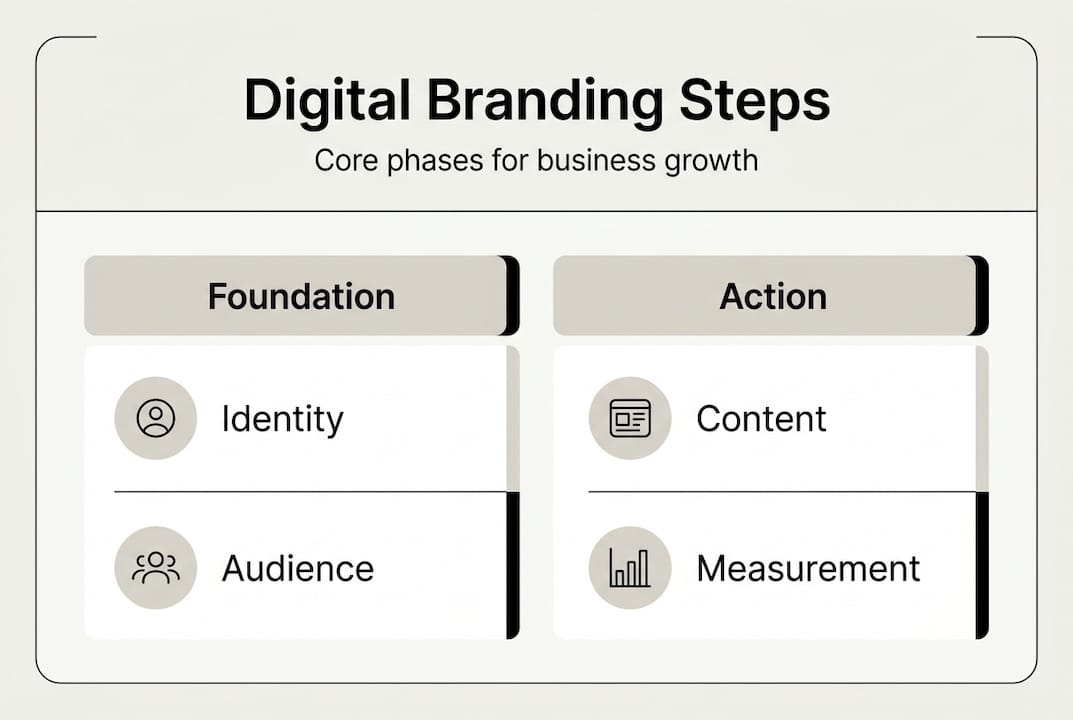
Building effective digital branding follows a systematic process. Business leaders who skip steps or rush implementation typically waste resources and confuse their audience. Here’s the proven sequence:
- Establish your brand foundation by defining your mission, vision, values, and positioning statement that differentiate you from competitors
- Research your target audience deeply to understand their digital behaviors, pain points, preferred platforms, and content consumption patterns
- Select primary platforms where your audience spends time and where your brand can deliver consistent value without overextending resources
- Develop a content strategy with clear themes, formats, publishing cadence, and quality standards that reflect your brand personality
- Create design systems and brand guidelines that ensure visual and tonal consistency across all digital properties and team members
- Implement governance processes to maintain brand standards as your team grows and new channels emerge
- Measure performance continuously using defined metrics and adjust strategy based on data rather than assumptions
Steps include brand foundation, audience research, platform selection, content strategy, and measurement using metrics like SEO rankings and engagement. Each step builds on the previous one, creating a cohesive system rather than disconnected tactics.
Measurement focuses on indicators that reflect brand strength and business impact:
| Metric category | What to measure | Why it matters |
|---|---|---|
| SEO performance | Keyword rankings for brand and category terms | Shows visibility and authority in your market |
| Engagement | Time on site, pages per session, social interactions | Indicates audience connection and content relevance |
| Brand sentiment | Mentions, reviews, social listening data | Reveals how customers perceive and talk about your brand |
| Organic traffic | Direct and branded search volume growth | Demonstrates brand awareness and recall strength |
Social listening tools inform brand perception by capturing conversations happening outside your owned channels. These insights reveal gaps between your intended brand identity and how customers actually experience and describe your business. Smart leaders use this feedback to refine messaging, address pain points, and identify opportunities competitors miss.

Pro Tip: Prioritize scalable governance systems early to maintain brand consistency as you grow. Document decision-making frameworks, approval processes, and quality standards before you need them. Reactive governance after inconsistencies emerge costs far more than proactive systems. Building an online community becomes easier when your brand foundation and governance create clear rails for community managers and content creators.
Digital branding vs digital marketing: understanding the difference
Business leaders frequently confuse digital branding with digital marketing, leading to misallocated budgets and strategic gaps. The distinction matters because each serves different business objectives and requires different approaches.
Digital branding focuses on identity and why; digital marketing focuses on tactics and how. Branding is behavioral and identity based, establishing who you are, what you stand for, and why customers should care about your business long term. Marketing is campaign based and tactical, promoting specific products or services to generate immediate conversions and sales.
Key differences include:
- Purpose: Branding builds long-term equity and relationships; marketing drives short-term transactions and leads
- Scope: Branding encompasses your entire identity system; marketing executes specific campaigns with defined start and end dates
- Metrics: Branding measures awareness, sentiment, and loyalty; marketing measures clicks, conversions, and return on ad spend
- Time horizon: Branding compounds value over years; marketing delivers results within weeks or months
- Investment: Branding requires consistent commitment regardless of immediate returns; marketing adjusts spend based on campaign performance
| Aspect | Digital branding | Digital marketing |
|---|---|---|
| Definition | Who you are and why you exist | How you promote what you sell |
| Primary goal | Build trust and recognition | Generate leads and sales |
| Methods | Identity systems, content strategy, community building | Advertising campaigns, email promotions, conversion optimization |
| Measurement | Brand awareness, sentiment, loyalty scores | Click-through rates, cost per acquisition, revenue |
| Time frame | Long-term investment | Campaign-specific results |
Confusion between the two leads to ineffective investments. Companies that treat branding like marketing chase short-term metrics that don’t build lasting value. They change messaging frequently based on campaign performance, creating inconsistency that confuses customers. Conversely, companies that treat marketing like branding waste budget on awareness campaigns when they need direct response tactics to hit revenue targets.
Successful businesses recognize that branding and marketing work together. Strong branding makes marketing more effective by providing clear positioning, consistent messaging, and established trust. Effective marketing reinforces branding by putting your identity in front of target audiences repeatedly. Digital marketing services deliver better results when they build on a solid brand foundation rather than operating in isolation.
Pitfalls and nuances in digital branding: lessons from real-world examples
Even experienced business leaders make costly mistakes with digital branding. Real-world examples reveal patterns worth avoiding.
Gap’s 2010 logo redesign lasted six days before customer backlash forced a reversal. Tropicana’s 2009 packaging rebrand caused a 20% sales drop in one month, costing the company millions. Cracker Barrel’s recent rebrand attempt faced similar resistance from loyal customers who felt the company abandoned its heritage. These failures share common threads: erasing brand heritage, ignoring existing customer relationships, and prioritizing designer preferences over customer recognition.
Rebrands often fail when ignoring brand heritage or user trust leading to loss of revenue and brand equity. The desire for modernization doesn’t justify throwing away distinctive assets customers recognize and trust. Evolution works better than revolution for established brands.
UX contradictions represent another critical pitfall. When your brand promises simplicity but your website navigation confuses users, the disconnect damages credibility. Over-minimalism in pursuit of modern aesthetics often strips away the distinctive elements that made brands memorable. Generic sans-serif wordmarks and flat color schemes create visual sameness across industries, making differentiation harder.
Top pitfalls to avoid:
- Erasing heritage elements that customers associate with your brand identity and values
- Ignoring user experience quality while focusing solely on visual design updates
- Over-simplification that removes distinctive brand assets in favor of generic minimalism
- Leadership fatigue where executives tire of their brand before customers do
- Testing concepts only internally without gathering customer feedback before launch
- Rushing implementation without proper governance systems to maintain consistency
Failed rebrands typically cost companies between 10-30% of revenue in the quarters following launch, with recovery taking 12-24 months if the company reverses course quickly. The financial and reputational damage extends beyond immediate sales drops to include lost customer trust and competitive advantage.
Pro Tip: Test rebrand concepts rigorously with actual customers before full launch, and blend heritage elements with innovation. Evolutionary changes that respect brand history while modernizing execution typically outperform revolutionary overhauls that ignore customer relationships. Social media campaign failures often stem from similar disconnects between internal assumptions and customer reality.
How Monstrous Media Group can help build your digital brand
Building a digital brand that drives revenue requires specialized expertise across multiple disciplines. Most businesses lack the internal resources to execute comprehensive digital branding while managing daily operations.
Monstrous Media Group offers integrated SEO services, digital marketing services, and AI-powered marketing services designed to strengthen brand identity and optimize digital presence for consistent revenue growth. Our systems focus on outcomes rather than activities, building frameworks that generate, capture, and close more revenue without adding chaos to your operations.
We specialize in scalable strategies that maintain brand consistency as you grow, combining creativity with data-driven performance measurement. Our approach integrates brand foundation work with tactical execution, ensuring your identity translates into effective marketing campaigns and customer experiences. Whether you need to establish a new digital brand or strengthen an existing one, our team brings the expertise to deliver measurable results without wasted spend.
FAQ
What is the difference between digital branding and digital marketing?
Digital branding defines your brand’s identity, values, and why your business exists, focusing on building long-term customer relationships and trust. Digital marketing uses specific tactics like advertising campaigns, email promotions, and conversion optimization to promote products and generate immediate sales. Branding creates the foundation that makes marketing more effective by establishing clear positioning and consistent messaging customers recognize.
How can consistent digital branding increase revenue?
Consistent multichannel digital branding builds trust and brand recognition by ensuring customers encounter the same personality, visual identity, and messaging across all touchpoints. This consistency leads to increased customer loyalty, higher referral rates, and the ability to command premium pricing because customers perceive greater value in brands they trust. Consistent branding can boost revenue by up to 33% by reducing customer acquisition costs and increasing lifetime value through stronger relationships.
What metrics should businesses track to measure digital branding success?
Businesses should track SEO rankings for both branded and category keywords to gauge market visibility and authority. Monitor engagement metrics like time on site, pages per session, and social media interactions to assess how well your content resonates with your audience. Key metrics include keyword rankings, engagement rates, brand sentiment, and organic traffic. Evaluate brand sentiment through social listening tools and review monitoring to understand how customers perceive and discuss your brand in their own words.
How long does it take to build a strong digital brand?
Building a strong digital brand typically requires 12-24 months of consistent effort before you see significant market recognition and measurable business impact. The timeline depends on your starting position, market competition, resource commitment, and execution quality. Quick wins like improved website consistency can happen within weeks, but building lasting brand equity and customer loyalty requires sustained investment over multiple quarters. Patience and consistency matter more than speed when building brand value that compounds over time.
Should established businesses rebrand or evolve their digital presence?
Established businesses should prioritize evolution over revolution when updating their digital presence. Evolutionary changes that modernize execution while respecting brand heritage typically deliver better results than complete rebrands that erase customer recognition. Test any significant changes with actual customers before full launch to identify potential disconnects between your vision and their expectations. Reserve complete rebrands for situations where your business model, target audience, or market position has fundamentally changed, making your existing brand identity genuinely misaligned with current reality.
Recommended
Hire the team to help you with your website, app, or other marketing needs.
We have a team of digital marketers who can help plan and bring to life all your digital marketing strategies. They can help with social media marketing, email marketing, and digital advertising!
CONTACT US
Comments