
 https://www.omahamediagroup.com/images/uploads/monster_gallery/Omaha-Media-Group-Black.jpg
admin
https://www.omahamediagroup.com/images/uploads/monster_gallery/Omaha-Media-Group-Black.jpg
admin
What is content strategy? A business leader’s guide

TL;DR:
- Many companies mistake content activity for strategy, which hampers revenue growth and alignment with business goals.
- Content strategy involves deliberate planning, governance, and measurement to connect content efforts to specific outcomes.
- Effective strategies require clear audience understanding, buyer journey mapping, governance, KPI tracking, and integration with SEO to achieve measurable revenue impact.
Most business leaders think content strategy means having a blog calendar or a social media posting schedule. That misunderstanding is quietly killing revenue. What is content strategy, really? It is the deliberate planning, governance, and measurement system that connects every piece of content your organization produces to a specific business outcome. Not publishing for the sake of publishing. Not content marketing dressed up with a fancier name. As Salesforce explains, content strategy governs what content exists, why it exists, who it serves, and how success is defined against business outcomes, not activity levels.
Table of Contents
- Defining content strategy: More than just content marketing
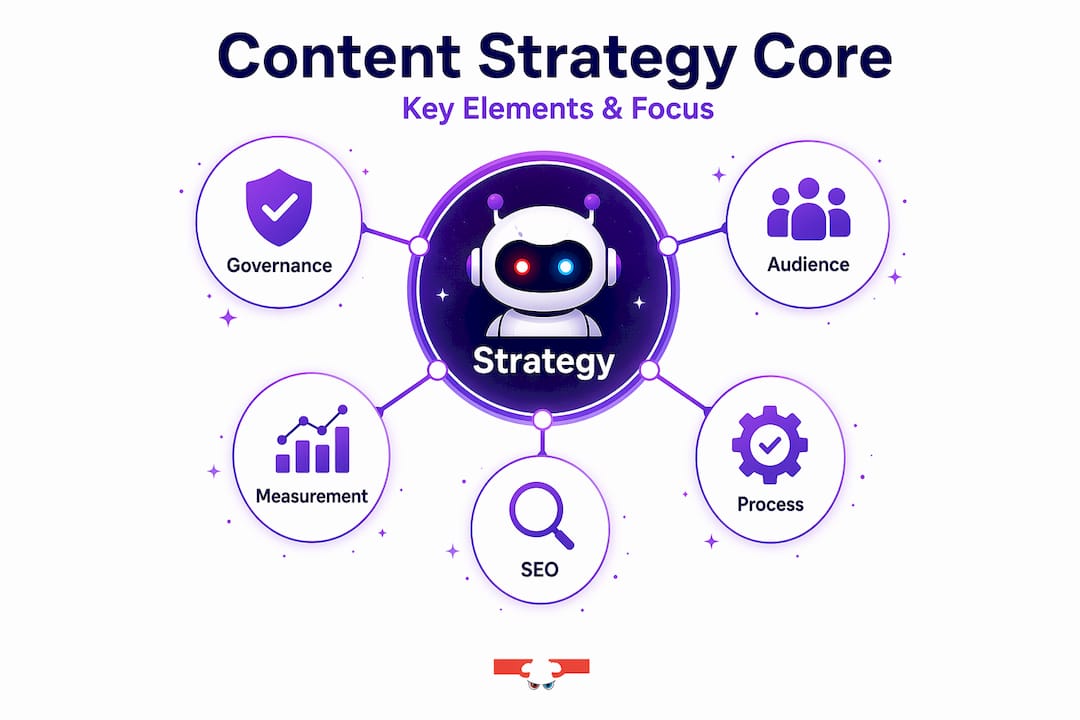
- Key elements of an effective content strategy
- How content strategy drives revenue and marketing optimization
- Operationalizing content strategy for consistent business impact
- Why most companies fail at content strategy and how to fix it
- Partner with Monstrous Media Group to supercharge content strategy
- Frequently asked questions
Key Takeaways
| Point | Details |
|---|---|
| Content strategy defined | Content strategy plans content purpose, audience, governance, and measurement beyond mere marketing execution. |
| Revenue alignment | Effective strategies connect every content asset to business goals and measurable revenue outcomes. |
| Operational process | A repeatable framework with governance and workflows ensures consistent, impactful content delivery. |
| Avoid common pitfalls | Confusing strategy with execution and tracking vanity metrics undermines business impact. |
| SEO integration | Content strategy makes SEO and owned media systematic revenue-driving channels, not ad-hoc tactics. |
Defining content strategy: More than just content marketing
The confusion between content strategy and content marketing is more than a semantic disagreement. It has real operational consequences. When a company conflates the two, it typically ends up investing heavily in content production while seeing little measurable return. Teams are busy. Revenue is not growing. Nobody can explain why.
Here is the distinction that matters. Content marketing is a specific application within a broader discipline. It focuses on creating and distributing content through marketing channels to attract and engage audiences. Content strategy, by contrast, is the broader planning discipline that governs all content across every function, including marketing, sales enablement, customer success, and corporate communications.
“Content tactics execute the plan, but without the strategy layer you get activity without business outcomes.”
Think of it this way: content marketing is what you do. Content strategy is why you do it, who it is for, how it is governed, and how you know if it is working. A company can run a content marketing program without a strategy. Many do. The result is a growing library of content that serves no one in particular and converts no one at all.
For business decision-makers, this distinction is the first filter. Before approving content budgets, ask whether there is a governing strategy behind the work. If the answer is a blog calendar and a social media plan, you have execution without direction. That is an expensive problem to carry forward.
Key things a true content strategy defines:
- Purpose: Why does this content exist and what business problem does it solve?
- Audience: Who specifically is this content for and what do they need at each stage of their journey?
- Governance: Who owns each content type, who approves it, and what quality standards apply?
- Measurement: What KPIs demonstrate that this content is contributing to revenue, not just traffic?
- Distribution: Where will this content live and how will it reach the right audience?
Understanding the content strategy overview at this structural level is what separates marketing organizations that produce results from those that produce noise.
Key elements of an effective content strategy
With a clear content strategy definition established, the next question is what an effective strategy actually contains. These are not abstract concepts. They are operational decisions that determine whether your content system compounds value over time or slowly drains your marketing budget.
The core elements, in order of execution:
- Define SMART business goals tied to revenue. Every content initiative should trace back to a measurable target: pipeline contribution, lead volume, customer retention rate, or organic search visibility for high-intent queries.
- Build detailed audience personas. Surface-level demographics are not enough. Effective personas capture what problems buyers are actively trying to solve, what information they seek at each stage, and what formats they prefer.
- Map content to buyer journey stages. Awareness-stage content educates. Consideration-stage content compares and validates. Decision-stage content removes friction. Mismatching content to stage is one of the most common and costly errors.
- Plan topics and formats by channel. Not every topic belongs in a blog post. Some ideas are better served by video, comparison pages, case studies, or long-form guides. Format selection should follow function.
- Build a content calendar with governance checkpoints. A calendar is not strategy, but it is the operational scaffold that keeps strategy moving. It should include due dates, owners, approval steps, and distribution plans.
- Publish, distribute, and track against KPIs. Distribution is not an afterthought. Owned media, email, and SEO-integrated publishing should be baked into the plan from the start.
- Review and iterate based on performance data. As Harvard Business School outlines, the typical content strategy flow cycles continuously from goal-setting through performance tracking, with each cycle informing the next.
Pro Tip: Before mapping any content topics, audit what you already have. Most organizations discover they are missing content for the decision stage entirely, which explains why they generate traffic but not conversions.
| Strategy element | Business outcome it drives |
|---|---|
| Audience persona development | Higher content relevance and engagement |
| Buyer journey mapping | Shorter sales cycles and improved conversion |
| Governance and approval workflows | Consistent brand messaging and faster production |
| KPI-based measurement | Demonstrable ROI and smarter budget allocation |
| SEO-integrated distribution | Compounding organic reach and lower acquisition cost |
For organizations ready to move from reactive publishing to a purposeful system, building a content strategy starts with aligning your content roadmap directly to your revenue targets.
How content strategy drives revenue and marketing optimization
Here is where the importance of content strategy becomes concrete for marketing executives. A properly structured content marketing strategy does not just generate awareness. It functions as a revenue-generating infrastructure, pulling buyers through the funnel with the right information at the right time.

The critical shift is moving from traffic-focused metrics to revenue-connected KPIs. Salesforce research confirms that content strategy ties content efforts to demand generation, conversion, and retention KPIs rather than vanity metrics, ensuring clear revenue impact. Pageviews tell you that content is being read. Pipeline contribution tells you that content is earning its budget.
What a revenue-connected content strategy tracks:
- Lead generation volume from organic and owned media channels
- Pipeline contribution measured by content-influenced deal stages
- Customer retention rates tied to educational or onboarding content consumption
- Conversion rates from content entry points to qualified inquiries
- Cost per acquisition compared across content-driven versus paid channels
“Measurement must move beyond traffic and rankings to meaningful engagement and retention signals.”
The comparison below illustrates the difference between a content program running without strategy and one operating with a revenue-focused framework:
| Content without strategy | Content with strategy |
|---|---|
| Blog posts published on gut instinct | Topics selected based on buyer intent data |
| Success measured by pageviews | Success measured by lead quality and pipeline |
| No defined audience or stage mapping | Every piece mapped to a persona and funnel stage |
| Inconsistent publishing cadence | Governed calendar with clear ownership |
| SEO treated as an afterthought | SEO integrated from topic selection forward |
For marketing leaders, the benefits of a content strategy extend beyond marketing itself. When content is aligned to buyer decisions across the full journey, sales teams spend less time educating and more time closing. That is a measurable efficiency gain that compounds over time. Explore how content strategy connects to revenue outcomes for a deeper look at building that connection.
Operationalizing content strategy for consistent business impact
Knowing what is in a content plan is only part of the answer. The harder challenge is building the operational infrastructure that keeps that plan running reliably at scale. This is where many organizations stumble. They build a strategy document, distribute it to the team, and watch it quietly gather dust while the old habits return.
Operationalizing content strategy requires explicit governance. HubSpot’s content management guidance makes this clear: operational content strategy includes defined ownership, governance workflows, and approval turnarounds that maintain momentum and messaging consistency. Without those structures, content production becomes whoever has bandwidth this week, and quality and strategy alignment erode quickly.
Best practices for content strategy governance:
- Assign content ownership by type and channel. One person owns the blog. Another owns email. Shared ownership creates gaps.
- Document approval workflows with defined turnaround times. Vague review processes kill publication velocity.
- Establish quality standards and a content brief template. Every piece should start from the same structural foundation.
- Map all planned content to a buyer journey stage before creation begins. This prevents the common trap of producing content that attracts traffic but never converts.
- Schedule regular content performance reviews. Monthly at minimum. Quarterly is too slow to catch problems before they cost you.
Pro Tip: The single most common governance failure is having no one accountable for ensuring content aligns with strategy before it goes into production. Appoint a content strategy owner who reviews briefs before writing begins, not after.
Avoiding content strategy pitfalls often comes down to governance decisions made before a single word is written. Structure protects strategy from the natural entropy of organizational life.
Why most companies fail at content strategy and how to fix it
Having spent years building content systems for businesses across industries, a pattern emerges that is almost embarrassingly consistent. Companies do not fail at content strategy because they lack talented writers or creative ideas. They fail because they never actually had a strategy. They had a production plan.
Mistaking output for direction is the root cause of nearly every underperforming content program we have seen. A team publishing three blog posts per week with no defined audience persona, no stage mapping, and no connection to pipeline metrics is not executing a strategy. It is creating activity. And as the research confirms, confusing strategy with execution leads to activity with little business impact.
The second most common failure is fragmented governance. When five different stakeholders can approve or redirect content without a governing framework, messaging becomes inconsistent, deadlines slip, and the editorial calendar collapses into whoever shouted loudest that week. This is not a content problem. It is a systems problem.
Measuring the wrong things compounds both failures. When leadership sees pageview reports and calls them success, no one has any reason to question whether the content is actually driving leads or revenue. The metrics are green, so the strategy must be working. It is not. The absence of bad news is not evidence of good outcomes.
The fixes are structural, not creative. Executive alignment on what success looks like in revenue terms. A governance framework with named owners and documented workflows. KPIs that connect content activity to pipeline and retention. And integration with SEO from the start, so that owned media channels build compounding authority rather than isolated traffic spikes. Businesses that address these common content strategy mistakes early avoid the painful experience of rebuilding their entire content program after two years of disappointing results.
The uncomfortable truth is that most content strategy failures are leadership failures. When the executive team cannot define what a successful content program looks like in revenue terms, the content team defaults to what they can measure easily: volume and vanity metrics. Fix the measurement framework at the top, and the content program below it will follow.
Partner with Monstrous Media Group to supercharge content strategy
Understanding what content strategy is and building one that actually drives revenue are two different problems. Monstrous Media Group helps businesses solve both.

As a multi-award-winning SEO services and digital marketing services company, Monstrous Media Group builds content systems that connect your owned media channels to measurable revenue outcomes. Not publishing schedules dressed up as strategy. Actual systems with governance, audience alignment, KPI frameworks, and SEO integration baked in from day one. From content strategy architecture to web design and development that supports scalable content delivery, every solution is built to stop revenue leaks and generate real outcomes. If your content program is producing activity but not results, it is time to talk.
Frequently asked questions
What is the primary purpose of a content strategy?
A content strategy plans and governs what content exists, who it is for, why it exists, and how success is measured, ensuring alignment with business goals and audience needs rather than defaulting to volume for its own sake.
How is content strategy different from content marketing?
Content strategy is the overarching plan governing all content types and their business objectives, while content marketing is a specific application focused on creating and distributing content through marketing channels.
Why is measurement important in content strategy?
Measurement links content efforts to business outcomes through meaningful KPIs, because shifting beyond traffic to engagement and retention signals is what separates revenue-generating programs from expensive publishing exercises.
What role does SEO play in content strategy?
SEO ensures content is discoverable and systematically supports owned media, because content and SEO working together compound authority and drive qualified traffic rather than relying on paid acquisition alone.
How can businesses operationalize content strategy effectively?
By defining clear ownership, governance workflows, and quality standards, then aligning content to buyer journey stages to ensure consistent, impactful delivery at scale.
What common mistakes cause content strategy failure?
Confusing strategy with execution, poor governance, tracking vanity metrics, and neglecting SEO integration are the four most common causes of underperforming content programs.
How does content strategy support revenue generation?
It ties content initiatives directly to business goals like lead generation and conversion, measuring revenue-focused KPIs that demonstrate real impact rather than activity.
Why is governance important in content strategy?
Governance defines content ownership, approval processes, and quality rules, because without governance structures teams produce inconsistent messaging and slow approvals that hurt both productivity and revenue.
Can content strategy improve marketing efficiency?
Yes, by replacing ad-hoc publishing with a purposeful, measured system, content strategy moves content from a cost center to a predictable revenue driver that improves resource allocation over time.
What are the first steps in creating a content strategy?
Begin with thorough audience research and set clear, SMART goals tied to business objectives before planning content topics, formats, or publishing cadence.
Recommended
Hire the team to help you with your website, app, or other marketing needs.
We have a team of digital marketers who can help plan and bring to life all your digital marketing strategies. They can help with social media marketing, email marketing, and digital advertising!
CONTACT US
Comments