
 https://www.omahamediagroup.com/images/uploads/monster_gallery/Omaha-Media-Group-Black.jpg
admin
https://www.omahamediagroup.com/images/uploads/monster_gallery/Omaha-Media-Group-Black.jpg
admin
What is content marketing? A 2026 guide to strategic growth

Businesses that publish blog content consistently see 165% lead growth versus 73% for companies that do not. That gap reveals a truth many marketing executives miss: content marketing is not about occasional posts or sporadic campaigns. It is a disciplined system that builds audience trust, drives engagement, and converts prospects into customers. This guide clarifies what content marketing truly means, why consistency matters more than creativity alone, and how you can implement a strategic framework to enhance your online presence and accelerate revenue growth in 2026.
Table of Contents
- Understanding Content Marketing: Definition And Importance
- How Consistent Content Boosts Lead Growth And Buyer Engagement
- Strategic Content Marketing: Frameworks And Best Practices For 2026
- Applying Content Marketing: Practical Steps To Enhance Your Online Presence And Revenue
- Monstrous Media Group: Your Partner For Content Marketing Success
Key takeaways
| Point | Details |
|---|---|
| Content marketing definition | Creating valuable, relevant, and consistent content to attract and retain audiences while driving profitable customer action. |
| Lead growth impact | Consistent content publishing delivers 165% lead growth compared to 73% for sporadic efforts. |
| Strategic framework | The Content Engine Methodology provides a complete operational system with workflow layers and interconnected pillars. |
| Buyer engagement | B2B buyers consume three to seven pieces of content before engaging sales teams. |
| Practical application | Define target audience, align content with customer journey stages, distribute strategically, and measure success with clear KPIs. |
Understanding content marketing: definition and importance
Content marketing is not blogging for the sake of blogging. It is creating valuable, relevant and consistent content to attract and retain an audience while driving profitable action. The definition emphasizes four critical elements: value that solves real problems, relevance to your target audience, consistency in delivery, and clear business intent. Without these pillars, content becomes noise.
Why is content marketing no longer optional? Because buyers now control the sales process. They research independently, compare solutions, and form opinions before contacting vendors. Your content shapes those opinions. If you are absent from this research phase, competitors fill the void. Content marketing positions your brand as the trusted authority when prospects are ready to buy.
Common misconceptions plague this discipline. Many executives believe content marketing means posting on social media occasionally or publishing a quarterly newsletter. Others think it is purely creative work disconnected from revenue goals. Both views miss the point. Content marketing is strategic, measurable, and commercially driven. It spans blog posts, videos, infographics, podcasts, case studies, white papers, and email campaigns. Each format serves specific audience needs at different journey stages.
The business benefits are measurable. Creative content marketing builds brand authority, generates qualified leads, nurtures prospects through the sales funnel, and reduces customer acquisition costs. Companies that execute content marketing strategically see higher conversion rates, longer customer lifetime value, and stronger competitive differentiation. The key is treating content as a system, not a series of isolated tactics.
Content marketing is about creating something of value and giving it away for free to build trust, authority, and long term customer relationships.
Understanding this foundation separates businesses that see content as overhead from those that leverage it as a growth engine. The difference shows in results.
How consistent content boosts lead growth and buyer engagement
The data is unambiguous. Businesses that publish blog content consistently see 165% lead growth versus 73% for companies that do not. That 92 percentage point gap represents lost revenue, missed opportunities, and weakened market position. Consistency compounds value over time, building domain authority, expanding search visibility, and creating a content library that works continuously.
Buyer behavior reinforces this reality. 62% of B2B buyers read three to seven pieces of content before talking to sales. They want education, not pitches. They seek proof points, use cases, and expert perspectives. When your content answers their questions at each research stage, you shape their evaluation criteria and position your solution favorably. Without this content foundation, sales teams enter conversations late and disadvantaged.

Multiple touchpoints across diverse formats maximize engagement. Blog posts establish thought leadership and capture organic search traffic. Email marketing benefits include direct audience nurturing and personalized messaging at scale. Social media engagement amplifies reach, fosters community, and drives traffic back to owned properties. Videos demonstrate complex concepts visually. Case studies provide social proof. Each format serves distinct purposes within an integrated strategy.
Consider the buyer journey stages: awareness, consideration, decision. Awareness content educates on problems and trends. Consideration content compares approaches and solutions. Decision content addresses implementation, pricing, and vendor selection. Mapping content types to these stages ensures relevance. A prospect researching industry challenges needs different information than one evaluating vendors.
Pro Tip: Align your content publishing cadence with buyer journey velocity. Industries with longer sales cycles benefit from deeper, less frequent content like monthly white papers. Faster moving markets require weekly blog posts and daily social updates to maintain visibility.
The table below illustrates content performance by consistency level:
| Publishing Frequency | Lead Growth Rate | Buyer Engagement Score | SEO Impact |
|---|---|---|---|
| Daily or multiple times weekly | 165% | High | Strong domain authority |
| Weekly | 120% | Moderate to High | Growing visibility |
| Monthly or sporadic | 73% | Low to Moderate | Limited traction |
| Inactive | Negative growth | Minimal | Declining rankings |
Consistency builds momentum. Search engines reward fresh, regular content with higher rankings. Audiences develop consumption habits around predictable publishing schedules. Sales teams gain current materials to share with prospects. The cumulative effect transforms content from expense to asset.
Strategic content marketing: frameworks and best practices for 2026
Ad hoc publishing produces ad hoc results. Strategic content marketing requires operational frameworks that align creation, distribution, and measurement with business objectives. The Content Engine Methodology is a complete operational framework with four workflow layers and interconnected pillars. It systematizes content production, ensuring quality, consistency, and commercial alignment.
The framework layers include strategy, creation, distribution, and optimization. Strategy defines audience, goals, topics, and success metrics. Creation establishes processes for ideation, production, review, and approval. Distribution maps content to channels and schedules. Optimization uses performance data to refine future efforts. Each layer connects, creating a self improving system.
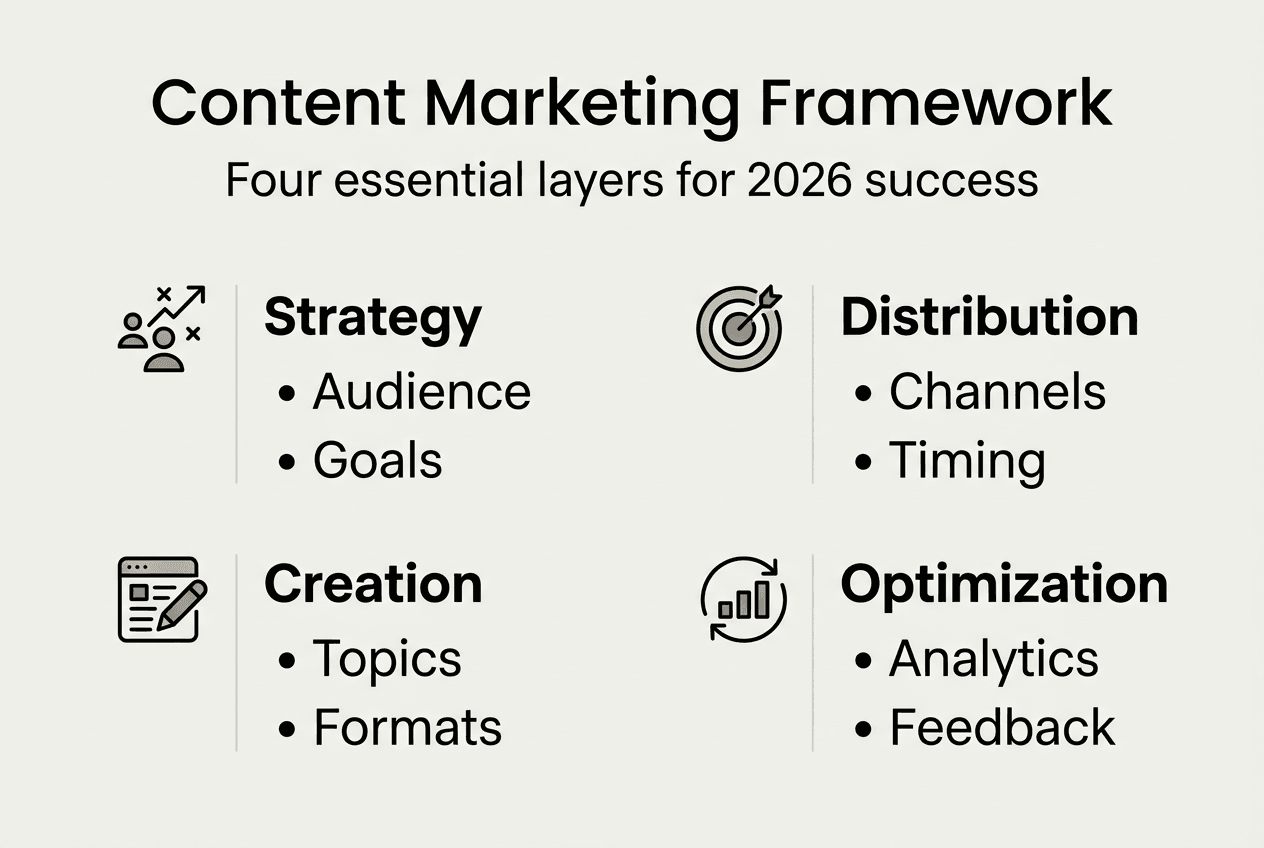
This structured approach contrasts sharply with unplanned publishing. Strategic execution targets specific audience segments with tailored messages. It prioritizes topics based on search demand, competitive gaps, and business priorities. It measures ROI through defined KPIs. Unplanned publishing chases trends, lacks focus, and wastes resources on content that does not convert.
Defining your target audience goes beyond demographics. Understand pain points, information needs, preferred content formats, and trusted sources. Create detailed personas representing key buyer segments. Map their journey from problem awareness to solution evaluation. Identify content gaps competitors have not addressed. A targeted content strategy yields stronger business returns because it focuses resources on high value opportunities.
The comparison table below contrasts strategic versus unplanned approaches:
| Aspect | Strategic Content Marketing | Unplanned Publishing |
|---|---|---|
| Planning | Documented strategy with clear goals | Reactive, trend based |
| Audience Focus | Persona driven, journey mapped | Generic, broad |
| Topic Selection | Data informed, competitive analysis | Random, inspiration based |
| Distribution | Multi channel, scheduled | Single channel, sporadic |
| Measurement | KPI tracked, ROI focused | Vanity metrics, inconsistent |
| Resource Allocation | Budgeted, sustainable | Inefficient, unpredictable |
Best practices for 2026 emphasize integration and automation. Content marketing does not exist in isolation. It supports SEO through keyword optimization and link building. It fuels social media with shareable assets. It enables sales with collateral. Integrate content planning with broader marketing strategy transformation initiatives to maximize impact.
Pro Tip: Balance quality with feasible output. Publishing two exceptional pieces monthly beats ten mediocre posts. Define your content production capacity realistically, then commit to that cadence. Consistency at a sustainable pace outperforms ambitious schedules that collapse.
Strategic visual content marketing enhances engagement and comprehension. Infographics simplify complex data. Videos demonstrate products and processes. Images break up text and improve retention. Incorporate visual elements into every content piece to increase shareability and dwell time.
Applying content marketing: practical steps to enhance your online presence and revenue
Theory means nothing without execution. Implementing content marketing requires clear steps aligned with strategic goals and commercial outcomes. Content marketing strategy defines what to create, who it’s for, distribution methods, and success measurement. Follow this process to build or refine your approach.
-
Define business objectives and align content goals. Start with revenue targets, market positioning goals, and customer acquisition costs. Determine how content marketing supports these objectives. Set specific, measurable goals like generating 500 qualified leads quarterly or increasing organic traffic 40% year over year.
-
Identify and research target audience segments. Create detailed buyer personas including demographics, job roles, challenges, information sources, and decision criteria. Conduct interviews with current customers to validate assumptions. Analyze competitor audiences to find underserved segments.
-
Map the customer journey and content needs. Outline stages from problem awareness through post purchase advocacy. Identify questions prospects ask at each stage. Determine which content formats best address those questions. Prioritize topics based on search volume, competitive difficulty, and business value.
-
Develop a content calendar with realistic production capacity. Plan topics, formats, authors, and publish dates for at least 90 days. Build in flexibility for timely opportunities. Assign clear ownership for creation, review, and distribution tasks.
-
Create high quality content optimized for search and user intent. Research keywords prospects use. Structure content with clear headings, short paragraphs, and scannable formatting. Include data, examples, and actionable insights. Edit ruthlessly to eliminate fluff.
-
Distribute content across appropriate channels. Publish on your website blog as the owned content hub. Share excerpts and links via email to subscribers. Post on social platforms where your audience engages. Consider guest posting on industry publications. Repurpose long form content into multiple formats: turn blog posts into videos, infographics, or podcast episodes.
-
Measure performance against defined KPIs. Track metrics including organic traffic, lead generation, conversion rates, engagement rates, and revenue attribution. Use analytics tools to identify top performing content and underperforming pieces. Conduct quarterly reviews to assess strategy effectiveness.
Distribution channels and measurement tactics include:
- Email newsletters for direct subscriber engagement and lead nurturing
- Social media platforms for amplification and community building
- SEO optimization for organic search visibility and long term traffic
- Paid promotion for targeted reach and faster results
- Partner collaborations for expanded audiences and credibility
- Analytics dashboards tracking traffic sources, user behavior, and conversions
- CRM integration linking content engagement to sales outcomes
Align content with customer journey stages and pain points. Awareness stage content educates on industry trends and common challenges without promoting solutions. Consideration stage content compares approaches, explains methodologies, and showcases expertise. Decision stage content addresses implementation, pricing, and vendor selection criteria. Post purchase content ensures successful adoption and identifies expansion opportunities.
Repurposing content maximizes ROI. A comprehensive guide becomes a webinar, blog series, social posts, and email sequence. A customer interview becomes a case study, testimonial quotes, and video snippet. This approach multiplies value from each creation effort.
Collaborating with external partners extends reach. Guest posts on industry blogs tap established audiences. Co created content with complementary vendors provides mutual value. Influencer partnerships add credibility and visibility. Building a strong online community around your content creates organic advocacy and sustained engagement.
Integrate content marketing with broader digital efforts. Content supports PPC advertising by providing landing page assets and retargeting fuel. It enhances social media by supplying shareable material. It empowers sales with educational resources. Treat content as the connective tissue linking all marketing activities.
Monstrous Media Group: your partner for content marketing success
Executing strategic content marketing demands expertise, resources, and sustained commitment. Monstrous Media Group builds systems that stop revenue leaks and drive growth, not busywork. We help businesses generate, capture, and close more revenue without adding chaos, headcount, or wasted spend.
Our digital marketing services integrate content strategy with SEO, social media, and paid advertising to maximize impact. We do not sell activities or vanity metrics. We build systems that produce outcomes. Our approach combines strategic planning, disciplined execution, and rigorous measurement.
Our SEO services ensure your content ranks where prospects search, driving qualified organic traffic. Social media management amplifies reach and fosters community engagement. We tailor solutions to your industry, competitive landscape, and business goals. Partner with a team that understands content marketing is not overhead but a growth engine when executed strategically.
FAQ
What is the difference between content marketing and traditional advertising?
Content marketing focuses on providing valuable, targeted content to build relationships and trust over time. Traditional advertising primarily promotes products or services directly through paid media placements. Content marketing attracts audiences by solving problems and educating, while advertising interrupts audiences with promotional messages.
How often should a business publish content to see results?
Consistent, regular publishing is critical. Businesses that blog consistently see 165% lead growth compared to 73% for sporadic publishers. Frequency should balance quality with available resources and audience expectations. Weekly publishing works well for most B2B companies, while daily updates suit faster moving consumer markets.
What types of content are most effective for B2B buyers?
B2B buyers typically read three to seven pieces of content before contacting sales teams. Effective formats include blog posts for thought leadership, white papers for in depth analysis, case studies for social proof, videos for product demonstrations, and infographics for data visualization. Mix formats to address different learning preferences and journey stages.
How can businesses measure content marketing success?
Measure KPIs like lead generation volume and quality, website traffic growth, engagement rates including time on page and social shares, and conversion rates from content to sales opportunities. Align metrics with strategic business goals defined in your content marketing plan. Use attribution modeling to connect content touchpoints with revenue outcomes.
Recommended
Hire the team to help you with your website, app, or other marketing needs.
We have a team of digital marketers who can help plan and bring to life all your digital marketing strategies. They can help with social media marketing, email marketing, and digital advertising!
CONTACT US
Comments