
 https://www.omahamediagroup.com/images/uploads/monster_gallery/Omaha-Media-Group-Black.jpg
admin
https://www.omahamediagroup.com/images/uploads/monster_gallery/Omaha-Media-Group-Black.jpg
admin
What Is Campaign Attribution and Why It Matters

TL;DR:
- Most marketing teams lack the infrastructure necessary for reliable attribution, which is essential for confident, data-driven budget decisions. Implementing effective CRM integration, campaign tracking, and consistent tagging systems enables accurate multi-touch attribution across buyer journeys. Combining robust infrastructure with incrementality testing and strategic model selection enhances marketing performance measurement and decision-making.
Most marketing teams are making budget decisions based on incomplete data. They see which campaigns closed deals but miss the five touchpoints that brought the buyer into the funnel in the first place. Understanding what is campaign attribution is not a nice-to-have for performance marketers. It is the operational foundation that separates teams making confident, data-backed budget decisions from those recycling the same spend because they cannot prove what is actually working.
Table of Contents
- Key takeaways
- What campaign attribution is and how it works
- Comparing the major attribution models
- Common challenges in campaign attribution
- Implementing attribution that actually works
- Beyond attribution: incrementality and emerging trends
- My take on what most teams get wrong
- How Monstrousmediagroup builds attribution systems that drive decisions
- FAQ
Key takeaways
| Point | Details |
|---|---|
| Attribution assigns conversion credit | Campaign attribution links specific marketing touchpoints to conversions like leads, deals, and revenue. |
| Model choice changes outcomes | Each attribution model distributes credit differently, directly affecting which channels appear to perform best. |
| Last-touch models hide upper funnel value | Relying only on last-click data systematically undervalues the campaigns that start buying journeys. |
| CRM integration is non-negotiable | Accurate attribution requires linking touchpoints to identifiable customer records inside your CRM. |
| Attribution shows correlation, not causation | Incrementality testing is the only method that proves a campaign actually caused a conversion. |
What campaign attribution is and how it works
Campaign attribution is the practice of assigning conversion credit to the marketing campaigns and touchpoints that influenced a specific outcome. That outcome might be a form submission, a qualified lead, a created opportunity, or closed revenue. Every step a buyer takes before converting can be captured, tagged, and credited back to the campaign that drove it.
Marketing analytics tells you what happened. Campaign attribution explains why it happened by connecting touchpoints to outcomes across the buyer’s journey. Without attribution, you are reading a scoreboard with no game film.
Here is what attribution actually tracks in practice:
- Conversion events: Form fills, demo requests, free trial signups, deal creations, and revenue milestones
- Interaction types: Clicks, page views, email opens, ad impressions, and phone calls
- Touchpoint milestones: First interaction, lead creation, opportunity creation, and deal close
Platforms like HubSpot structure their attribution reporting around these specific milestones, allowing teams to assign credit at first interaction, lead creation, deal creation, and closed-won stages. This milestone-based approach makes attribution defensible when presenting results to leadership because every credit assignment is tied to a measurable business event.
The technical backbone of attribution is data connectivity. Your ad platforms, website analytics, and CRM must share a common identifier for the same contact. Without that connection, touchpoints from paid search, email, and organic channels appear as separate, disconnected events instead of a coordinated journey. Multi-touch attribution in Salesforce, for example, requires enabling the Campaign Influence object and ensuring campaigns are marked active so full touchpoint history is preserved rather than collapsed into a single record.

Pro Tip: Before selecting an attribution model, audit your tracking infrastructure. If your campaigns are not consistently tagged with UTM parameters and your CRM is not capturing the source of every new contact, your attribution data will be unreliable regardless of which model you choose.
Comparing the major attribution models
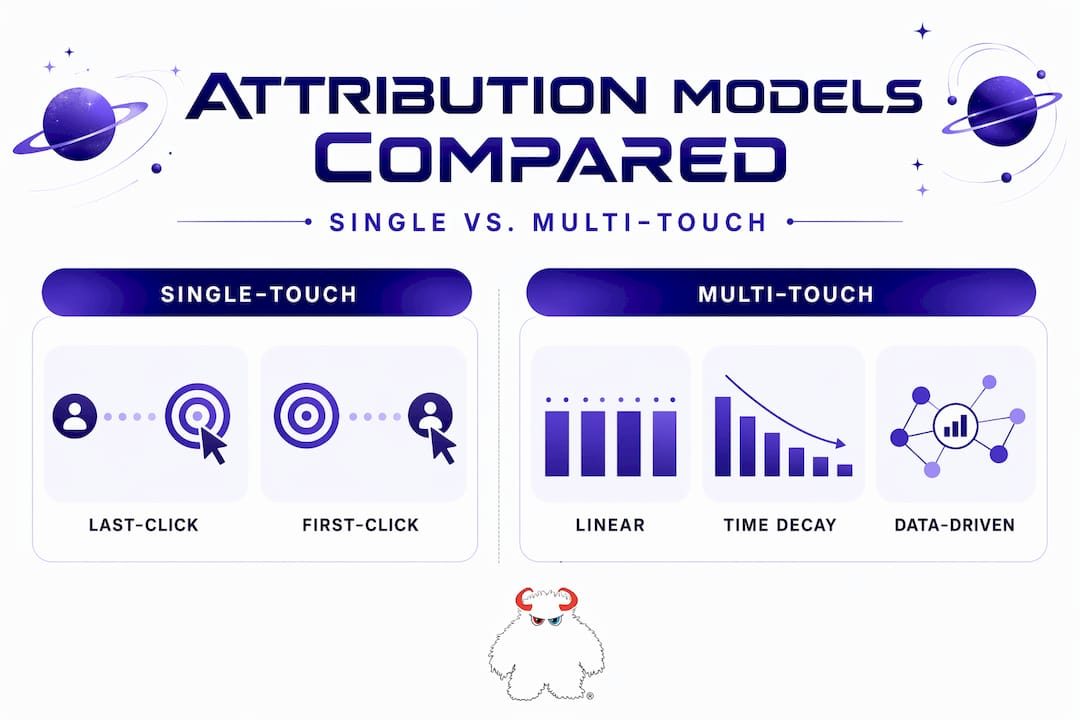
Understanding marketing attribution starts with knowing how each model distributes credit. The model you choose will change which campaigns look effective and which look wasteful. That is not a small decision when budget reallocations follow.
| Model | How credit is assigned | Best use case | Key limitation |
|---|---|---|---|
| Last-touch | 100% to the final touchpoint | Short sales cycles, direct response | Ignores all prior influence |
| First-touch | 100% to the first touchpoint | Brand awareness measurement | Ignores nurturing and closing channels |
| Linear | Equal credit to all touchpoints | Teams needing balanced visibility | No distinction between high and low value touches |
| Time decay | More credit to recent touchpoints | Long B2B sales cycles | Undervalues early awareness campaigns |
| U-shaped (Position-based) | 40% first, 40% last, 20% middle | Demand generation teams | Arbitrary weight distribution |
| W-shaped | Weighted to first, lead create, and opportunity create | Complex B2B funnels | Requires clean CRM data at every milestone |
| Data-driven | Algorithmic credit based on actual conversion patterns | High-volume, data-rich programs | Requires significant data volume to generate reliable outputs |
The divide between single-touch and what is multi-touch attribution is where most attribution strategy decisions get made. Single-touch models (first and last) are simple to implement but produce a fundamentally incomplete picture. Last-touch models systematically miss conversions that happened after an ad view without a click. TikTok’s attribution research makes this concrete: a significant portion of conversions driven by video ads never register a click, making last-click dashboards structurally blind to an entire channel’s contribution.
Multi-touch models address this by spreading credit across the full journey. The tradeoff is data complexity. You need clean, connected records at every stage of the funnel to produce outputs leadership will trust.
Data-driven attribution, available in Google Analytics 4 and select ad platforms, takes a different approach entirely. It uses machine learning to analyze which touchpoint combinations actually correlate with conversion. The catch is volume. Without sufficient conversion data, the model cannot produce statistically meaningful outputs, making it impractical for smaller programs.
Common challenges in campaign attribution
Attribution is harder to execute cleanly than most teams expect. The challenges are not conceptual. They are operational.
- Data fragmentation: Your paid media platform, email tool, and CRM each track user behavior in their own system. Without a unified identifier connecting them, you get three separate stories instead of one.
- Incomplete campaign tagging: Campaigns without consistent UTM parameters create attribution gaps. One untagged email blast can corrupt months of clean data by assigning direct credit to conversions that actually came from email.
- Over-reliance on last-touch reports: When the only dashboard the executive team sees is last-click, budget flows to closing channels while awareness and nurturing campaigns are cut for appearing to underperform.
- CRM data quality issues: Salesforce attribution requires campaigns to be marked active and Campaign Influence to be enabled. Teams that skip this setup lose multi-touch history entirely.
- Confusing attribution with proof of impact: Attribution shows which touchpoints were present during a conversion journey. It does not prove those touchpoints caused the conversion.
That last point deserves direct attention. Attribution measures correlation, not causation. A buyer who saw your LinkedIn ad and later converted may have converted without ever seeing it. Attribution gives that ad credit. Incrementality testing finds out if it actually moved the needle.
Attribution tells you who showed up to the game. Incrementality testing tells you who actually changed the score.
Pro Tip: Run a monthly campaign tagging audit. Pull every active campaign in your CRM and verify each has a properly structured UTM source, medium, and campaign name. One hour of governance work each month prevents the kind of attribution gaps that take quarters to diagnose.
Implementing attribution that actually works
Getting attribution right is less about selecting the perfect model and more about building the infrastructure that makes any model reliable. Here is how to approach it systematically:
- Integrate your CRM first. Every touchpoint needs to resolve to an identifiable contact record. Tools like marketing automation platforms connect ad platform data, email engagement, and web behavior into a single customer timeline that attribution models can actually read.
- Align your model to your funnel stage and goal. A brand awareness campaign should be measured on first-touch contribution. A retargeting campaign should be measured on closed revenue influence. Using the same model for both produces misleading comparisons.
- Maintain active campaign records. In Salesforce, enabling Campaign Influence and keeping campaigns active is the technical prerequisite for multi-touch data capture. If campaigns are closed or deactivated prematurely, that touchpoint history is gone.
- Use attribution to kill low-performers confidently. When you have clean multi-touch data, you can identify campaigns that appear in zero conversion journeys across a 90-day window and cut them without second-guessing. This is how attribution protects budget from wasted spend.
- Build executive reporting on funnel milestones. Aligning attribution reports to contact creation, opportunity creation, and revenue lets you walk into a budget meeting with a defensible answer to “what drove our pipeline last quarter?”
The practical goal is not a perfect attribution model. It is a system that gives you enough signal to make better decisions than your competitors are making with last-click dashboards alone.
Beyond attribution: incrementality and emerging trends
Attribution is a starting point, not the finish line. For teams running significant media spend, layering in incrementality testing is the logical next step.
Incrementality testing compares a group exposed to a campaign against a control group that was not. The difference in conversion rates between those groups represents the true causal lift of the campaign. Controlled holdout tests provide the gold standard for validating whether a campaign actually drove outcomes beyond what would have happened organically.
Several trends are reshaping how attribution gets done in 2026:
- Privacy constraints are shrinking trackable data. Cookie deprecation and platform-level privacy changes mean fewer user-level signals are available for deterministic attribution. Probabilistic and modeled approaches are filling the gap.
- AI-driven attribution tools are becoming more accessible, using machine learning to infer touchpoint contributions from aggregate patterns rather than individual user journeys.
- AI-powered marketing platforms now incorporate predictive attribution that estimates the likely value of a touchpoint before a conversion even occurs, enabling real-time optimization.
- Measurement mix modeling is making a comeback for teams that need channel-level performance insights without relying on user-level tracking.
Treat attribution as one instrument in a measurement system, not the entire system. Teams that combine model-based attribution with incrementality testing and periodic media mix analysis make budget decisions with a level of confidence that last-click shops simply cannot match.
My take on what most teams get wrong
I’ve watched marketing teams at every level spend months debating which attribution model to adopt while their campaign tagging is broken, their CRM has duplicate contact records, and their last-touch dashboard is driving the actual budget decisions. The model debate is a distraction when the infrastructure is not ready to support any model reliably.
In my experience, the organizations that get the most value from campaign attribution are not the ones running the most sophisticated models. They are the ones with disciplined campaign governance: consistent naming conventions, active CRM integration, regular tagging audits, and clear alignment between funnel stages and attribution goals. That foundation makes even a linear model useful. Without it, a data-driven model produces confident-sounding garbage.
The other thing I’ve seen consistently: teams treat attribution as a reporting exercise rather than a decision-making system. The point is not to produce a pretty dashboard. It is to answer the question “where should we put next quarter’s budget?” If your attribution output cannot answer that question clearly, something in the setup needs fixing before you add more model complexity.
Start with clean data. Build CRM connectivity. Run one quarter with a multi-touch model. Then add incrementality testing on your highest-spend channels. That progression produces real improvement. Jumping straight to AI-driven attribution without the foundational infrastructure in place is a fast way to build a complex system that produces unreliable outputs.
— Vector
How Monstrousmediagroup builds attribution systems that drive decisions

Most marketing teams are not missing attribution knowledge. They are missing attribution infrastructure. Monstrousmediagroup builds the systems that make attribution work: CRM integration, campaign tracking frameworks, marketing automation setup, and multi-channel reporting that connects touchpoints to revenue. The result is not a dashboard. It is a decision-making engine that tells you exactly where your budget is working and where it is leaking. If you are ready to stop guessing and start allocating with confidence, explore what Monstrousmediagroup’s digital marketing systems can build for your organization.
FAQ
What is campaign attribution in marketing?
Campaign attribution is the process of assigning conversion credit to the marketing touchpoints that influenced an outcome, such as a lead, opportunity, or closed deal. It connects specific campaigns to measurable business results across the buyer’s journey.
What are the main types of campaign attribution models?
The main types include last-touch, first-touch, linear, time decay, position-based (U-shaped and W-shaped), and data-driven attribution. Each model distributes conversion credit differently, making model selection a direct function of your funnel structure and business goals.
How does multi-touch attribution differ from single-touch?
Single-touch models assign 100% of credit to one touchpoint, either the first or last interaction. Multi-touch attribution splits credit across multiple touchpoints throughout the buyer’s journey, giving teams a more complete view of which campaigns contribute at every stage.
Why is last-click attribution considered unreliable?
Last-click attribution ignores every touchpoint before the final interaction, which means upper funnel campaigns that generate awareness and nurture prospects receive zero credit. Research from TikTok’s attribution data shows that many conversions happen after ad views without a click, which last-click models miss entirely.
How do you measure campaign attribution accurately?
Accurate measurement requires consistent UTM tagging across all campaigns, CRM integration that links touchpoints to contact records, and a multi-touch attribution model aligned to your funnel milestones. Supplementing attribution with incrementality testing provides the causal validation that attribution alone cannot deliver.
Recommended
Hire the team to help you with your website, app, or other marketing needs.
We have a team of digital marketers who can help plan and bring to life all your digital marketing strategies. They can help with social media marketing, email marketing, and digital advertising!
CONTACT US
Comments